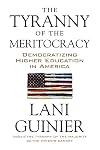
The Tyranny of the Meritocracy: Democratizing Higher Education in America
by Lani Guinier
On This Page
Description
"Standing on the foundations of America's promise of equal opportunity, our universities purport to "serve as engines of social mobility" and "practitioners of democracy." But as acclaimed scholar and pioneering civil rights advocate Lani Guinier argues, the merit systems that dictate the admissions practices of these institutions are functioning to select and privilege elite individuals rather than create learning communities geared to advance democratic societies. Having studied and taught show more at schools such as Harvard University, Yale Law School, and the University of Pennsylvania Law School, Guinier has spent years examining the experiences of ethnic minorities at the nation's top institutions of higher education, and here she lays bare the practices that impede the stated missions of these schools. Guinier argues for reformation, not only of the very premises of admissions practices but of the shape of higher education itself, and she offers many examples of new collaborative initiatives that prepare students for engaged citizenship in our increasingly multicultural society"-- show lessTags
Recommendations

































Member Reviews
Lani Guinier's new book The Tyranny of the Meritocracy will be of interest to many in the connectivist circles where I run. We believe that individual knowledge is created in social contexts and through social interaction. We prize collaboration skills. We've heard it all, and buy it - that this is an increasingly connected age, that good jobs will involve work in teams, that globalization and demographic change will require the abilities to negotiate diversity, that the "problems of the twenty-first century" are only solvable by multidisciplinary teams, that in fact many of those social and political problems have roots in people who can't communicate outside themselves or their home group. We want to work for an America (for a world) show more where all people have equal prospects regardless of the color of their skin and circumstances of their birth.
Then we exist in an educational system which mostly rewards people for individual accomplishment, and trains them accordingly in individualistic methods which are remarkably vulnerable to the privileges of class and race.
Guinier points out that this is out of step. She uses Amartya Sen's definition that merit is the "incentive system which rewards the actions a society values" and points out the stunning disconnect between the skills we claim to value for democracy, and the "testocratic" skills of the K-Ph.D system. This focus on individualized tests and grades actually serves to reinforce power relationships in society - first, because those with the means to impact curricula or hire tutors have a massive incentive to do so, and perhaps more ominously, because students who succeed in the testocracy are allowed to believe that they have achieved success alone, without noting the assistance of their teachers, parents, and classmates. More democratic education would do a better job of reinforcing the importance of working together across difference - and provide that benefit more equitably to those locked out of our current system.
The argument against the SAT is iron-clad. It predicts family income and race much better than grades in the first year of college, and was never designed to assess anything further out than the first year. Yet I found Guinier's hope for a system like the Posse Foundation's Dynamic Assessment Process a bit optimistic. Surely, if elite colleges shifted admissions to some form of behavioral interview, it would create a market for coaching. Such tutoring might be more socially valuable than classes on "SAT words" and how to answer a multiple choice question, but it would still be unevenly distributed. We can already see this in admissions processes which do value extracurricular and community involvement. Anyone can take such opportunities, and it makes the admissions process better to consider them. Kids whose families don't need them to work, or whose parents can shuttle them from school to club to volunteer site, can take advantage of more of them. It might still be better than the system we've got, but not quite as diverse as Guinier argues.
Guinier goes on to suggest alternatives in college preparation, recruitment, and pedagogy. As someone who works with college professors on teaching issues, it's easy for me to hear the argument that we need to make changes in K-12 schools and the college admissions office. (It's always easier when someone else has to change.) Then she points out that it wouldn't be fair to bring students into college for their collaborative skills, and demand of them the same individualized pedagogy we tend to use now. Students selected for democratic skills will prosper most in a democratic classroom. Oh. That's a challenge.
It struck me as interesting that the models here weren't particularly new to me. It seems impossible to read 5 articles on improving college teaching without someone bringing up the peer instruction work of Eric Mazur, as Guinier does. Yet most of the work in the "blended learning" sphere focuses simply on how group work and class discussion is better for retention and transfer of domain knowledge. That's an easy sell; it's harder to talk about the idea that you might actually shift your learning goals in a collaborative classroom. Guinier's frames these potentially fractious issues within the purpose of higher education in a democracy, and if you've accepted the assertion through the first half of the book,
Of course, the assertion that college exists to develop good citizens is not universally accepted. Even among those who accept the general idea, we debate exactly what the proper components of a liberal education are. Guinier asserts that colleges exist to fill a democratic need, without much considering the counter-arguments, and other than skills related to diversity and teamwork, she doesn't have specific recommendations for a curriculum. Given how much we hear about colleges as paths to "good jobs", though, or how much "student development" can be taken for granted within the academy, Guinier provides a clear argument, crisply stated and well worth the read. show less
Then we exist in an educational system which mostly rewards people for individual accomplishment, and trains them accordingly in individualistic methods which are remarkably vulnerable to the privileges of class and race.
Guinier points out that this is out of step. She uses Amartya Sen's definition that merit is the "incentive system which rewards the actions a society values" and points out the stunning disconnect between the skills we claim to value for democracy, and the "testocratic" skills of the K-Ph.D system. This focus on individualized tests and grades actually serves to reinforce power relationships in society - first, because those with the means to impact curricula or hire tutors have a massive incentive to do so, and perhaps more ominously, because students who succeed in the testocracy are allowed to believe that they have achieved success alone, without noting the assistance of their teachers, parents, and classmates. More democratic education would do a better job of reinforcing the importance of working together across difference - and provide that benefit more equitably to those locked out of our current system.
The argument against the SAT is iron-clad. It predicts family income and race much better than grades in the first year of college, and was never designed to assess anything further out than the first year. Yet I found Guinier's hope for a system like the Posse Foundation's Dynamic Assessment Process a bit optimistic. Surely, if elite colleges shifted admissions to some form of behavioral interview, it would create a market for coaching. Such tutoring might be more socially valuable than classes on "SAT words" and how to answer a multiple choice question, but it would still be unevenly distributed. We can already see this in admissions processes which do value extracurricular and community involvement. Anyone can take such opportunities, and it makes the admissions process better to consider them. Kids whose families don't need them to work, or whose parents can shuttle them from school to club to volunteer site, can take advantage of more of them. It might still be better than the system we've got, but not quite as diverse as Guinier argues.
Guinier goes on to suggest alternatives in college preparation, recruitment, and pedagogy. As someone who works with college professors on teaching issues, it's easy for me to hear the argument that we need to make changes in K-12 schools and the college admissions office. (It's always easier when someone else has to change.) Then she points out that it wouldn't be fair to bring students into college for their collaborative skills, and demand of them the same individualized pedagogy we tend to use now. Students selected for democratic skills will prosper most in a democratic classroom. Oh. That's a challenge.
It struck me as interesting that the models here weren't particularly new to me. It seems impossible to read 5 articles on improving college teaching without someone bringing up the peer instruction work of Eric Mazur, as Guinier does. Yet most of the work in the "blended learning" sphere focuses simply on how group work and class discussion is better for retention and transfer of domain knowledge. That's an easy sell; it's harder to talk about the idea that you might actually shift your learning goals in a collaborative classroom. Guinier's frames these potentially fractious issues within the purpose of higher education in a democracy, and if you've accepted the assertion through the first half of the book,
Of course, the assertion that college exists to develop good citizens is not universally accepted. Even among those who accept the general idea, we debate exactly what the proper components of a liberal education are. Guinier asserts that colleges exist to fill a democratic need, without much considering the counter-arguments, and other than skills related to diversity and teamwork, she doesn't have specific recommendations for a curriculum. Given how much we hear about colleges as paths to "good jobs", though, or how much "student development" can be taken for granted within the academy, Guinier provides a clear argument, crisply stated and well worth the read. show less
 This review was written for LibraryThing Early Reviewers.
This book has changed my life. Guinier offers a brilliant, detailed criticism of our test-reliant education system. As she shows, the word "meritocracy" is a bit dishonest. Our system doesn't actually reward "merit"; it rewards test-taking success. None of our education "reforms" try to measure how students use and retain information, how they figure things out, how much they've actually learned. The result is short-term, rote memorization but very little actual education.
I'm a teacher and so these problems with testing are familiar to me. But after two chapters Guinier goes on to look at how some teachers have adapted their teaching in response to cognitive research. The result is a more student-centered classroom in which students show more are a vital part of the experience, rather than passive watchers/listeners. I've never been a lecturer and have always tried to make my classes as interactive as possible, but Guinier's book has inspired me to completely change how I teach. Next semester my students will be leading a lot more discussions, making more presentations, doing more group projects, getting their voices heard more frequently. As Guinier shows, this sort of activity and authority makes students remember concepts more clearly than if they were only reading/listening/test-taking.
I'm so grateful to Guinier for writing this, to Beacon Press for publishing it, and for LibraryThing for allowing me to read it through Early Reviewers. I'm excited for next semester! show less
I'm a teacher and so these problems with testing are familiar to me. But after two chapters Guinier goes on to look at how some teachers have adapted their teaching in response to cognitive research. The result is a more student-centered classroom in which students show more are a vital part of the experience, rather than passive watchers/listeners. I've never been a lecturer and have always tried to make my classes as interactive as possible, but Guinier's book has inspired me to completely change how I teach. Next semester my students will be leading a lot more discussions, making more presentations, doing more group projects, getting their voices heard more frequently. As Guinier shows, this sort of activity and authority makes students remember concepts more clearly than if they were only reading/listening/test-taking.
I'm so grateful to Guinier for writing this, to Beacon Press for publishing it, and for LibraryThing for allowing me to read it through Early Reviewers. I'm excited for next semester! show less
This review was written for LibraryThing Early Reviewers.In "The Tyranny of the Meritocracy," Lani Guinier argues that America’s system of higher education has devolved into a testocracy that defines merit by one’s score on the SAT. According to Guinier, American colleges and universities have lost sight of their mission to prepare individuals to be contributing citizens in a democratic society. Individualism, epitomized by the cult of the test, is worshipped over the democratic value of collaboration. Test scores are given priority consideration in college admissions decisions over the character of applicants. The result is a system that favors the elite and their sense of entitlement.
Guinier does not prescribe a solution to this problem. Instead, she points to possible alternatives by show more highlighting successful efforts in and out of the classroom to develop in students the collaborative skills needed to contribute in a democratic society. She also refers to research in the cognitive sciences, problem solving, and group dynamics. Even though Guinier does not provide a specific approach to democratizing American higher education, her book will likely spark debate about the ultimate purpose of a college education. This is reason enough to read the book. show less
Guinier does not prescribe a solution to this problem. Instead, she points to possible alternatives by show more highlighting successful efforts in and out of the classroom to develop in students the collaborative skills needed to contribute in a democratic society. She also refers to research in the cognitive sciences, problem solving, and group dynamics. Even though Guinier does not provide a specific approach to democratizing American higher education, her book will likely spark debate about the ultimate purpose of a college education. This is reason enough to read the book. show less
This review was written for LibraryThing Early Reviewers.While Lani Guinier's book offers the reform of college admissions as a hook to readers, the broader target of her critique is the definition of "merit" itself. Does quantifying "merit" via grades and test scores really serve the educational needs of future leaders? Or, as she suggests, does this merely confer upon those already quite privileged the belief that the rewards they reap are the result of innate qualities they possess, rather than benefits accruing like compound interest on family wealth and other unearned advantages? Asserting that the latter is true, Guinier goes on to propose a "democratic" definition of merit based primarily on collaborative problem-solving skills, leadership potential, and drive for success. This show more definition, combined with educational processes that inculcate it and social structures that clearly value it, could be the gateway, she argues, to a more equitable society and a more participatory democracy. Along the way, she offers examples based on the research of social scientists and the initiatives of educational reformers. It is indeed, as one reviewer has already noted, a short book, but it is clear, provocative, and suggestive of real possibilities for change. To point out that Guinier hardly has all the answers about how to implement such educational reforms or what other kinds of privilege-reinforcing systems besides college admissions might need changing is not to downplay the significance of the book. She brings together between two covers information from disparate fields, gives it the Harvard imprimatur, and offers it to a public that has, for at least the last six years, been gorging on a steady diet of "higher ed reform" books that propose little in the way of sweeping change, offering merely buzzwords like "accountability" and "assessment." One can only hope that creative, collaborative problem solvers of the type she advocates take her suggestions and run with them. show less
This review was written for LibraryThing Early Reviewers.Lani Guinier offers a thoughtful critique of the current failed "meritocracy" of American higher education and asks us to reconsider the purpose of college. Is it for individual sorting and advancement? Or for the good of our national community? Guinier clearly comes down on the latter side and offers a plan for a more democratic higher education and a more democratic society.
A strength of the book is in Guinier's focus on "democratic merit" as a new way of organizing higher education to better educate citizens for our democracy. She contends that colleges should focus on leadership, collaboration ability, resiliency, a drive to learn, and other aptitudes rather than test-taking skills when they select, educate, and measure students. show more Graduates with these characteristics will be better citizens than those who can simply score well on a standardized test. show less
A strength of the book is in Guinier's focus on "democratic merit" as a new way of organizing higher education to better educate citizens for our democracy. She contends that colleges should focus on leadership, collaboration ability, resiliency, a drive to learn, and other aptitudes rather than test-taking skills when they select, educate, and measure students. show more Graduates with these characteristics will be better citizens than those who can simply score well on a standardized test. show less
This review was written for LibraryThing Early Reviewers.Lani Guinier takes a strong stand in The Tyranny of the Meritocracy against one of the sacred cows of higher education in the U.S.: the college admissions process. That takes guts. To Guinier, the current admissions process, which assesses merit largely on standardized testing—a “testocracy”—creates a feeder system that spits out graduates who are individualistic and entitled and sorely misses the greater mission of higher education to educate young minds toward civic-mindedness and leadership.
The first half of the book is dedicated to describing the flaws in the current system. To this, Guinier largely blames the weight the admissions process gives to the SAT and ACT. She cites credible research that shows the tests act more show more as predictors of socioeconomic status than of potential or performance in college. Wealthy families can afford test prep and tutoring; they can afford to send their kids to Nicaragua to volunteer at orphanages, or to attend some other summer program to pad their resumes. And a stellar college application, including high test scores, doesn’t necessarily reflect an applicant who is going to contribute to society.
Whether or not you buy into the SATs-as-a-wealth test argument (and the author does make plenty of assumptions—e.g., what about the variations of scores within income brackets?), Guinier does make a compelling case nonetheless calling into question the usefulness of these tests as be-all-end-all metrics for admissions. Money matters—to a point (the correlation between socioeconomic status and SAT scores is around .40—fairly high, statistically speaking.)
One counterargument to Guinier’s claims is that admissions tests like the SAT don’t really perpetuate disparities, they merely reflect them. Even before students take those admission tests in high school they have already been treated to an upbringing of benefits and advantages associated with family socioeconomic status—from better childhood nutrition and healthcare and access to cultural amenities and travel, to extended social networks and rigorous high school coursework, AP classes, and supportive teachers. Better school districts means wealthier school districts that can draw from a better tax base. In other words, the test is a straw man; the reason for those higher test scores isn’t the fault of the test but everything else that makes up a very stratified K-12 system.
Maybe Guinier’s obsession with the bogey man of college admissions is all wrong. Maybe we should be looking at a bigger picture. And besides—the SAT is just one part of the application package being evaluated. The fuzzy stuff—extracurriculars, resumes—they can be gamed, too.
For Guinier, what is troublesome is how merit in the current system is largely intrinsic, individualistic merit. Society needs people who have three skills: “collaborative problem-solving, independent thinking, and creative leadership.” In other words the soft skills, the abstract qualities that don’t come through in a multiple choice exam—like character, integrity, grit. According to Guinier, “Our colleges and universities have to take pride not in compiling an individualistic group of very-high-scoring students but in nurturing a diverse group of thinkers and facilitating how they solve complex problems creatively.”
Far more compelling is the second half of the book, where Guinier outlines the solutions for fixing our current meritocracy. Strangely, she glosses over how to retool the admissions process in favor of changing how learning takes place in the lecture halls of colleges and universities. Two ideas she explores are collaborative learning and peer learning. She illustrates these concepts by delving into various case studies and examples, as well as discussing psychology research delving into teamwork-based learning modalities. Bottom-line: Change the instructional format from a passive, lecture-based one into one where students work in pairs or small groups to discuss and solve problems. Like in the real world.
The Tyranny of the Meritocracy advocates for a cultural shift in education—and a much-needed one. It was a thought-provoking read. If anything it made me think back to junior and senior year of high school and the high stakes of applying to universities and schools. Was the admissions process fair? Did the various schools I applied to make the right decision in choosing me? Did my school teach me to be Guinier’s ideal of the creative leader, independent thinker, and collaborative problem solver? This is a worthy book to read, especially for its policy message about how we need to change the way students are taught, how we need to train students to be people who value the learning process over the right answer, and who value effort over ability. show less
The first half of the book is dedicated to describing the flaws in the current system. To this, Guinier largely blames the weight the admissions process gives to the SAT and ACT. She cites credible research that shows the tests act more show more as predictors of socioeconomic status than of potential or performance in college. Wealthy families can afford test prep and tutoring; they can afford to send their kids to Nicaragua to volunteer at orphanages, or to attend some other summer program to pad their resumes. And a stellar college application, including high test scores, doesn’t necessarily reflect an applicant who is going to contribute to society.
Whether or not you buy into the SATs-as-a-wealth test argument (and the author does make plenty of assumptions—e.g., what about the variations of scores within income brackets?), Guinier does make a compelling case nonetheless calling into question the usefulness of these tests as be-all-end-all metrics for admissions. Money matters—to a point (the correlation between socioeconomic status and SAT scores is around .40—fairly high, statistically speaking.)
One counterargument to Guinier’s claims is that admissions tests like the SAT don’t really perpetuate disparities, they merely reflect them. Even before students take those admission tests in high school they have already been treated to an upbringing of benefits and advantages associated with family socioeconomic status—from better childhood nutrition and healthcare and access to cultural amenities and travel, to extended social networks and rigorous high school coursework, AP classes, and supportive teachers. Better school districts means wealthier school districts that can draw from a better tax base. In other words, the test is a straw man; the reason for those higher test scores isn’t the fault of the test but everything else that makes up a very stratified K-12 system.
Maybe Guinier’s obsession with the bogey man of college admissions is all wrong. Maybe we should be looking at a bigger picture. And besides—the SAT is just one part of the application package being evaluated. The fuzzy stuff—extracurriculars, resumes—they can be gamed, too.
For Guinier, what is troublesome is how merit in the current system is largely intrinsic, individualistic merit. Society needs people who have three skills: “collaborative problem-solving, independent thinking, and creative leadership.” In other words the soft skills, the abstract qualities that don’t come through in a multiple choice exam—like character, integrity, grit. According to Guinier, “Our colleges and universities have to take pride not in compiling an individualistic group of very-high-scoring students but in nurturing a diverse group of thinkers and facilitating how they solve complex problems creatively.”
Far more compelling is the second half of the book, where Guinier outlines the solutions for fixing our current meritocracy. Strangely, she glosses over how to retool the admissions process in favor of changing how learning takes place in the lecture halls of colleges and universities. Two ideas she explores are collaborative learning and peer learning. She illustrates these concepts by delving into various case studies and examples, as well as discussing psychology research delving into teamwork-based learning modalities. Bottom-line: Change the instructional format from a passive, lecture-based one into one where students work in pairs or small groups to discuss and solve problems. Like in the real world.
The Tyranny of the Meritocracy advocates for a cultural shift in education—and a much-needed one. It was a thought-provoking read. If anything it made me think back to junior and senior year of high school and the high stakes of applying to universities and schools. Was the admissions process fair? Did the various schools I applied to make the right decision in choosing me? Did my school teach me to be Guinier’s ideal of the creative leader, independent thinker, and collaborative problem solver? This is a worthy book to read, especially for its policy message about how we need to change the way students are taught, how we need to train students to be people who value the learning process over the right answer, and who value effort over ability. show less
This review was written for LibraryThing Early Reviewers.The Tyranny of the Meritocracy is written by Lani Guinier, professor of law at Harvard University. She has written a persuasive argument against the prevalence of high-stakes testing (particularly the SAT) as the primary way of evaluating and predicting student achievement. Her argument, however, is not only against the inaccuracy of the testing process but of the very purpose of education in general and colleges in particular. Instead of merely a means of accessing more powerful and lucrative employment, Guinier focuses on the function of education as a means of creating thinking, participatory citizens who work collaboratively with others and leave school prepared (and willing) to contribute to society and to become leaders.
I found show more the first part of the book the most interesting. Guinier demonstrates how the current "meritocracy" (or, as she also calls it, "testocracy") replicates current socio-economic status and create individualists who compete with others at the expense of public policy and a healthy society. Students who score well on the SATs are usually those who have been taught how to take a test successfully, not necessarily those who think most creatively or effectively and certainly not those who consider the welfare of others, or the group as a whole. By focusing intensively on test success, we create a society of takers rather than givers. We also exclude most of the society from access to institutions that, Guinier argues, should function as shapers of society not merely gateways to (a narrowly defined) success.
But although many colleges consider factors outside of the SATs for admissions, most primary and secondary schools also fail to prepare students to work collaboratively with others or problem solve creatively, In the second part of the book, Guinier examines programs that have worked to turn this focus around at all levels. Professors who have moved from lecture-oriented to collaborative-focused classes where students work in groups to both challenge and support each other have seen test scores rise across the board and discrepancies between students from minority groups and the traditionally high scoring white male students disappear.
In the final section of the book, and, for me, the least interesting, Guinier reviews the well-documented (and publicized) studies showing that students who believe that intelligence is malleable and success based on effort rather than innate qualities over which one has little or no control are more successful than students who view intelligence as a fixed quality.
I found the first section of the book the most successful and interesting. The second section tended to focus on such specific examples that the flow of the book virtually halted. However, the examples were interesting and did point the way for systemic changes that could change the course of American democracy.
The book is brief but passionate and for me convincing in its arguments for a more inclusive, democratic view of student potential and how to develop it.
In the interest of transparency, I won this book through LibraryThing's Early Reviewer program in exchange for an honest review. show less
I found show more the first part of the book the most interesting. Guinier demonstrates how the current "meritocracy" (or, as she also calls it, "testocracy") replicates current socio-economic status and create individualists who compete with others at the expense of public policy and a healthy society. Students who score well on the SATs are usually those who have been taught how to take a test successfully, not necessarily those who think most creatively or effectively and certainly not those who consider the welfare of others, or the group as a whole. By focusing intensively on test success, we create a society of takers rather than givers. We also exclude most of the society from access to institutions that, Guinier argues, should function as shapers of society not merely gateways to (a narrowly defined) success.
But although many colleges consider factors outside of the SATs for admissions, most primary and secondary schools also fail to prepare students to work collaboratively with others or problem solve creatively, In the second part of the book, Guinier examines programs that have worked to turn this focus around at all levels. Professors who have moved from lecture-oriented to collaborative-focused classes where students work in groups to both challenge and support each other have seen test scores rise across the board and discrepancies between students from minority groups and the traditionally high scoring white male students disappear.
In the final section of the book, and, for me, the least interesting, Guinier reviews the well-documented (and publicized) studies showing that students who believe that intelligence is malleable and success based on effort rather than innate qualities over which one has little or no control are more successful than students who view intelligence as a fixed quality.
I found the first section of the book the most successful and interesting. The second section tended to focus on such specific examples that the flow of the book virtually halted. However, the examples were interesting and did point the way for systemic changes that could change the course of American democracy.
The book is brief but passionate and for me convincing in its arguments for a more inclusive, democratic view of student potential and how to develop it.
In the interest of transparency, I won this book through LibraryThing's Early Reviewer program in exchange for an honest review. show less
This review was written for LibraryThing Early Reviewers.Members
- Recently Added By
Lists

Books for Educators
164 works; 6 members

Top Five Books of 2015
811 works; 241 members

Non-Fiction Worth Reading
1,016 works; 262 members

Best Books Won from LibraryThing Early Reviewers
11 works; 3 members

Black Authors
384 works; 32 members

Female Author
1,234 works; 67 members

Best 21st Century Books (So Far)
670 works; 86 members

Club Read's Recommended Nonfiction Written by Women
618 works; 30 members

Books We Discovered On LibraryThing
530 works; 130 members
Author Information

6+ Works 463 Members
In 1998, Lani Guinier became the first woman of color appointed to a tenured professorship at Harvard Law School. She has published many hooks, including The Tyranny of the Majority, Becoming Gentlemen, and Lift Every Voice, and she coauthored The Miner's Canary with Gerald Tones.
Common Knowledge
- Blurbers
- Alexander, Michelle; Steele, Claude M.; Ogletree, Charles J., Jr.; Banaji, Mahzarin R.
Classifications
Statistics
- Members
- 78
- Popularity
- 406,294
- Reviews
- 19
- Rating
- (3.85)
- Languages
- English
- Media
- Paper, Ebook
- ISBNs
- 3
- ASINs
- 2