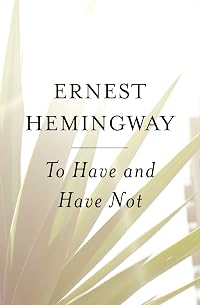
To Have and Have Not
by Ernest Hemingway 
On This Page
Description
The dramatic, brutal story of Harry Morgan, an honest boat owner who is forced into running contraband between Cuba and Key West as a means of keeping his crumbling family financially afloat. His adventures lead him into the world of the wealthy and dissipated yachtsmen who swarm the region, and involve him in a strange and unlikely love affair.Tags
Recommendations









Member Recommendations
Member Reviews
I always struggle to rate Hemingway's books, because there's aspects of them which I like, and also aspects of them which I detest. To Have and Have Not is no different.
The things I don't like: the excessive, name-calling racism, which is pretty heavy in this book. The hints of anti-semitism. The casual sexism. Hemingway is terrible with female characters. His women are shallow, vapid, and serve mainly as sexual partners. Many of them don't even get names. The only characters with any sort of nuance are the white men.
I have read that this novel was a couple of short stories stitched together and enlarged, and in places that's how it reads. It goes from first person to third person to omniscient POV, which is jarring. It starts off with show more a linear series of events, and turns into a pastiche of character sketches. It skips from the main story of Harry Morgan, boat owner, who becomes a smuggler between Cuba and Florida after a wealthy client fails to pay him for a weeks-long chartered fishing trip, to portraying various other characters who are part of the wealthy yachting class of the Keys. These other characters are not sympathetic; one rather despises their empty lives which are filled with debauchery.
Neither the rich, nor the revolutionaries, think twice about the damage they cause or the people they ruin in pursuit of their goals. But Harry also is at times vicious and violent even as he struggles to support his family. There are no heroes here, not even (or especially) Harry Morgan.
Hemingway's language is so oddly vivid, despite its simplicity. I can visualize everything, despite his spare prose style. The boats, the Gulf Stream, the environs of Havana and Key West. It's all there. The prose is clear and clean, making for a fairly fast read.
I'm not sure on his intent with this novel. Is it to compare and contrast the 'have's' and 'have-nots' at a time (the Depression) when that difference was stark and painful? Is it to show what desperate men are capable of (crime, murder, and revolution)? Much of the story is taken up with things like fishing, fighting, and drinking, pursuits that Hemingway himself devoted much time to. Maybe the story is just trying to show the many things that men do as they react to their circumstances. show less
The things I don't like: the excessive, name-calling racism, which is pretty heavy in this book. The hints of anti-semitism. The casual sexism. Hemingway is terrible with female characters. His women are shallow, vapid, and serve mainly as sexual partners. Many of them don't even get names. The only characters with any sort of nuance are the white men.
I have read that this novel was a couple of short stories stitched together and enlarged, and in places that's how it reads. It goes from first person to third person to omniscient POV, which is jarring. It starts off with show more a linear series of events, and turns into a pastiche of character sketches. It skips from the main story of Harry Morgan, boat owner, who becomes a smuggler between Cuba and Florida after a wealthy client fails to pay him for a weeks-long chartered fishing trip, to portraying various other characters who are part of the wealthy yachting class of the Keys. These other characters are not sympathetic; one rather despises their empty lives which are filled with debauchery.
Neither the rich, nor the revolutionaries, think twice about the damage they cause or the people they ruin in pursuit of their goals. But Harry also is at times vicious and violent even as he struggles to support his family. There are no heroes here, not even (or especially) Harry Morgan.
Hemingway's language is so oddly vivid, despite its simplicity. I can visualize everything, despite his spare prose style. The boats, the Gulf Stream, the environs of Havana and Key West. It's all there. The prose is clear and clean, making for a fairly fast read.
I'm not sure on his intent with this novel. Is it to compare and contrast the 'have's' and 'have-nots' at a time (the Depression) when that difference was stark and painful? Is it to show what desperate men are capable of (crime, murder, and revolution)? Much of the story is taken up with things like fishing, fighting, and drinking, pursuits that Hemingway himself devoted much time to. Maybe the story is just trying to show the many things that men do as they react to their circumstances. show less
It's said that Ernest Hemingway considered To Have and Have Not his worst novel, demonstrating that Papa was more self-aware than commonly believed. It's also said that he wrote it only to fulfil a contract, or because he needed cash. That's plausible, but it's no excuse. This novel is vile; it begins badly, and deteriorates from there.
A summary: Harry Morgan, like his piratical namesake, is a good man pushed into crime by the times and by bad luck. His luck just gets worse. Times are tough in Key West, at least for the locals. They're not so bad for all the rotten rich people in their yachts. Why are good men poor and bad men rich? The end.
To Have and Have Not is two short stories grafted onto a novel. It begins badly: as far as we can show more see at the outset, Harry Morgan isn't really a good man but a pirate -- thus, no doubt, the name. When we get through those stories into the novel proper, Harry suddenly grows a sympathetic wife and three daughters, for whom he's struggling to provide, and a bunch of dissipated rich people show up and take over the story. All this arrives too late; the whole thing seems disjointed, messy, as if Hemingway couldn't be bothered with rewriting it to unify the story.
This is also his worst writing -- it often reads as a bad parody of Hemingway, a screenplay for a cheesy noir film featuring stereotypical sailors and brassy blondes. The opening stories might not give you a sympathetic Morgan -- he's brutal, and casually racist -- but at least they're well written. Part 3, in which Morgan emerges as decent, is not.
Read The Sun Also Rises, A Farewell to Arms, For Whom the Bell Tolls, and then this. It's hard to believe it's really the same writer. show less
A summary: Harry Morgan, like his piratical namesake, is a good man pushed into crime by the times and by bad luck. His luck just gets worse. Times are tough in Key West, at least for the locals. They're not so bad for all the rotten rich people in their yachts. Why are good men poor and bad men rich? The end.
To Have and Have Not is two short stories grafted onto a novel. It begins badly: as far as we can show more see at the outset, Harry Morgan isn't really a good man but a pirate -- thus, no doubt, the name. When we get through those stories into the novel proper, Harry suddenly grows a sympathetic wife and three daughters, for whom he's struggling to provide, and a bunch of dissipated rich people show up and take over the story. All this arrives too late; the whole thing seems disjointed, messy, as if Hemingway couldn't be bothered with rewriting it to unify the story.
This is also his worst writing -- it often reads as a bad parody of Hemingway, a screenplay for a cheesy noir film featuring stereotypical sailors and brassy blondes. The opening stories might not give you a sympathetic Morgan -- he's brutal, and casually racist -- but at least they're well written. Part 3, in which Morgan emerges as decent, is not.
Read The Sun Also Rises, A Farewell to Arms, For Whom the Bell Tolls, and then this. It's hard to believe it's really the same writer. show less
A hard book from a hard time and a hard man. This is the third time I've read To Have and Have Not. More layers surfaced, or maybe I just remembered them after forgetting. Harry Morgan would have been a great serial detective in an earlier grittier Key West and EH a great detective writer. The casual crossings of the wealthy and the poor from a time when people did starve in this country. Before the option of corn syrup laden junk food. The casual use of the n word as part of conversation and not the N word used for conscious denigration immediately makes this one of EH's least popular books. But the hardness of the lives led and the unsparing gaze of Hemingway left me feeling, that with my peripheral vision, I caught a glimpse of a show more slice of life from another time and of how hard life could be. No happy endings here. After reading I held paperback and patted the attractive Scribner's cover, thinking that though it wasn't smooth, that it was a good read. A tell tale sign of a very good book. show less
A good book but nothing special. Hemingway doesn't seem to identify where he wants to take the story, and this is evidenced in his experimental (and somewhat jarring) switches between third- and first-person, and between stream-of-consciousness and detached description. Consequently, the reader has to work harder to engage with the story than one does for Hemingway's better works. Even at a modest 180 pages, it makes for a mildly exhausting read. This is a shame as the story holds some promise. In his circumstances and motivations, Harry Morgan is one of Hemingway's better anti-heroes (or 'code heroes', if you prefer) and you would think that rum-running/trafficking between the US and Cuba would be fertile territory for this writer in show more particular.
Thematically, it also seems disjointed, and though one can identify Hemingway's attempt to juxtapose the lives of the rich and the poor (the 'haves' and the 'have-nots' of the title), the execution lacks conviction. If there is a section which is hard-hitting, it is Chapter 24, where Hemingway relates the stories of a few newly-introduced characters. The despair is palpable: in a particularly chilling section, one character contemplates suicide by gun - those admirable American instruments... designed to end the American dream when it becomes a nightmare" (pg. 164) - which becomes even creepier when one recalls Hemingway's own tragic end. This chapter perhaps redeems the novel, but it is notable that Harry Morgan is barely involved in this part. The chapter seems like it was simply dropped into the story - indeed, it reads like something completely separate that one might find in a collection of Hemingway's short stories - and the overarching story of Harry seemed to lack commitment from the author. Hemingway later called the story a 'bunch of junk', but this is somewhat unfair. Alongside the junk there is some good stuff in To Have and Have Not, but be aware that you'll have to work to find it." show less
Thematically, it also seems disjointed, and though one can identify Hemingway's attempt to juxtapose the lives of the rich and the poor (the 'haves' and the 'have-nots' of the title), the execution lacks conviction. If there is a section which is hard-hitting, it is Chapter 24, where Hemingway relates the stories of a few newly-introduced characters. The despair is palpable: in a particularly chilling section, one character contemplates suicide by gun - those admirable American instruments... designed to end the American dream when it becomes a nightmare" (pg. 164) - which becomes even creepier when one recalls Hemingway's own tragic end. This chapter perhaps redeems the novel, but it is notable that Harry Morgan is barely involved in this part. The chapter seems like it was simply dropped into the story - indeed, it reads like something completely separate that one might find in a collection of Hemingway's short stories - and the overarching story of Harry seemed to lack commitment from the author. Hemingway later called the story a 'bunch of junk', but this is somewhat unfair. Alongside the junk there is some good stuff in To Have and Have Not, but be aware that you'll have to work to find it." show less
This would be a tough read for many. Impossible for some, in the current climate. Some of the characters in this are casually racist. Not much of the extreme variety, but more of the this-is-the-way-it-was assumptions of stereotypes applying across peoples and usage of racial slurs, as if it were their name. The other difficulty may come in structure. This is was originally a couple short stories and a novella that were stitched together to make a novel. It shows. Not least in the way that some parts are first person, some third, and not the same characters, but the lengthier parts focus on Harry Morgan, regardless of who's telling that part.
So, that's the forward, to warn away those who aren't interested in dealing with period show more Americana that isn't filtered. And wobbly-structured prose, too.
I now know that the Bogart movie had little to do with the book, beyond the hero being captain of a fishing vessel that is used for illegal activities. And this book is DARK. I mean, Jesus it's dark. Like and Edward Gorey cartoon about children dying. Dark.
The haves are almost entirely secondary characters. Not entirely antagonists, but certainly everything begins to turn bad for Harry Morgan because of being cheated by a "have". And Harry, our "hero", definitely one of the have nots, is no prince, himself. He's a good husband and a good provider to his kids, but beyond that he's capable of doing evil and does.
Eventually, everyone who screws others over in pursuit of his own needs (righteous or not) suffers in some way, regardless of wealth or position. There are no happy endings, here. There is death, suffering, and an ending bathed in tears. But that's the Great Depression, for you.
You'll get guns and killing and espionage and rebel douche-bags fighting the douche-bags in power and rich people and poor people and mostly they get what they deserve, whether you like them or not.
Harsh. show less
So, that's the forward, to warn away those who aren't interested in dealing with period show more Americana that isn't filtered. And wobbly-structured prose, too.
I now know that the Bogart movie had little to do with the book, beyond the hero being captain of a fishing vessel that is used for illegal activities. And this book is DARK. I mean, Jesus it's dark. Like and Edward Gorey cartoon about children dying. Dark.
The haves are almost entirely secondary characters. Not entirely antagonists, but certainly everything begins to turn bad for Harry Morgan because of being cheated by a "have". And Harry, our "hero", definitely one of the have nots, is no prince, himself. He's a good husband and a good provider to his kids, but beyond that he's capable of doing evil and does.
Eventually, everyone who screws others over in pursuit of his own needs (righteous or not) suffers in some way, regardless of wealth or position. There are no happy endings, here. There is death, suffering, and an ending bathed in tears. But that's the Great Depression, for you.
You'll get guns and killing and espionage and rebel douche-bags fighting the douche-bags in power and rich people and poor people and mostly they get what they deserve, whether you like them or not.
Harsh. show less
To Have and Have Not may be America's Depression Era equivalent of Dickens's A Tale of Two Cities. It was the best of times and it was the worst of times for those Americans at opposite ends of the economic spectrum. The Haves were the rich and idle vacationers in the Florida Keys, those with mansions and yachts, latter-day Rober Barons, partygoers. The Have Nots was the native Conchs, the Vets who drank themselves to oblivion at bars like Freddy's while getting into incessant fights with one another, the laborers of the Great Works program who worked for starvation wages. And then there is Harry Morgan - somewhere in between those extremes, possessing, at least in the beginning, both a house and a boat, but nevertheless desperate to show more keep it all together to feed his family. Morgan is the book's main character, though one could hardly call him the protagonist because he disappears from the narrative for long stretches (most likely because this novel was knit together from a collection of short stories). He epitomizes the novel's title, as a string of bad luck slowly demonstrates how one can possess, and be dispossessed, in rapid succession. And so this novel shows over and over again: marriages that are and then are not, lives that end in an instant, wealth that is accumulated over a lifetime at risk of being taken away by forces beyond one's control, love that is strong at one point that ends in disappointment and hatred, sexual desire that wanes. This book is ultimately at some level about the ephemeral nature of everything. show less
A book club pick ;)
The only Hemingway I’ve ever read was The Old Man and the Sea, and as a school assignment besides. So I voted yes with enthusiasm when my book club suggested we read this one.
I enjoyed the writing from the start. The descriptions of fishing were magnificent. And yet, why would you fight a beautiful creature of the sea, just so that you may win and it may die?
The dialogues are alive, rich and colourful, you can taste them.
“What happened to your arm?” the lawyer asked Harry. Harry has the sleeve pinned up to the shoulder.
“I didn’t like the look of it so I cut it off,” Harry told him.
I liked how Hemingway lets you catch glimpses of a different time and place, with a word here, or just a hint of a scent, a show more colour there.
Despite all this, I felt annoyed and bored. The women were mostly very silly and ridiculous. In general, there was a lot of “of its time” stuff in here, and I am still not sure how I felt about that. Also, I have seen this story before; I’ve met all these people before, in various reincarnations, in other books. Had this very short novel been better constructed, I would have been willing to overlook this. The POV changes and jumps between first and third person jarred, I felt. The cacophony of characters by the end added nothing to the narrative and just felt chaotic. They were not people, either, they were more like bugs under a magnifying glass – watch them crawl, oh, look, they picked up a piece of shit and are eating it, such weird bugs. I mostly just wanted the book to be over.
P.S. There might be better Hemingways out there. Recommendations, anyone? show less
The only Hemingway I’ve ever read was The Old Man and the Sea, and as a school assignment besides. So I voted yes with enthusiasm when my book club suggested we read this one.
I enjoyed the writing from the start. The descriptions of fishing were magnificent. And yet, why would you fight a beautiful creature of the sea, just so that you may win and it may die?
The dialogues are alive, rich and colourful, you can taste them.
“What happened to your arm?” the lawyer asked Harry. Harry has the sleeve pinned up to the shoulder.
“I didn’t like the look of it so I cut it off,” Harry told him.
I liked how Hemingway lets you catch glimpses of a different time and place, with a word here, or just a hint of a scent, a show more colour there.
Despite all this, I felt annoyed and bored. The women were mostly very silly and ridiculous. In general, there was a lot of “of its time” stuff in here, and I am still not sure how I felt about that. Also, I have seen this story before; I’ve met all these people before, in various reincarnations, in other books. Had this very short novel been better constructed, I would have been willing to overlook this. The POV changes and jumps between first and third person jarred, I felt. The cacophony of characters by the end added nothing to the narrative and just felt chaotic. They were not people, either, they were more like bugs under a magnifying glass – watch them crawl, oh, look, they picked up a piece of shit and are eating it, such weird bugs. I mostly just wanted the book to be over.
P.S. There might be better Hemingways out there. Recommendations, anyone? show less
Members
- Recently Added By
Published Reviews
". . . a turbulent, searching story of Key West and Havana in these strange years of grace. . . . stronger than 'The Sun Also Rises,' not as good as 'A Farewell to Arms' . . ."
added by GYKM
Lists

1001 Books You Must Read Before You Die
1,448 works; 1,132 members

Classics you know you should have read but probably haven't
421 works; 406 members

Read the book and saw the movie
1,170 works; 195 members

Novels from The Guardian's Great American Novelist Tournament
148 works; 24 members

20th Century Literature
1,161 works; 54 members

Books Featured on Gilmore Girls
307 works; 21 members

1930s
262 works; 5 members

Tammen Keltainen kirjasto
81 works; 1 member
The Complete Rory Gilmore Reading List
506 works; 5 members
Author Information

660+ Works 173,744 Members
Ernest Miller Hemingway was born in the family home in Oak Park, Ill., on July 21, 1899. In high school, Hemingway enjoyed working on The Trapeze, his school newspaper, where he wrote his first articles. Upon graduation in the spring of 1917, Hemingway took a job as a cub reporter for the Kansas City Star. After a short stint in the U.S. Army as a show more volunteer Red Cross ambulance driver in Italy, Hemingway moved to Paris, and it was here that Hemingway began his well-documented career as a novelist. Hemingway's first collection of short stories and vignettes, entitled In Our Time, was published in 1925. His first major novel, The Sun Also Rises, the story of American and English expatriates in Paris and on excursion to Pamplona, immediately established him as one of the great prose stylists and preeminent writers of his time. In this book, Hemingway quotes Gertrude Stein, "You are all a lost generation," thereby labeling himself and other expatriate writers, including F. Scott Fitzgerald, T.S. Eliot, and Ford Madox Ford. Other novels written by Hemingway include: A Farewell To Arms, the story, based in part on Hemingway's life, of an American ambulance driver on the Italian front and his passion for a beautiful English nurse; For Whom the Bell Tolls, the story of an American who fought, loved, and died with the guerrillas in the mountains of Spain; and To Have and Have Not, about an honest man forced into running contraband between Cuba and Key West. Non-fiction includes Green Hills of Africa, Hemingway's lyrical journal of a month on safari in East Africa; and A Moveable Feast, his recollections of Paris in the Roaring 20s. In 1954, Hemingway won the Nobel Prize in Literature for his novella, The Old Man and the Sea. A year after being hospitalized for uncontrolled high blood pressure, liver disease, diabetes, and depression, Hemingway committed suicide on July 2, 1961, in Ketchum, Idaho. (Bowker Author Biography) show less
Ernest Hemingway has a Legacy Library. Legacy libraries are the personal libraries of famous readers, entered by LibraryThing members from the Legacy Libraries group.
Some Editions
Awards and Honors
Series
Belongs to Publisher Series
Work Relationships
Is contained in
Ernest Hemingway Book-of-the-Month-Club Set of 6: A Farewell to Arms, A Moveable Feast, For Whom the Bell Tolls, The Sun Also Rises, The Old Man and the Sea, The Complete Short Stories by Ernest Hemingway (indirect)
The Complete Short Stories of Ernest Hemingway: The Finca Vigía Edition by Ernest Hemingway (indirect)
The Sun Also Rises / A Farewell to Arms / For Whom the Bell Tolls / The Old Man and the Sea / The Complete Short Stories by Ernest Hemingway (indirect)
The Sun Also Rises / A Farewell to Arms / To Have and Have Not / The Old Man and the Sea / For Whom the Bell Tolls by Ernest Hemingway
The Sun Also Rises / A Farewell to Arms / To Have and Have Not / For Whom the Bell Tolls by Ernest Hemingway
Narrativa completa 2 Aguas primaverales / Fiesta / Adios a las armas / tener y no tener by Ernest Hemingway
6 Volume Set: Death in the Afternoon / A Farewell to Arms / The Fifth Column and the First 49 Stories / For Whom the Bell Tolls / The Sun Also Rises / To Have and to Have Not by Ernest Hemingway
The Sun Also Rises / A Farewell to Arms / Death in the Afternoon / To Have and Have Not by Ernest Hemingway
Has the adaptation
Has as a commentary on the text
Common Knowledge
- Canonical title*
- Avere e non avere
- Original title
- To have and have not
- Alternate titles*
- Paupers en prinsen
- Original publication date
- 1937
- People/Characters
- Harry Morgan
- Important places
- Caribbean Region; Florida, USA; Cuba; Key West, Florida, USA
- Important events
- Great Depression
- Related movies
- To Have and Have Not (1944 | IMDb); The Breaking Point (1950 | IMDb); The Gun Runners (1958 | IMDb); Nakhoda Khorshid (1987 | IMDb)
- First words
- You know how it is there early in the morning in Havana with the bums still asleep against the walls of the buildings; before even the ice wagons come by with ice for the bars?
- Last words
- (Click to show. Warning: May contain spoilers.)A large white yacht was coming into the harbor and seven miles out on the horizon you could see a tanker, small and neat in profile against the blue sea, hugging the reef as she made to the westward to keep from wasting fuel against the stream.
- Original language
- English
*Some information comes from Common Knowledge in other languages. Click "Edit" for more information.
Classifications
Statistics
- Members
- 4,651
- Popularity
- 3,100
- Reviews
- 82
- Rating
- (3.41)
- Languages
- 24 — Bengali, Czech, Danish, Dutch, English, Estonian, Finnish, French, German, Greek, Hebrew, Indonesian, Italian, Norwegian (Bokmål), Norwegian, Polish, Portuguese, Russian, Serbian, Slovenian, Spanish, Swedish, Turkish, Ukrainian
- Media
- Paper, Audiobook, Ebook
- ISBNs
- 92
- ASINs
- 94