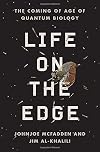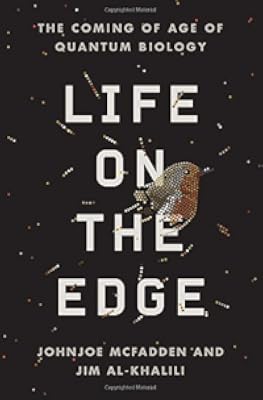
Life on the Edge: The Coming of Age of Quantum Biology
by Johnjoe McFadden (Author), Jim Al-Khalili (Author)
On This Page
Description
Life is the most extraordinary phenomenon in the known universe; but how does it work? It is remarkable that in this age of cloning and even synthetic biology, nobody has ever made anything living entirely out of dead material. Life remains the only way to make life. Are we missing a vital ingredient in its creation? Like Richard Dawkins' The Selfish Gene which provided a new perspective on evolution by shifting the focus of natural selection from organisms to genes, Life On The Edge alters show more our understanding of life from cells or biomolecules to the fundamental particles that drive life's dynamics. From this new perspective, life makes more sense as its missing ingredient is revealed to be quantum mechanics and the strange phenomena that lie at the heart of this most mysterious of sciences. show lessTags
Recommendations





Member Reviews
I'm an avid reader of popular science books, particularly on physics and cosmology. I was impressed with the authors' ability to make the utterly counter-intuitive world of quantum mechanics accessible to a lay audience. Phenomena I have never been able to grasp because they are so hard to describe outside of mathematical formulae were comprehensible for the first time. The idea of quantum effects explaining mysterious processes central to the generation, replication, and astoundingly efficient survival capabilities of living things is a tantalizing one. But the authors' whiz-bang excitement about the possibilities for synthetic life that our mastery of the quantum realm could generate did not endear me to their thesis or help to show more convince me of its credibility. They repeatedly quoted the great physicist Richard Feynman's dictum: "If I can't create it, I don't understand it." But unforeseen consequences, often negative, seem to dog many of these creations of science. They could be particularly severe with respect to living things. It's not a knee-jerk fear of science to feel that the authors were trying to hype a theory that still lacks conclusive experimental confirmation in almost every example they described, by selling us on all the cool stuff scientists might be able to create if they could learn exactly how quantum processes are used in living organisms. What they were in effect talking about, which unfortunately still seems to be the desideratum of many scientists, is a completely mechanical understanding of the universe and everything in it.
Perhaps fortunately, their theory is still a long way from such confirmation, although Life on the Edge seeks to make you believe it is only a matter of time before it comes. However, other scientists have noted that at both the smallest and largest scales, the universe appears resistant to our efforts to use mechanistic models to pin it down and thus to exert our dominance over it. While still being an avid fan of science, I have to hope that the questions posed in this book continue to mystify and frustrate us until we re-learn a little more respect, particularly for life and living things. show less
Perhaps fortunately, their theory is still a long way from such confirmation, although Life on the Edge seeks to make you believe it is only a matter of time before it comes. However, other scientists have noted that at both the smallest and largest scales, the universe appears resistant to our efforts to use mechanistic models to pin it down and thus to exert our dominance over it. While still being an avid fan of science, I have to hope that the questions posed in this book continue to mystify and frustrate us until we re-learn a little more respect, particularly for life and living things. show less
 This review was written for LibraryThing Early Reviewers.
This is a good functional summary of the emerging field of quantum biology. It's hard not to see the fascination of quantum weirdness, but a lot of people are probably turned off by the remoteness of it from our classical physical world. This book smashes the two together with CERN-like force. We are quantum, it says. Everything is quantum. At the same time, this is the weakness of "Life on the Edge". By invoking quantum effects to explain so many and varied biological mysteries, the authors seem to protest too much. Sometimes (magnetoreception in migratory birds) there is very strong experimental evidence to support their case, and other times (origin of life) they freely admit that there isn't (yet). I don't begrudge them their show more enthusiasm - I suppose it's inevitable in such an emergent field - but I was left with the feeling that Johnjoe McFadden and Jim Al-Khalili would happily blame everything from earthquakes to the Easter Bunny on Quantum Biology, given half the chance. Recommended for its sheer novelty. show less
This review was written for LibraryThing Early Reviewers.Highly readable, revelatory, up-to-the-minute accounting of the strides made in a new science that have led to discoveries about heretofore unanswered questions in Nature. The authors argue that quantum mechanics is beginning to explain what life is and even how it arose.
Readers may struggle to comprehend terms like "superposition," "quantum tunneling," "quantum coherence," and quantum concepts like "entangled particles," or "action at a distance." But they should be able to glide along on the power of the narrative to appreciate how quantum biology untangled the mysteries of how enzymes get the tadpole to develop into a frog; how photosynthesis is such an efficient way for plants to get energy from sunlight; how the sense of smell show more requires more than specialized molecular detectors and relies on vibrations; how migrating birds, butterflies, and other creatures depend on biological compasses that allow them to find their way over long distances when quantum reactions take place in molecules of cryptochrome (a pigment found in some birds' and other animals' eyes) in the presence of Earth's weak magnetic field.
All that said, the most thrilling idea to be found in this book is the discussion of how DNA is able to replicate itself so accurately over thousand of years, preserving the genome of every living thing and guaranteeing the continuation and continuity of life.
I enjoyed a serendipitous coincidence in reading this book shortly after finishing Michio Kaku's The Future of the Mind: The Scientific Quest to Understand, Enhance, and Empower the Mind. McFadden and Al-Khalili delve into the mind-body problem to explore whether quantum mechanics can explain how conscious awareness (mind) can cause behavior (body) -- how ideas are turned into action.
The authors arranged each chapter with an introductory anecdote or story that illustrates the Question. This is followed by explanations of the biochemistry that drives biological reactions. They dig further into those reactions by discussing the exact quantum processes that are the basic foundation of those functions. The book ends on a happy note that is the crux of Life on the Edge: We can appreciate all the variety, the functions, the growth, movement, change, creativity, and "miraculous" fact of existence itself exhibited by our planets' flora and fauna as a result of "good, good, good, good (quantum) vibrations." show less
Readers may struggle to comprehend terms like "superposition," "quantum tunneling," "quantum coherence," and quantum concepts like "entangled particles," or "action at a distance." But they should be able to glide along on the power of the narrative to appreciate how quantum biology untangled the mysteries of how enzymes get the tadpole to develop into a frog; how photosynthesis is such an efficient way for plants to get energy from sunlight; how the sense of smell show more requires more than specialized molecular detectors and relies on vibrations; how migrating birds, butterflies, and other creatures depend on biological compasses that allow them to find their way over long distances when quantum reactions take place in molecules of cryptochrome (a pigment found in some birds' and other animals' eyes) in the presence of Earth's weak magnetic field.
All that said, the most thrilling idea to be found in this book is the discussion of how DNA is able to replicate itself so accurately over thousand of years, preserving the genome of every living thing and guaranteeing the continuation and continuity of life.
I enjoyed a serendipitous coincidence in reading this book shortly after finishing Michio Kaku's The Future of the Mind: The Scientific Quest to Understand, Enhance, and Empower the Mind. McFadden and Al-Khalili delve into the mind-body problem to explore whether quantum mechanics can explain how conscious awareness (mind) can cause behavior (body) -- how ideas are turned into action.
The authors arranged each chapter with an introductory anecdote or story that illustrates the Question. This is followed by explanations of the biochemistry that drives biological reactions. They dig further into those reactions by discussing the exact quantum processes that are the basic foundation of those functions. The book ends on a happy note that is the crux of Life on the Edge: We can appreciate all the variety, the functions, the growth, movement, change, creativity, and "miraculous" fact of existence itself exhibited by our planets' flora and fauna as a result of "good, good, good, good (quantum) vibrations." show less
This review was written for LibraryThing Early Reviewers.Professors McFadden and Al-Khalili, both at the University of Surrey, have given us an exciting romp through the 'weird' (their word) view of the field of quantum mechanics intersecting that of molecular biology (or perhaps its the other way around) to give us a new way of looking into the origins of life, evolution, genetic engineering, communication theory, even mind moving matter.
_Life on the Edge_ is framed by the migrations of a northern European robin, first flying from the spruce forests of Sweden with the first frosts of winter southward to the Mediterranean, and six months later, from the cedar tress in Tunisia northward to return to the Scandinavian spruce forest to find a mate, nest, raise chicks, and begin the cycle once show more again. How does the "magneto-reception" compass built into the robin's DNA enable it to find its way over thousands of migratory miles? This is the guiding question (and theme) of this marvelous book.
[ . . . ] show less
_Life on the Edge_ is framed by the migrations of a northern European robin, first flying from the spruce forests of Sweden with the first frosts of winter southward to the Mediterranean, and six months later, from the cedar tress in Tunisia northward to return to the Scandinavian spruce forest to find a mate, nest, raise chicks, and begin the cycle once show more again. How does the "magneto-reception" compass built into the robin's DNA enable it to find its way over thousands of migratory miles? This is the guiding question (and theme) of this marvelous book.
[ . . . ] show less
This review was written for LibraryThing Early Reviewers.This is an interesting book, obtained as a LibraryThing Early Reviewer. The authors delve into several seemingly unrelated biological topics, and show that a quantum physics explanation is necessary to understand them. The topics include basic functions of enzymes, photosynthesis, bird migration, scent receptors, and gene transcription.
They also propose a solution to one of the greatest ‘how did that ever happen’ questions in the origin of life – the numerous steps necessary to end up with functioning RNA as a precursor to DNA. This is necessary to answer astronomer Fred Hoyle’s ‘tornado in a junkyard creating a functioning 747’ argument, a strong argument for some sort of design from a primordial soup on earth.
The show more problem:
“Chemists are able to synthesize the RNA bases from simple chemicals by going through a very complex series of carefully controlled reactions in which each desired product from one reaction is isolated and purified before taking it on to the next reaction. The Scottish chemist Graham Cairns-Smith estimated that there are about 140 steps necessary for the synthesis of an RNA base from simple organic compounds likely to have been present in the primordial soup. For each step there is a minimum of about six alternative reactions that need to be avoided. This makes the chemical synthesis easy to visualize, for you can conceive of each molecule as a kind of molecular die, with each step corresponding to a throw where the number six represents generating the correct product and any other number indicates that the wrong product has been made. So, the odds of any starting molecule eventually being converted into RNA is equivalent to throwing a six 140 times in a row.”
These odds are vanishingly small, of course, and might as well be zero. Yet we are here, nonetheless.
The answer, according to the authors, as far as I can understand, is that on the quantum level all particles are in all possible states at once, continuously, and once some sort of prebiotic life was viable the quantum ‘wave’ collapsed into the world of classical physics we are all more comfortable with. A world-wide experiment of the wave-particle duality around four billion years old!
Other interesting conclusions are that many migratory species, such as birds, can see the earth’s magnetic field. Enzymes (substances that allow chemical reactions to occur at lower energy levels than they otherwise would) work via quantum effects. The photosynthesis process is nearly 100% efficient at the cellular level, again due to quantum effects. Finally, almost as an aside, the author’s allow that quantum computing may prove impossible, as it may be too difficult to avoid the ‘observer’s effect’ on wave/particle duality.
Five stars. show less
They also propose a solution to one of the greatest ‘how did that ever happen’ questions in the origin of life – the numerous steps necessary to end up with functioning RNA as a precursor to DNA. This is necessary to answer astronomer Fred Hoyle’s ‘tornado in a junkyard creating a functioning 747’ argument, a strong argument for some sort of design from a primordial soup on earth.
The show more problem:
“Chemists are able to synthesize the RNA bases from simple chemicals by going through a very complex series of carefully controlled reactions in which each desired product from one reaction is isolated and purified before taking it on to the next reaction. The Scottish chemist Graham Cairns-Smith estimated that there are about 140 steps necessary for the synthesis of an RNA base from simple organic compounds likely to have been present in the primordial soup. For each step there is a minimum of about six alternative reactions that need to be avoided. This makes the chemical synthesis easy to visualize, for you can conceive of each molecule as a kind of molecular die, with each step corresponding to a throw where the number six represents generating the correct product and any other number indicates that the wrong product has been made. So, the odds of any starting molecule eventually being converted into RNA is equivalent to throwing a six 140 times in a row.”
These odds are vanishingly small, of course, and might as well be zero. Yet we are here, nonetheless.
The answer, according to the authors, as far as I can understand, is that on the quantum level all particles are in all possible states at once, continuously, and once some sort of prebiotic life was viable the quantum ‘wave’ collapsed into the world of classical physics we are all more comfortable with. A world-wide experiment of the wave-particle duality around four billion years old!
Other interesting conclusions are that many migratory species, such as birds, can see the earth’s magnetic field. Enzymes (substances that allow chemical reactions to occur at lower energy levels than they otherwise would) work via quantum effects. The photosynthesis process is nearly 100% efficient at the cellular level, again due to quantum effects. Finally, almost as an aside, the author’s allow that quantum computing may prove impossible, as it may be too difficult to avoid the ‘observer’s effect’ on wave/particle duality.
Five stars. show less
This review was written for LibraryThing Early Reviewers.This is definitely not summer reading, but is well written and thought provoking. The authors provide stories to begin each chapter that illustrate a familiar behavior, discuss the basic science involved and then how quantum biology does (or might) provide explanations or mechanisms, including quantum coherence, entanglement and tunnelling. The writing is clear and there are many examples provided that help to illustrate the difficult concepts involved. The authors convey a deep knowledge of quantum biology as well as an infectious enthusiasm for the field. I was impressed with the frequent cross-references to earlier (or later) chapters where theory was discussed or examples provided –books like this often seem to be written show more chapter-by-chapter, with redundant material and a lack of overall cohesiveness—it is clear that the authors and editors went out of their way to avoid this. Was I convinced that these quantum ideas could explain things about processes like migration, hearing, smell, consciousness, etc.? Not always, but the ideas are intriguing, some of the evidence was compelling and it does open up an entirely different approach to how biological processes might work. show less
This review was written for LibraryThing Early Reviewers.My advice is: read the first half.
First, the good: Both authors are working scientists in their field who know what they're talking about, so the translation errors of pop-science writing are minimized. And the field is of course objectively very cool; the thought of quantum mechanics ticking away in living cells including our own is kind of mind-blowing. And the first chapters--where there is actually science and experimental data to discuss--are, if very technical and not always very clear, extremely interesting. I feel like I can at least use the right words in the right order to convey the basic ideas they covered on magnetoreception, photosynthesis, and scent, for example. (Though autocorrect is flagging magnetoreception for me, show more so maybe not.)
Now, the bad: The physics side of the science was described well, but the biology writing was a mess, with information out of order, and reader knowledge assumed that at least I don't have (I haven't taken a biology class for almost thirty years! Have some pity here!). And those were in the chapters were the writers were describing actual data and experiments.
Then I got to the chapter on genes; from that point on, the writers are not describing any kind of existing scientific knowledge. Everything is speculative. Quantum mechanics may play this kind of role in genetics, or maybe not, we don't know, no one has done the experiment yet, but it's an interesting idea, and here's an interesting idea about how quantum physics may have played a role in the origin of life on earth, of course no one has any idea how to test it, etc. and so on, until it quite drained from me the will to live ... or at least the will to finish the book. I gave up at p. 300 when I realized that yes, they were actually going to spend the last chapter of the book, revisiting and expanding on ideas from several of the other chapters, and I could no longer force my eyeballs to finish a sentence.
I've had this book on the to-read pile since it's publication, so I'm pleased to have finally worked my way through (most of) it, and I'm happy to have some kind of understanding of what quantum biology is and some of the research directions and findings. And if you enjoy reading around 160 pages of entirely speculative considerations of what the science *might* find at some point in the future, in extremely technical language, if and when someone actually does the experiments, you may have a different experience reading the second half than I did. show less
First, the good: Both authors are working scientists in their field who know what they're talking about, so the translation errors of pop-science writing are minimized. And the field is of course objectively very cool; the thought of quantum mechanics ticking away in living cells including our own is kind of mind-blowing. And the first chapters--where there is actually science and experimental data to discuss--are, if very technical and not always very clear, extremely interesting. I feel like I can at least use the right words in the right order to convey the basic ideas they covered on magnetoreception, photosynthesis, and scent, for example. (Though autocorrect is flagging magnetoreception for me, show more so maybe not.)
Now, the bad: The physics side of the science was described well, but the biology writing was a mess, with information out of order, and reader knowledge assumed that at least I don't have (I haven't taken a biology class for almost thirty years! Have some pity here!). And those were in the chapters were the writers were describing actual data and experiments.
Then I got to the chapter on genes; from that point on, the writers are not describing any kind of existing scientific knowledge. Everything is speculative. Quantum mechanics may play this kind of role in genetics, or maybe not, we don't know, no one has done the experiment yet, but it's an interesting idea, and here's an interesting idea about how quantum physics may have played a role in the origin of life on earth, of course no one has any idea how to test it, etc. and so on, until it quite drained from me the will to live ... or at least the will to finish the book. I gave up at p. 300 when I realized that yes, they were actually going to spend the last chapter of the book, revisiting and expanding on ideas from several of the other chapters, and I could no longer force my eyeballs to finish a sentence.
I've had this book on the to-read pile since it's publication, so I'm pleased to have finally worked my way through (most of) it, and I'm happy to have some kind of understanding of what quantum biology is and some of the research directions and findings. And if you enjoy reading around 160 pages of entirely speculative considerations of what the science *might* find at some point in the future, in extremely technical language, if and when someone actually does the experiments, you may have a different experience reading the second half than I did. show less
Members
- Recently Added By
Author Information
Johnjoe McFadden is a Reader in Molecular Microbiology at the University of Surrey, England. (Publisher Provided) Johnjoe McFadden is Professor of Molecular Genetics at the University of Surrey and is the editor of several leading text books. For over a decade, he has specialized in examining tuberculosis and meningitis, inventing the first show more successful molecular test for the latter. He is the author of Quantum Evolution and co-editor of Human Nature: Fact and Fiction. He made the shortlist for the 2015 Royal Society Winton Prize for Science Books with his title Life on the Edge: The Coming of Age of Quantum Biology. (Bowker Author Biography) show less

Jameel Sadik "Jim" Al-Khalili was born on September 21 1962 in Iraq. He is a theoretical physicist, author and broadcaster. After completing his A-levels in 1982, he studied physics at the University of Surrey and earned a Bachelor of Science degree in 1986. Despite having a job lined up at the National Physical Laboratory, he stayed on at Surrey show more to pursue a Doctor of Philosophy degree in nuclear reaction theory, which he obtained in 1989. He was also awarded a Science and Engineering Research Council (SERC) postdoctoral fellowship at University College London, In 1994, Al-Khalili was awarded an Engineering and Physical Sciences Research Council (EPSRC) Advanced Research Fellowship for five years, during which time he established himself as a leading expert on mathematical models of exotic atomic nuclei. Al-Khalili is now a professor of physics at the University of Surrey, where he also holds a chair in the Public Engagement in Science. Al-Khalili was awarded the Royal Society Michael Faraday Prize for science communication for 2007. As a broadcaster, Al-Khalili is frequently on television and radio and also writes articles for the British press. (Bowker Author Biography) show less
Some Editions
Awards and Honors
Awards
Distinctions
Notable Lists
Common Knowledge
- Canonical title*
- La fisica della vita: la nuova scienza della biologia quantistica
- Original title
- Life on the Edge: The Coming of Age of Quantum Biology
- Original publication date
- 2014
*Some information comes from Common Knowledge in other languages. Click "Edit" for more information.
Classifications
Statistics
- Members
- 579
- Popularity
- 50,954
- Reviews
- 27
- Rating
- (3.79)
- Languages
- 11 — Chinese, Czech, Dutch, English, German, Hungarian, Italian, Polish, Spanish, Swedish, Turkish
- Media
- Paper, Audiobook, Ebook
- ISBNs
- 28
- ASINs
- 9