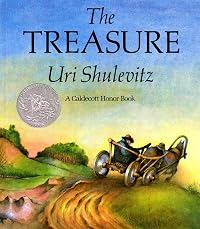
The Treasure
by Uri Shulevitz
On This Page
Description
A retelling of the traditional English tale in which a poor man follows the advice of his dream and is eventually led to a treasure.Tags
Recommendations


























Member Recommendations

raizel A man travels far to find the treasure in his own home; he uses some of it for his local house of worship.

raizel Marilyn Hirsh adds ditsy guardian angels as well as friendship and cooperation between the Jewish man and the guard (and among their followers) to the story that Uri Shulevitz tells more concisely.
Member Reviews
Beautifully illustrated, quiet (terse) retelling of the story used by Rabbi Nachman of Breslau. A man listens to his dream and travels a great distance to a city. Once there, he waits; eventually a guard at a bridge shares his own dream that a treasure is buried in a house a great distance away. The man returns to the treasure in his home, builds a house of prayer, and even sends a jewel to the guard.
The journey there and back again, showing the same pictures in opposite order, demonstrates how outwardly nothing has changed, while we know that inwardly everything has. Rabbi Nachman's moral is that sometimes we have to travel far to find someone who can teach us what is already within us. I think the journey, the effort, the willingness show more to risk much based on very little and probably unreliable information, is important. Perhaps the journey, even without any treasure, is worthwhile in and of itself.
It is interesting that the guard, who also dreams of a faraway treasure does not act on his knowledge. In some other versions, he does not receive any sort of thank you. The story does not originate with Rabbi Nachman: see The Peddler of Swaffham. Nor does it end with him: most adventure stories of the journey or quest type have the hero traveling there and back again. Dorothy realizes "there's no place like home." According to Wikipedia, the first known version is by Rumi. It then found its way into the Arabian Nights. show less
The journey there and back again, showing the same pictures in opposite order, demonstrates how outwardly nothing has changed, while we know that inwardly everything has. Rabbi Nachman's moral is that sometimes we have to travel far to find someone who can teach us what is already within us. I think the journey, the effort, the willingness show more to risk much based on very little and probably unreliable information, is important. Perhaps the journey, even without any treasure, is worthwhile in and of itself.
It is interesting that the guard, who also dreams of a faraway treasure does not act on his knowledge. In some other versions, he does not receive any sort of thank you. The story does not originate with Rabbi Nachman: see The Peddler of Swaffham. Nor does it end with him: most adventure stories of the journey or quest type have the hero traveling there and back again. Dorothy realizes "there's no place like home." According to Wikipedia, the first known version is by Rumi. It then found its way into the Arabian Nights. show less
This 1980 Caldecott Honor book tells the tale of Isaac, who, living in poverty and need, heeds a voice spoken to in dreams Traveling far from his country side in the quest of finding a treasure under the bridge by the royal palace, Isaac learns a valuable lesson.
After a long, weary journey, Isaac does not find a treasure there and is told by a guard that perhaps he should return to where he came from and look for the treasure in his own home!
Returning, Isaac does just that, and lo and behold finds treasure!
The moral of the story is "Sometimes one must travel far to discover what is near."
Lovely images augment a lesson we struggle to comprehend.
After a long, weary journey, Isaac does not find a treasure there and is told by a guard that perhaps he should return to where he came from and look for the treasure in his own home!
Returning, Isaac does just that, and lo and behold finds treasure!
The moral of the story is "Sometimes one must travel far to discover what is near."
Lovely images augment a lesson we struggle to comprehend.
Almost perfect in its simplicity, the journey of the old man presents the world as a conquerable challenge in an appealing place. The theme of trusting one's own experiences and dreams rather than what others say plays out in adult characters for once, their moustaches saying at least as much as the words.
As it's based on an old folktale, this book could be effectively used in instructing the art of simple storytelling or folktale retellling.
As it's based on an old folktale, this book could be effectively used in instructing the art of simple storytelling or folktale retellling.
Hmm. I have mixed feelings. If the message is in the moral, as stated, Sometimes one must travel fa to discover what is near," I think it would have been more effective to tell us a story of a greedy man who travels to find material wealth and comes home to find love and contentment. The emphasis on material treasure puts me off. But then again, maybe I'm missing something. The Jewish lesson plans I found online imply that the treasure is not material (even though Isaac subsequently built a house of prayer and sent a ruby to the Captain). Looking further, I see texts that use a simplified version of this story to metaphorically illustrate the proverb. The implication is that we're supposed to totally ignore the literal interpretation. show more Well, that seems a lot to expect from the target audience, to me. What do you think? I wish I could remember better the other version I read of this: I recall feeling less negative about it. I do like the illustrations, a lot. And I've liked several other books by Uri Shulevitz too." show less
I enjoyed reading this book, not just because the illustrations were beautiful and dreamlike but because the story itself is a reminder that love, happiness, and fulfillment can be found in unexpected places such as inside of yourself. This is the message that it could teach to children.
In this Caldecott Honor Book, Uri Shulevitz tells the story of a poverty-stricken old man, Isaac, whose recurring dream compels him to seek a treasure in a far-off city. Isaac eventually relents and sets off to search for this treasure. When he finally reaches the city, the information he gathers points him right back where he came from. He eventually discovers a treasure—literal and, it can be argued, figurative— when he returns home, building a house of prayer to share both his gratitude and the lesson that you may have to “travel far to discover what is near.” The Treasure explores numerous themes that can be taken literally and figuratively: the concept of following one’s dreams, the idea of finding what one seeks show more (treasure) in one’s own home, the concept of traveling away in search of what has been nearby/inside all along. The prayer house, message of gratitude, and idea of a search for answers/meaning lend religious overtones to the story. Very young children may not fully grasp the meaning behind the story, but are likely to enjoy the main plotline and colorful illustrations.
Librarians could use this book in various activities and discussions with young children. The themes of treasure, following dreams and going on a journey provide opportunities for imagination and creativity, while the message of giving back and using gratitude as a reason to share can support moral discussions. As a Caldecott book, it is a solid choice for children’s collections, and is regarded by many as a children’s classic. show less
Librarians could use this book in various activities and discussions with young children. The themes of treasure, following dreams and going on a journey provide opportunities for imagination and creativity, while the message of giving back and using gratitude as a reason to share can support moral discussions. As a Caldecott book, it is a solid choice for children’s collections, and is regarded by many as a children’s classic. show less
This book is a mystery yet a treasure! The illustrations are showing readers the traditional Eastern European cities and countrysides in glowing colors. Isaac is determined to go find the treasure that appears to him in his dreams more than once. He sets out on foot and travels to a far bridge that guarded by guards day and night. The guard tells him if he could live his dream he would go and dig up treasure under a stove of a guy named Isaac. Isaac goes back home on foot and ends u digging up treasure under his stove. This book tells readers to just have faith and believe in yourself. Stay determined.
Members
- Recently Added By
Lists

Caldecott Honor Books
296 works; 23 members

Honey For a Child's Heart
1,152 works; 25 members

HMS: Make Your Child a Lover of Books, Ages 3-5
14 works; 2 members
Author Information

29+ Works 6,478 Members
Awards and Honors
Common Knowledge
- Canonical title
- The Treasure
- Original publication date
- 1978
- People/Characters
- Isaac; the guard
- Dedication
- To Gertrude Hopkins, and to Peter Hopkins, who taught me the techniques of the Old Masters
- First words
- There once was a man and his name was Isaac.
- Last words
- (Click to show. Warning: May contain spoilers.)Isaac sent the captain of the guards a priceless ruby. And for the rest of his days he lived in contentment and he was never poor again.
Classifications
Statistics
- Members
- 1,281
- Popularity
- 19,090
- Reviews
- 26
- Rating
- (4.04)
- Languages
- English, French, Norwegian, Spanish
- Media
- Paper, Audiobook, Ebook
- ISBNs
- 25
- ASINs
- 11