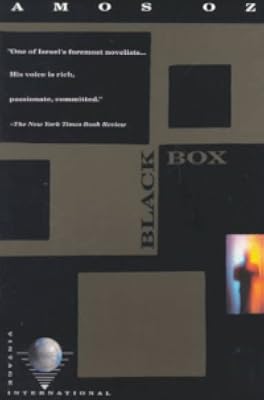
Black Box
by Amos Oz 
On This Page
Description
Seven years after their divorce, Ilana breaks the bitter silence with a letter to Alex, a world-renowned authority on fanaticism, begging for help with their rebellious adolescent son, Boaz. One letter leads to another, and so evolves a correspondence between Ilana and Alex, Alex and Michel (Ilana's Moroccan husband), Alex and his Mephistophelian Jerusalem lawyer--a correspondence between mother and father, stepfather and stepson, father and son, each pleading his or her own case. The show more grasping, lyrical, manipulative, loving Ilana has stirred things up. Now, her former husband and her present husband have become rivals not only for her loyalty but for her son's as well. Black Box is a record of passion, an ingenious, witty, feeling novel of contemporary life. Amos Oz at his novelistic, human, and poetic best-- show lessTags
Recommendations

















Member Reviews
59. Black Box by Amos Oz (1986, 259 pages, read Nov 2-23)
The first normal book I had read in awhile, excluding all the audio books, graphic novels, and other oddball stuff (It is the only novel I have read since July, when I read Toni Morrison's Sula). And it took me awhile, with gaps of time in between. An epistolary novel, it first took me some time to get into it, and then, once I did get involved, it just seemed to get so intense - mind you this was partly my state of mind.
This is a tragic love story, where love and hatred are so densely interwoven, then cannot be untangled. The book begins long after Alec and Ilana's divorce and after Ilana has remarried Michel
A born Harlet.
Yes. I know you would say that {about me}, with your show more oceanic wickedness glimmering like the northern lights in the depths of your grey eyes. But no, Alex. You are mistaken. This deceit is different: every time I deceived you with your friends, with your superiors in the army, with your pupils, with the electrician or the plumber, I was always trying to approach you by deceiving you. It was always you I had in mind. Even when I was screaming aloud. Especially then. As it is written in letters of gold above the Holy Ark in Michel's synagogue: I have placed the Lord before me always.
And this is Israel. An enmeshment of clashing fanatical and irreverent views on religion, with serious political consequences. Oz dives right in. Somewhere in here Alec publishes a book which gets reviews like these:
...sheds new light--or, rather, deep shade--on the psychopathology of various faiths...
..an ice-cold analysis of the phenomenon of messianic fervor...
...maintains that all world-reformers since the dawn of history have actually sold their souls to the devil of fanaticism...
Letters go back and forth from the Ilana, her husband, her son, Alec and Alec's very entertaining lawyer, along with other odd bits thrown in. Old feelings are dug up and dealt with anew. Here Alex is writing to Ilana, and beginning to deal with her affect on him:
Try to picture this man, if you can, thinner than you remember and with much less hair, in dark blue corduroy trousers and a red cashmere sweater. Even though, in principle, as you say, he is in black and white. Standing at the window with his brow pressed against the glass. The eyes, in which you detect an "arctic malice" search the outside world where the light is fading. And his hands are in his pockets. Clenched. Every few minutes he shrugs his shoulders for some reason and hums in a British sort of way. A coldness passes through his bones. He shudders, removes his hands from his pockets, and clasps his shoulders with his arms crossed. This is the embrace of those who have nobody. And yet, for all that, a tight-coiled animal element still endows his silent standing by the window with some characteristic of inner tension: as though flexed to leap back like lightning and anticipate his assailants.
But there is no reason for tension. The world is red and strange.
I'm not sure I will be able to draw anyone else into this particular work of Oz's, but it has drawn me into wanting to read more Oz. This is a complex and thought-provoking work. I still think about the vanity of it all, and still wonder exactly who did what to whom with these letters. These writers evolve. Ilana opens the book with a melodramatic letter that almost turned me off, but later she finds her muse, so to speak, and becomes the most interesting character and the best letter writer in the book. Recommended.
Michel, you ought to take care. Even an old snake can still bite for a finale. I may still have a drop left in my poison gland.
It looks a little nicer on my LT thread here: http://www.librarything.com/topic/160515#4402136 (2013) show less
The first normal book I had read in awhile, excluding all the audio books, graphic novels, and other oddball stuff (It is the only novel I have read since July, when I read Toni Morrison's Sula). And it took me awhile, with gaps of time in between. An epistolary novel, it first took me some time to get into it, and then, once I did get involved, it just seemed to get so intense - mind you this was partly my state of mind.
This is a tragic love story, where love and hatred are so densely interwoven, then cannot be untangled. The book begins long after Alec and Ilana's divorce and after Ilana has remarried Michel
A born Harlet.
Yes. I know you would say that {about me}, with your show more oceanic wickedness glimmering like the northern lights in the depths of your grey eyes. But no, Alex. You are mistaken. This deceit is different: every time I deceived you with your friends, with your superiors in the army, with your pupils, with the electrician or the plumber, I was always trying to approach you by deceiving you. It was always you I had in mind. Even when I was screaming aloud. Especially then. As it is written in letters of gold above the Holy Ark in Michel's synagogue: I have placed the Lord before me always.
And this is Israel. An enmeshment of clashing fanatical and irreverent views on religion, with serious political consequences. Oz dives right in. Somewhere in here Alec publishes a book which gets reviews like these:
...sheds new light--or, rather, deep shade--on the psychopathology of various faiths...
..an ice-cold analysis of the phenomenon of messianic fervor...
...maintains that all world-reformers since the dawn of history have actually sold their souls to the devil of fanaticism...
Letters go back and forth from the Ilana, her husband, her son, Alec and Alec's very entertaining lawyer, along with other odd bits thrown in. Old feelings are dug up and dealt with anew. Here Alex is writing to Ilana, and beginning to deal with her affect on him:
Try to picture this man, if you can, thinner than you remember and with much less hair, in dark blue corduroy trousers and a red cashmere sweater. Even though, in principle, as you say, he is in black and white. Standing at the window with his brow pressed against the glass. The eyes, in which you detect an "arctic malice" search the outside world where the light is fading. And his hands are in his pockets. Clenched. Every few minutes he shrugs his shoulders for some reason and hums in a British sort of way. A coldness passes through his bones. He shudders, removes his hands from his pockets, and clasps his shoulders with his arms crossed. This is the embrace of those who have nobody. And yet, for all that, a tight-coiled animal element still endows his silent standing by the window with some characteristic of inner tension: as though flexed to leap back like lightning and anticipate his assailants.
But there is no reason for tension. The world is red and strange.
I'm not sure I will be able to draw anyone else into this particular work of Oz's, but it has drawn me into wanting to read more Oz. This is a complex and thought-provoking work. I still think about the vanity of it all, and still wonder exactly who did what to whom with these letters. These writers evolve. Ilana opens the book with a melodramatic letter that almost turned me off, but later she finds her muse, so to speak, and becomes the most interesting character and the best letter writer in the book. Recommended.
Michel, you ought to take care. Even an old snake can still bite for a finale. I may still have a drop left in my poison gland.
It looks a little nicer on my LT thread here: http://www.librarything.com/topic/160515#4402136 (2013) show less
Told in letter form, Black Box focuses on the broken relationship between Ilana and Alex, set in a broken country, Israel, where the deeply flawed personalities of the main characters often seem to reflect the flawed political and cultural structure of Israel.
The trigger that starts the novel is Boaz, the violent, unruly teenager son of Ilana and Alex. Ilana in Israel reaches out to her professor ex husband, Alex, to help. Initially recriminations fly back and forth, as do many lies. During the divorce there was even a question mark as to whether Alex is even the father of Boaz, given Ilana's promiscuousness. But whether this is true or not, Alex, not poor, does provide some money to help. Ilana's current very religious, right wing, show more husband, Michael, senses an opportunity, and demands a huge amount more (close to $200,000), and is given it. Is this some clever tactic from Alex to draw Ilana back into Alex's life, or are there are motives?
As the novel develops, everyone slowly changes, and, for Ilana and Alex at least, their lies dissolve and a new, deeper honesty emerges. Much of this honesty involves an analysis of their upbringing, the start of their marriage, and where and why everything went wrong. This brings them closer, and Michael, a rather petty, inconsistent man, is slowly left by the wayside.
Eventually Boaz finds peace, maturity and even wisdom, living on the old family estate of his father, and he is joined by Alex, possibly dying of cancer, and Ilana, there to find her own kind of peace, and to look after ailing Alex. From hatred and recriminations, Ilana and Alex now are close, loving, but not necessarily in a romantic way - there is something purer between them, amidst a deeper acceptance of life generally.
The novel explores, in minute detail, the way that lives can be burnt from the start, how people deceive and manipulate themselves and each other, and how we can change through circumstances. It plays on how religion can interact with all this, and how Israeli politics of the 1970's was a confusing and developing backdrop to personal lives.
Black Box is, at times, deeply moving, funny, thoughtful, real, and extremely closely observed. It is a book one is increasingly drawn into as the letters reveal more of the lives of the main characters. We are forced to question every line, though, given the propensity of characters to lie, and this only makes the novel more interesting. The structure and language of the novel are masterful, as the epistolary format feeds us just the right amount of plot snippets at just the right time, while it also highlights the different voices and forms of communication within it. show less
The trigger that starts the novel is Boaz, the violent, unruly teenager son of Ilana and Alex. Ilana in Israel reaches out to her professor ex husband, Alex, to help. Initially recriminations fly back and forth, as do many lies. During the divorce there was even a question mark as to whether Alex is even the father of Boaz, given Ilana's promiscuousness. But whether this is true or not, Alex, not poor, does provide some money to help. Ilana's current very religious, right wing, show more husband, Michael, senses an opportunity, and demands a huge amount more (close to $200,000), and is given it. Is this some clever tactic from Alex to draw Ilana back into Alex's life, or are there are motives?
As the novel develops, everyone slowly changes, and, for Ilana and Alex at least, their lies dissolve and a new, deeper honesty emerges. Much of this honesty involves an analysis of their upbringing, the start of their marriage, and where and why everything went wrong. This brings them closer, and Michael, a rather petty, inconsistent man, is slowly left by the wayside.
Eventually Boaz finds peace, maturity and even wisdom, living on the old family estate of his father, and he is joined by Alex, possibly dying of cancer, and Ilana, there to find her own kind of peace, and to look after ailing Alex. From hatred and recriminations, Ilana and Alex now are close, loving, but not necessarily in a romantic way - there is something purer between them, amidst a deeper acceptance of life generally.
The novel explores, in minute detail, the way that lives can be burnt from the start, how people deceive and manipulate themselves and each other, and how we can change through circumstances. It plays on how religion can interact with all this, and how Israeli politics of the 1970's was a confusing and developing backdrop to personal lives.
Black Box is, at times, deeply moving, funny, thoughtful, real, and extremely closely observed. It is a book one is increasingly drawn into as the letters reveal more of the lives of the main characters. We are forced to question every line, though, given the propensity of characters to lie, and this only makes the novel more interesting. The structure and language of the novel are masterful, as the epistolary format feeds us just the right amount of plot snippets at just the right time, while it also highlights the different voices and forms of communication within it. show less
Black Box by Amos Oz
★★★★.5
I picked up this book with little enthusiasm. Based on the summary, I was convinced that I would not care for it. The GoodReads summary was as follows, “examines the lives of a contemporary Israeli couple whose marriage has ended in disaster.” My initial reaction was “that sounds boring and depressing.” Boy, was I wrong (about the boring part, it is not exactly uplifting). I loved this book. The Black Box is an epistolary novel told through a series of letters, memos, notes between a formerly married couple, their son, the wife’s current husband, her sister, and the ex-husband’s lawyer. Oz takes us (the reader) on a journey of a marital breakdown that has so many twists and turns that you show more never quite know where you are going to end up. Each new letter adds to the jigsaw puzzle and contributes to an almost complete picture of how each character ends up in their current situation. Your heart breaks for these flawed and emotionally damaged people.
This book is about so much more than the disintegration of a relationship. It is in many ways a book about fanaticism. All characters are extreme or fanatics in different ways. Alec, the ex-husband, is the secular rationalist (often cruel, seemingly emotionless), Michel, the current husband, is the religious fanatic, Ilana the seductress (all emotion, desire, etc), Boaz, the son, is naturalist with no faith. Oz clearly has little positive regard for fanaticism and he constantly points out the flaws in his characters. I would describe this book as a commentary or observation on the human condition, one that is set in a complex political setting. Oz captures the voices of each character so well. The letters are at times funny, at times bitter and cruel, and at other times filled with a sense of sadness and desperation.
I have lots to say about this book, but fear that my comments will give too much away. So, instead I’ll just say that the book is complex, beautifully-written and engaging. My only criticisms (and thus the reason for not giving it a 5) are: 1) Ilana remains somewhat elusive. We are given a lot of information behind what drives many of the other characters (their childhood history, etc), but little background about Ilana and her flaws; & 2) some of the letters don’t quite read like letters since the characters will rehash in great detail exactly what they had said to the recipient of the letter (something that would be needless if you had actually had the conversation with that person to begin with).
Favorite quotes:
-“as after a plane crash, we have sat down and analyzed, by correspondence, the contents of the black box.”
-“there is happiness in the world, Alec, and suffering is not its opposite but the narrow passage through which stooping, crawling among nettles, we reach the silent clearing in the forest bathed in lunar silver.”
-“our love had filled with hate. Which consumed everything yet continued to masquerade as love.” show less
★★★★.5
I picked up this book with little enthusiasm. Based on the summary, I was convinced that I would not care for it. The GoodReads summary was as follows, “examines the lives of a contemporary Israeli couple whose marriage has ended in disaster.” My initial reaction was “that sounds boring and depressing.” Boy, was I wrong (about the boring part, it is not exactly uplifting). I loved this book. The Black Box is an epistolary novel told through a series of letters, memos, notes between a formerly married couple, their son, the wife’s current husband, her sister, and the ex-husband’s lawyer. Oz takes us (the reader) on a journey of a marital breakdown that has so many twists and turns that you show more never quite know where you are going to end up. Each new letter adds to the jigsaw puzzle and contributes to an almost complete picture of how each character ends up in their current situation. Your heart breaks for these flawed and emotionally damaged people.
This book is about so much more than the disintegration of a relationship. It is in many ways a book about fanaticism. All characters are extreme or fanatics in different ways. Alec, the ex-husband, is the secular rationalist (often cruel, seemingly emotionless), Michel, the current husband, is the religious fanatic, Ilana the seductress (all emotion, desire, etc), Boaz, the son, is naturalist with no faith. Oz clearly has little positive regard for fanaticism and he constantly points out the flaws in his characters. I would describe this book as a commentary or observation on the human condition, one that is set in a complex political setting. Oz captures the voices of each character so well. The letters are at times funny, at times bitter and cruel, and at other times filled with a sense of sadness and desperation.
I have lots to say about this book, but fear that my comments will give too much away. So, instead I’ll just say that the book is complex, beautifully-written and engaging. My only criticisms (and thus the reason for not giving it a 5) are: 1) Ilana remains somewhat elusive. We are given a lot of information behind what drives many of the other characters (their childhood history, etc), but little background about Ilana and her flaws; & 2) some of the letters don’t quite read like letters since the characters will rehash in great detail exactly what they had said to the recipient of the letter (something that would be needless if you had actually had the conversation with that person to begin with).
Favorite quotes:
-“as after a plane crash, we have sat down and analyzed, by correspondence, the contents of the black box.”
-“there is happiness in the world, Alec, and suffering is not its opposite but the narrow passage through which stooping, crawling among nettles, we reach the silent clearing in the forest bathed in lunar silver.”
-“our love had filled with hate. Which consumed everything yet continued to masquerade as love.” show less
This book took me a lot longer to finish than I expected... it’s very complex and not an easy read at all. An epistolary novel told in notes and letters between a divorced couple, her new husband, their teenager son, and some other characters, there is a lot going on here. Religious fanaticism, Israeli issues, war, marriage, family... it’s a lot, but it’s so well written, it’s absolutely worth the work.
Caveat – I read this book nearly 40 years ago and am only now writing this review. Therefore, Dear Reader, forgive me any inaccuracies that may appear, but after so many years the book still resonates, and my impressions were formed in a different age and time. - October 2025
Reading The Black Box by Amos Oz is when I fell in love with the epistolary genre.
The book centers on the charged relationship between the Main Characters of Alec (an emotionally challenged college professor and retired IDF Officer), his ex-wife Ilana, their son Boaz, and Ilana’s current husband Michel – a Moroccan-born, conniving, manipulative, bible thumping zealot. You might assume by my description of Michel, above (not including his ethnicity), that I show more considered him a totally unlikeable character, and you would be correct, even if my view is still based on the impression of a much younger woman whose memory of the minutiae might be lacking in a book that I read approximately 40 years ago. Why, specifically, Oz chose to note Michel’s ethnicity is unclear (even if I think there might have been some stigma intended or satirized). I felt there was a correlation between the character of Michel and Meir Kahane, the right-wing extremist and political activist who immigrated to Israel in 1979 and then won a seat in the 1984 Israeli Parliament (Knesset). The book takes place circa 1976 five years after Kahane emigrated to Israel from the U.S., and was written five years before Kahane was assassinated (1990) while making a speech before an ultra-orthodox Jewish community in Brooklyn, N.Y.
It is hard to believe that today – fifty-five years after he immigrated to Israel and after his Kach party was banned from future elections when in 1985 the Israel Knesset passed a law banning political parties that incited to racism – Kahanist ideology still thrives and/or has roots among prominent political figures in Itamar Ben-Gvir’s Otzma Yehudit (Jewish Power) Party, and today holds significant influence within the Knesset and is a pivotal member of the government coalition.
I note that despite the fact that I rarely see the character Michel appearing in reviews of Black Box, other than in scholarly analyses which go way over my head and do not strike a comparison with Meir Kahane, the character of Michel and his letters comprise a large portion of the book that is mostly ignored (at least in the English reviews I have read).
The relationship between Alec and Ilana was a charged one. Ilana, who thirsted for love and companionship, felt deprived of both while married to Alec. Alec displayed only frigid animosity toward Ilana, once she reached out to him seven years after their divorce, to help get their troubled sixteen-year-old son on track. Alec was a successful, published, Professor in Chicago and divided his time in academic circles outside of Israel – hence letters was the method of communication between all the parties concerned. It is hard to fathom why Ilana married the ultra-religious Michel, whose preachy letters were strewn with religious scripture and schnorring for among other things, the purchase of land for religious West Bank settlement.
Amos Oz, has won numerous accolades and awards during his long and prolific career. The Black Box is one of the most widely-read books in Israel and was awarded the Prix Femina Étranger in 1988 for the best foreign novel in France and the Wingate Prize in London in the same year. show less
Reading The Black Box by Amos Oz is when I fell in love with the epistolary genre.
The book centers on the charged relationship between the Main Characters of Alec (an emotionally challenged college professor and retired IDF Officer), his ex-wife Ilana, their son Boaz, and Ilana’s current husband Michel – a Moroccan-born, conniving, manipulative, bible thumping zealot. You might assume by my description of Michel, above (not including his ethnicity), that I show more considered him a totally unlikeable character, and you would be correct, even if my view is still based on the impression of a much younger woman whose memory of the minutiae might be lacking in a book that I read approximately 40 years ago. Why, specifically, Oz chose to note Michel’s ethnicity is unclear (even if I think there might have been some stigma intended or satirized). I felt there was a correlation between the character of Michel and Meir Kahane, the right-wing extremist and political activist who immigrated to Israel in 1979 and then won a seat in the 1984 Israeli Parliament (Knesset). The book takes place circa 1976 five years after Kahane emigrated to Israel from the U.S., and was written five years before Kahane was assassinated (1990) while making a speech before an ultra-orthodox Jewish community in Brooklyn, N.Y.
It is hard to believe that today – fifty-five years after he immigrated to Israel and after his Kach party was banned from future elections when in 1985 the Israel Knesset passed a law banning political parties that incited to racism – Kahanist ideology still thrives and/or has roots among prominent political figures in Itamar Ben-Gvir’s Otzma Yehudit (Jewish Power) Party, and today holds significant influence within the Knesset and is a pivotal member of the government coalition.
I note that despite the fact that I rarely see the character Michel appearing in reviews of Black Box, other than in scholarly analyses which go way over my head and do not strike a comparison with Meir Kahane, the character of Michel and his letters comprise a large portion of the book that is mostly ignored (at least in the English reviews I have read).
The relationship between Alec and Ilana was a charged one. Ilana, who thirsted for love and companionship, felt deprived of both while married to Alec. Alec displayed only frigid animosity toward Ilana, once she reached out to him seven years after their divorce, to help get their troubled sixteen-year-old son on track. Alec was a successful, published, Professor in Chicago and divided his time in academic circles outside of Israel – hence letters was the method of communication between all the parties concerned. It is hard to fathom why Ilana married the ultra-religious Michel, whose preachy letters were strewn with religious scripture and schnorring for among other things, the purchase of land for religious West Bank settlement.
Amos Oz, has won numerous accolades and awards during his long and prolific career. The Black Box is one of the most widely-read books in Israel and was awarded the Prix Femina Étranger in 1988 for the best foreign novel in France and the Wingate Prize in London in the same year. show less
One of the joys of renting a holiday cottage is exploring books left for the perusing guest. This is how I discovered Amos Oz, acknowledged by many to be Israel's finest writer. After reading, Black Box, I have no doubt about such claims. It is simply one of the most intelligent novels I have read in a long, long time; politically thought-provoking, simultaneously erotic and theological. Through communiques of letters, telegrams, and notes, we are brought into the intense triad relationship of a couple and an ex-husband trying to sort out each other's intentions and motivations, as they pertain to the state of the woman's first born son, the Zionist nation, and their own lives. Heroic and tragic, heaven and hell, love and pain, this show more book comes as close to perfect as one could want. It should be required reading for all fanatics, serve as an instruction manual for troubled marriages, and rise to the top of everyone else's "to be read next" list. show less
The year is 1976, and the setting is mostly Jerusalem. Seven years earlier, Alex and Ilana divorced. Their son, Boaz, stayed with her, and Ilana remarried an Algerian/French immigrant, Michel. Alex is a university professor who lives in America now and studies religious fanaticism. Michel is just the kind of fanatic he studies. Boaz, at sixteen years old, wanders through life without real direction and gets into trouble more often than not. His father and stepfather spend much of the novel fighting for his loyalty and trying to get him to follow in their footsteps. Ilana’s letters leave her as a bit of a mystery, but more than anything, she wants to help those she loves. These four characters, along with Alex’s (possibly show more untrustworthy?) lawyer Manfred, tell their stories through a series of letters to each other.
The plot here is secondary to the characters. Because the novel is written entirely through letters, it takes a while before the reader has enough pieces to put together to really get a feel for each of the characters. I found this technique to be quite effective. In addition, the prose is beautiful. It’s difficult to explain what the novel is really about under the surface because there is so much going on, and I really like how each reader can see something different in the book. Two minor things that I didn’t like are that Oz gets a little too ambiguous at times to the point where I felt like I was missing something important (but that could just be my relative unfamiliarity with the political situation in Israel at the time) and that some of his letters ramble on for so long in such detail that they would have been more suited to straight narration than an epistolary novel. Overall though, this was a thought-provoking work of art. show less
The plot here is secondary to the characters. Because the novel is written entirely through letters, it takes a while before the reader has enough pieces to put together to really get a feel for each of the characters. I found this technique to be quite effective. In addition, the prose is beautiful. It’s difficult to explain what the novel is really about under the surface because there is so much going on, and I really like how each reader can see something different in the book. Two minor things that I didn’t like are that Oz gets a little too ambiguous at times to the point where I felt like I was missing something important (but that could just be my relative unfamiliarity with the political situation in Israel at the time) and that some of his letters ramble on for so long in such detail that they would have been more suited to straight narration than an epistolary novel. Overall though, this was a thought-provoking work of art. show less
Members
- Recently Added By
Lists

1001 Books You Must Read Before You Die
1,448 works; 1,137 members

Jewish Books
367 works; 24 members

1980s
356 works; 23 members
Canon de la narrativa universal del s. XX (cicutadry)
499 works; 3 members
Author Information

119+ Works 12,335 Members
Amos Oz was born Amos Klausner in Jerusalem on May 4, 1939. As a young teenager, he moved to Kibbutz Hulda, where he completed his secondary education and worked on a farm. After he completed mandatory military service in 1961, the kibbutz assembly sent him to study at the Hebrew University of Jerusalem, where he received a B.A. in philosophy and show more literature. After graduation, he moved back to Hulda, where he wrote, did farm work, did guard and dining-room duty, and taught in the kibbutz high school. He fought in the 1967 and 1973 wars and spent a year as a visiting fellow at Oxford University. He wrote novels, collections of short fiction, works of nonfiction, and essays. His novels included My Michael, Black Box, and The Gospel According to Judas. His memoir, A Tale of Love and Darkness, was adapted into a movie in 2016. His last book, Dear Zealot, was made up of three essays on the theme of fanaticism. He was an advocate for peace and believed in a two-state solution, meaning the establishment of a Palestinian state alongside Israel. In the late 1970s, he helped found Peace Now. He received several awards including the Goethe Prize, the French Knight's Cross of the Légion D'Honneur, and the Israel Prize. He died after a short battle with cancer on December 28, 2018 at the age of 79. (Bowker Author Biography) show less
Amos Oz is a LibraryThing Author, an author who lists their personal library on LibraryThing.
Some Editions
Awards and Honors
Series
Belongs to Publisher Series
Common Knowledge
- Canonical title
- Black Box
- Original title
- Koefsa sjechora
- Original publication date
- 1986 (hebrew) (hebrew)
- People/Characters
- Michel Sommo; Alexander Gideon; Ilana Sommo; Boaz Brandstetter
- Important places
- Jerusalem
- First words*
- Schalom Alek,
Wenn Du diesen Brief beim Anblick meiner Handschrift auf dem Umschlag nicht sofort vernichtet hast, zeigt sich wieder einmal, dass die Neugier noch stärker ist als der Hass. - Last words*
- (Click to show. Warning: May contain spoilers.)Doch die Huld des Herrn währt immer und ewig für alle, die ihn fürchten und ehren. Amen.
Michael Sommo - Original language*
- Hebreeuws
*Some information comes from Common Knowledge in other languages. Click "Edit" for more information.
Classifications
- Genres
- General Fiction, Fiction and Literature
- DDC/MDS
- 892.4 — Literature & rhetoric Literatures of other languages Afro-Asiatic literatures Jewish, Israeli, and Hebrew
- LCC
- PJ5054 .O9 .K8413 — Language and Literature Oriental languages and literatures Oriental philology and literature Hebrew Literature Individual authors and works
- BISAC
Statistics
- Members
- 731
- Popularity
- 38,883
- Reviews
- 24
- Rating
- (3.88)
- Languages
- 20 — Catalan, Czech, Danish, Dutch, English, Finnish, French, German, Hebrew, Hungarian, Italian, Latvian, Norwegian (Bokmål), Polish, Portuguese (Portugal), Romanian, Russian, Serbian, Slovenian, Spanish
- Media
- Paper, Ebook
- ISBNs
- 58
- ASINs
- 9