
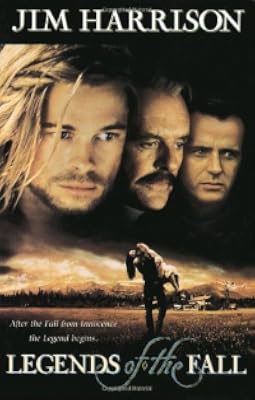
Legends of the Fall [Novella Collection]
by Jim Harrison
On This Page
Description
The publication of this magnificent trilogy of short novels--Legends of the Fall, Revenge, and The Man Who Gave Up His Name--confirmed Jim Harrison's reputation as one of the finest American writers of his generation. These absorbing novellas explore the theme of revenge and the actions to which people resort when their lives or goals are threatened, adding up to an extraordinary vision of the twentieth-century man. Set in the Rocky Mountains, Legends of the Fall is the epic tale of three show more brothers and their lives of passion, madness, exploration, and danger at the beginning of World War I. In Revenge, love causes the course of a man's life to be savagely and irrevocably altered. And in The Man Who Gave Up His Name, a man named Nordstrom is unable to relinquish his consuming obsessions with women, dancing, and food. show lessTags
Recommendations








Member Reviews
With Legends of the Fall, author Jim Harrison presents three superbly crafted novellas that offer very different takes on the quest to find oneself and the consequences involved with such a journey. The title story is a sweeping family saga of love, devotion, jealousy, crime, and betrayal. Three brothers leave the family’s Montana ranch to fight in Europe during World War I, with only two of them, Tristan and Alfred, returning home. The resulting loss will shape the lives of the surviving brothers in drastically different ways, along with those of the woman involved with both of them and the father they left behind. Much of the action focuses on Tristan’s restless nature as he tries to outrun his pain and guilt at not being able to show more protect his younger brother during the war.
‘Revenge’ tells the tale of Cochran, a former military pilot who has an affair with Miryea, the wife of Tibey, a Mexican mobster. In one of the more dramatic opening scenes in recent memory, the story begins with the discovery of Cochran’s battered body after he was beaten by the vengeful husband and left to die in the desert. He recovers with the help of a downtrodden missionary and sets out to exact his own revenge on Tibey and reclaim his lover, who has been punished following the discovery of her infidelity by first being forced into prostitution and then hidden away in a remote religious asylum. Cochran’s desire to rescue Miryea and the psychological battle that ensues between him and Tibey leads to the novella’s melancholy conclusion.
‘The Man Who Gave Up His Name’ follows Nordstrom from his college days, where he meets Laura, the woman who will eventually become his wife for eighteen years before drifting apart. While married, the couple have a daughter named Sonia, to whom Nordstrom is very much attached. Nordstrom becomes a great success in the oil business, but ultimately loses interest in his professional career as his relationship with Laura unwinds and he begins to dream of giving away all of this wealth to start life anew as a cook in a humble restaurant. Eventually, after a disastrous and fatal encounter at Sonia’s college graduation celebration where his family and friends are threatened, Nordstrom clears all remaining obstacles and executes his plan to walk away from the man he always been.
I really liked each of the novellas in Legends of the Fall, but for diverse reasons. ‘Legends of the Fall’ was the most cinematic of the three—in fact, it has been made into an award-winning film—and was more ambitious in its scope and range of emotions. ‘Revenge’, which was also turned into a movie, comes the closest to being an old-fashioned thriller in which the most basic of human feelings are played out with deadly consequences. The final story, on the other hand, is generally more introspective and less violent than the other two, although just as effective in developing complex and interesting characters. Harrison was a gifted and versatile story-teller and it is easy to see why the short-form fiction contained in this volume is considered essential reading by so many of the author’s fans. show less
‘Revenge’ tells the tale of Cochran, a former military pilot who has an affair with Miryea, the wife of Tibey, a Mexican mobster. In one of the more dramatic opening scenes in recent memory, the story begins with the discovery of Cochran’s battered body after he was beaten by the vengeful husband and left to die in the desert. He recovers with the help of a downtrodden missionary and sets out to exact his own revenge on Tibey and reclaim his lover, who has been punished following the discovery of her infidelity by first being forced into prostitution and then hidden away in a remote religious asylum. Cochran’s desire to rescue Miryea and the psychological battle that ensues between him and Tibey leads to the novella’s melancholy conclusion.
‘The Man Who Gave Up His Name’ follows Nordstrom from his college days, where he meets Laura, the woman who will eventually become his wife for eighteen years before drifting apart. While married, the couple have a daughter named Sonia, to whom Nordstrom is very much attached. Nordstrom becomes a great success in the oil business, but ultimately loses interest in his professional career as his relationship with Laura unwinds and he begins to dream of giving away all of this wealth to start life anew as a cook in a humble restaurant. Eventually, after a disastrous and fatal encounter at Sonia’s college graduation celebration where his family and friends are threatened, Nordstrom clears all remaining obstacles and executes his plan to walk away from the man he always been.
I really liked each of the novellas in Legends of the Fall, but for diverse reasons. ‘Legends of the Fall’ was the most cinematic of the three—in fact, it has been made into an award-winning film—and was more ambitious in its scope and range of emotions. ‘Revenge’, which was also turned into a movie, comes the closest to being an old-fashioned thriller in which the most basic of human feelings are played out with deadly consequences. The final story, on the other hand, is generally more introspective and less violent than the other two, although just as effective in developing complex and interesting characters. Harrison was a gifted and versatile story-teller and it is easy to see why the short-form fiction contained in this volume is considered essential reading by so many of the author’s fans. show less
In the three novellas within this collection, Harrison displays a great eye for craft, building stories that climb and convey familiar forms while defying them, with Revenge being the case in point as a Western with unconventional turns and resolutions. His protagonists are masterful character studies, with all of their internal woes and joys dissected while still seamlessly integrated into the overall narrative of a story. Harrison has an eye for rich detail, which he never allows to become a detriment to his creating gripping and memorable stories.
This book consists of three novellas: 1) Revenge, 2) The Man Who Gave Up His Name, and 3) Legends of the Fall. In Revenge, a man has an affair with the wife of a drug lord and consequences are paid by all. In The Man Who Gave Up His Name, a business tycoon feels a growing dissatisfaction and decides to change his life. In Legends of the Fall, three sons of a Montana rancher travel to Canada to join the armed forces in the Great War. Multiple tragedies befall the family.
Each novella contains violent dramatic action. The tone is dark. Revenge is a shared theme. Harrison somehow manages to keep these three tragic stories from becoming too depressing. His writing has a macho edge. The endings of the first two novellas are not as effective show more as the third, which was my personal favorite. show less
Each novella contains violent dramatic action. The tone is dark. Revenge is a shared theme. Harrison somehow manages to keep these three tragic stories from becoming too depressing. His writing has a macho edge. The endings of the first two novellas are not as effective show more as the third, which was my personal favorite. show less
Three novellas in one collection, each very distinct and unconnected from the others. “Revenge” was excellent, reminding me of the fever-dream beauty of James Lee Burke's writing, and the stark no-nonsense violence of Thomas Perry, though obviously predating both those writers. “The Man Who Gave Up His Name” was less successful, I thought, being more inward-looking and self-absorbed, though quite entertaining and more thoughtful than it seems at first glance. The title novella, “Legends of the Fall”, was again excellent, remarkably epic despite its length. Overall, two 5-stars and a 3-star, makes for a 4-1/3 average, though I'm not sure that's a fair way to look at it. Beautiful writing, sharp dialog, richly-observed show more settings, sometimes-brutal action, and a deep sense of mastery. show less
Three unrelated novellas in one book, the titular Legends of the Fall inspired a movie that has very little to do with the novella - and that one is decidedly the worst of this collection. The first, Revenge picks up an almost Cormac McCarthy-esque style, from the themes to the setting, but can't stay as relentless and fumbles the ending. The Man Who Gave Up His Name has a very interesting beginning, almost a pastiche on the literary novel, summing up the quiet desperation of an ordinary man's failures in a minimal amount of words, before embarking on the actual story it wants to tell, wherein the anonymous man of no direction morphs into a character from a crime novel.
His way with words is good, but there was little here that captured me.
His way with words is good, but there was little here that captured me.
Legends of the Fall by Jim Harrison follows the life of Tristan Ludlow, the only brother of three to survive the Great War physically intact. His younger brother, Samuel, the apple of his mother's eye, dies in France while his older brother Alfred is wounded in an accident and sent home before he reaches Europe.
Tristan survives physically but emotionally he never fully recovers. He escapes an asylum in France, where he is sent after scalping six German soldiers, and takes up work as a weapons smuggler for the English spending the next several years at sea. He travels the world, winning medals from the English while smuggling various types of contraband for his own profit. Years later he returns to his father's ranch to find that his show more brother has married the wife he abandoned. Alfred ends up a senator for Montana; Tristan remarries and takes over running the family ranch. Things go very well for everyone for a time. He is deeply in love with his new wife; they have several children; he makes his father's ranch a success.
Returning from a trip to town with his wife's shopping and with several carloads of newly illegal whiskey Tristan is stopped by federal agents along a narrow stretch of road. The agents fire several shots into the air and calmly inform Tristan and his men that they will have to surrender the whiskey they are smuggling. Then they all see that Tristan's wife sits dead in the front seat of the car; a bullet ricocheted from somewhere into her forehead. This second round of loss moves Tristan to another round violent revenge and to life on the run as an outlaw smuggling whiskey.
Tristan faces severe loss several times throughout the novel. Each time he is aware that the person killed, his brother, his wife, is the better person, that he is the one who should have been taken. This compounds his sense of loss and complicates how the reader judges his reaction. His brother dies an innocent, a life wasted in a battle that was never his. The same thing happens to his wife; that her death is accidental does not lessen it's impact. (I gasped when I read it.) Tristan is far from perfect to begin with and I doubt his life would have been exemplary under the best of circumstances, but the events of the novel make it difficult to judge him harshly. He is a very attractive hero/anti-hero to begin with; that the reader sympathizes with him even as he makes mistakes is no suprise.
Legends of the Fall by Jim Harrison is novella length by it's events and it's impact carry the weight of a novel. I'm giving it four out of five stars and a very strong recommendation. I've not seen the movie, and judging from the cover artwork on my movie tie-in edition I don't think I care to. The characters in the novella are as real to me as they could get. Seeing them acted would lesson their power in my memory show less
Tristan survives physically but emotionally he never fully recovers. He escapes an asylum in France, where he is sent after scalping six German soldiers, and takes up work as a weapons smuggler for the English spending the next several years at sea. He travels the world, winning medals from the English while smuggling various types of contraband for his own profit. Years later he returns to his father's ranch to find that his show more brother has married the wife he abandoned. Alfred ends up a senator for Montana; Tristan remarries and takes over running the family ranch. Things go very well for everyone for a time. He is deeply in love with his new wife; they have several children; he makes his father's ranch a success.
Returning from a trip to town with his wife's shopping and with several carloads of newly illegal whiskey Tristan is stopped by federal agents along a narrow stretch of road. The agents fire several shots into the air and calmly inform Tristan and his men that they will have to surrender the whiskey they are smuggling. Then they all see that Tristan's wife sits dead in the front seat of the car; a bullet ricocheted from somewhere into her forehead. This second round of loss moves Tristan to another round violent revenge and to life on the run as an outlaw smuggling whiskey.
Tristan faces severe loss several times throughout the novel. Each time he is aware that the person killed, his brother, his wife, is the better person, that he is the one who should have been taken. This compounds his sense of loss and complicates how the reader judges his reaction. His brother dies an innocent, a life wasted in a battle that was never his. The same thing happens to his wife; that her death is accidental does not lessen it's impact. (I gasped when I read it.) Tristan is far from perfect to begin with and I doubt his life would have been exemplary under the best of circumstances, but the events of the novel make it difficult to judge him harshly. He is a very attractive hero/anti-hero to begin with; that the reader sympathizes with him even as he makes mistakes is no suprise.
Legends of the Fall by Jim Harrison is novella length by it's events and it's impact carry the weight of a novel. I'm giving it four out of five stars and a very strong recommendation. I've not seen the movie, and judging from the cover artwork on my movie tie-in edition I don't think I care to. The characters in the novella are as real to me as they could get. Seeing them acted would lesson their power in my memory show less
And here comes my midlife crises - this is one of those books that reads very differently as young man vs when re-read in your 40s. Ooof.
Members
- Recently Added By
Published Reviews
ThingScore 100
The story’s narrative voice is arbitrary and godlike, always very distant but by turns lyrical and essayistic, superbly telling instead of showing... Not so much world-weary as cosmically tired, Harrison’s storytelling is sometimes hushed and sometime sonorous, rolling out on waves of complicated syntax that are averse to commas. This tale of brothers has so much on its mind that the show more author’s choice of the compact novella form seems almost perverse, a kind of stunt. A Tolstoyan view of the world (“There is little to tell of happiness — happiness is only itself, placid, emotionally dormant”) must also make room for “the Cheyenne sense of fatality that what had happened had already happened.” By the time “Legends of the Fall” is finished, it has the reader believing that life is little more than death’s back story. show less
added by danielx
Many “western” stories present love in a straightforward, simple manner. Not “Legends.” Here, we see all sides of the love coin: pure lust, sacrificial love, twisted, dependent love. While each might be momentarily satisfying for the reader and characters, it does not end well. Every single romantic relationship in the story is inherently flawed, save for perhaps Tristan’s brief show more marriage to Isabel Two... The beautiful old American West, the passionate love scenes, the bond of familial ties—these all mesmerize us yet also, in the end, collude to reveal any person seeking true joy in these things will feel sad and hollow. For all its passion and grit, its love and scenery, “Legends” reminds us not only that we are flawed human beings but that none of the things we seek pleasure from—booze, sex, politics, nature—are ultimately satisfying, at least long-term. show less
added by danielx
“Legends of the Fall” begins: “Late in October 1914 three brothers rode from Choteau, Montana to Calgary, Alberta to enlist in the Great War. . .” In that sentence, Mr. Harrison discloses the method that will enable him to include so much in his novella without having it sound like a synopsis. The opening line establishes both the voice and the manner of the epic storyteller, who deals show more in great vistas and vast distances. The story will take us through 50 years... In “Legends of the Fall,” the steady, singing, epic voice assures and reassures us that we are hearing‐as the title claims — legend, not reality. In compression, unexpectedly, lies credibility. show less
added by danielx
Lists

Top Five Books of 2013
1,562 works; 721 members

Read the book and saw the movie
1,170 works; 195 members

1970s
657 works; 23 members

Literary Travelogue of the United States Challenge
133 works; 6 members

Books Read in 2021
5,361 works; 114 members
Author Information

81+ Works 11,877 Members
James Thomas Harrison was born on December 11, 1937 in Grayling, Michigan. After receiving a B.A. in comparative literature from Michigan State University in 1960 and a M.A. in comparative literature from the same school in 1964, he briefly taught English at the State University of New York at Stony Brook. During his lifetime, he wrote 14 show more collections of poetry, 21 volumes of fiction, two books of essays, a memoir, and a children's book. His collections of poetry included Plain Song, The Theory and Practice of Rivers, Songs of Unreason, and Dead Man's Float. He received a Guggenheim fellowship for his poetry in 1969. His essays on food, much of which first appeared in Esquire, was collected in the 2001 book, The Raw and the Cooked. His memoir, Off to the Side, was published in 2002. His first novel, Wolf, was published in 1971. His other works of fiction included A Good Day to Die, Farmer, The Road Home, Julip, and The Ancient Minstrel. His novel, Legends of the Fall, was adapted into a feature film starring Anthony Hopkins and Brad Pitt. Harrison wrote the screenplay for the movie. His novel, Dalva, was adapted as a made-for-television movie starring Rod Steiger and Farrah Fawcett. He died on March 26, 2016 at the age of 78. (Bowker Author Biography) show less
Some Editions
Awards and Honors
Series
Belongs to Publisher Series
Otavan kirjasto (9)
Work Relationships
Is contained in
Contains
Has the adaptation
Common Knowledge
- Canonical title
- Legends of the Fall [Novella Collection]
- Original title
- Legends of the Fall
- Alternate titles*
- The Legends of the Fall
- Original publication date
- 1979
- People/Characters
- Alfred Ludlow; Tristan Ludlow; Samuel Ludlow
- Important places
- Montana, USA
- Important events
- World War I
- Related movies
- Legends of the Fall (1994 | IMDb)
- Epigraph
- Revenge is a dish, better served cold. (Old Sicilian adage)
(Editions Robert Laffont, 1981)
(Editions Flammarion, 2018)
Vengeance...
La vengeance est un plat qui se mange froid.
(Vieux proverbe sicilien)
... (show all)b>
(Editions Flammarion, 2018)
« Si les portes de la perception étaient nettoyées, toute chose apparaîtrait à l'homme telle qu'elle est, infinie. »
William Blake - Dedication
- To Guy and Jack
- First words
- You could not tell if you were a bird descending (and there was a biord descending, a vulture) if the naked man was dead or alive. [Revenge]
Nordstrom had taken to dancing alone. [The Man Who Gave Up His Name]
Late in October 1914 three brothers rode from Choteau, Montana, to Calgary, Alberta, to enlist in the Great War (the U.S. did not enter until 1917.) [Legends of the Fall] - Last words
- (Click to show. Warning: May contain spoilers.)Tristan is buried up in Alberta.
(Click to show. Warning: May contain spoilers.)(Edition Robert Laffont, 1981)
(Epilogue)
[...]. Toujours isolé, résolument à l'écart, un peu seul peut-être, Tristan est enterré quelque part en Alberta. - Original language
- English
- Disambiguation notice
- This is the book, a collection of three novellas. Please do not combine with the movie or individual novellas.
Contents: 1. Revenge -- 2. The Man Who Gave Up His Name -- 3. Legends of the Fall
*Some information comes from Common Knowledge in other languages. Click "Edit" for more information.
Classifications
Statistics
- Members
- 1,311
- Popularity
- 18,380
- Reviews
- 34
- Rating
- (3.83)
- Languages
- 8 — Dutch, English, Finnish, French, German, Greek, Spanish, Swedish
- Media
- Paper, Audiobook, Ebook
- ISBNs
- 50
- ASINs
- 10