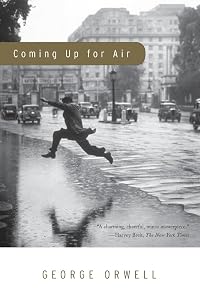
Coming Up for Air
by George Orwell 
On This Page
Description
Classic Literature. Fiction. HTML:From the book:The idea really came to me the day I got my new false teeth. I remember the morning well. At about a quarter to eight I’d nipped out of bed and got into the bathroom just in time to shut the kids out. It was a beastly January morning, with a dirty yellowish-grey sky. Down below, out of the little square of bathroom window, I could see the ten yards by five of grass, with a privet hedge round it and a bare patch in the middle, that we call show more the back garden. There’s the same back garden, some privets, and same grass, behind every house in Ellesmere Road. Only difference—where there are no kids there’s no bare patch in the middle. I was trying to shave with a bluntish razor-blade while the water ran into the bath. My face looked back at me out of the mirror, and underneath, in a tumbler of water on the little shelf over the washbasin, the teeth that belonged in the face. It was the temporary set that Warner, my dentist, had given me to wear while the new ones were being made. I haven’t such a bad face, really. It’s one of those bricky-red faces that go with butter-coloured hair and pale-blue eyes. I’ve never gone grey or bald, thank God, and when I’ve got my teeth in I probably don’t look my age, which is forty-five. show less
Tags
Recommendations





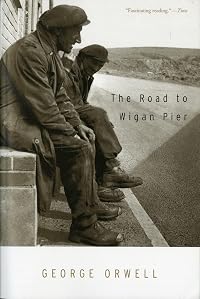
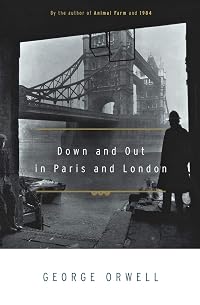




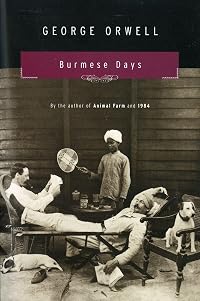
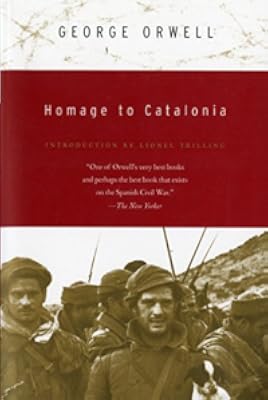



















Member Recommendations


Member Reviews
"… you could see the roofs of the houses stretching on and on, the little red roofs where the bombs are going to drop…" (pg. 19)
George Orwell's novel Coming Up for Air, published a few months before war broke out in 1939, is less a walk than a ramble down memory lane. Largely plotless, it follows a fretting middle-aged insurance salesman who fears the future and looks back on his past with a disjointed nostalgia. He has good reason for both – a catastrophic war is indeed coming, and the Old England of his youth is indeed being "sawn off at the roots" (pg. 166) – but Orwell's approach fails to excite the temper.
There are two significant features to the novel which account for its cloudiness. Firstly, the protagonist, George show more Bowling, is a dull, unremarkable man, and Orwell makes a glaring mistake in telling the story in the first-person. Orwell's authorial clarity and erudition strains against the decision to have the staid and confused middle-brow Bowling speak to the reader directly. Bowling bores us, and his pre-eminence over Orwell's own voice means that the insights into the coming war and the fading England lack the emphatic literary stamp they need.
The only way such unremarkable characters can ever engage a reader is when remarkable things happen to them. This doesn't happen in the plotless Coming Up for Air, which leads one to the second feature accounting for the novel's cloudy direction: it's just all too routine. The book outlines George's benign lower-middle-class life, musing all the way with its repressed commentary on career and family, war and politics, youth and the countryside. It ends, predictably, with George returning to his hometown, which he has idealised in memory, and finding it's all been paved over and developed: the town of his youth is gone, and now the memory of it is also tainted.
Coming Up for Air is never wrong, only unfocused. Orwell wrote the novel while recuperating from illness and, without meaning to sound too fanciful, some of that feverishness can be sensed by the reader. Orwell has a thesis we can all accept: the war will change things, and what will go are things that cannot be retrieved, and that the magic of our youth is something that was both real and also a dream. But the story never really makes a strong point, never really dissects the feelings of nostalgia. It never manages to make a drama out of its dual sense of wistfulness and impending doom, which besides was something that had already been done with great success by James Hilton a few years earlier, in Lost Horizon and Goodbye Mr Chips.
The closest Orwell gets to his own literary moment here is when he has Bowling recognise that what he fears is not the war itself – he's too old to be called up to fight – but "the after-war. The world we're going down into, the kind of hate-world, slogan-world" (pg. 157). These moments aren't seized upon by Orwell here, but they will be – in Orwell's hauntingly precise and emphatic post-war works Animal Farm and Nineteen-Eighty Four. Of course, Orwell in March 1939 wasn't to know that this was what he was trying to reach for in the haze of his present writing, but we do, and can forgive it easily. But their whispers here in this pre-war novel only show that Coming Up for Air lacks the acuity that is so much a hallmark of Orwell in his more well-known writing. show less
George Orwell's novel Coming Up for Air, published a few months before war broke out in 1939, is less a walk than a ramble down memory lane. Largely plotless, it follows a fretting middle-aged insurance salesman who fears the future and looks back on his past with a disjointed nostalgia. He has good reason for both – a catastrophic war is indeed coming, and the Old England of his youth is indeed being "sawn off at the roots" (pg. 166) – but Orwell's approach fails to excite the temper.
There are two significant features to the novel which account for its cloudiness. Firstly, the protagonist, George show more Bowling, is a dull, unremarkable man, and Orwell makes a glaring mistake in telling the story in the first-person. Orwell's authorial clarity and erudition strains against the decision to have the staid and confused middle-brow Bowling speak to the reader directly. Bowling bores us, and his pre-eminence over Orwell's own voice means that the insights into the coming war and the fading England lack the emphatic literary stamp they need.
The only way such unremarkable characters can ever engage a reader is when remarkable things happen to them. This doesn't happen in the plotless Coming Up for Air, which leads one to the second feature accounting for the novel's cloudy direction: it's just all too routine. The book outlines George's benign lower-middle-class life, musing all the way with its repressed commentary on career and family, war and politics, youth and the countryside. It ends, predictably, with George returning to his hometown, which he has idealised in memory, and finding it's all been paved over and developed: the town of his youth is gone, and now the memory of it is also tainted.
Coming Up for Air is never wrong, only unfocused. Orwell wrote the novel while recuperating from illness and, without meaning to sound too fanciful, some of that feverishness can be sensed by the reader. Orwell has a thesis we can all accept: the war will change things, and what will go are things that cannot be retrieved, and that the magic of our youth is something that was both real and also a dream. But the story never really makes a strong point, never really dissects the feelings of nostalgia. It never manages to make a drama out of its dual sense of wistfulness and impending doom, which besides was something that had already been done with great success by James Hilton a few years earlier, in Lost Horizon and Goodbye Mr Chips.
The closest Orwell gets to his own literary moment here is when he has Bowling recognise that what he fears is not the war itself – he's too old to be called up to fight – but "the after-war. The world we're going down into, the kind of hate-world, slogan-world" (pg. 157). These moments aren't seized upon by Orwell here, but they will be – in Orwell's hauntingly precise and emphatic post-war works Animal Farm and Nineteen-Eighty Four. Of course, Orwell in March 1939 wasn't to know that this was what he was trying to reach for in the haze of his present writing, but we do, and can forgive it easily. But their whispers here in this pre-war novel only show that Coming Up for Air lacks the acuity that is so much a hallmark of Orwell in his more well-known writing. show less
An absolutely wonderful evocative novel, full of witty and poignant observations about lower middle class life between the wars, the fear of war (this was published in 1939), the securities and horrors of cosy family life and the power of nostalgia and the "golden age" myth of one's youth. Orwell's fear of war is that of the triumph of totalitarianism in Britain, and his descriptions of what he fears this will be like clearly presage his descriptions of Aistrip One in 1984. Despite this horror, there are many laugh out loud moments. This should be better known and more widely read than it is.
“THE IDEA REALLY came to me the day I got my false teeth.”
With that short opening paragraph I knew Coming Up for Air was going to be a good read - and I wasn’t disappointed. This is a very funny book and George ‘Fatty’ Bowling is a likeable what-you-see-is-what-you get character with no illusions about himself, no affectations at all and, on the face of it, comfortable in his body - even if there are “several parts” of it he “can’t reach”.
I was going to say that this is a ‘good book’ to read, but George said that “... a ‘good’ book was a book one didn’t have any intention of reading.” He is a sensitive fellow in many ways and I don’t want to upset him by contradiction, so I will leave it as a book show more ‘well worth the time taken to read’. show less
With that short opening paragraph I knew Coming Up for Air was going to be a good read - and I wasn’t disappointed. This is a very funny book and George ‘Fatty’ Bowling is a likeable what-you-see-is-what-you get character with no illusions about himself, no affectations at all and, on the face of it, comfortable in his body - even if there are “several parts” of it he “can’t reach”.
I was going to say that this is a ‘good book’ to read, but George said that “... a ‘good’ book was a book one didn’t have any intention of reading.” He is a sensitive fellow in many ways and I don’t want to upset him by contradiction, so I will leave it as a book show more ‘well worth the time taken to read’. show less
This is my second read of this wonderful 1938 novel, possibly my favourite Orwell novel (along with the very different and later 1984), and indeed one of my favourite novels of all time. George Bowling is a lower middle class middle aged man with a nagging and remorselessly downbeat wife and two annoying children, and the novel is essentially his search, ultimately fruitless, to recapture the simplicity and happiness of his youth in a small town before the Great War. He recognises life was far from perfect then, with his parents' generation facing the potential threat of the workhouse if their shop went out of business, but he is searching for the elusive inner happiness and peace that I guess many of us search for all our lives and may show more sometimes find: "what was it that people had in those days? A feeling of security, even when they weren’t secure. More exactly, it was a feeling of continuity. All of them knew they’d got to die, and I suppose a few of them knew they were going to go bankrupt, but what they didn’t know was that the order of things could change. Whatever might happen to themselves, things would go on as they'd known them."
Taking advantage of a win of as much as £17 in a bet, he takes off in his car with his new found riches to enjoy a week on his own to stay in a hotel and enjoy good food and drink and look up the town where he grew up. He searches, but he finds it unrecognisable - swallowed up in a larger urban area where his family and way of life are forgotten. He doesn't rail against this, it is more of a bittersweet resignation to the inevitability of change. Mixed with these emotions is his fear of the impending war with Hitler's Germany changing the whole nature of existence: "The very idea of sitting all day under a willow tree beside a quiet pool — and being able to find a quiet pool to sit beside — belongs to the time before the war, before the radio, before aeroplanes, before Hitler". There is a really striking and often quite bleak and stifling atmosphere of the impending war and the totalitarian future that George believes will be that war's inevitable follow up, reflecting Orwell's fear of the twin totalitarian extremes of fascism and communism. One can almost see George Bowling transmuting into 1984's Winston Smith. He says: "I’ve enough sense to see that the old life we’re used to is being sawn off at the roots. I can feel it happening. I can see the war that’s coming and I can see the after-war, the food-queues and the secret police and the loudspeakers telling you what to think". This description may make this sound like a bleak novel but it is anything but - it is a humorous and bittersweet story, and is truly wonderful, especially if you're a middle aged man yourself! show less
Taking advantage of a win of as much as £17 in a bet, he takes off in his car with his new found riches to enjoy a week on his own to stay in a hotel and enjoy good food and drink and look up the town where he grew up. He searches, but he finds it unrecognisable - swallowed up in a larger urban area where his family and way of life are forgotten. He doesn't rail against this, it is more of a bittersweet resignation to the inevitability of change. Mixed with these emotions is his fear of the impending war with Hitler's Germany changing the whole nature of existence: "The very idea of sitting all day under a willow tree beside a quiet pool — and being able to find a quiet pool to sit beside — belongs to the time before the war, before the radio, before aeroplanes, before Hitler". There is a really striking and often quite bleak and stifling atmosphere of the impending war and the totalitarian future that George believes will be that war's inevitable follow up, reflecting Orwell's fear of the twin totalitarian extremes of fascism and communism. One can almost see George Bowling transmuting into 1984's Winston Smith. He says: "I’ve enough sense to see that the old life we’re used to is being sawn off at the roots. I can feel it happening. I can see the war that’s coming and I can see the after-war, the food-queues and the secret police and the loudspeakers telling you what to think". This description may make this sound like a bleak novel but it is anything but - it is a humorous and bittersweet story, and is truly wonderful, especially if you're a middle aged man yourself! show less
Orwell drops the simpering sensibilities and experimental narration of the earlier novels, developing here the vigorous delivery of plain words and thoughts so effective in his later essays and in 'Animal Farm' and '1984'. A suburban clerk everyman looks back nostalgically to an already distant Edwardian golden age, and too to the timeless pleasures of boyhood; but also prefigures the war and upheaval that's round the corner (the book came out in 1939). A memorable portrayal, and a snapshot of the bullish spirit of the English, as well as their chippiness, the latent fear and tension within the bland calm and continuity of the age (that reliable and comforting social order still familiar in the satirical world of Profesor Branestawm's show more stories, which I note were written in this period too). show less
Coming Up for Air is the internal monologue of unhappily married insurance salesman George Bowling, forty-five, fat, and equipped with new false teeth. It is perhaps less a novel and more a fictionalised essay. Bowling is not an entirely convincing character because he keeps reminding you of George Orwell. Or, if you prefer, he is entirely convincing because he is so obviously not a character at all - just Eric Blair hiding in plain sight. A thin man pretending to be a fat man. An Old Etonian pretending to be a grammar school boy. In addition to his first name Bowling shares many of Orwell’s tastes and opinions: his hatred of the chromium-plated modern world, with such horrors as tinned food and the radio always blaring, and his show more unsentimental love of nature. He also shares Orwell’s artfully achieved plain-speaking prose style familiar from the essays. Bowling is from the shopkeeping class but has married into a family of British Empire administrators remarkably like Orwell’s own. He frequently exhibits such a detached sociological overview of his own circumstances (suburbia is ‘a prison with the cells all in a row’) that you are left wondering why he became an insurance salesman in the first place: he clearly should have been a social and political essayist.
Orwell wrote the book in Morocco in 1938-1939. He was suffering from tuberculosis and also recuperating from his injuries in the Spanish Civil War. Although never mentioned, his horrifying experiences in Spain in 1937 seem to lie behind it. Being shot through the throat by a facist bullet while fighting fascists is one thing, but fleeing for your life from what was supposed to be your own side is something else entirely. This is Orwell brooding on recent events, looking fretfully towards the future, and seeking reassurance and continuity in his Oxfordshire childhood. It is far from coincidental that it is also a homage of sorts to Kipps and The History of Mr Polly, as H. G. Wells was one of his favourite writers as a child.
The shadow of war in Europe hangs heavily over Coming Up for Air. Bowling knows war is on its way and, having fought in the Great War, is against it, as Orwell himself was at the time. He is frightened by the coming conflict and a world that sounds very much like 1984-:
‘The bombs, the food-queues, the rubber truncheons, the barbed wire, the coloured shirts, the slogans, the enormous faces, the machine-guns squirting out of bedroom windows. It’s all going to happen. I know it - or at any rate, I knew it then. There’s no escape.’
Bowling, however, does find a means of escape: into the past. His recollections of his Edwardian childhood in the (fictional) Oxfordshire village of Lower Binfield, before the horrors of a war which changed everything forever, form the heart of the novel. It’s evocative and aromatic stuff: Penny Monsters, Paradise Mixture, fizzy lemonade, sugar mice and sugar pigs, dusty roads, endless summer days and still summer evenings, hooting owls and nightjars and cockchafers, the stone floor of his mother’s kitchen and the blackleaded range, chestnut trees and country lanes, the smell of fennel, white peppermint, ground coffee, pipe-tobacco, and the rubbish dump. And fishing, lots of fishing. But Bowling doesn’t evade the brutalities of childhood, a great deal of his communing with nature involved killing wildlife. Eventually he decides to make a return trip to Lower Binfield for old times sake. When he gets there he finds the present has caught up with it. It has been urbanised, distended, and made ugly with housing estates. The house he was brought up in has been turned into a particularly tacky tea shop. And no one recognises him. Not even his childhood sweetheart, herself now so ground down by life that she is almost unrecognisable.
Coming Up for Air has sometimes been described as simply an exercise in nostalgia. It’s certainly much more than that. As usual Orwell’s straightforward prose style masks a complex and slippery set of ideas. I used to think it was a warning about how nostalgia blinds one to the dangers of the present; rereading it I wasn’t so sure. It might be about how nostalgia can help one deal with the present. What is striking is that running through Bowling’s reminiscences is a vein of ambivalence so deep that it amounts to what Orwell, in 1984, would call doublethink: the ability to simultaneously accept two contradictory ideas as true. He alternates between acknowledging that his rose-tinted view of his childhood is a ‘delusion’ and insisting on its truth. But then memory can be both factually false and emotionally true. For Bowling, and surely for Orwell also, nostalgia for his childhood is a sort of lifeline or private mythology, a way of preserving an image of the world that represents values that are important to him, values he feels have been lost in modern society, and which enable him to retain his humanity and sanity in an increasingly inhuman and insane world. Despite his disastrous holiday in Lower Binfield one feels that his affectionate attachment to his past as a way of understanding the present will survive.
In his 1940 essay Inside the Whale, which begins as an appreciation of Henry Miller before turning into an analysis of English literature since World War 1, Orwell argued that good novels were now more likely to be written from a ‘passive’ or ‘quietist’ perspective rather than an overtly political one-:
‘Progress and reaction have both turned out to be swindles. Seemingly there is nothing left but quietism - robbing reality of its terrors by simply submitting to it….Give yourself over to the world-process, stop fighting against it or pretending that you control it; simply accept it, endure it, record it. That seems to be the formula that any sensitive novelist is now likely to adopt’.
Coming Up for Air is very much that kind of novel. Bowling, even if he does feel more like a projection of certain aspects of Orwell’s thought and experience than an actual character, is emphatically inside the whale; a man on the sidelines of history. He recognises that he is powerless to change the course of events and doesn’t really have any great desire to do so. He thinks that, whatever happens, life will always continue pretty much unaltered for ordinary unpolitical lower-middling chaps like himself.
The vision of life presented in this book is ultimately bleak: politics is reduced to two rival yet interchangeable groups of hate-filled gangsters, marriage is a trap, the present is a struggle, and the future is a nightmare. It is also highly readable, consistently interesting, sometimes intoxicatingly lyrical, and shot through with sardonic humour. In many ways it is a key Orwell text, peppered with themes also found in the essays, and transfigured scenes from his childhood, as well as prefiguring the dystopian worlds of Animal Farm and 1984. show less
Orwell wrote the book in Morocco in 1938-1939. He was suffering from tuberculosis and also recuperating from his injuries in the Spanish Civil War. Although never mentioned, his horrifying experiences in Spain in 1937 seem to lie behind it. Being shot through the throat by a facist bullet while fighting fascists is one thing, but fleeing for your life from what was supposed to be your own side is something else entirely. This is Orwell brooding on recent events, looking fretfully towards the future, and seeking reassurance and continuity in his Oxfordshire childhood. It is far from coincidental that it is also a homage of sorts to Kipps and The History of Mr Polly, as H. G. Wells was one of his favourite writers as a child.
The shadow of war in Europe hangs heavily over Coming Up for Air. Bowling knows war is on its way and, having fought in the Great War, is against it, as Orwell himself was at the time. He is frightened by the coming conflict and a world that sounds very much like 1984-:
‘The bombs, the food-queues, the rubber truncheons, the barbed wire, the coloured shirts, the slogans, the enormous faces, the machine-guns squirting out of bedroom windows. It’s all going to happen. I know it - or at any rate, I knew it then. There’s no escape.’
Bowling, however, does find a means of escape: into the past. His recollections of his Edwardian childhood in the (fictional) Oxfordshire village of Lower Binfield, before the horrors of a war which changed everything forever, form the heart of the novel. It’s evocative and aromatic stuff: Penny Monsters, Paradise Mixture, fizzy lemonade, sugar mice and sugar pigs, dusty roads, endless summer days and still summer evenings, hooting owls and nightjars and cockchafers, the stone floor of his mother’s kitchen and the blackleaded range, chestnut trees and country lanes, the smell of fennel, white peppermint, ground coffee, pipe-tobacco, and the rubbish dump. And fishing, lots of fishing. But Bowling doesn’t evade the brutalities of childhood, a great deal of his communing with nature involved killing wildlife. Eventually he decides to make a return trip to Lower Binfield for old times sake. When he gets there he finds the present has caught up with it. It has been urbanised, distended, and made ugly with housing estates. The house he was brought up in has been turned into a particularly tacky tea shop. And no one recognises him. Not even his childhood sweetheart, herself now so ground down by life that she is almost unrecognisable.
Coming Up for Air has sometimes been described as simply an exercise in nostalgia. It’s certainly much more than that. As usual Orwell’s straightforward prose style masks a complex and slippery set of ideas. I used to think it was a warning about how nostalgia blinds one to the dangers of the present; rereading it I wasn’t so sure. It might be about how nostalgia can help one deal with the present. What is striking is that running through Bowling’s reminiscences is a vein of ambivalence so deep that it amounts to what Orwell, in 1984, would call doublethink: the ability to simultaneously accept two contradictory ideas as true. He alternates between acknowledging that his rose-tinted view of his childhood is a ‘delusion’ and insisting on its truth. But then memory can be both factually false and emotionally true. For Bowling, and surely for Orwell also, nostalgia for his childhood is a sort of lifeline or private mythology, a way of preserving an image of the world that represents values that are important to him, values he feels have been lost in modern society, and which enable him to retain his humanity and sanity in an increasingly inhuman and insane world. Despite his disastrous holiday in Lower Binfield one feels that his affectionate attachment to his past as a way of understanding the present will survive.
In his 1940 essay Inside the Whale, which begins as an appreciation of Henry Miller before turning into an analysis of English literature since World War 1, Orwell argued that good novels were now more likely to be written from a ‘passive’ or ‘quietist’ perspective rather than an overtly political one-:
‘Progress and reaction have both turned out to be swindles. Seemingly there is nothing left but quietism - robbing reality of its terrors by simply submitting to it….Give yourself over to the world-process, stop fighting against it or pretending that you control it; simply accept it, endure it, record it. That seems to be the formula that any sensitive novelist is now likely to adopt’.
Coming Up for Air is very much that kind of novel. Bowling, even if he does feel more like a projection of certain aspects of Orwell’s thought and experience than an actual character, is emphatically inside the whale; a man on the sidelines of history. He recognises that he is powerless to change the course of events and doesn’t really have any great desire to do so. He thinks that, whatever happens, life will always continue pretty much unaltered for ordinary unpolitical lower-middling chaps like himself.
The vision of life presented in this book is ultimately bleak: politics is reduced to two rival yet interchangeable groups of hate-filled gangsters, marriage is a trap, the present is a struggle, and the future is a nightmare. It is also highly readable, consistently interesting, sometimes intoxicatingly lyrical, and shot through with sardonic humour. In many ways it is a key Orwell text, peppered with themes also found in the essays, and transfigured scenes from his childhood, as well as prefiguring the dystopian worlds of Animal Farm and 1984. show less
This is one of Orwell's comic novels, but with a serious undertone. It's 1938, and there are hints that England may soon be at war again. "Fatty" Bowling is a middle-aged suburban insurance salesman. He feels oppressed by his wife--"She's one of those people who get their main lack in life out of forseeing disasters. Only petty disasters of course." Disasters such as the price of butter going up, the gas bill being enormous, the kids needing new shoes. His children are monsters: "The truth is that kids aren't in any way poetic, they're merely savage little animals, except an animal is a quarter as selfish." His life is stultifying, and his street "a prison with all the cells in a row. A line of semi-detached torture-chambers."
When Fatty show more has to get false teeth--a landmark: "When your last natural tooth goes, the time when you can kid yourself that you're a Hollywood sheik is definitely at an end. And I was fat as well."--he decides to stop and run away for a week--to come up for air--to reflect on his life. He returns to his childhood village in an attempt to recapture his idyllic pre-WWI youth. Of course he finds the village irrevocably changed, and the impending war with Germany intrusive. There are even hints of 1984 here:
"The world we're going down into, the kind of hate-world, slogan-world. The coloured shirts, the barbed wire, the rubber truncheons. The secret cells where the electric light burns night and day, and the detectives watching you while you sleep. and the processions and the posters with enormous faces, and the crowds of a million people all cheering the leader till they deafen themselves into thinking that they really worship him..."
We all know that you can't go home again--can't recapture the Edenic past. So while there is plenty of humor in this book, it is ultimately a downer, and even Fatty recognizes this:
"I'm finished with this notion of getting back into the past. What's the good of trying to revisit the scenes of your boyhood? They don't exist! Coming up for air! But there isn't any air. The dust bin that we're in reaches up to the atmosphere." show less
When Fatty show more has to get false teeth--a landmark: "When your last natural tooth goes, the time when you can kid yourself that you're a Hollywood sheik is definitely at an end. And I was fat as well."--he decides to stop and run away for a week--to come up for air--to reflect on his life. He returns to his childhood village in an attempt to recapture his idyllic pre-WWI youth. Of course he finds the village irrevocably changed, and the impending war with Germany intrusive. There are even hints of 1984 here:
"The world we're going down into, the kind of hate-world, slogan-world. The coloured shirts, the barbed wire, the rubber truncheons. The secret cells where the electric light burns night and day, and the detectives watching you while you sleep. and the processions and the posters with enormous faces, and the crowds of a million people all cheering the leader till they deafen themselves into thinking that they really worship him..."
We all know that you can't go home again--can't recapture the Edenic past. So while there is plenty of humor in this book, it is ultimately a downer, and even Fatty recognizes this:
"I'm finished with this notion of getting back into the past. What's the good of trying to revisit the scenes of your boyhood? They don't exist! Coming up for air! But there isn't any air. The dust bin that we're in reaches up to the atmosphere." show less
Members
- Recently Added By
Lists

1001 Books You Must Read Before You Die
1,448 works; 1,134 members

20th Century Literature
1,161 works; 55 members

1930s
262 works; 5 members

Books Read in 2022
5,218 works; 114 members

Literary Works Read in College
316 works; 15 members

Books We Love to Reread
688 works; 296 members
Reading LIst
648 works; 1 member
Author Information

394+ Works 221,595 Members
George Orwell was born Eric Arthur Blair on June 25, 1903 in Motihari in Bengal, India and later studied at Eton College for four years. He was an assistant superintendent with the Indian Imperial Police in Burma. He left that position after five years and moved to Paris, where he wrote his first two books: Burmese Days and Down and Out in Paris show more and London. He then moved to Spain to write but decided to join the United Workers Marxist Party Militia. After being decidedly opposed to communism, he served in the British Home Guard and with the Indian Service of the BBC during World War II. After the war, he wrote for the Observer and was literary editor for the Tribune. His best known works are Animal Farm and 1984. His other works include A Clergyman's Daughter, Keep the Aspidistra Flying, The Road to Wigan Pier, Homage to Catalonia, and Coming Up for Air. He died on January 21, 1950 at the age of 46. (Bowker Author Biography) show less
George Orwell has a Legacy Library. Legacy libraries are the personal libraries of famous readers, entered by LibraryThing members from the Legacy Libraries group.
Some Editions
Awards and Honors
Series
Belongs to Publisher Series
Work Relationships
Common Knowledge
- Canonical title
- Coming Up for Air
- Original title
- Coming up for Air
- Alternate titles*
- Happend naar lucht : roman
- Original publication date
- 1939
- People/Characters
- George Bowling; Hilda Bowling; Joe Bowling; Uncle Ezekiel; Old Porteous; Elsie
- Important places
- Lower Binfield, England, UK; London, England, UK
- Epigraph
- He's dead, but he won't lie down
- Popular Song - First words
- The idea really came to me the day I got my new false teeth.
- Last words
- (Click to show. Warning: May contain spoilers.)But damn it! I knew which it would have to be.
- Original language
- English
*Some information comes from Common Knowledge in other languages. Click "Edit" for more information.
Classifications
Statistics
- Members
- 2,518
- Popularity
- 7,641
- Reviews
- 50
- Rating
- (3.74)
- Languages
- 18 — Catalan, Chinese, Czech, Danish, Dutch, English, Finnish, French, German, Greek, Hungarian, Italian, Polish, Russian, Spanish, Swedish, Turkish, Portuguese (Portugal)
- Media
- Paper, Audiobook, Ebook
- ISBNs
- 99
- ASINs
- 42