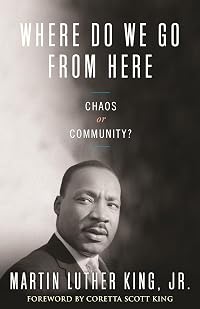
Where Do We Go from Here: Chaos or Community? (King Legacy)
by Martin Luther King, Jr.
On This Page
Description
The last book written by King his final reflections after a decade of civil rights strugglesIn 1967, Dr. Martin Luther King, Jr., isolated himself from the demands of the civil rights movement, rented a house in Jamaica with no telephone, and labored over his final manuscript. In this significantly prophetic work, which has been unavailable for more than ten years, we find King’s acute analysis of American race relations and the state of the movement after a decade of civil rights show more efforts. Here he lays out his thoughts, plans, and dreams for America’s future, including the need for better jobs, higher wages, decent housing, and quality education. With a universal message of hope that continues to resonate, King demanded an end to global suffering, powerfully asserting that humankind—for the first time—has the resources and technology to eradicate poverty.
A King Legacy Series Book. show less
Tags
Recommendations






Member Reviews
King wrote this decades ago and yet it’s shockingly relevant today. The most disturbing part of the whole book is that it feels like not much has changed. His thoughts on peaceful demonstrations in the phrase “black power” are interesting. The calls to action, especially calling out white people, are convicting and crucial right now.
“In the days ahead we must not consider it unpatriotic to raise certain basic questions about our national character.”
“Whites, it must frankly be said, are not putting in a similar mass effort to reeducate themselves out of their racial ignorance. It is an aspect of their sense of superiority that the white people of America believe they have so little to learn.”
“Social justice and progress show more are the absolute guarantors of riot prevention. There is no other answer. Constructive social change will bring certain tranquillity; evasions will merely encourage turmoil. Negroes hold only one key to the double lock of peaceful change. The other is in the hands of the white community.” show less
“In the days ahead we must not consider it unpatriotic to raise certain basic questions about our national character.”
“Whites, it must frankly be said, are not putting in a similar mass effort to reeducate themselves out of their racial ignorance. It is an aspect of their sense of superiority that the white people of America believe they have so little to learn.”
“Social justice and progress show more are the absolute guarantors of riot prevention. There is no other answer. Constructive social change will bring certain tranquillity; evasions will merely encourage turmoil. Negroes hold only one key to the double lock of peaceful change. The other is in the hands of the white community.” show less
By the end of the 1960s, you would have think that non-violent actions truly had been successful when it comes to the fate of African-Americans and their civil rights. Racial segregation was ended in most buses across the South, Freedom Rides had expanded such desegregation for journeys across States, coffee shops and restaurants were subjected to the same process, the Civil Right Act had been signed, Jim Crow laws were officially abolished, the Voting Right Act had been implemented, so-called 'breadbaskets operations' were in full swing... And yet...
And yet, Blacks, by the 1970s, were still mostly living in ghettos, their unemployment rate was as high as their infant mortality rate (twice that of White people), those working were show more still earning twice less than their White counterparts, and performed surveys about the racial question were everything but hopeful: 88% of White people reported not wanting their children to be in a relationship with a Black person, 80% that they would feel uncomfortable should a friend or relative be in one, and 50% admitted to not wanting Blacks as neighbours. The conclusion to be drawn was very bleak indeed: equality in rights had not brought about equality in facts. Was it any wonder that the civil right movement itself was then entering into a crisis phase?
The crisis was so deep, that it would personally affect MLK himself, as his message centred around non-violence was becoming seriously challenged. What was he to do with racial and urban riots such as Watts (1965) or, the new slogan 'Black Power', hiding a growing resent and hatred towards Whites over a coherent and workable political approach? Violence had fed violence, and the cycle seemed then to be about to lead the whole country down a path to hell -again.
Reflecting upon it all, MLK's book makes, here, for a sad read, especially when it comes to his bitterness in seeing his message being betrayed by a new generation of leaders. Yet, beyond his contained rancour (or so I felt), lies a clever and relevant analysis. What's to blame, for him, is certainly not pacifism and non-violent deeds -far from that! What's to blame is poverty. And it worked both ways.
His diagnosis, here, was rather simple, and yet quite correct. For as long as Blacks will be ostracised into ghettos, treated like second class citizens, fed an inadequate education, having but very poor access to decent public services, let alone work opportunities, then they will be pushed into, from crime to resent towards Whites, a cycle that will keep feeding White racism towards them. On the other hand, for as long as poor Whites, too, will be made resentful of Black by wrongly perceiving them as competitors when it comes to political attention, education, jobs, and housing, then they, too, will be pushed into racist populisms feeding hatred, while not solving anyone's problem. But then again: cui bono? Again, the pastor faces a sad, bitter truth; that of a government back then far more concerned about a war in Vietnam than addressing its problems at home.
I truly liked this book, which, I think, might be his best. This is not only about defending non-violent action and warning against hatred and violence feeding nothing but hatred and violence; it is, above all, about a brilliant analysis which is still valid today: poverty is a terrible scourge, and refusing to address it can only feeds a whole set of other societal diseases, those consequences can be far reaching indeed. Once again, then, MLK's message will never get old. show less
And yet, Blacks, by the 1970s, were still mostly living in ghettos, their unemployment rate was as high as their infant mortality rate (twice that of White people), those working were show more still earning twice less than their White counterparts, and performed surveys about the racial question were everything but hopeful: 88% of White people reported not wanting their children to be in a relationship with a Black person, 80% that they would feel uncomfortable should a friend or relative be in one, and 50% admitted to not wanting Blacks as neighbours. The conclusion to be drawn was very bleak indeed: equality in rights had not brought about equality in facts. Was it any wonder that the civil right movement itself was then entering into a crisis phase?
The crisis was so deep, that it would personally affect MLK himself, as his message centred around non-violence was becoming seriously challenged. What was he to do with racial and urban riots such as Watts (1965) or, the new slogan 'Black Power', hiding a growing resent and hatred towards Whites over a coherent and workable political approach? Violence had fed violence, and the cycle seemed then to be about to lead the whole country down a path to hell -again.
Reflecting upon it all, MLK's book makes, here, for a sad read, especially when it comes to his bitterness in seeing his message being betrayed by a new generation of leaders. Yet, beyond his contained rancour (or so I felt), lies a clever and relevant analysis. What's to blame, for him, is certainly not pacifism and non-violent deeds -far from that! What's to blame is poverty. And it worked both ways.
His diagnosis, here, was rather simple, and yet quite correct. For as long as Blacks will be ostracised into ghettos, treated like second class citizens, fed an inadequate education, having but very poor access to decent public services, let alone work opportunities, then they will be pushed into, from crime to resent towards Whites, a cycle that will keep feeding White racism towards them. On the other hand, for as long as poor Whites, too, will be made resentful of Black by wrongly perceiving them as competitors when it comes to political attention, education, jobs, and housing, then they, too, will be pushed into racist populisms feeding hatred, while not solving anyone's problem. But then again: cui bono? Again, the pastor faces a sad, bitter truth; that of a government back then far more concerned about a war in Vietnam than addressing its problems at home.
I truly liked this book, which, I think, might be his best. This is not only about defending non-violent action and warning against hatred and violence feeding nothing but hatred and violence; it is, above all, about a brilliant analysis which is still valid today: poverty is a terrible scourge, and refusing to address it can only feeds a whole set of other societal diseases, those consequences can be far reaching indeed. Once again, then, MLK's message will never get old. show less
"This is a book about power -- specifically the power of a nonviolent army of determined Negroes who, with a smaller band of committed whites, have concluded that equality is not given but is taken, and that nothing but relentless pressure will ever achieve full citizenship for America's Negroes.
"'Power, properly understood, is the ability to achieve purpose,' writes Dr. King in an eloquent chapter on the Black Power Movement. 'It is the strength required to bring about social, political, or economic changes. In this sense power is not only desirable but necessary in order to implement the demands of love and justice.'" - from book jacket
"'Power, properly understood, is the ability to achieve purpose,' writes Dr. King in an eloquent chapter on the Black Power Movement. 'It is the strength required to bring about social, political, or economic changes. In this sense power is not only desirable but necessary in order to implement the demands of love and justice.'" - from book jacket
Hard to know what to think. The first book I’ve read by King, but of course as an American I’ve absorbed a lot of his work through my life. A lot in the book seemed obvious now but surely was much more striking at the time. As I was reading I often felt like I heard his voice. I was interested in his discussions about dealing with racism directly as opposed to dealing with multiracial poverty.
You get the impression learning about MLK he was ahead of his time. This book makes you realize just how many light years ahead he was. A true, infinitely compassion visionary.
I am once again in awe of how relevant the work of Dr. King is. The words in this book could easily be addressing political and social issues today. In this work he definitely moves his thinking to include education, poverty issues, employment and more. He also addresses the money spent on the military. It's definitely a broader and more edgy book and I appreciated that.
Read for class.
I am astonished, perhaps amazed by Dr. King's thoughts. His transcendent non-violent morality, as well as his world-weary readiness for martyrdom are both apparent here. This was written after the momentous Civil Rights victory, and his efforts shifted from organizational and de facto instead of de jure racism. In short, the problems which still plague most of the black community today. If only he was alive a little bit longer. Much has been done to solve these problems in America, but there is still much to be done. Invaluable.
I am astonished, perhaps amazed by Dr. King's thoughts. His transcendent non-violent morality, as well as his world-weary readiness for martyrdom are both apparent here. This was written after the momentous Civil Rights victory, and his efforts shifted from organizational and de facto instead of de jure racism. In short, the problems which still plague most of the black community today. If only he was alive a little bit longer. Much has been done to solve these problems in America, but there is still much to be done. Invaluable.
Members
- Recently Added By
Lists

Black Authors
381 works; 29 members

1960s
281 works; 16 members

Books Read in 2020
4,379 works; 124 members
Author Information

158+ Works 13,319 Members
Martin Luther King, Jr. was born on January 15, 1929 into a middle-class black family in Atlanta, Georgia. He received a degree from Morehouse College. While there his early concerns for social justice for African Americans were deepened by reading Henry David Thoreau's essay "Civil Disobedience." He enrolled in Crozer Theological Seminary and show more there became acquainted with the Social Gospel movement and the works of its chief spokesman, Walter Rauschenbusch. Mohandas Gandhi's practice of nonviolent resistance (ahimsaahimsa) later became a tactic for transforming love into social change. After seminary, he postponed his ministry vocation by first earning a doctorate at Boston University School of Theology. There he discovered the works of Reinhold Niebuhr and was especially struck by Niebuhr's insistence that the powerless must somehow gain power if they are to achieve what is theirs by right. In the Montgomery bus boycott, it was by economic clout that African Americans broke down the walls separating the races, for without African American riders, the city's transportation system nearly collapsed. The bus boycott took place in 1954, the year King and his bride, Coretta Scott, went to Montgomery, where he had been called to serve as pastor of the Dexter Avenue Baptist Church. Following the boycott, he founded the Southern Christian Leadership Conference (SCLC) to coordinate civil rights organizations. Working through African American churches, activists led demonstrations all over the South and drew attention, through television and newspaper reports, to the fact that nonviolent demonstrations by blacks were being suppressed violently by white police and state troopers. The federal government was finally forced to intervene and pass legislation protecting the right of African Americans to vote and desegregating public accommodations. For his nonviolent activism, King received the Nobel Peace Prize in 1964. While organizing a "poor people's campaign" to persuade Congress to take action against poverty, King accepted an invitation to visit Memphis, Tennessee, where sanitation workers were on strike. There, on April 4, 1968, he was gunned down while standing on the balcony of his hotel. (Bowker Author Biography) show less
All Editions
Series
Belongs to Publisher Series
Common Knowledge
- Original publication date
- 1967-04
- People/Characters
- Henry Aaron; John Emerich Edward Dalberg-Acton; Herbert Baxter Adams; John Quincy Adams; AFL-CIO; Alfred the Great (show all 161); Muhammad Ali; American Historical Association; Marian Anderson; Ellis Arnall; Arthur Ashe; Crispus Attucks; James Baldwin; Fulgencio Batista; Charles A. Beard; Harry Belafonte; Ruth Benedict; Hyman Bookbinder; James Brown; Henrietta Buckmaster; Ole Bull; Ralph J. Arnold; Edmund Burke; John Calhoun; Roy Campanella; Al Capone; Stokely Carmichael; George Washington Carver; Fidel Castro; Wilt Chamberlain; Ray Charles; Chicago Urban League; Marcus Tullius Cicero; Jim Clark; Kenneth Clark; Richard L. Cloward; James Coleman; James B. Conant; Bull Connor; Earl Conrad; Countee Cullen; Dante Alighieri; Ossie Davis; Sammy Davis, Jr.; Deacons for Defense; Frederick Douglass; Charles Drew; W.E.B. DuBois; Paul Laurence Dunbar; Thomas A. Edison; Adolf Eichmann; Albert Einstein; Duke Ellington; Ralph Ellison; Frantz Fanon; Walter Fauntroy; Richmond Flowers; Harry Emerson Fosdick; Benjamin Franklin; E. Franklin Frazier; Edward A. Freeman; John Kenneth Galbraith; Mahatma Gandhi; William Lloyd Garrison; Marcus Garvey; Henry George; George III, King of the United Kingdom; Althea Gibson; Arthur de Gobineau; Barry Goldwater; Horace Greeley; Fanny Lou Hamer; Roland Hayes; Patrick Henry; Adolf Hitler; Langston Hughes; Victor Hugo; Washington Irving; Jimmy Lee Jackson; Mahalia Jackson; Thomas Jefferson; Jesus Christ; John Birch Society; Jack Johnson; James Weldon Johnson; Lyndon Baines Johnson; Immanuel Kant; George Kelsey; John F. Kennedy; John Killens; Ku Klux Klan; James Lawson; Herbert Lehman; Oscar Lewis; Abraham Lincoln; John Locke; Henry Wadsworth Longfellow; Joe Lewis; Lester Maddox; Cotton Mather; Donald R. Matthews; Jan Matzeliger; Willie Mays; Claude McKay; Floyd McKissick; James Meredith; S. M. Miller; Bishop Moore; Samuel G. Morton; Gunnar Myrdal; Don Newcombe; Reinhold Niebuhr; Friedrich Nietzsche; Josiah C. Nott; Barack Obama; Orpheus; Jesse Owens; Thomas Paine; Arthur Pearl; Thomas Pettigrew; Plato; Sidney Poitier; Adam Clayton Powell; Leontyne Price; James W. Prothro; A. Philip Randolph; James Reeb; Walter Reuther; Willie Ricks; Frank Riessman; Morbert Rilleux; Frank Robinson; Jackie Robinson; Eleanor Roosevelt; Bill Russell; Bayard Rustin; Cleveland Sellers; Jean Sibelius; Kenneth Stampp; Adlai Stevenson; Bishop William Stubbs; Charles Sumner; Henry David Thoreau; Paul Tillich; Leo Tolstoy; Arturo Toscanini; Arnold Toynbee; Nat Turner; Rip Turner; Denmark Vesey; George G. Wallace; Earl Warren; Booker T. Washington; George Washington; Alfred North Whitehead; Daniel Hale Williams; W. Willard Wirtz; Granville T. Woods; Richard Wright; Andrew Young; Buddy Young
- Important places
- Selma, Alabama, USA; Angola; Atlanta, Georgia, USA; Birmingham, Alabama, USA; Chicago, Illinois, USA; Cicero, Illinois, USA (show all 28); Columbia University, New York, New York, USA; Cornell University, Ithaca, New York, USA; Dominican Republic; Englewood, Chicago, Illinois, USA; Ghana; Greenwood, Mississippi, USA; Harvard University, Cambridge, Massachusetts, USA; Johns Hopkins University; Lawndale, Chicago, Illinois, USA; Lowndes County, Alabama, USA; Montgomery, Alabama, USA; Nigeria; Red China; South Africa; Southern Rhodesia; Soviet Union; Statue of Liberty, New York, USA; Tanganyika; Vietnam; University of Wisconsin; Yazoo City, Mississippi, USA; Zambia
- Important events
- Albany Movement (1962); Back to Africa Movement; Civil Rights Act of 1964; Civil Rights Bill (1868); Civil Rights Movement, USA; American Civil War (show all 22); Dred Scott Decision; Emancipation Proclamation; Fifteenth Amendment; Freedom Budget; Freedom March; Freedom Rides; Great Society; March on Washington; Battle of Marengo; New York School Boycott; Operation Breadbasket; Operation Headstart; Southern Freedom Movement; Voting Rights Act; Wagner Act; Watts Riots
- Dedication
- To the committed supporters of the civil rights movement, Negro and white, whose steadfastness amid confusions and setbacks gives assurance that brotherhood will be the condition of man, not the dream of man
- First words
- On August 6, 1965, the President's Room of the Capitol could scarcely hold the multitude of white and Negro leaders crowding it.
- Last words
- (Click to show. Warning: May contain spoilers.)We still have a choice today: nonviolent coexistence or violent coannihilation. This may well be mankind's last chance to choose between chaos and community.
Classifications
- Genres
- Nonfiction, Politics and Government, General Nonfiction, History, Religion & Spirituality
- DDC/MDS
- 323.1196 — Society, government, & culture Political science Civil Rights & Liberties/ Human Rights Minority Politics Specific Groups Biography And History African Origin
- LCC
- E185.615 .K5 — History of the United States United States
- BISAC
Statistics
- Members
- 855
- Popularity
- 31,824
- Reviews
- 14
- Rating
- (4.43)
- Languages
- 5 — Dutch, English, Finnish, German, Swedish
- Media
- Paper, Audiobook, Ebook
- ISBNs
- 15
- ASINs
- 10