On This Page
Description
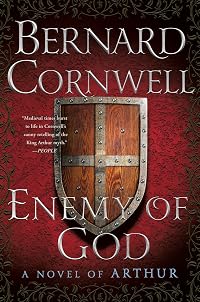
At the end of The Winter King Arthur fought the battle that forces unity on the warring British kingdoms and now he sets out to face the real enemy - the English (it is one of the great ironies of the Arthur stories that he should have become an English hero when, if he existed at all, he was a great war-leader who opposed the invading Sais). First, though, Merlin leads a perilous expedition into the mysterious west to retrieve a cauldron, one of the treasures of Britain - this cauldron show more story is almost certainly the root of the holy grail strand in the Arthur tales. The treasures of Britain, Merlin believes, will bring the old Gods onto the side of the British in their struggle against the Saxons (and the Christians, whom Merlin hates). But the treasures will also set Briton against Briton - especially as Guinevere, now Arthur's wife, wants to make a magic of her own. 'Chaos was now thick across Britain, for someone had spilt the Cauldron's power and its horror threatened to engulf us all.'. show lessTags
Recommendations



Member Reviews
Cornwell truly has a gift for spinning an epic yarn rooted in history, legend, and just enough magic to make it all seem plausible. Well constructed characters and gut-wrenching detail puts you in the thick of battle one moment and a starlit interlude the next. Both rousingly heroic and sadly tragic, he adds to the Arthurian mythos while staying mostly true to historic facts, his "Camelot" a far cry from the fairytale idyll of medieval literature. And on a more contemporary note, this story of two opposing forces---one a romantic idealist blinded to the darker side of humanity, the other a lying narcissist hiding behind the sheen of Christianity---should certainly strike a chord with modern readers.
This is the second book in The Warlord Chronicles trilogy based upon the legend of King Arthur. It picks up where the first book (The Winter King) left off. The main character (and narrator) is Derfel Cadarn, a former Saxon slave who is now one of Arthur’s warriors and friends. He is narrating his story to his patron, looking back on his youth and the older days of Arthur.
It is more historical fiction than fantasy, as it presents a plausible world without the usual magical elements (or at least with rational explanations for what is viewed as magic). It is replete with Christianity versus paganism and leadership power struggles. In this installment, Merlin convinces Derfel to accompany him on a quest for a valuable cauldron, which show more mirrors the search for the holy grail. Cornwell’s version upends the usual depiction of Lancelot, and here he is more of a villain than a hero.
Women play a critical role and are far from damsels in distress. Here we have several strong women (Nimue, Guinevere, Ceinwyn) who feel frustrated by expectations of subservience, and are able to exert influence in unusual ways. Tristan and Iseult make an appearance, as does Mordred. Cornwell excels at storytelling. We have action, adventure, love stories, friendship, betrayal, scheming, and various rulers trying to achieve their own ends. Cornwell does not spare descriptions of the brutality of the time, especially in the battle scenes. It is a satisfying blend of fact, fiction, and fable. show less
It is more historical fiction than fantasy, as it presents a plausible world without the usual magical elements (or at least with rational explanations for what is viewed as magic). It is replete with Christianity versus paganism and leadership power struggles. In this installment, Merlin convinces Derfel to accompany him on a quest for a valuable cauldron, which show more mirrors the search for the holy grail. Cornwell’s version upends the usual depiction of Lancelot, and here he is more of a villain than a hero.
Women play a critical role and are far from damsels in distress. Here we have several strong women (Nimue, Guinevere, Ceinwyn) who feel frustrated by expectations of subservience, and are able to exert influence in unusual ways. Tristan and Iseult make an appearance, as does Mordred. Cornwell excels at storytelling. We have action, adventure, love stories, friendship, betrayal, scheming, and various rulers trying to achieve their own ends. Cornwell does not spare descriptions of the brutality of the time, especially in the battle scenes. It is a satisfying blend of fact, fiction, and fable. show less
I liked this book better than book 1 in the trilogy. I understood the pacing a little better and how the author is trying to set the stage for Arthur becoming the reluctant king. This isn't a happy retelling of the legend. Its definitely going for a more realistic take on who these people would be, what their lives would actually be like, and what their true motivations would be. I love how Cornwell turns a lot of the legend on its head. The Knights of the Round Table didn't exist under that name. Camelot wasn't a real thing until the bards made it so. Etc, etc. Dervel is a very likeable protagonist. I appreciate that the author didn't make Arthur the lead. It's more interesting to see him through the eyes of a person near him. Also show more fascinating is the portrayal of religion during this time. Paganism is on the decline, and the Christians are becoming more and more fanatic. As a pragmatic man who doesn't have much use for religion, Arthur is almost destroyed for not taking Christianity seriously enough. Nimue, Merlin's apprentice, continues to be a fascinating character. I don't really care for Morgan in this series however. Ceinwyn and Guinyvere and both interesting and complicated characters who are allowed to have depth as much as the men, but they suffer more for it. Overall, I'm looking forward to the final book in the series. show less
The other twist I loved was the new way of unfolding the Guinevere and Lancelot love story - tying it into Guinevere's secret cult of Isis. While creative, I found it a bit sad to see Lancelot portrayed so negatively.
Overall, a wonderfully grounded historical fiction approach to the Arthurian legend. I'm already looking
Enemy of God suffers, ever so slightly, from "second book syndrome". Clearly the second part of a planned three book trilogy, it definitely takes some time to get going. An improvement in some ways on the first book, with more developed characters and plots and schemes finally coming together, it nonetheless didn't grab me immediately.
It starts very slow - and by starts I mean the first half of the book really plods along - so slowly that it's taken my quite a while to finish. But somewhere between the halfway and the two-thirds mark things really start coming together and it ends in an incredibly satisfying, brilliant crescendo of action that makes the earlier build-up all worth it. The chickens come home to roost, Arthur is made show more darker, grittier, more than the paragon he was in the first novel. This version of Arthur is what everyone means when they describe this series as the "darkest, most 'realistic'" version of the tale ever told.
Cornwell has masterfully set us up for the end of the trilogy, the way forward is clear and I'm immediately starting the final novel. Knowing how the popular version of Arthur's tale ends has given me a broad idea of where this version will go, and I'm excited to see how Cornwell gets there. I just wish this book didn't take quite so long to get there. show less
It starts very slow - and by starts I mean the first half of the book really plods along - so slowly that it's taken my quite a while to finish. But somewhere between the halfway and the two-thirds mark things really start coming together and it ends in an incredibly satisfying, brilliant crescendo of action that makes the earlier build-up all worth it. The chickens come home to roost, Arthur is made show more darker, grittier, more than the paragon he was in the first novel. This version of Arthur is what everyone means when they describe this series as the "darkest, most 'realistic'" version of the tale ever told.
Cornwell has masterfully set us up for the end of the trilogy, the way forward is clear and I'm immediately starting the final novel. Knowing how the popular version of Arthur's tale ends has given me a broad idea of where this version will go, and I'm excited to see how Cornwell gets there. I just wish this book didn't take quite so long to get there. show less
The second in Cornwell's Arthurian Warlord Chronicles is a brilliant follow up to the first. There is no "middle book syndrome" here as Derfel continues to tell the story of Arthur and his aim to create a peaceful kingdom and to drive the Saxons from its shores. Merlin is trying to collect the lost Thirteen Treasures of Britain, along with Nimue; the Christians are expecting the Second Coming and Arthur's hopes for a brotherhood of warriors faces difficulties from within.
This is good story telling, great characters (though maybe not quite how they have been portrayed in other tellings of the Arthurian legend) and a dirty gritty recounting of how life might have been in the Fifth Century. As Cornwell says in his authors note Not that I show more can pretend that the Warlord trilogy is in any way an accurate history of those years; it is not even an attempt at such a history, merely another variation on a fantastic and complicated saga that has come to us from a barbaric age, yet it still enthralls us because it is so replete with heroism, romance and tragedy.
I was enthralled and look forward to reading the concluding book of this trilogy. show less
This is good story telling, great characters (though maybe not quite how they have been portrayed in other tellings of the Arthurian legend) and a dirty gritty recounting of how life might have been in the Fifth Century. As Cornwell says in his authors note Not that I show more can pretend that the Warlord trilogy is in any way an accurate history of those years; it is not even an attempt at such a history, merely another variation on a fantastic and complicated saga that has come to us from a barbaric age, yet it still enthralls us because it is so replete with heroism, romance and tragedy.
I was enthralled and look forward to reading the concluding book of this trilogy. show less
Wow, this book along with the first one (The Winter King) is so well written. Bernard Cornwell really took the Arthurian legend and removed all of the fairytale bluster and put it in the setting of 5th BC Britian to historical context.
Written through the eyes of his trusted warrior Derfel, this book carries on from where the first ended after the battle of Lugg Vale where Arthur brings peace to the land of Dumnonia. I never thought I'd hate Lancelot as from the fairytale's he's written as a paragon, but here is a dastardly schemer. I can't wait to read book 3 Excalibur.
Written through the eyes of his trusted warrior Derfel, this book carries on from where the first ended after the battle of Lugg Vale where Arthur brings peace to the land of Dumnonia. I never thought I'd hate Lancelot as from the fairytale's he's written as a paragon, but here is a dastardly schemer. I can't wait to read book 3 Excalibur.
Members
- Recently Added By
Lists

Historical Fiction
889 works; 91 members

Best Arthurian Fiction
104 works; 33 members
Modern Arthurian Fiction
237 works; 16 members
Author Information

172+ Works 93,823 Members
Bernard Cornwell was born in London, England, on February 23, 1944, and came to the United States in 1980. He received a B.A. from the University of London in 1967. Cornwell served as producer of the British Broadcasting Corporation from 1969-1976. After this he was head of current affairs for BBC-TV in Belfast, Northern Ireland. In 1979 he became show more editor of television news for Thames Television of London. Since 1980 he has been a freelance writer. he lives with his wife on Cape Cod. Cornwell's Sharpe series, adventure stories about a British soldier set in the Peninsula War of 1808-1814, are built on the author's interest in the Duke of Wellington's army. Titles include Sharpe's Rifles, Sharpe's Revenge, Sharpe's Siege, Sharpe's Regiment, and Sharpe's Waterloo. The Last Kingdom series has ten books. Book ten, The Flame Bearer is on the bestsellers list. He has also written other works including Wildtrack, Killer's Wake, Sea Lord, Stormchild, Rebel, Copperhead, and Battle Flag. His title Death of Kings made The New York Times Best Seller List in 2012 and In 2014 his title The Pagan Lord made the list again. (Bowker Author Biography) show less
Series

Belongs to Publisher Series
rororo (24625)
Work Relationships
Is contained in
Has as a student's study guide
Common Knowledge
- Canonical title
- Enemy of God
- Original title
- The Enemy of God
- Original publication date
- 1998-03-15
- People/Characters
- Ade; Aelle; Agrícola; Ailleann; Amhar; Artur (show all 77); Balin; Ban; Bedwin; Bors; Brochvael; Byrthig; Cadoc; Cadwy; Callyn; Cavan; Cei; Ceinwyn; Cerdic; Culhwch; Cuneglas; Cythryn; Derfel Cadarn; Dian; Dinas; Diwrnach; Eachern; Elaine; Emyrs; Erce; Galahad; Gorfyddyd; Guinevere; Gundleus; Gwenhwyvach; Gwlyddyn; Gwydre; Helledd; Hygwydd; Igraine; Iorweth; Isolda; Issa; Lancelot; Lanval; Lavaine; Leodegan; Ligessac; Loholt; Lunete; Maelgwyn; Malaine; Malla; Mark; Melwas; Merlin; Meurig; Mordred; Morfans; Morgana; Morwenna; Nabur; Nimue; Norwenna; Oengus Mac Airem; Peredur; Pyrlig; Ralla; Sagramor; Sansum; Scarach; Seren; Tanaburs; Tewdric; Tristan; Tudwal; Uther Pendragon
- Important places
- Benoic
- Dedication
- Enemy For God is for Susan Watt, its onlie begetter
- First words
- Today I have been thinking about the dead.
- Last words
- (Click to show. Warning: May contain spoilers.)But for us, who had kept our oaths, it was what we had always wanted, for now, in all but name, Arthur was King.
- Original language*
- Englisch
*Some information comes from Common Knowledge in other languages. Click "Edit" for more information.
Classifications
Statistics
- Members
- 2,696
- Popularity
- 6,889
- Reviews
- 55
- Rating
- (4.14)
- Languages
- 11 — Danish, Dutch, English, French, German, Greek, Hungarian, Polish, Spanish, Turkish, Portuguese (Brazil)
- Media
- Paper, Audiobook, Ebook
- ISBNs
- 57
- UPCs
- 1
- ASINs
- 19