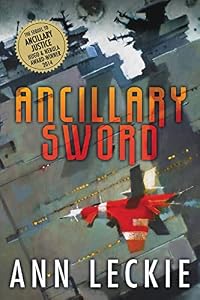
On This Page
Description
What if you once had thousands of bodies and near god-like technology at your disposal? And what if all of it were ripped away? The Lord of the Radch has given Breq command of the ship Mercy of Kalr and sent her to the only place she would have agreed to go -- to Athoek Station, where Lieutenant Awn's sister works in Horticulture. Athoek was annexed some six hundred years ago, and by now everyone is fully civilized -- or should be. But everything is not as tranquil as it appears. Old show more divisions are still troublesome, Athoek Station's AI is unhappy with the situation, and it looks like the alien Presger might have taken an interest in what's going on. With no guarantees that interest is benevolent. show lessTags
Recommendations





























Member Recommendations


rakerman Although it might seem unusual to link a science fiction book to historical fiction, the Radch empire as presented in Ancillary Sword has many echoes of Ancient Rome, whether small things like bathhouses or major elements like clients and slavery. These themes are also ably dealt with in Robert Harris' Imperium, about Cicero establishing his position and fighting imperial injustice.
12
Member Reviews
Note: There will necessarily be spoilers for Book One in this series, but none for this book.
This is Book Two of a series which began with Ancillary Justice, a book that won just about every big award for science fiction and fantasy in 2013, including the Hugo Award, the Nebula Award, the BSFA Award (presented by the British Science Fiction Association), the Arthur C. Clarke Award, and the Locus Award. There is a lot of love for this series.
In this universe far into the future, there are a number of beings who are massive entities with hive-minds that reside in multiple bodies at once. This is true of the Lord of the Radch Empire, a being who goes by the name of Anaander Mianaai. It was also once true of Breq, who used to be an show more “ancillary” or segment of the Justice of Toren, a massive starship. The Justice of Toren was destroyed by Anaander Mianaai, with only Breq escaping. Because Breq occupies just one body now, Breq can pass for human.
[I should note, as I did in the review of Book One, that in this future galaxy, gender is maybe a matter of choice, or maybe of convenience; it’s unclear. We don’t know what gender anyone is, but everyone is universally designated as “she” except in the case of children, who are noted to be “sisters” or “brothers.”]
In Book One, we learned that the Lord of the Radch is at war with “herself” over the destruction of an entire solar system some thousand years previously. The Lord has now divided into two factions, one good and one evil. It is of course pretty difficult to figure out which is which, and to support either one is treason, as far as the other is concerned. This puts citizens of the Radch in a very difficult position. Occasionally it is possible to infer which is which from the relative justice of the act being ordered by the Lord. When Breq was still part of the Justice of Toren, Anaander Mianaai ordered Breq to shoot her beloved superior, Lieutenant Awn, in the head. Awn had discovered the split in Anaander Mianaai, and refused to obey the orders of the faction she concluded was evil. Breq had no choice; Awn would die in any event, and she thought she would die as well. Indeed, the Lord destroyed the Justice of Toren; it was an accident that Breq escaped. Breq loved Awn, and never recovered from what she had to do.
In Ancillary Sword, Breq has been sent by the Lord of the Radch to Athoek Station as Captain of the starship Mercy of Kalr. This assignment dovetails with Breq’s own needs, because she wants to find the sister of the late Lieutenant Awn, and offer her support. But the sister, Basnaaid, will have nothing to do with Breq. While at the station, however, there is plenty to keep Breq busy: she gets involved with the station’s management and with the vicious undercurrent of race and class conflict that officially doesn’t exist.
Breq, no doubt because of her own past as a former ancillary, is outraged at the way the underclass is treated by those who think they are better; it is slavery de facto if not de jure. In particular, workers from other planetary systems are used as the elite wishes to use them, including being denied sufficient food and education, and being taken advantage of for sexual and labor exploitation. Once again, the notion of “justice” becomes a critical point for Breq. The political philosophy of the Radch is summed up by the slogan: "Justice, propriety, and benefit."
"No just act could be improper, no proper act unjust. Justice and propriety, so intertwined, themselves led to benefit. The question of just who or what benefited was a topic for late-night discussions over half empty bottles of arrack, but ordinarily no Radchaai questioned that justice and propriety would ultimately be beneficial in some gods-approved way."
But that has always been the problem of course, over all of time, and over the expanse of the known universe. Who gets to decide what is just? And now that the Lord of the Radch can't even agree, the question is more salient than ever.
Discussion: I appreciated the first book for its distinctive innovativeness, but I struggled with all of the “alien concepts.” In this book, the “heavy lifting” of the world building has already been done, and the author can just get on with the story; it is much, much easier to read.
Also, in the first book, Seivarden - a sad case who was rescued and rehabilitated by Breq, here comes into her own as Breq’s most trusted lieutenant. She is not featured as much in the story, but when she is, her character evolution is clear, as is the fact that she thinks of Breq much as Breq once thought of Lieutenant Awn. It's a nice symmetry.
Two digressionary notes:
1. There is a very funny moment in this book when Breq reflects on the “oddness” of the name of a visitor from another place. The person’s name is “Dlique.” Everyone stumbles over this name, which is a riot considering their names are, for example, Anaander, Raughd, Daos, Skaaiat, and so on.
2. In thinking about the hive-mind/multi-bodied nature of the ruler, it strikes me as a brilliant way to solve the problem of administering a vast empire; i.e., if one is able actually to be everywhere at once! This was always a problem in the past, with the Persians, Ottomans, Holy Roman Empire, etc. In our current political systems, we are quick to blame our leaders for not being omniscient, but it really isn’t possible. On Radch, however, the problem is solved!
Evaluation: This is a middle book - definitely not a standalone, but I found that, unlike many middle books, it is a better read than the first book. This is, however, only because I didn’t have to struggle with all the "out-of-the-box" concepts in this one. I know that readers either love these books beyond all reason, or find them “alienating.” I am closer to the former camp than the latter. show less
This is Book Two of a series which began with Ancillary Justice, a book that won just about every big award for science fiction and fantasy in 2013, including the Hugo Award, the Nebula Award, the BSFA Award (presented by the British Science Fiction Association), the Arthur C. Clarke Award, and the Locus Award. There is a lot of love for this series.
In this universe far into the future, there are a number of beings who are massive entities with hive-minds that reside in multiple bodies at once. This is true of the Lord of the Radch Empire, a being who goes by the name of Anaander Mianaai. It was also once true of Breq, who used to be an show more “ancillary” or segment of the Justice of Toren, a massive starship. The Justice of Toren was destroyed by Anaander Mianaai, with only Breq escaping. Because Breq occupies just one body now, Breq can pass for human.
[I should note, as I did in the review of Book One, that in this future galaxy, gender is maybe a matter of choice, or maybe of convenience; it’s unclear. We don’t know what gender anyone is, but everyone is universally designated as “she” except in the case of children, who are noted to be “sisters” or “brothers.”]
In Book One, we learned that the Lord of the Radch is at war with “herself” over the destruction of an entire solar system some thousand years previously. The Lord has now divided into two factions, one good and one evil. It is of course pretty difficult to figure out which is which, and to support either one is treason, as far as the other is concerned. This puts citizens of the Radch in a very difficult position. Occasionally it is possible to infer which is which from the relative justice of the act being ordered by the Lord. When Breq was still part of the Justice of Toren, Anaander Mianaai ordered Breq to shoot her beloved superior, Lieutenant Awn, in the head. Awn had discovered the split in Anaander Mianaai, and refused to obey the orders of the faction she concluded was evil. Breq had no choice; Awn would die in any event, and she thought she would die as well. Indeed, the Lord destroyed the Justice of Toren; it was an accident that Breq escaped. Breq loved Awn, and never recovered from what she had to do.
In Ancillary Sword, Breq has been sent by the Lord of the Radch to Athoek Station as Captain of the starship Mercy of Kalr. This assignment dovetails with Breq’s own needs, because she wants to find the sister of the late Lieutenant Awn, and offer her support. But the sister, Basnaaid, will have nothing to do with Breq. While at the station, however, there is plenty to keep Breq busy: she gets involved with the station’s management and with the vicious undercurrent of race and class conflict that officially doesn’t exist.
Breq, no doubt because of her own past as a former ancillary, is outraged at the way the underclass is treated by those who think they are better; it is slavery de facto if not de jure. In particular, workers from other planetary systems are used as the elite wishes to use them, including being denied sufficient food and education, and being taken advantage of for sexual and labor exploitation. Once again, the notion of “justice” becomes a critical point for Breq. The political philosophy of the Radch is summed up by the slogan: "Justice, propriety, and benefit."
"No just act could be improper, no proper act unjust. Justice and propriety, so intertwined, themselves led to benefit. The question of just who or what benefited was a topic for late-night discussions over half empty bottles of arrack, but ordinarily no Radchaai questioned that justice and propriety would ultimately be beneficial in some gods-approved way."
But that has always been the problem of course, over all of time, and over the expanse of the known universe. Who gets to decide what is just? And now that the Lord of the Radch can't even agree, the question is more salient than ever.
Discussion: I appreciated the first book for its distinctive innovativeness, but I struggled with all of the “alien concepts.” In this book, the “heavy lifting” of the world building has already been done, and the author can just get on with the story; it is much, much easier to read.
Also, in the first book, Seivarden - a sad case who was rescued and rehabilitated by Breq, here comes into her own as Breq’s most trusted lieutenant. She is not featured as much in the story, but when she is, her character evolution is clear, as is the fact that she thinks of Breq much as Breq once thought of Lieutenant Awn. It's a nice symmetry.
Two digressionary notes:
1. There is a very funny moment in this book when Breq reflects on the “oddness” of the name of a visitor from another place. The person’s name is “Dlique.” Everyone stumbles over this name, which is a riot considering their names are, for example, Anaander, Raughd, Daos, Skaaiat, and so on.
2. In thinking about the hive-mind/multi-bodied nature of the ruler, it strikes me as a brilliant way to solve the problem of administering a vast empire; i.e., if one is able actually to be everywhere at once! This was always a problem in the past, with the Persians, Ottomans, Holy Roman Empire, etc. In our current political systems, we are quick to blame our leaders for not being omniscient, but it really isn’t possible. On Radch, however, the problem is solved!
Evaluation: This is a middle book - definitely not a standalone, but I found that, unlike many middle books, it is a better read than the first book. This is, however, only because I didn’t have to struggle with all the "out-of-the-box" concepts in this one. I know that readers either love these books beyond all reason, or find them “alienating.” I am closer to the former camp than the latter. show less
Looking back at my review of Ancillary Justice, it seemed that while I liked the book, it and I didn’t actually hit it off as well as I’d hoped. Mind you, I’m most definitely in the minority there. And despite not falling in love with the novel, I did appreciate its many merits and was pleased to see it win many awards and garner so much praise – all seriously well-deserved. In fact, I was so impressed with the concepts in the book and the sheer innovation that went into it, I knew that I would read the sequel if Ann Leckie were to continue with Breq’s story.
And lo and behold, we have Ancillary Sword, the second installment of the Imperial Radch series which picks up from the end of book one.
However, it is also very different show more novel. But hey, “different” can be good! “Different” changes things up. And “different” keeps things fresh. It’s tough to follow up a book like Ancillary Justice which took the SFF scene by storm, and Leckie definitely took a few risks here by greatly streamlining the story as well as departing from the first book’s distinctive style.
Did it pay off? I feel a bit torn on this, personally. On the one hand, the biggest challenge I had with the first book was the style of narration. Breq was formerly one of thousands of corpse soldiers all linked up as part of a massive starship, and the resulting “omniscient effect” was not only confusing but also a source of distraction. Now that she is a single mind in a single body, I found the story in this book so much easier to follow. Add to that, we’re no longer shifting back and forth in time, and there’s a lot less information to digest. On the whole, I would say simplifying the narrative and making it more linear worked wonders for me. It addressed a couple of the major issues I had with the first book, and I didn’t feel as overwhelmed.
However, the changes also affected the scope of the story, whittling what seemed to be a massive space-opera-in-the-making down to more modest proportions. Ancillary Sword almost reads like a character study, offering a more intimate and personal look into the mind of Breq. While the character development is superb, the pacing suffered. Compared to the first book, this one is far slower, and there’s almost no action at all. Furthermore, I’m not sure it contributed all that much to the overall story arc; this felt a lot like a “middle book”, a nice little detour to get a chance to better acquaint ourselves with the main protagonist.
I’m fine with the slower, tamer direction of Ancillary Sword. What I’m not so keen on though, was the lack of a sense of purpose. I wasn’t sure what I expected from the sequel, but it certainly wasn’t this. After all that effort and time working up to the jaw-dropping conclusion in the first book, I wanted the momentum to continue, and I wanted to see what the next big thing was for Breq. Most of all I wanted to see where Ann Leckie is taking this series, and unfortunately, I’m still none the wiser.
I wanted to like this book more than its predecessor, but in the end I think the pros balanced out the cons and I ended up liking it just the same. To sum up, I loved how much easier this book was to read and how it put me more in my comfort zone, and I appreciated the deeper look into Breq’s life and thought processes now that she is separated from the hive mind. On the downside, the story didn’t hold my attention too well, and certain parts dragged.
That said, Ann Leckie is a talented author with a way with words, and what I wouldn’t give to see what other creative ideas she has up her sleeve. If these books are any indication, the next Imperial Radch novel will be just as deep-seated and cerebral. I hope the third book will strike more of a balance for me, but as the author is clearly not averse to changing things up, I’m curious to see what it’ll bring regardless. show less
And lo and behold, we have Ancillary Sword, the second installment of the Imperial Radch series which picks up from the end of book one.
However, it is also very different show more novel. But hey, “different” can be good! “Different” changes things up. And “different” keeps things fresh. It’s tough to follow up a book like Ancillary Justice which took the SFF scene by storm, and Leckie definitely took a few risks here by greatly streamlining the story as well as departing from the first book’s distinctive style.
Did it pay off? I feel a bit torn on this, personally. On the one hand, the biggest challenge I had with the first book was the style of narration. Breq was formerly one of thousands of corpse soldiers all linked up as part of a massive starship, and the resulting “omniscient effect” was not only confusing but also a source of distraction. Now that she is a single mind in a single body, I found the story in this book so much easier to follow. Add to that, we’re no longer shifting back and forth in time, and there’s a lot less information to digest. On the whole, I would say simplifying the narrative and making it more linear worked wonders for me. It addressed a couple of the major issues I had with the first book, and I didn’t feel as overwhelmed.
However, the changes also affected the scope of the story, whittling what seemed to be a massive space-opera-in-the-making down to more modest proportions. Ancillary Sword almost reads like a character study, offering a more intimate and personal look into the mind of Breq. While the character development is superb, the pacing suffered. Compared to the first book, this one is far slower, and there’s almost no action at all. Furthermore, I’m not sure it contributed all that much to the overall story arc; this felt a lot like a “middle book”, a nice little detour to get a chance to better acquaint ourselves with the main protagonist.
I’m fine with the slower, tamer direction of Ancillary Sword. What I’m not so keen on though, was the lack of a sense of purpose. I wasn’t sure what I expected from the sequel, but it certainly wasn’t this. After all that effort and time working up to the jaw-dropping conclusion in the first book, I wanted the momentum to continue, and I wanted to see what the next big thing was for Breq. Most of all I wanted to see where Ann Leckie is taking this series, and unfortunately, I’m still none the wiser.
I wanted to like this book more than its predecessor, but in the end I think the pros balanced out the cons and I ended up liking it just the same. To sum up, I loved how much easier this book was to read and how it put me more in my comfort zone, and I appreciated the deeper look into Breq’s life and thought processes now that she is separated from the hive mind. On the downside, the story didn’t hold my attention too well, and certain parts dragged.
That said, Ann Leckie is a talented author with a way with words, and what I wouldn’t give to see what other creative ideas she has up her sleeve. If these books are any indication, the next Imperial Radch novel will be just as deep-seated and cerebral. I hope the third book will strike more of a balance for me, but as the author is clearly not averse to changing things up, I’m curious to see what it’ll bring regardless. show less
Sequels are always tricky, balancing what made the first book good while doing something different. Ancillary Sword is a much more generously paced book that Ancillary Justice, a diversion of force before the greater struggle we all know is coming. Torren/Breq is dispatched to distant Athoek Station to hold it for Anaander Mianaai, and finds herself trying to fix the troubles of an unhappy world.
The first part of the story, focusing on the new Lt. Tisarwat, and the lengths to which Anaander will go is quite interesting, if mostly prelude. However the middle sags and drags, as Breq investigates abandoned areas of the station, labor exploitation, racism, and abusive relationships. The Raach is an appropriately exotic and alien society, show more and one actually feels feudal as opposed to a veil of monarchy pasted over 21st century American sensibilities, but you don't need to sell the idea that a feudal empire ruled by a 3000 year old distributed intelligence with schizophrenia might be unjust, even if it nominally provides food, clothing, and shelter for all citizens. The plus side is that the conclusion is explosively tense and fulfilling, it just takes too long to get there.
Ancillary Justice was a race, every plot point building to the climatic attack on the palace, where this book wanders and pauses to enjoy the ornamental gardens. But I'd say that the biggest weakness is actually the psychology of our narrator. Torren/Breq is not human, and the first book did a great job showing how strange and traumatic it is to be the sole remaining part of a Ship in the universe. Here, she is camouflaged by her position as Fleet Captain and assumed House Name, people mostly treat her like she's human and she acts like one. There's a lot of anger and tight control, but only a few scenes that authentically reveal how strange our narrator is.
And I know that the Ancillary series is somewhat of a deconstruction of milSF, with it's David Weber style wanking over acceleration curves, beam coherence, and megaton missile salvos, but at some point there's going to be a war, and all this stuff matters. I wish that Leckie would sit down with a war nerd and figure out the tactical and operational limitations of her ships, because it'll make the posturing for planetary influence matter. show less
The first part of the story, focusing on the new Lt. Tisarwat, and the lengths to which Anaander will go is quite interesting, if mostly prelude. However the middle sags and drags, as Breq investigates abandoned areas of the station, labor exploitation, racism, and abusive relationships. The Raach is an appropriately exotic and alien society, show more and one actually feels feudal as opposed to a veil of monarchy pasted over 21st century American sensibilities, but you don't need to sell the idea that a feudal empire ruled by a 3000 year old distributed intelligence with schizophrenia might be unjust, even if it nominally provides food, clothing, and shelter for all citizens. The plus side is that the conclusion is explosively tense and fulfilling, it just takes too long to get there.
Ancillary Justice was a race, every plot point building to the climatic attack on the palace, where this book wanders and pauses to enjoy the ornamental gardens. But I'd say that the biggest weakness is actually the psychology of our narrator. Torren/Breq is not human, and the first book did a great job showing how strange and traumatic it is to be the sole remaining part of a Ship in the universe. Here, she is camouflaged by her position as Fleet Captain and assumed House Name, people mostly treat her like she's human and she acts like one. There's a lot of anger and tight control, but only a few scenes that authentically reveal how strange our narrator is.
And I know that the Ancillary series is somewhat of a deconstruction of milSF, with it's David Weber style wanking over acceleration curves, beam coherence, and megaton missile salvos, but at some point there's going to be a war, and all this stuff matters. I wish that Leckie would sit down with a war nerd and figure out the tactical and operational limitations of her ships, because it'll make the posturing for planetary influence matter. show less
In a move perhaps unsurprising to no one, I continue to swim against public current on Leckie’s Ancillary series. I had been warned that the pace of the second book was oh-so-very-slow and contained gallons of tea. Be warned that everything from here on out is spoilery in one form or another. There is simply no way I’m going to remember either what went on or my reactions.
The tea part was true; the pacing, not as much. I actually I found it to have more internal tension than the first book, which was almost non-existent in the parallel timeline. However, here Breq ends up involved in a series of puzzles that kept me intrigued. In the first one, the ship is preparing to gate to Athoek Station. Breq is very tightly wound, tense and show more angry with the crew, and neither they nor the reader has any idea why. The problem and solution, when it becomes apparent, is both clever, evil and harsh. It also gives the reader more insight into the process of making ancillaries and the utter callousness towards human life.
Once arriving through the Gate, they are faced with the puzzle of an ancillary Sword running from them toward a permanent Ghost Gate, though they hailed as friends. That resolved, somewhat, Breq is confronted at the Station with the puzzle of the Underground, an unsanctioned habitation that was previously damaged and left unrepaired. Captain Hetnys, of the Sword that had run away, is parochial and suspicious of alien infiltratrators, and the Station Administrator is hardly any better. When the alien translator is killed because of a malicious prank by the sociopathic Raughd, daughter of an influential citizen, Breq is forced to go into a ritual morning in hopes that the alien Presger will not take action against the Station.
This then, is where it goes off the rails. The next puzzle is the socio-economic culture of the planet, and the tea plantation–formerly a temple–where Breq is residing. It ends up largely being an exploration of sharecropping, and contains large paragraphs of didactic text detailing the ethnic and economic injustices. Perhaps as part of the trip here, Breq discovers two final puzzles: the particularly fine and ancient tea set that Captain Hetys supposedly procured, and that of a peculiar ethnic population distribution. Once Breq returns to the Station, she sends her own Ship and Seivarden on an investigation run.
Because of all these small puzzles, I was drawn along and had a hard time putting the book down. However, when we reached the tea plantation section, I found myself particularly disappointed with the turn of the writing. Though some of the social issues had been simplistic up to that point, the plantation seemed to drag on, being more concerned with ‘slice of life’,’ perhaps reader education, and a discussion on ‘justice,’ than moving the greater arc forward. Over a hundred pages of the book are wasted on discovering those final two puzzles.
At the end, I found myself puzzled that Breq seemed concerned about justice on the plantation. Not that I minded it as an issue, but as Breq pointed out, “And over the ridge lived dozens of Valskaavyans, they or their parents or grandparents transported here for no better reason than to clear a planet for Radchaai occupation, and to provide cheap labor here.” Breq, as she mentions, is thousands of years old in this Empire. Why does she care? Perhaps I'm missing the point, because I don’t think Breq knows what she is doing. Though she says they need to prepare to be closed-off from other systems, does she realize this is all tea plantation, and no one has done anything to change tea to vegetables? Is she stabilizing the society or destabilizing it? Even worse, I have the sneaking suspicion that Leckie doesn't know what she is doing. Is this occurring because a millennia-old AI is mostly an independent human again? I'm missing the internal conflict that lets me know whether this is deliberate, and am left with the sinking sensation that this might just be sloppy characterization.
As a side note, narrative this time is in one time-line, although since Ship knows Breq is an ancillary, it allows Breq access to a bit more information than the average human. Thus, Breq occasionally ‘dips’ into the perspective of both officers, Seivarden and Tisarwat, and rarely, Lt. Ekalu. There’s no chapter or page breaks, only paragraph, so the first couple of times it is a bit disorienting, but after that, flows relatively well.
Verdict? Much more readable than expected, but much less sophisticated than expected. I had the feeling of watching one of those Olympic ice-skating routines where the skater aims for a triple something and ends up landing badly. I wish she would have tried a little less and performed perfectly. Yes, I still want to read the last! show less
The tea part was true; the pacing, not as much. I actually I found it to have more internal tension than the first book, which was almost non-existent in the parallel timeline. However, here Breq ends up involved in a series of puzzles that kept me intrigued. In the first one, the ship is preparing to gate to Athoek Station. Breq is very tightly wound, tense and show more angry with the crew, and neither they nor the reader has any idea why. The problem and solution, when it becomes apparent, is both clever, evil and harsh. It also gives the reader more insight into the process of making ancillaries and the utter callousness towards human life.
Once arriving through the Gate, they are faced with the puzzle of an ancillary Sword running from them toward a permanent Ghost Gate, though they hailed as friends. That resolved, somewhat, Breq is confronted at the Station with the puzzle of the Underground, an unsanctioned habitation that was previously damaged and left unrepaired. Captain Hetnys, of the Sword that had run away, is parochial and suspicious of alien infiltratrators, and the Station Administrator is hardly any better. When the alien translator is killed because of a malicious prank by the sociopathic Raughd, daughter of an influential citizen, Breq is forced to go into a ritual morning in hopes that the alien Presger will not take action against the Station.
This then, is where it goes off the rails. The next puzzle is the socio-economic culture of the planet, and the tea plantation–formerly a temple–where Breq is residing. It ends up largely being an exploration of sharecropping, and contains large paragraphs of didactic text detailing the ethnic and economic injustices. Perhaps as part of the trip here, Breq discovers two final puzzles: the particularly fine and ancient tea set that Captain Hetys supposedly procured, and that of a peculiar ethnic population distribution. Once Breq returns to the Station, she sends her own Ship and Seivarden on an investigation run.
Because of all these small puzzles, I was drawn along and had a hard time putting the book down. However, when we reached the tea plantation section, I found myself particularly disappointed with the turn of the writing. Though some of the social issues had been simplistic up to that point, the plantation seemed to drag on, being more concerned with ‘slice of life’,’ perhaps reader education, and a discussion on ‘justice,’ than moving the greater arc forward. Over a hundred pages of the book are wasted on discovering those final two puzzles.
At the end, I found myself puzzled that Breq seemed concerned about justice on the plantation. Not that I minded it as an issue, but as Breq pointed out, “And over the ridge lived dozens of Valskaavyans, they or their parents or grandparents transported here for no better reason than to clear a planet for Radchaai occupation, and to provide cheap labor here.” Breq, as she mentions, is thousands of years old in this Empire. Why does she care? Perhaps I'm missing the point, because I don’t think Breq knows what she is doing. Though she says they need to prepare to be closed-off from other systems, does she realize this is all tea plantation, and no one has done anything to change tea to vegetables? Is she stabilizing the society or destabilizing it? Even worse, I have the sneaking suspicion that Leckie doesn't know what she is doing. Is this occurring because a millennia-old AI is mostly an independent human again? I'm missing the internal conflict that lets me know whether this is deliberate, and am left with the sinking sensation that this might just be sloppy characterization.
As a side note, narrative this time is in one time-line, although since Ship knows Breq is an ancillary, it allows Breq access to a bit more information than the average human. Thus, Breq occasionally ‘dips’ into the perspective of both officers, Seivarden and Tisarwat, and rarely, Lt. Ekalu. There’s no chapter or page breaks, only paragraph, so the first couple of times it is a bit disorienting, but after that, flows relatively well.
Verdict? Much more readable than expected, but much less sophisticated than expected. I had the feeling of watching one of those Olympic ice-skating routines where the skater aims for a triple something and ends up landing badly. I wish she would have tried a little less and performed perfectly. Yes, I still want to read the last! show less
From my booklog:
Ann Leckie’s debut novel, Ancillary Justice, won about every major science fiction award going: the BSFA, the Clarke, The Nebula and the Hugo, the first time any author won the four most important awards in the field with the same book, let alone with their debut novel. Anticipation has therefore been high for the sequel, not least on my part. Would Leckie been able to keep up the high standard of her debut? Would Ancillary Sword build up on it or be more of the same? Is Ann Leckie really the major new sf talent she seems to be or just a flash in the pan?
The main reason for Ancillary Justice‘s impact was Leckie’s use of gender. The Radchaai culture she created uses female pronouns exclusively, making no distinction show more between male and female in their language. but it goes further than just mere language. Leckie’s protagonist, Breq, struggles with establishing gender, has to consciously evaluate gender clues even when she does speak a gendered language. Possibly this is because she’s an ancillary — one of the meat puppet extensions of a ship AI — because from what we saw in the first novel other Radchaai had no such difficulties. Breq is also the last surviving part of her ship AI because her ship, The Justice of Toren was killed by the immortal ruler of the Radch, Anaander Mianaai, at war with herself.
As Ancillary Sword opens, the civil war between Anaander Mianaai factions has come into the open due to the events of Ancillary Justice. She’s only been able to rule for so long and over such a large volume of space by making use of the same technology that enabled ancillaries to exist, by raising clone bodies and using implants to keep her memories aligned with each over. Over time it was of course inevitable that two or more Mianaais would get out of sync, develop their own vision on how the Radchaai should be run but until now this had been a hidden war. No longer.
Breq is caught up in the middle of it, was in fact its catalyst and now is sent by one faction of Mianaai to Athoek Station where Basnaaid Elming lives, sister to Breq’s old lieutenant Awn, the one she had murdered herself on orders of Anaander Mianaai. Breq only let herself be sent to keep Athoek system safe because of Basnaaid, to atone for her actions.
Once an independent system but long since conquered by the Radchaai, Athoek is one of the major tea producers of the Radch, providing some of its most valued tea, valued especially because it’s all handplucked. Not by the Athoeki themselves anymore, but by Valskaayan workers originally imported from off planet. The station itself is home to the system’s governor and the political elite, as well as the famous garden where Basnaaid works as chief horticulturist. Underneath the garden, in part of the station that doesn’t officially exist anymore, is where the slums are.
When Breq arrives in the system, it’s not long before she finds out the corruption and exploitation inherent in the system as it’s set up. With her power as fleet captain she sets out to change this, though she doesn’t state this in so many words, rather let’s her actions speak. Instead of lodging at the governor’s mansion, she takes up residence in the Undergardens. She also becomes involved in the affairs of the richest of the tea planters, Fosyf Denche and her family.
Whereas you might have expected, after the way Ancillary Justice ended, that Ancillary Sword would revolve around the Mianaai civil war with Breq playing a central role in it, this instead continues the theme of colonial justice that the former book also revolved around. The Radch is a colonial, caste system, with the Radchaai on top and anybody who isn’t Radchaai, who isn’t a citizen, is inferior. Within the Radchaai themselves there are very many fine distinctions, not just in terms of aristocracy, but also amongst the various conquered peoples that have been “civilised”. Some, like the Valskaayans working the tea plantations are still seen as uncivilised if technically with the same rights as other Radchaai.
Breq coming to this system and setting out to change it through the powers vested into her as a fleet captain in service to Anaander Mianaai, reminded me of Nikolai Gogol’s the Inspector General. That idea that corruption can be rooted out if only a honest representative of the czar would visit. But as the Russian saying has it, the cossacks always work for the czar. Leckie, like Gogol, is under no illusions that this is true and shows that the exploitation in Athoek is endemic because of Anaander Mianaai, not in spite of her. Breq herself plays a part in it just as well, helping those she notices for her own reasons, not necessarily changing the system.
The other major theme carried over from Ancillary Justice is Breq herself, her life as the last surviving component of One Esk, as ancillary who no longer has her fellow ancillaries around her. The ship she now captains, The Mercy of Kalr, doesn’t contain any ancillaries, just humans trained by their previous captain to behave as ancillaries. Breq now also misses the abilities she had previously to be omniscient, though through the link with her new ship she can still keep tabs on her officers and crew. That of course also has the useful function of keeping us informed of what happens outside of Breq’s own viewpoint. It’s a clever trick.
I got Ancillary Sword last Thursday and if it wasn’t for me needing to finish the Andre Norton novel I was reading, I would’ve finished it immediately. This is the sort of novel you want to finish in one big gulp until you’re about twothirds of the way through and then you just don’t want it to end quickly. Leckie has only improved as a writer even if the novelty value of her gender relations has worn off. With Ancillary Sword Leckie has proved it wasn’t a gimmick, nor she a flash in the pan. The only thing I can grumble about now is that it will take another year before we get the next book. show less
Ann Leckie’s debut novel, Ancillary Justice, won about every major science fiction award going: the BSFA, the Clarke, The Nebula and the Hugo, the first time any author won the four most important awards in the field with the same book, let alone with their debut novel. Anticipation has therefore been high for the sequel, not least on my part. Would Leckie been able to keep up the high standard of her debut? Would Ancillary Sword build up on it or be more of the same? Is Ann Leckie really the major new sf talent she seems to be or just a flash in the pan?
The main reason for Ancillary Justice‘s impact was Leckie’s use of gender. The Radchaai culture she created uses female pronouns exclusively, making no distinction show more between male and female in their language. but it goes further than just mere language. Leckie’s protagonist, Breq, struggles with establishing gender, has to consciously evaluate gender clues even when she does speak a gendered language. Possibly this is because she’s an ancillary — one of the meat puppet extensions of a ship AI — because from what we saw in the first novel other Radchaai had no such difficulties. Breq is also the last surviving part of her ship AI because her ship, The Justice of Toren was killed by the immortal ruler of the Radch, Anaander Mianaai, at war with herself.
As Ancillary Sword opens, the civil war between Anaander Mianaai factions has come into the open due to the events of Ancillary Justice. She’s only been able to rule for so long and over such a large volume of space by making use of the same technology that enabled ancillaries to exist, by raising clone bodies and using implants to keep her memories aligned with each over. Over time it was of course inevitable that two or more Mianaais would get out of sync, develop their own vision on how the Radchaai should be run but until now this had been a hidden war. No longer.
Breq is caught up in the middle of it, was in fact its catalyst and now is sent by one faction of Mianaai to Athoek Station where Basnaaid Elming lives, sister to Breq’s old lieutenant Awn, the one she had murdered herself on orders of Anaander Mianaai. Breq only let herself be sent to keep Athoek system safe because of Basnaaid, to atone for her actions.
Once an independent system but long since conquered by the Radchaai, Athoek is one of the major tea producers of the Radch, providing some of its most valued tea, valued especially because it’s all handplucked. Not by the Athoeki themselves anymore, but by Valskaayan workers originally imported from off planet. The station itself is home to the system’s governor and the political elite, as well as the famous garden where Basnaaid works as chief horticulturist. Underneath the garden, in part of the station that doesn’t officially exist anymore, is where the slums are.
When Breq arrives in the system, it’s not long before she finds out the corruption and exploitation inherent in the system as it’s set up. With her power as fleet captain she sets out to change this, though she doesn’t state this in so many words, rather let’s her actions speak. Instead of lodging at the governor’s mansion, she takes up residence in the Undergardens. She also becomes involved in the affairs of the richest of the tea planters, Fosyf Denche and her family.
Whereas you might have expected, after the way Ancillary Justice ended, that Ancillary Sword would revolve around the Mianaai civil war with Breq playing a central role in it, this instead continues the theme of colonial justice that the former book also revolved around. The Radch is a colonial, caste system, with the Radchaai on top and anybody who isn’t Radchaai, who isn’t a citizen, is inferior. Within the Radchaai themselves there are very many fine distinctions, not just in terms of aristocracy, but also amongst the various conquered peoples that have been “civilised”. Some, like the Valskaayans working the tea plantations are still seen as uncivilised if technically with the same rights as other Radchaai.
Breq coming to this system and setting out to change it through the powers vested into her as a fleet captain in service to Anaander Mianaai, reminded me of Nikolai Gogol’s the Inspector General. That idea that corruption can be rooted out if only a honest representative of the czar would visit. But as the Russian saying has it, the cossacks always work for the czar. Leckie, like Gogol, is under no illusions that this is true and shows that the exploitation in Athoek is endemic because of Anaander Mianaai, not in spite of her. Breq herself plays a part in it just as well, helping those she notices for her own reasons, not necessarily changing the system.
The other major theme carried over from Ancillary Justice is Breq herself, her life as the last surviving component of One Esk, as ancillary who no longer has her fellow ancillaries around her. The ship she now captains, The Mercy of Kalr, doesn’t contain any ancillaries, just humans trained by their previous captain to behave as ancillaries. Breq now also misses the abilities she had previously to be omniscient, though through the link with her new ship she can still keep tabs on her officers and crew. That of course also has the useful function of keeping us informed of what happens outside of Breq’s own viewpoint. It’s a clever trick.
I got Ancillary Sword last Thursday and if it wasn’t for me needing to finish the Andre Norton novel I was reading, I would’ve finished it immediately. This is the sort of novel you want to finish in one big gulp until you’re about twothirds of the way through and then you just don’t want it to end quickly. Leckie has only improved as a writer even if the novelty value of her gender relations has worn off. With Ancillary Sword Leckie has proved it wasn’t a gimmick, nor she a flash in the pan. The only thing I can grumble about now is that it will take another year before we get the next book. show less
Breq, an Ancillary, is the last remnant of the Artificial Intelligence that was once "Justice of Toren", a star ship built for conquest, with direct control of thousands of conquered human who have been mind-wiped and turned into "Ancillaries".
In the first book of the series "Ancillary Justice" we followed Breq's multi-planet quest for justice, or at least vengence, on the Lord of the Radch who used her to do a terrible thing and then betrayed and destroyed her. It was space opera on a grand scale, with astonishing universe-building that was still mainly about showing how Breq's experiences as a lone, much less powerful, entity shaped her, revealing her honesty and her compassion while honing her anger at everything the Lord of the show more Radch stood for.
"Ancillary Sword" continues straight on from "Ancillary Justice" but represents a complete change of pace. The Lord of the Radch, who occupies multiple bodies simultaneously across the Empire, is at war with herself. Part of her wants to use Breq as a weapon against the other part and so grants her her House name, accords her the rank of Fleet Captain, gives her command of a Ship, "Mercy of Kalr", staffed with human crew who choose to behave as if they were Ancillaries, and sends her to "Athoek Station", above a planet that produces the best tea in the Empire.
Breq's accepts the mission only because she wants to make amends to the sister of one her own officers on the "Justice of Toren". She arrives at the station and finds it to be a microcosm of The Radch where corruption and exploitation has been allowed to flourish to the edge of introducing slavery.
What follows is almost an inversion of scale from "Ancillary Justice".The focus is no longer on galaxy-spanning hi-tech warfare but on the rituals and civilities that provide the basis for people living together in a peace and on the persistent ability of the privileged to see themselves as the embodiment of culture and civilization while imposing a regime of brutal repression on those they see as inferior.
At first, I found the change in pace disorienting. I kept waiting for a Battle Fleet to arrive. Then I realised that this was really about Breq starting to decide how to relate to the human world. None of the people on the planet or the Station know that Breq is not human, so she builds relationships with them start with her House Name and her rank and grow based on the actions she takes to make the world around her more just.
Breq's relationship with her crew, humans who choose to try to appear as emotionless as the mind-wiped ancillaries, grows as Mercy of Kalr, who knows what Breq is, allows her to see monitor them as she would have her own officers when she was Juster of Toren. Her straighforwardness, her honesty and her refusal to bow to power when it is in the wrong, win the crew's trust and loyalty despite all of Breq's peculiarities.
Breq's relationship with the poor and the privileged and her reactions to the injustices she finds are all part of building her personal vision of how the world should if it were not ruled by The Lord of the Radch.
This is a book driven by the character of the actors. It takes a hard look at what it means to be a person, how power should be used and what justice means.
Of course, in the end, things get blown up and there is action on a spectacular scale but what lingers with me from this book is the power of a tea ceremony to turn what might be bloody conflct into a controlled struggle for power. show less
In the first book of the series "Ancillary Justice" we followed Breq's multi-planet quest for justice, or at least vengence, on the Lord of the Radch who used her to do a terrible thing and then betrayed and destroyed her. It was space opera on a grand scale, with astonishing universe-building that was still mainly about showing how Breq's experiences as a lone, much less powerful, entity shaped her, revealing her honesty and her compassion while honing her anger at everything the Lord of the show more Radch stood for.
"Ancillary Sword" continues straight on from "Ancillary Justice" but represents a complete change of pace. The Lord of the Radch, who occupies multiple bodies simultaneously across the Empire, is at war with herself. Part of her wants to use Breq as a weapon against the other part and so grants her her House name, accords her the rank of Fleet Captain, gives her command of a Ship, "Mercy of Kalr", staffed with human crew who choose to behave as if they were Ancillaries, and sends her to "Athoek Station", above a planet that produces the best tea in the Empire.
Breq's accepts the mission only because she wants to make amends to the sister of one her own officers on the "Justice of Toren". She arrives at the station and finds it to be a microcosm of The Radch where corruption and exploitation has been allowed to flourish to the edge of introducing slavery.
What follows is almost an inversion of scale from "Ancillary Justice".The focus is no longer on galaxy-spanning hi-tech warfare but on the rituals and civilities that provide the basis for people living together in a peace and on the persistent ability of the privileged to see themselves as the embodiment of culture and civilization while imposing a regime of brutal repression on those they see as inferior.
At first, I found the change in pace disorienting. I kept waiting for a Battle Fleet to arrive. Then I realised that this was really about Breq starting to decide how to relate to the human world. None of the people on the planet or the Station know that Breq is not human, so she builds relationships with them start with her House Name and her rank and grow based on the actions she takes to make the world around her more just.
Breq's relationship with her crew, humans who choose to try to appear as emotionless as the mind-wiped ancillaries, grows as Mercy of Kalr, who knows what Breq is, allows her to see monitor them as she would have her own officers when she was Juster of Toren. Her straighforwardness, her honesty and her refusal to bow to power when it is in the wrong, win the crew's trust and loyalty despite all of Breq's peculiarities.
Breq's relationship with the poor and the privileged and her reactions to the injustices she finds are all part of building her personal vision of how the world should if it were not ruled by The Lord of the Radch.
This is a book driven by the character of the actors. It takes a hard look at what it means to be a person, how power should be used and what justice means.
Of course, in the end, things get blown up and there is action on a spectacular scale but what lingers with me from this book is the power of a tea ceremony to turn what might be bloody conflct into a controlled struggle for power. show less
Ancillary Justice was a book with a lot of a narrative drive: you kept reading because you both wanted to know how Breq had ended up in her situation, and because you wanted to know how she would carry out her vengeance. Each of the parallel plotlines had a great hook and a lot of energy.
Ancillary Sword is weirdly energy-less. Given her own ship and sent off on a mission, Breq seems to pretty much have nothing to do beyond stick her nose into various local affairs at the planet where she and her ship (Mercy of Kalr) end up. I never really got what her purpose was. Supposedly she's helping to defend the Radch, but there are no clear stakes to Breq's mission in this book-- contrast that with the enormous stakes in Ancillary Justice. show more Furthermore, what she does do quickly becomes obnoxious, as Breq is smarter and more moral than everyone else in the novel, accomplishing all of her goals with an ease that soon becomes dull. Is there no one she can't outwit? Apparently. Is everyone in the Radch less principled than her? It sure seems so, deflating all tension. How did she get so good? Why make your main character a former spaceship if it has no bearing on the story?
I like Breq, I like the setting (it's very complicated, politically and culturally), I like many of the side characters, such as Seivarden (though she doesn't do much in this volume) and Kalr Five (who is awesome). But Ancillary Sword is not the best story that could have been told with them, unfortunately, and huge let-down compared to the first book. show less
Ancillary Sword is weirdly energy-less. Given her own ship and sent off on a mission, Breq seems to pretty much have nothing to do beyond stick her nose into various local affairs at the planet where she and her ship (Mercy of Kalr) end up. I never really got what her purpose was. Supposedly she's helping to defend the Radch, but there are no clear stakes to Breq's mission in this book-- contrast that with the enormous stakes in Ancillary Justice. show more Furthermore, what she does do quickly becomes obnoxious, as Breq is smarter and more moral than everyone else in the novel, accomplishing all of her goals with an ease that soon becomes dull. Is there no one she can't outwit? Apparently. Is everyone in the Radch less principled than her? It sure seems so, deflating all tension. How did she get so good? Why make your main character a former spaceship if it has no bearing on the story?
I like Breq, I like the setting (it's very complicated, politically and culturally), I like many of the side characters, such as Seivarden (though she doesn't do much in this volume) and Kalr Five (who is awesome). But Ancillary Sword is not the best story that could have been told with them, unfortunately, and huge let-down compared to the first book. show less
Members
- Recently Added By
Lists

Best Science Fiction Novels
816 works; 426 members

Favorite Science Fiction by Women Authors
737 works; 202 members

Best Feminist Science Fiction
188 works; 35 members

Novels featuring language professionals
98 works; 12 members

Locus Award for Best Novel/SF Novel
53 works; 6 members

Recommend the 20 best books you've read in the last five years
2,167 works; 606 members

Science Fiction
42 works; 7 members

Top Five Books of 2015
811 works; 241 members
Recommended Speculative Fiction by Women and People of Color
298 works; 45 members

Sentient ships
20 works; 3 members

Female Author
1,235 works; 67 members
LGBTQ+ Speculative Fiction
818 works; 51 members

Speculative Fiction to Read
706 works; 31 members

SFFCat 2015
35 works; 1 member

Books Read in 2025
4,090 works; 97 members

Books Read in 2023
5,547 works; 145 members

Books Read in 2017
4,248 works; 130 members

Books Tagged Artificial Intelligence
17 works; 1 member

Books Read in 2020
4,379 works; 124 members
Books Read in 2018
4,360 works; 110 members

Books Read in 2016
4,666 works; 197 members

Fiction with Prominent Confirmed Asexual Characters
20 works; 3 members
Books Read in 2015
3,298 works; 126 members
naturallogg's 2025 in Books
50 works; 1 member
Talk Discussions
Past Discussions
Gender roles in Ann Leckie's Imperial Radch in Science Fiction Fans (December 2016)
Author Information

29+ Works 19,611 Members
Ann Leckie was born in Toledo, Ohio on March 2, 1966. She attended Clarion West Writers Workshop and studied under Octavia Butler. Her debut novel Ancillary Justice won several awards, 2014 Hugo Award for Best Novel, Nebula Award, the Arthur C. Clarke Award, and the 2013 BSFA Award. Her next book was Ancillary Sword. It won the 2014 BSFA Award for show more Best Novel and the 2015 Locus Award for Best Science Fiction Novel. Ancillary Mercy is the third book the Imperial Radch trilogy. Her short stories include Hesperia and Glory, Marsh Gods, The God of Au, The Endangered Camp, The Unknown God, Beloved of the Sun, and Maiden, Mother, Crone. (Bowker Author Biography) show less

Ann Leckie is a LibraryThing Author, an author who lists their personal library on LibraryThing.
Some Editions
Awards and Honors
Awards
Distinctions
Series

Work Relationships
Is contained in
Common Knowledge
- Canonical title
- Ancillary Sword
- Original title
- Ancillary Sword
- Original publication date
- 2014-10-07
- People/Characters
- Breq; Lieutenant Tisarwat; Seivarden Vendaai; Captain Hetnys; Governor Giarod; Basnaaid Elming (show all 17); Sirix Odela; Fosyf Denche; Raughd Denche; Anaander Mianaai; Mercy of Kalr; Lieutenant Ekalu; Translator Dlique; Kalr Five; Medic; Skaaiat Awer; Dlique Zeiat Presger
- Important places
- Radch Empire; Athoek System; Omaugh Palace
- First words
- "Considering the circumstances, you could use another lieutenant."
- Last words
- (Click to show. Warning: May contain spoilers.)But it would have to be enough.
- Publisher's editor
- Hinton, Will; Hill, Jenni
- Blurbers
- Scalzi, John; Bear, Elizabeth
- Original language
- English
- Disambiguation notice
- Sequel to Ancillary Justice
Classifications
Statistics
- Members
- 3,598
- Popularity
- 4,498
- Reviews
- 195
- Rating
- (4.03)
- Languages
- 12 — Dutch, English, Estonian, French, German, Hungarian, Italian, Polish, Portuguese, Romanian, Spanish, Turkish
- Media
- Paper, Audiobook, Ebook
- ISBNs
- 27
- ASINs
- 14