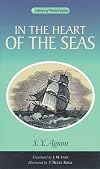
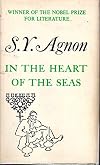
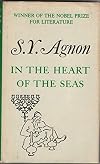
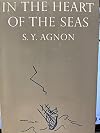
In the Heart of the Seas
by Shmuel Yosef Agnon
On This Page
Description
"In the Heart of the Seas" is a sophisticated fantasy that tells the story of a pilgrimage of a group of Hasidim to the Holy Land. During an early decade of the nineteenth century in Bucsacz, S.Y. Agnon's actual birthplace, a small group of pious townspeople decides to sell their property and belongings, put aside their business affairs, and make their way to the Holy Land to spend the remainder of their days in study and prayer.The pilgrims are joined by a simple Jew by the name of Hananya, show more who carries all of his possessions in a kerchief and who has encountered many obstacles and privations in his longstanding efforts to reach Jerusalem. He not only completes their minyan but also drives one of the wagons and provides the practical know-how that enables the faithful to negotiate the long journey from Eastern Europe to Constantinople.Along the way many Jewish settlements are encountered and described and many legends about the Holy Land are told. Hananya is late to the ship's departure from Constantinople to the Holy Land because he is busy reading the Agunah, and unaware of his absence, the faithful embark upon the tempest-tossed voyage without him. When they arrive in Jaffa, Hananya is there before them, having flown over the seas transported on his "magical" kerchief. Settled in Jerusalem, the members of the group experience a mixture of fates, and it is only Hananya who lives to a contented old age. Named by Harper San Francisco one of "The 100 Best Spiritual Books of the Twentieth Century" and among Harold Bloom's selections for "The Western Canon: The Books and School of the Ages." The Wisconsin edition is not for sale in the Republic of Ireland, South Africa, or the traditional British Commonwealth (excluding Canada.)" show lessTags
Recommendations





















Member Reviews
Sort of damning with faint praise but all I can say is that I didn't mind it. A gentle tale of a group of rabbis traveling from Eastern Europe to Israel. It was amusing at times...I enjoyed a rabbi asking an innkeeper how he knew God wanted his prayers instead of a glass of brandy and a dish of groats. However, I also found it tedious at times; fortunately it is short. I've read that Agnon is a great stylist in Hebrew, writing very taut and compelling prose. The translation gave me none of that, mostly emerging as a parody of an archaic form of speech.
The last few weeks of my life were louder than usual, thanks to the blessed noises and cries of our newborn. Agnon’s book was the perfect retreat to at least inner quietness. Whenever I read any of his books, the near-Biblical language he is using and the pace of his books always provide the calmness I seek from them. I was not disappointed this time either; I could transfer myself to mellower times by reading In the Heart of the Seas. The constant reference to the heroes as “our men of good heart” greatly contributed to the pleasant atmosphere the book emanated.
The plot of the story sounds simple; a group of Hasidim make aliyah, emigrate to Israel. On one hand this does not sound too exciting; after all, nowadays lots of people show more travel, emigrate or even make aliyah. On the other hand we have to consider that these travelers made their journey back in the day, when traveling was a much more arduous process. Furthermore, making aliyah is not just any journey, but THE journey for a devout Jews of the 19th or any century, it requires as much spiritual preparation, strength and persistence as physical. Agnon’s story draws a clear parallel between the physical, spiritual and lifelong journey. By the last I mean that it is possible to read the book at a deeper level as a metaphor for life journey. We start out somewhere low and as we aspire to higher ground, we do everything we can to get there. What we strive for more of is not material wealth, but getting closer to G-d. This is Agnon’s main point in my reading.
Another focus is that the journey cannot be done alone. The value of community is essential for our travelers. They would not be able to survive alone. They value each other and each others’ differences. The group develops from a band of travelers to a close-knit congregation through their tribulations.
There are two literary connections I could not escape noticing. Joseph Campbell described the monomyth, aka the hero’s journey, in The Hero with a Thousand Faces as a tri-stage process,
" A hero ventures forth from the world of common day into a region of supernatural wonder: fabulous forces are there encountered and a decisive victory is won: the hero comes back from this mysterious adventure with the power to bestow boons on his fellow man."
In this case (most of) our heroes do not return, but they definitely follow the rest of the pattern Campbell recognized. In this sense Agnon’s book is a typical monomyth.
The other famous book where ten people travel together and tell stories to each other is Boccaccio’s Decameron. It is mostly known for its erotic and tragic content, but that too deserves more attention. There the characters escape from the Black Death. Here they are not escaping from death but going towards fulfillment of their lifelong dream. There Lady Fortune, aka fate, is the decisive factor of what happens. Here divine authority saves or condemns people, who have the power through their actions and prayers to influence their life. Rather different outlooks, wouldn’t you say?
Just last week I wrote that I like reading fiction books for their plot and character development. I forgot to mention that I enjoy descriptive just as much. Shmuel Yosef Agnon is a master of that. (I spelled out his first and middle name on purpose, because almost all the time he is referred to only as S. Y. Agnon. He deserves his full name to be known. And not just because the Nobel Prize for Literature he won in 1966.) Here is the very opening of the book, setting the tone for the rest,
"Just before the first of the Hasidim went up to the Land of Israel, a certain man named Hananiah found his way to their House of Study. His clothes were torn, rags were wound around his legs, and he wore no boots on his feet; his hair ad beard were covered with th dust of the roads, and all his worldly goods were tied up in a little bundle which he carried with him in his kerchief."
I cannot omit mentioning the work of I. M. Lask, who magnificently translated the book from Hebrew to English. T. Herzl Rome illustrated the book with nine pictures. His style of drawing with simple, yet powerful lines fit well the book’s theme. show less
The plot of the story sounds simple; a group of Hasidim make aliyah, emigrate to Israel. On one hand this does not sound too exciting; after all, nowadays lots of people show more travel, emigrate or even make aliyah. On the other hand we have to consider that these travelers made their journey back in the day, when traveling was a much more arduous process. Furthermore, making aliyah is not just any journey, but THE journey for a devout Jews of the 19th or any century, it requires as much spiritual preparation, strength and persistence as physical. Agnon’s story draws a clear parallel between the physical, spiritual and lifelong journey. By the last I mean that it is possible to read the book at a deeper level as a metaphor for life journey. We start out somewhere low and as we aspire to higher ground, we do everything we can to get there. What we strive for more of is not material wealth, but getting closer to G-d. This is Agnon’s main point in my reading.
Another focus is that the journey cannot be done alone. The value of community is essential for our travelers. They would not be able to survive alone. They value each other and each others’ differences. The group develops from a band of travelers to a close-knit congregation through their tribulations.
There are two literary connections I could not escape noticing. Joseph Campbell described the monomyth, aka the hero’s journey, in The Hero with a Thousand Faces as a tri-stage process,
" A hero ventures forth from the world of common day into a region of supernatural wonder: fabulous forces are there encountered and a decisive victory is won: the hero comes back from this mysterious adventure with the power to bestow boons on his fellow man."
In this case (most of) our heroes do not return, but they definitely follow the rest of the pattern Campbell recognized. In this sense Agnon’s book is a typical monomyth.
The other famous book where ten people travel together and tell stories to each other is Boccaccio’s Decameron. It is mostly known for its erotic and tragic content, but that too deserves more attention. There the characters escape from the Black Death. Here they are not escaping from death but going towards fulfillment of their lifelong dream. There Lady Fortune, aka fate, is the decisive factor of what happens. Here divine authority saves or condemns people, who have the power through their actions and prayers to influence their life. Rather different outlooks, wouldn’t you say?
Just last week I wrote that I like reading fiction books for their plot and character development. I forgot to mention that I enjoy descriptive just as much. Shmuel Yosef Agnon is a master of that. (I spelled out his first and middle name on purpose, because almost all the time he is referred to only as S. Y. Agnon. He deserves his full name to be known. And not just because the Nobel Prize for Literature he won in 1966.) Here is the very opening of the book, setting the tone for the rest,
"Just before the first of the Hasidim went up to the Land of Israel, a certain man named Hananiah found his way to their House of Study. His clothes were torn, rags were wound around his legs, and he wore no boots on his feet; his hair ad beard were covered with th dust of the roads, and all his worldly goods were tied up in a little bundle which he carried with him in his kerchief."
I cannot omit mentioning the work of I. M. Lask, who magnificently translated the book from Hebrew to English. T. Herzl Rome illustrated the book with nine pictures. His style of drawing with simple, yet powerful lines fit well the book’s theme. show less
This was a delightful tale of a group of Jews who make a journey from their East European home to “the Land of Israel.” The writing about the people, the journey and their adventures was beautifully descriptive so that the story really comes alive for the reader. Along the way we also get to “listen” to the fables and legends they share with each other as they travel. We are even privileged to witness a miracle! Although short, this book is rich with illusion, humor and, especially, heart. We gain a deeper understanding of the importance of the idea of “Israel” is to these people. I want to buy this book because it was a joy to read and I know I will want to read it again
Here’s a strange book. I spent most of this picaresque account of a group of Jewish friends attempting to reach Jerusalem on a pilgrimage from the Ukraine trying to figure out why it’s on the 1001 books list.
Unfortunately, reading the entry in the 1001 Books book didn’t really enlighten me much. I’m aware, from the cover of the book, that Agnon was a Nobel Prize-Winner. I thus thought that perhaps it is the legacy of this book which makes its importance. It’s certainly not the plot, characters, style or other things that I usually rate a book on.
Digging around on the web, I did discover that Agnon is pretty much the apogee of modern Hebrew literature and figures largely in the identity of the nation. And, this novel, show more understandably from a Jewish point of view with its focus on the seemingly unattainable prize of reaching Jerusalem, would have been a common theme among the diaspora when the book was written in 1933.
The group of friends who embark on this pilgrimage do so with their only knowledge of Jerusalem coming from their scriptures. It’s almost a fantastical place which they strive to remind themselves is real and will be attainable if only they persevere against the many barriers that lie in their path. Much of this short book is taken up not so much with the journey as discussions among the friends as they stop off on the way.
This is one of those books that broadens your understanding of what’s important in other literary cultures. For that reason, I’m glad I read it. show less
Unfortunately, reading the entry in the 1001 Books book didn’t really enlighten me much. I’m aware, from the cover of the book, that Agnon was a Nobel Prize-Winner. I thus thought that perhaps it is the legacy of this book which makes its importance. It’s certainly not the plot, characters, style or other things that I usually rate a book on.
Digging around on the web, I did discover that Agnon is pretty much the apogee of modern Hebrew literature and figures largely in the identity of the nation. And, this novel, show more understandably from a Jewish point of view with its focus on the seemingly unattainable prize of reaching Jerusalem, would have been a common theme among the diaspora when the book was written in 1933.
The group of friends who embark on this pilgrimage do so with their only knowledge of Jerusalem coming from their scriptures. It’s almost a fantastical place which they strive to remind themselves is real and will be attainable if only they persevere against the many barriers that lie in their path. Much of this short book is taken up not so much with the journey as discussions among the friends as they stop off on the way.
This is one of those books that broadens your understanding of what’s important in other literary cultures. For that reason, I’m glad I read it. show less
A mythic and poetic journey of the faithful to Israel.
Nobel Prize (1966). Traveler's tale from East Europe to Jerusalem, as the heavenly city's reflection and meeting the Divine Presence
Ratings
Members
- Recently Added By
Lists

Harold Bloom - The Western Canon: D. The Chaotic Age
833 works; 24 members

My TBR
371 works; 3 members
Author Information

132+ Works 2,621 Members
Shmuel Yosef Agnon was born Shmuel Yosef Halevi Czaczkes in 1888 in Galicia, Austria-Hungary (now Poland). He received training in Yiddish, Hebrew and the Talmud from his father, and was introduced to German literature by his mother. When he was fifteen, his first poems, written in Yiddish and Hebrew, were published in the newspaper. He took his show more pen name, later his legal name, S.Y. Agnon, from the title of his first story Agunot, published in 1909. He lived and worked in Palestine from 1907 until his death in 1970, except for an eleven year stay in Germany. He was buried on the Mount of Olives. Agnon was a prolific novelist and short-story writer. After his move to Jerusalem from Germany, Agnon began writing about the decline of Jewry in Galicia. His first major publication was a two-volume novel, Hakhnasat Kalah (The Bridal Canopy), 1932, which recreates the golden age of Hassidism. Ore'ah Nata' Lalun (A Guest for the Night), 1939, is an apocalyptic novel depicting the ruin of Galicia after World War I. 'Tmol Shilshom (Only Yesterday), published in 1946, is considered his greatest novel, portraying the early pioneer immigrants to Palestine. A great many of his later books are set in his adopted Palestine and deal with the replacement of early Jewish settlements after World War II. Agnon received the Nobel Prize for Literature in 1966, boosting interest in his work outside of Israel. About 85 of Agnon's works have been translated into at least 18 languages. Agnon was made an honorary citizen of Jerusalem in 1962. His portrait appears on the Israeli Fifty New Sheqalim banknote. Other works include Sefer Hamaasim (The Book of Deeds ), published in 1932, Pat Shlema (A Whole Loaf ), from 1933, Shevuat Emunim (Two Tales), 1943, and Kol Sipurav Shel Sh. Y. Agnon ( The Collected Works in 11 volumes), 1931-62. (Bowker Author Biography) Agnon was born in Galicia, the former Austrian crown land in east central Europe. In his home he was influenced by rabbinical and Hasidic traditions and the reviving spirit of European culture, Agnon began writing Hebrew and Yiddish at the age of eight. He contributed poetry and prose to periodicals, such as Ha-Mizpeh and Der Juedische Wecker. After he immigrated to Palestine in 1907, he no longer wrote in Yiddish. He chose the pen name "Agnon" from the title of his first novel, Agunot (Forsaken Wives); its meaning is "cut off" in Hebrew. From 1912 to 1914 Agnon lived in Germany, where he met Salman Schocken and convinced him that someone should undertake the publishing of Hebrew books. In 1931 Berlin Schocken Verlag published four volumes of Agnon's collected works in Hebrew. Agnon was awarded the Bialik Prize for literature in 1934, and in 1936 the Jewish Theological Seminary of America made him an honorary Doctor of Hebrew Letters. Other honors followed, including the Israel Prize in 1954 and 1958. In 1966 he became the first Israeli to receive the Nobel Prize for literature, which was awarded jointly to the Swedish writer Nelly Sachs. Agnon often deals with philosophical and psychological problems in a miraculous or supernatural manner. Reality is colored in a dreamlike atmosphere. Agnon is concerned with contemporary problems of a spiritual nature-the disintegration of traditional life, loss of faith and identity, and loneliness. At the center of his work is the Jew in various manifestations: a person of faith, a nihilist, a victim of pogroms and the Holocaust, a pioneer, and a saint. Creating a unique Hebrew prose style, his works link historic Jewish piety and martyrdom with longing for Israel. Yet they have universal appeal to the modern reader. Agnon himself has said: "I am not a modern writer. I am astounded that I even have one reader. I don't see the reader before me... No, I see before me only the Hebrew letter saying 'write me thus and not thus.' I, to my regret, am like the wicked Balaam. It is written of him that "the word that God putteth in my mouth, that shall I speak"' (The New York Times). (Bowker Author Biography) show less
Some Editions
Awards and Honors
Series
Belongs to Publisher Series
Work Relationships
Is contained in
Common Knowledge
- Canonical title
- In the Heart of the Seas
- Original title
- Belevav Yamim
- Original publication date
- 1934
- People/Characters
- Hananiah
- Important places
- Istanbul, Turkey; Jerusalem
- First words
- Just before the first of the hasidim went up to the Land of Israel, a certain man named Hananiah found his way to their House of Study.
- Last words
- (Click to show. Warning: May contain spoilers.)But of the latter I say in the words of the Psalmist: 'But those who wait for the Lord, they shall inherit the land.'
- Original language
- Hebrew
Classifications
- Genres
- General Fiction, Fiction and Literature
- DDC/MDS
- 892.435 — Literature & rhetoric Literatures of other languages Afro-Asiatic literatures Jewish, Israeli, and Hebrew Hebrew fiction 1885–1947
- LCC
- PZ3 .A2733 .I — Language and Literature Fiction and juvenile belles lettres Fiction and juvenile belles lettres Fiction in English
- BISAC
Statistics
- Members
- 223
- Popularity
- 146,600
- Reviews
- 6
- Rating
- (3.14)
- Languages
- 5 — English, French, Hebrew, Italian, Russian
- Media
- Paper
- ISBNs
- 7
- ASINs
- 7