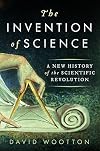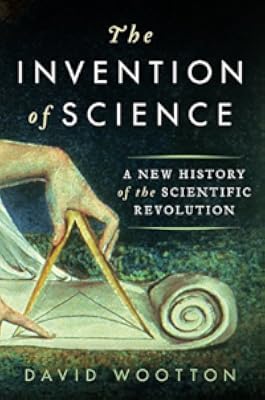
The Invention of Science: A New History of the Scientific Revolution
by David Wootton
On This Page
Description
"The Invention of Science goes back five hundred years in time to chronicle this crucial transformation, exploring the factors that led to its birth and the people who made it happen. Wootton argues that the Scientific Revolution was actually five separate yet concurrent events that developed independently, but came to intersect and create a new worldview. Here are the brilliant iconoclasts--Galileo, Copernicus, Brahe, Newton, and many more curious minds from across Europe--whose studies of show more the natural world challenged centuries of religious orthodoxy and ingrained superstition. From gunpowder technology, the discovery of the new world, movable type printing, perspective painting, and the telescope to the practice of conducting experiments, the laws of nature, and the concept of the fact, Wootton shows how these discoveries codified into a social construct and a system of knowledge." -- Publisher's website show lessTags
Recommendations













Member Recommendations

themulhern Both are lively accounts of the invention of science.
20

themulhern Asimov's general discussion of science and its invention, which in his book is only in the first chapter, really complement Wootton's, and vice-versa. By the time Asimov's fourth guide, "Asimov's New Guide to Science" was published in the 1980s he had done some pretty deep thinking and it's remarkable how his thoughts and Wootton's seem to align.
themulhern The books cover much the same period in science. "Seashell" is less erudite and not as well written as "Invention". Both quote Henry Power, "Invention" with more vigor and conviction.
themulhern One should think of "The Royal Society" as a sort of moderately informative appendix to David Wootton's book.

themulhern These two books both go into detail about the early history of steam power.
Member Reviews
This is probably a very important book to read if you're a philosopher of science who thinks that the theories of phlogiston and evolution are of equal validity. Of course, those people do not exist. This is clearly a failure of editing, agenting, and a triumph of misleading marketing. This book is not at all a general reader's book about the scientific revolution, and certainly not about the invention of science. it is, instead, scholarly articles embedded in a polemic against postmodernists (the book was apparently conceived in 1982).
Others have written about the book's many structural flaws; I will just note two intellectual flaws. First, Wootton opposes the sociology of science, because they approach science sociologically, without show more any regard for the truth claims of scientific theories. Does he feel the same way about the sociology of religion, I wonder? To make my point clear: sociologists study human interactions. They do not care what those interactions are *about*, and if they did, they would be betraying the point of sociology.
Second, Wootton's positive arguments are horrific. To take the most obvious: he claims that Columbus' discovery* of the Americas made science possible, by introducing the very concept of discovery. It was not possible to 'discover' gravity, in other words, without the concept of discovery; without that concept, one could just go on adjusting already existing theories, rather than taking account of new facts (he also covers the invention of the idea of the fact). Slight problem here: Columbus' 'discovery' of the Americas was also the Americans' 'discovery' of Europe. And yet, science did not develop in the Americas until after the Europeans had really, really, really 'discovered' it. Why not? Because concepts are useless in the absence of economic development, political support, and so on. Science may rely on the concept of discovery *grammatically* (Wootton loves him some Wittgenstein, and is at pains to show that Wittgenstein was not a relativist), but not *historically*. There is nothing here about the importance of economic development for the development of science, which is no failing in an academic article about the concept of 'discovery,' but a rather glaring one in a book about the scientific revolution.
A true disappointment.
*: Columbus did not, of course, 'discover' the Americas. They'd been discovered for some time by, you know, the many civilizations spread out over the continent for a millenium or more. Wootton does not care. show less
Others have written about the book's many structural flaws; I will just note two intellectual flaws. First, Wootton opposes the sociology of science, because they approach science sociologically, without show more any regard for the truth claims of scientific theories. Does he feel the same way about the sociology of religion, I wonder? To make my point clear: sociologists study human interactions. They do not care what those interactions are *about*, and if they did, they would be betraying the point of sociology.
Second, Wootton's positive arguments are horrific. To take the most obvious: he claims that Columbus' discovery* of the Americas made science possible, by introducing the very concept of discovery. It was not possible to 'discover' gravity, in other words, without the concept of discovery; without that concept, one could just go on adjusting already existing theories, rather than taking account of new facts (he also covers the invention of the idea of the fact). Slight problem here: Columbus' 'discovery' of the Americas was also the Americans' 'discovery' of Europe. And yet, science did not develop in the Americas until after the Europeans had really, really, really 'discovered' it. Why not? Because concepts are useless in the absence of economic development, political support, and so on. Science may rely on the concept of discovery *grammatically* (Wootton loves him some Wittgenstein, and is at pains to show that Wittgenstein was not a relativist), but not *historically*. There is nothing here about the importance of economic development for the development of science, which is no failing in an academic article about the concept of 'discovery,' but a rather glaring one in a book about the scientific revolution.
A true disappointment.
*: Columbus did not, of course, 'discover' the Americas. They'd been discovered for some time by, you know, the many civilizations spread out over the continent for a millenium or more. Wootton does not care. show less
The workings of science are almost entirely naturalized. For us, it seems natural that scientists discover facts about the natural universe, and that they do so by formulating hypotheses and designing experiments to test those hypotheses. But to someone in the in the 15th century, this process was entirely alien.
Wootton aims to discuss the scientific revolution, the period between Tycho's Nova of 1572 and the publication of Newton's Principia in 1687, where science became an accepted mode of knowledge. But the real objective is a broadside against a school of scholarship which has wrecked proper history of science, namely David Bloor's Strong Programme, and an undue relativism in history of science, with it's origins in Thomas Kuhn's show more paradigm shift theory of scientific revolutions.
This book is at its best in discussing the world of knowledge prior to the scientific revolution. I was entirely unaware of the controversy about the location of the sphere of land and the sphere of water in Aristotelian physics, or the belief that the oceans were literally above dry land, as preserved in the phrase 'high seas'. There's a lot of good linguistic explanation of the origins and usages of words like experiment, fact, and discovery. Wootton's argument is that the discovery and exploitation of the New World provided the initial crack in the armor of scholastic Aristotelian knowledge, since the Americas were so obviously there and the ancients had said nothing about them. An interesting graph of sales of a popular Ptolemaic astronomy textbook shows a dip in sales in the 1570s, since a nova cannot be explained in a universe of divine spheres, and then a collapse with Galileo's discover of the moons of Jupiter and phases of Venus around 1608. The old knowledge was dead.
But how did the new knowledge arise? Here, Wootton is sadly less detailed, talking a little about the various uses of Torricelli's experiment. And of course, the printing press played a key role in bringing down the price of books and allowing precise copies of complex technical diagrams, something scribes were hopeless at reproducing accurately. But where there should be evidence, there is mostly invective against postmodern relativists.
Now I'll admit that I'm part of the science and technology studies tradition Wootton rails against. He's right that the Strong Programme is often poorly used, and that relativism misses the key ability of science to accurately describe the natural world. Yet, even a sophisticated realism has trouble getting out of the recursive trap that 'successful science accurately describes the natural world, which we know because of successful science, which has been shown to accurately describe the natural world, etc". There were experimenters prior to Galileo, but as Wootton discusses, their discoveries died, because they did not exist in a social context which allowed for scientific discovery. show less
Wootton aims to discuss the scientific revolution, the period between Tycho's Nova of 1572 and the publication of Newton's Principia in 1687, where science became an accepted mode of knowledge. But the real objective is a broadside against a school of scholarship which has wrecked proper history of science, namely David Bloor's Strong Programme, and an undue relativism in history of science, with it's origins in Thomas Kuhn's show more paradigm shift theory of scientific revolutions.
This book is at its best in discussing the world of knowledge prior to the scientific revolution. I was entirely unaware of the controversy about the location of the sphere of land and the sphere of water in Aristotelian physics, or the belief that the oceans were literally above dry land, as preserved in the phrase 'high seas'. There's a lot of good linguistic explanation of the origins and usages of words like experiment, fact, and discovery. Wootton's argument is that the discovery and exploitation of the New World provided the initial crack in the armor of scholastic Aristotelian knowledge, since the Americas were so obviously there and the ancients had said nothing about them. An interesting graph of sales of a popular Ptolemaic astronomy textbook shows a dip in sales in the 1570s, since a nova cannot be explained in a universe of divine spheres, and then a collapse with Galileo's discover of the moons of Jupiter and phases of Venus around 1608. The old knowledge was dead.
But how did the new knowledge arise? Here, Wootton is sadly less detailed, talking a little about the various uses of Torricelli's experiment. And of course, the printing press played a key role in bringing down the price of books and allowing precise copies of complex technical diagrams, something scribes were hopeless at reproducing accurately. But where there should be evidence, there is mostly invective against postmodern relativists.
Now I'll admit that I'm part of the science and technology studies tradition Wootton rails against. He's right that the Strong Programme is often poorly used, and that relativism misses the key ability of science to accurately describe the natural world. Yet, even a sophisticated realism has trouble getting out of the recursive trap that 'successful science accurately describes the natural world, which we know because of successful science, which has been shown to accurately describe the natural world, etc". There were experimenters prior to Galileo, but as Wootton discusses, their discoveries died, because they did not exist in a social context which allowed for scientific discovery. show less
David Wootton is a professor of history at the University of York. In The Invention of Science he proposes a new view of the definition, the significance, and the timing of the “Scientific Revolution.”
Most historians would point to Copernicus as the initiator of the revolution with his publication in 1543 of a heliocentric vision of the universe. But Wootton argues that Copernicus was not really a scientist in that he did not attempt to gather new data - he relied on the observations of the ancients. Nor was he as revolutionary as once thought. He envisioned the earth and the planets as located in solid crystalline spheres that rotated around and within each other. He was concerned with preserving Aristotle’s concept of celestial show more circular motion. Indeed, one did not contradict Aristotle lightly; from the end of the eleventh century until the middle of the eighteenth Aristotle’s take on natural phenomena was taught in the universities across Europe; his influence was profound.
Adding to the ossification of knowledge was an unquestioning belief in the literal truth of the Bible. Between the teachings of Aristotle and the Bible, most European thinkers concluded “there was no such thing as new knowledge.”
The epistemological issues Wootton discusses are fascinating. He observes, for example, that the notion of “discovery” was a relatively modern concept. When Columbus “discovered” the New World, this was a game-changer; before this, the assumption was that there were no “discoveries” to be made. Pursuant to the texts accepted as authoritative, “the greatest achievements of civilization were believed to lie not in the present or the future but in the past, in ancient Greece and classical Rome.”
Wootton also takes on the theory of scientific “revolutions” formulated and popularized by Thomas Kuhn. Kuhn, writing at the peak of the intellectual infatuation with post-modernism, stated that science has undergone several distinct revolutions in the form of paradigm shifts, in which scientists did not so much discover new data, but rather began to view the same data in a different light. No, says Wootton. Kuhn’s analytical lenses were too narrowly constructed; he lost sight, Wootton argues persuasively, of the wider environment within which those shifts took place.
Wootton suggests that modern science was invented between 1572, when Tycho Brahe discovered a new star [which we now know was a distant super nova], and 1704, when Isaac Newton published his work on prisms. What made the difference, according to Wootton, was the notion of “discovery”; a research program; precise measurements; a community of experts; the willingness to question long-established certainties in light of new evidence; and above all, the triumph of experience over philosophy. Furthermore, the invention of the printing press accelerated the process by transforming access to information and becoming itself an agent of change. To support his thesis, he presents a detailed history of how science worked before, during, and after this period.
“Science” itself was until recently known as “natural philosophy,” and the word “scientist” was not used until the 19th Century! Wootton analyzes language closely, because, as he stresses, “[a]ll history involves translation from the source language.” But understanding the words originally used also can indicate how the words signified for a particular place and time. In fact, one of Wootton’s key premises is that “a revolution in ideas requires a revolution in language.”
Thus, Wootton argues that the scientific revolution was not merely a collection of new discoveries, but rather a cultural transformation. The printing press, in addition to its benefits mentioned above, was instrumental in the intellectual revolution because it fostered the dissemination and criticism (“peer review”) of new ideas. New instruments (telescopes, microscopes, barometers, prisms) allowed the discovery of new facts. Finally, the new science was given a distinctive identity by a new language that stressed facts, theories, hypotheses, and laws.
Evaluation: Wootton has mastered a truly enormous corpus of scholarly work. His bibliography runs to 68 pages. His writing is lucid and interesting, even when he is discussing arcane issues of historiography, and in comparison to most other books on epistemology. This book is well worth the effort.
(JAB) show less
Most historians would point to Copernicus as the initiator of the revolution with his publication in 1543 of a heliocentric vision of the universe. But Wootton argues that Copernicus was not really a scientist in that he did not attempt to gather new data - he relied on the observations of the ancients. Nor was he as revolutionary as once thought. He envisioned the earth and the planets as located in solid crystalline spheres that rotated around and within each other. He was concerned with preserving Aristotle’s concept of celestial show more circular motion. Indeed, one did not contradict Aristotle lightly; from the end of the eleventh century until the middle of the eighteenth Aristotle’s take on natural phenomena was taught in the universities across Europe; his influence was profound.
Adding to the ossification of knowledge was an unquestioning belief in the literal truth of the Bible. Between the teachings of Aristotle and the Bible, most European thinkers concluded “there was no such thing as new knowledge.”
The epistemological issues Wootton discusses are fascinating. He observes, for example, that the notion of “discovery” was a relatively modern concept. When Columbus “discovered” the New World, this was a game-changer; before this, the assumption was that there were no “discoveries” to be made. Pursuant to the texts accepted as authoritative, “the greatest achievements of civilization were believed to lie not in the present or the future but in the past, in ancient Greece and classical Rome.”
Wootton also takes on the theory of scientific “revolutions” formulated and popularized by Thomas Kuhn. Kuhn, writing at the peak of the intellectual infatuation with post-modernism, stated that science has undergone several distinct revolutions in the form of paradigm shifts, in which scientists did not so much discover new data, but rather began to view the same data in a different light. No, says Wootton. Kuhn’s analytical lenses were too narrowly constructed; he lost sight, Wootton argues persuasively, of the wider environment within which those shifts took place.
Wootton suggests that modern science was invented between 1572, when Tycho Brahe discovered a new star [which we now know was a distant super nova], and 1704, when Isaac Newton published his work on prisms. What made the difference, according to Wootton, was the notion of “discovery”; a research program; precise measurements; a community of experts; the willingness to question long-established certainties in light of new evidence; and above all, the triumph of experience over philosophy. Furthermore, the invention of the printing press accelerated the process by transforming access to information and becoming itself an agent of change. To support his thesis, he presents a detailed history of how science worked before, during, and after this period.
“Science” itself was until recently known as “natural philosophy,” and the word “scientist” was not used until the 19th Century! Wootton analyzes language closely, because, as he stresses, “[a]ll history involves translation from the source language.” But understanding the words originally used also can indicate how the words signified for a particular place and time. In fact, one of Wootton’s key premises is that “a revolution in ideas requires a revolution in language.”
Thus, Wootton argues that the scientific revolution was not merely a collection of new discoveries, but rather a cultural transformation. The printing press, in addition to its benefits mentioned above, was instrumental in the intellectual revolution because it fostered the dissemination and criticism (“peer review”) of new ideas. New instruments (telescopes, microscopes, barometers, prisms) allowed the discovery of new facts. Finally, the new science was given a distinctive identity by a new language that stressed facts, theories, hypotheses, and laws.
Evaluation: Wootton has mastered a truly enormous corpus of scholarly work. His bibliography runs to 68 pages. His writing is lucid and interesting, even when he is discussing arcane issues of historiography, and in comparison to most other books on epistemology. This book is well worth the effort.
(JAB) show less
Wootton claims there are two major philosophical camps among those who write about the history of science. He calls them the 'realists' and the 'relativists'. The realists regard science as essentially a formalized application of human common sense. To them, science is a systematic method of asking questions about the natural world, which leads to reasonably accurate answers. As these answers build upon one another, collective human understanding grows. It's almost inevitable. Relativists, on the other hand, see science as an aspect of human culture. Both the questions it asks and the answers it finds are culturally dependent, so it never obtains any objective knowledge and consequently cannot progress in the sense that it gets us show more closer to a true understanding of what the world actually is or how it works. Instead, it creates stories about the world that work for a particular culture at a particular time. Relativism, he claims, "has been the dominant position in the history of science" for some time (Pg. 117). (This seems odd to me since, of the two extremes, relativism seems the most absurd, but that's what he says. Since he's the expert and I'm not, I'm sadly willing to entertain the idea that he may be right about this.)
Wootton sees some merit in both of these perspectives, and this book is his attempt to reconcile them. His self-appointed task can be summarized in these quotes that appear near the end of the book:
The task, in other words, is to understand how reliable knowledge and scientific progress can and do result from a flawed, profoundly contingent, culturally relative, all-too-human process. (pg. 541)
Hence the need for an historical epistemology which allows us to make sense of the ways in which we interact with the physical world (and each other) in the pursuit of knowledge. The central task of such an epistemology is not to explain why we have been successful in our pursuit of scientific knowledge; there is no good answer to that question. Rather it is to track the evolutionary process by which success has been built upon success; that way we can come to understand that science works, and how it works. (Pg. 543)
And this is what he does in an extensively researched and exhaustively documented account of the development and evolution of science. The way of thinking, which we now call science, truly was new and revolutionary. It emerged primarily in Western Europe between the times of Columbus and Newton. Wootton doesn't claim a single igniting spark, but he gives Columbus's voyage in 1492 credit for providing a powerful challenge to the prevailing belief that the ancients had known everything worth knowing. Although Columbus himself never accepted that the land he found by traveling west from Spain was a previously unknown continent, others soon came to this realization, and it showed that the authority of Ptolemy, Aristotle, and Holy Scripture were not as absolute as people believed. Here was an entirely new world, with strange animals, plants, and people, which the respected and authoritative ancients had known nothing about. Possibly just as significant was that the existence of these two huge continents was not found through philosophical reflection or by divine revelation. This new land was 'discovered' by a bunch of scruffy sailors—commoners!
From here, he explains that these emerging ideas added new words and new (and modern) definitions to old words, such as 'discovery', 'fact', 'experiment', 'objectivity', and 'evidence'. These all have their current meanings because of the scientific way of viewing the world that emerged between the 16th and 18th centuries. (Personally, I think his discussion of the word 'evidence' goes into more detail and greater length than needed to make his point, but for those in academia, it may be helpful).
He also shows how culture influenced the development of scientific thinking. More often than not, the culture of this time hindered rather than helped. Prior to the scientific revolution, philosophical disputes were decided through clever rhetoric, creative verbal arguments, and appeals to tradition and authority. Because of this, early practitioners of science felt it necessary to justify themselves by citing the works of long-dead philosophers like Epicurus, Democritus, and Lucretius. Although none had the authority of Aristotle, they were ancient, which implied a certain respectability. The new scientific way of thinking, on the other hand, "sought to resolve intellectual disputes through experimentation." (pg. 562)
I am more of an interested observer of science than I am a practitioner, but I have to admit that the realist view seems far closer to the truth to me than does the relativist concept. It is undeniable that science is done by scientists, that scientists are people, and that people are shaped by the cultures in which they live. But modern science originally began by challenging the assumptions of the culture in which it first emerged, and it retains that aspect of cultural skepticism to this day. I suspect that many current scientists are motivated, at least in part, by the dream of possibly overturning a prevailing theory or showing that it is somehow flawed or incomplete. In the 17th century, challenging cultural assumptions could bring a long, uncomfortable visit with inquisitors followed by a short, hot time tied to a stake. Today, it can bring a scientist fame and fortune.
Scientific progress isn't inevitable, but it can and does reveal culturally independent facts. Scientists are products of their cultures, but the process of science intentionally strives to put those cultural assumptions aside. It may be the only human activity that does so. show less
Wootton sees some merit in both of these perspectives, and this book is his attempt to reconcile them. His self-appointed task can be summarized in these quotes that appear near the end of the book:
The task, in other words, is to understand how reliable knowledge and scientific progress can and do result from a flawed, profoundly contingent, culturally relative, all-too-human process. (pg. 541)
Hence the need for an historical epistemology which allows us to make sense of the ways in which we interact with the physical world (and each other) in the pursuit of knowledge. The central task of such an epistemology is not to explain why we have been successful in our pursuit of scientific knowledge; there is no good answer to that question. Rather it is to track the evolutionary process by which success has been built upon success; that way we can come to understand that science works, and how it works. (Pg. 543)
And this is what he does in an extensively researched and exhaustively documented account of the development and evolution of science. The way of thinking, which we now call science, truly was new and revolutionary. It emerged primarily in Western Europe between the times of Columbus and Newton. Wootton doesn't claim a single igniting spark, but he gives Columbus's voyage in 1492 credit for providing a powerful challenge to the prevailing belief that the ancients had known everything worth knowing. Although Columbus himself never accepted that the land he found by traveling west from Spain was a previously unknown continent, others soon came to this realization, and it showed that the authority of Ptolemy, Aristotle, and Holy Scripture were not as absolute as people believed. Here was an entirely new world, with strange animals, plants, and people, which the respected and authoritative ancients had known nothing about. Possibly just as significant was that the existence of these two huge continents was not found through philosophical reflection or by divine revelation. This new land was 'discovered' by a bunch of scruffy sailors—commoners!
From here, he explains that these emerging ideas added new words and new (and modern) definitions to old words, such as 'discovery', 'fact', 'experiment', 'objectivity', and 'evidence'. These all have their current meanings because of the scientific way of viewing the world that emerged between the 16th and 18th centuries. (Personally, I think his discussion of the word 'evidence' goes into more detail and greater length than needed to make his point, but for those in academia, it may be helpful).
He also shows how culture influenced the development of scientific thinking. More often than not, the culture of this time hindered rather than helped. Prior to the scientific revolution, philosophical disputes were decided through clever rhetoric, creative verbal arguments, and appeals to tradition and authority. Because of this, early practitioners of science felt it necessary to justify themselves by citing the works of long-dead philosophers like Epicurus, Democritus, and Lucretius. Although none had the authority of Aristotle, they were ancient, which implied a certain respectability. The new scientific way of thinking, on the other hand, "sought to resolve intellectual disputes through experimentation." (pg. 562)
I am more of an interested observer of science than I am a practitioner, but I have to admit that the realist view seems far closer to the truth to me than does the relativist concept. It is undeniable that science is done by scientists, that scientists are people, and that people are shaped by the cultures in which they live. But modern science originally began by challenging the assumptions of the culture in which it first emerged, and it retains that aspect of cultural skepticism to this day. I suspect that many current scientists are motivated, at least in part, by the dream of possibly overturning a prevailing theory or showing that it is somehow flawed or incomplete. In the 17th century, challenging cultural assumptions could bring a long, uncomfortable visit with inquisitors followed by a short, hot time tied to a stake. Today, it can bring a scientist fame and fortune.
Scientific progress isn't inevitable, but it can and does reveal culturally independent facts. Scientists are products of their cultures, but the process of science intentionally strives to put those cultural assumptions aside. It may be the only human activity that does so. show less
This is a book with a simple argument to make: that the scientific revolution was a real thing, it definitely happened, and it happened at a specific point in time, namely, ‘between 1572, when Tycho Brahe saw a nova, and 1704, when Newton published his Opticks’. In that century and a half, a staggering number of new truths about reality became understood – we went from living at the centre of a universe of celestial spheres, reading manuscripts to glean the lessons of the ancient Greeks, to living on a terraqueous globe orbiting the sun, and studying printed books from a new breed of modern experimental scientists. And it was all driven by advances in instruments, a new awareness of the potential for discovery, and a growing show more conviction that empirical experience was more important than philosophical dogma or classical authority.
The simplicity of Wootton's premise is, in a way, a clue to his defensiveness. He is explicitly arguing against the claims of ‘postmodernist’ historians, who have suggested that successful scientific theories are, in terms of historical description, not fundamentally different from unsuccessful ones, and that anyway scientific ‘truths’ are culturally dependent and enforced by political authority. Wootton is having none of this.
More power to him; but unless you have gone through life with a steely conviction of the right-mindedness of Bloor's strong programme, Wootton's intramural aggression may quickly become tiresome. His arguments are aimed at his historiographical opponents, not at the general reader. And he is not above frequent asides to make this point explicit (‘It should be obvious that he was not right about this’; ‘the notion…seems to escape Boghossian’). Time and again he interrupts his narrative to bring the evil relativists on stage behind him, so we can shout at them like a pantomime audience. Look out, it's Simon Schaffer! It's Michel Foucault, with waxed moustaches and a black cape! Boo! Hiss! They're behind you (for a given local value of ‘behind’)!
I imagine that fifty or sixty years ago, histories of the scientific revolution presented a standard timeline of Great Men And Their Discoveries. Happily, things have moved on a bit since then; and yet, reading Wootton, I found myself yearning for some basic facts and figures about what actually happened and who did what. In the end, this is not (as its subtitle claims) a ‘history of the scientific revolution’ at all, but rather a history of the attitudes and thought processes that contributed to or grew out of it. Instead of looking at a steady progress of breakthroughs and developments, Wootton concerns himself with changes in the era's conceptual tools; he analyses texts in great detail, focusing on specific items of vocabulary as markers of changing attitudes – indeed, some chapters seem to consist of little more than a timeline of neologisms – and he lavishes much more time and attention on the coining of such terms as ‘discovery’, ‘fact’ or ‘experiment’ than he does on actual discoveries, facts or experiments.
I have a very high tolerance of this kind of semantic approach, but even I found it a bit exhausting after a while. Finally hitting a chapter on Newton, you rub your hands with anticipation, only to read: ‘My first goal in this chapter, then, is to establish why Newton was hostile to the word “hypothesis”…’ and your heart just sinks. Wootton's arguments about how language reflects mental attitudes are well-made and convincing, but what you don't get in this book is much sense of the grubby reality of early-modern science – the long nights, the sweating over furnaces, the trial and error of different practical approaches.
Combined with his combative stance vis-à-vis other historical treatments, it all serves to make his undoubted learning sound uncomfortably like pedantry in places. (This is not helped by a somewhat finicky approach to notation: Wootton uses Latin numerals for endnotes and Roman numerals for footnotes, so that many sentences end in a superscripted mishmash of characters: ‘…even then it was at first confined to political revolutionsˣˣˣⁱᵛ⁴¹’.)
Overall, I'm unsure how much I'd recommend this. On the one hand, it really has changed the way I think about the long seventeenth century, especially in terms of how I interpret the language of all these early scientists. And fundamentally I share Wootton's impatience with a lot of relativist history. All the same, the sad truth is that I'm just left craving a plainer, more chronological description of the key breakthroughs of the period. Doubtless many such histories exist, but this one, which positions itself as a new standard, feels too polemical to be in a position to fully replace them. show less
The simplicity of Wootton's premise is, in a way, a clue to his defensiveness. He is explicitly arguing against the claims of ‘postmodernist’ historians, who have suggested that successful scientific theories are, in terms of historical description, not fundamentally different from unsuccessful ones, and that anyway scientific ‘truths’ are culturally dependent and enforced by political authority. Wootton is having none of this.
More power to him; but unless you have gone through life with a steely conviction of the right-mindedness of Bloor's strong programme, Wootton's intramural aggression may quickly become tiresome. His arguments are aimed at his historiographical opponents, not at the general reader. And he is not above frequent asides to make this point explicit (‘It should be obvious that he was not right about this’; ‘the notion…seems to escape Boghossian’). Time and again he interrupts his narrative to bring the evil relativists on stage behind him, so we can shout at them like a pantomime audience. Look out, it's Simon Schaffer! It's Michel Foucault, with waxed moustaches and a black cape! Boo! Hiss! They're behind you (for a given local value of ‘behind’)!
I imagine that fifty or sixty years ago, histories of the scientific revolution presented a standard timeline of Great Men And Their Discoveries. Happily, things have moved on a bit since then; and yet, reading Wootton, I found myself yearning for some basic facts and figures about what actually happened and who did what. In the end, this is not (as its subtitle claims) a ‘history of the scientific revolution’ at all, but rather a history of the attitudes and thought processes that contributed to or grew out of it. Instead of looking at a steady progress of breakthroughs and developments, Wootton concerns himself with changes in the era's conceptual tools; he analyses texts in great detail, focusing on specific items of vocabulary as markers of changing attitudes – indeed, some chapters seem to consist of little more than a timeline of neologisms – and he lavishes much more time and attention on the coining of such terms as ‘discovery’, ‘fact’ or ‘experiment’ than he does on actual discoveries, facts or experiments.
I have a very high tolerance of this kind of semantic approach, but even I found it a bit exhausting after a while. Finally hitting a chapter on Newton, you rub your hands with anticipation, only to read: ‘My first goal in this chapter, then, is to establish why Newton was hostile to the word “hypothesis”…’ and your heart just sinks. Wootton's arguments about how language reflects mental attitudes are well-made and convincing, but what you don't get in this book is much sense of the grubby reality of early-modern science – the long nights, the sweating over furnaces, the trial and error of different practical approaches.
Combined with his combative stance vis-à-vis other historical treatments, it all serves to make his undoubted learning sound uncomfortably like pedantry in places. (This is not helped by a somewhat finicky approach to notation: Wootton uses Latin numerals for endnotes and Roman numerals for footnotes, so that many sentences end in a superscripted mishmash of characters: ‘…even then it was at first confined to political revolutionsˣˣˣⁱᵛ⁴¹’.)
Overall, I'm unsure how much I'd recommend this. On the one hand, it really has changed the way I think about the long seventeenth century, especially in terms of how I interpret the language of all these early scientists. And fundamentally I share Wootton's impatience with a lot of relativist history. All the same, the sad truth is that I'm just left craving a plainer, more chronological description of the key breakthroughs of the period. Doubtless many such histories exist, but this one, which positions itself as a new standard, feels too polemical to be in a position to fully replace them. show less
This is a fairly scholarly work to find on the shelves of a contemporary public library. It discusses philosophies of the history of science and includes extensive footnotes and endnotes which must have been compiled by an army of graduate students. It is far livelier than this suggests, in part due to the quotations from the works of various 16th and 17th century scientists and writers.
The most remarkable theme of this work is how confident many early scientists were that they were doing something new and how determined they were to keep on doing it. The second most remarkable is the obstinate stupidity of most academics currently working in the history of science.
The theories that the mediaeval scholars had about the world which gave show more way to the understanding of the terraqueous globe were so strange that I could not really understand them at all. It is nice however, to know that "piracy on the high seas" is a phrase from the days in which the oceans were supposed to be higher than the land.
=============================================================================
I read this with more attention than before in 2020, and continue to find it extremely compelling. What follows, though, is a discussion of what I think is an error in a two page discussion of Galileo's study of the principle of buoyancy. Wootton argues that Archimedes got it wrong, and that Galileo, by his experiments, arrived at a correction. I have an undergraduate engineering degree, and consequently studied the principle of buoyancy while taking a mechanics course in college. I think that Wootton is likely to be mistaken in his understanding of what Archimedes originally said, because that would make no sense and is not how it was taught to me. More likely Galileo just refined Archimedes' correct statement, working out some consequences and stating them precisely. It is quite possible that Archimedes got it right, mediaeval scholars misinterpreted him according to their prejudices, and that Galileo then interpreted Archimedes' work correctly, contradicting the mediaeval scholars misinterpretation. Wootton's discussion revolves around the meaning of the word "displaced" which he understands to mean a statement about a change that occurs when a body is placed in water, but which was understood in my engineering courses to mean a statement about the state of a system of a body of water and some other object in equilibrium. What follows is a detailed discussion of this particular topic.
I think there is an error in understanding of Archimedes principle of buoyancy in the chapter "Experiments". The error revolves around the interpretation of "displaced", which seems to me to mean something very different from what Wootton interprets it to mean. When I got my undergraduate degree in engineering, some of my courses covered hydrostatics. In the book I was able to dig out, the verb "displaced" is used precisely in a thought experiment where a body which is not water, is substituted for the water, instantaneously. The water displaced, and so the body substituted, are both wholly below the surface. Otherwise, nothing at all changes, and the water level does not rise or fall.
What is the point of this thought experiment? Well, the argument is that the forces on the water displaced are exactly the same as the forces on the body that displaced it. The water displaced also had weight. Clearly, the forces balanced out. The displacing body will have some weight, which may be different from that of the weight of the water. If it is less than the weight of the displaced water, it will rise, until eqilibrium is reached, and the net force is 0. The weight of the body remains the same. One way to reduce the net upward force of the water on the body is to have it displace less water, by reaching a point where it is actually floating on the surface, and not wholly submerged. Now the upward force is reduced, because it is only sufficient to hold up the amount of water displaced by the part of the body that is actually below the surface. This is how boats float.
Note that with all the use of the verb "displaced", no statement has been made about how much the water level has risen. In fact, the initial thought experiment specifies no change, hence no change to the water level. And if the object is actually floating after the thought experiment is concluded, then clearly the water level has actually fallen, because the displaced water is all gone, but some of the object is above the surface.
The book seems to think that the question to be settled is about the difference between the water level before and after the body reaches equilibrium. It also requires that the amount of water in the experiment remain constant. So you could imagine substituting the object for the water, letting the water-and-object system reach equilibrium then pouring the water back in, and seeing what the final result is.
The book begins the argument with a hypothetical infinite ocean. This is no help, because infinity is hard to reason about and an infinite ocean containing an infinite volume of water might, for all I can tell, be of infinitely small depth. Think about Torricelli's trumpet, which has infinite surface area but finite volume. So we'll skip trying to reason about infinity and instead reason about closed containers, where the notion of water level rising makes a practical kind of sense.
At this point in the review, I began doing some mathematical calculations, but I noticed that librarything cuts off my review in the middle. These calculations are anyway better by hand than a keyboard, so I"m leaving them out of the review. show less
The most remarkable theme of this work is how confident many early scientists were that they were doing something new and how determined they were to keep on doing it. The second most remarkable is the obstinate stupidity of most academics currently working in the history of science.
The theories that the mediaeval scholars had about the world which gave show more way to the understanding of the terraqueous globe were so strange that I could not really understand them at all. It is nice however, to know that "piracy on the high seas" is a phrase from the days in which the oceans were supposed to be higher than the land.
=============================================================================
I read this with more attention than before in 2020, and continue to find it extremely compelling. What follows, though, is a discussion of what I think is an error in a two page discussion of Galileo's study of the principle of buoyancy. Wootton argues that Archimedes got it wrong, and that Galileo, by his experiments, arrived at a correction. I have an undergraduate engineering degree, and consequently studied the principle of buoyancy while taking a mechanics course in college. I think that Wootton is likely to be mistaken in his understanding of what Archimedes originally said, because that would make no sense and is not how it was taught to me. More likely Galileo just refined Archimedes' correct statement, working out some consequences and stating them precisely. It is quite possible that Archimedes got it right, mediaeval scholars misinterpreted him according to their prejudices, and that Galileo then interpreted Archimedes' work correctly, contradicting the mediaeval scholars misinterpretation. Wootton's discussion revolves around the meaning of the word "displaced" which he understands to mean a statement about a change that occurs when a body is placed in water, but which was understood in my engineering courses to mean a statement about the state of a system of a body of water and some other object in equilibrium. What follows is a detailed discussion of this particular topic.
I think there is an error in understanding of Archimedes principle of buoyancy in the chapter "Experiments". The error revolves around the interpretation of "displaced", which seems to me to mean something very different from what Wootton interprets it to mean. When I got my undergraduate degree in engineering, some of my courses covered hydrostatics. In the book I was able to dig out, the verb "displaced" is used precisely in a thought experiment where a body which is not water, is substituted for the water, instantaneously. The water displaced, and so the body substituted, are both wholly below the surface. Otherwise, nothing at all changes, and the water level does not rise or fall.
What is the point of this thought experiment? Well, the argument is that the forces on the water displaced are exactly the same as the forces on the body that displaced it. The water displaced also had weight. Clearly, the forces balanced out. The displacing body will have some weight, which may be different from that of the weight of the water. If it is less than the weight of the displaced water, it will rise, until eqilibrium is reached, and the net force is 0. The weight of the body remains the same. One way to reduce the net upward force of the water on the body is to have it displace less water, by reaching a point where it is actually floating on the surface, and not wholly submerged. Now the upward force is reduced, because it is only sufficient to hold up the amount of water displaced by the part of the body that is actually below the surface. This is how boats float.
Note that with all the use of the verb "displaced", no statement has been made about how much the water level has risen. In fact, the initial thought experiment specifies no change, hence no change to the water level. And if the object is actually floating after the thought experiment is concluded, then clearly the water level has actually fallen, because the displaced water is all gone, but some of the object is above the surface.
The book seems to think that the question to be settled is about the difference between the water level before and after the body reaches equilibrium. It also requires that the amount of water in the experiment remain constant. So you could imagine substituting the object for the water, letting the water-and-object system reach equilibrium then pouring the water back in, and seeing what the final result is.
The book begins the argument with a hypothetical infinite ocean. This is no help, because infinity is hard to reason about and an infinite ocean containing an infinite volume of water might, for all I can tell, be of infinitely small depth. Think about Torricelli's trumpet, which has infinite surface area but finite volume. So we'll skip trying to reason about infinity and instead reason about closed containers, where the notion of water level rising makes a practical kind of sense.
At this point in the review, I began doing some mathematical calculations, but I noticed that librarything cuts off my review in the middle. These calculations are anyway better by hand than a keyboard, so I"m leaving them out of the review. show less
It took some real work and time to read this book, but it was so rewarding. History, science, philosophy, history of science, philosophy of science -- I learned so much about all of this. Wonderful work about the vocabulary of science, tracing the usage of words such as discovery, invention, evidence, proof, and many others including of course the word 'science" itself. Makes me proud to be a member of the same species as the author and the subjects of the book.
Members
- Recently Added By
Lists

Top Five Books of 2017
757 works; 230 members

Books Read in 2017
4,249 works; 129 members

Books That Changed Our Perspective
423 works; 168 members

Bibliography of How the Old World Ended by Jonathan Scott
308 works; 1 member

In Our Time books
4,934 works; 2 members
Author Information

11+ Works 1,203 Members
David Wootton is the Anniversary Professor of History at the University of York. His previous books include Paolo Sarpi, Bad Medicine, and Galileo. He writes reviews for the Wall Street Journal.
Some Editions
Awards and Honors
Awards
Distinctions
Notable Lists
Common Knowledge
- Canonical title
- The Invention of Science: A New History of the Scientific Revolution
- Original publication date
- 2015
- People/Characters
- Galileo Galilei; Sir Thomas Browne
- Dedication
- For Alison
'Hanc ego ed caelo ducentem sidera vidi'
(I have seen her draw down the stars from the sky)
-Tibullus, 'Elegies', I.ii - First words
- Modern science was invented between 1572, when Tyco Brahe saw a nova, or new star, and 1704, when Newton published his Opticks, which demonstrated that white light is made up of light of all the colours of the rainbow,... (show all) that you can split it into its component colours with a prism, and that colour inheres in light, not in objects.
- Quotations
- Epigraph for the introduction: "This is the age wherein (me-thinks) Philosophy comes in with a Spring-tide; and the Peripateticks may as well hope to stop the Current of the Tide, or (with Xerxes) to fetter the Ocean, as hind... (show all)er the overflowing of free Philosophy. Me-thinks, I see how all the old Rubbish must be thrown away, and the rotten Buildings be overthrown, and carried away with so powerful an Inundation. These are the days that must lay a new Foundation of a more magnificent Philosophy, never to be overthrown: that will Empirically and Sensibly canvass the Phaenomena of Nature, deducing the causes of things from such Originals in Nature, as we observe are producible by Art, and the infallible demonstration of Mechanicks, and certainly, this is the way, and no other, to build a true and permanent Philosophy..." - Henry Power, "Experimental Philosophy" (1664)
- Last words
- (Click to show. Warning: May contain spoilers.)The Scientific Revolution has become almost invisible simply because it has been so astonishingly successful.
- Publisher's editor
- Proffitt, Stuart
- Blurbers
- Ball, Philip; Wulf, Andrea; Hunter, Michael; Gingerich, Owen
Classifications
Statistics
- Members
- 609
- Popularity
- 47,823
- Reviews
- 12
- Rating
- (4.05)
- Languages
- 5 — English, Italian, Portuguese, Spanish, Turkish
- Media
- Paper, Audiobook, Ebook
- ISBNs
- 15
- ASINs
- 5