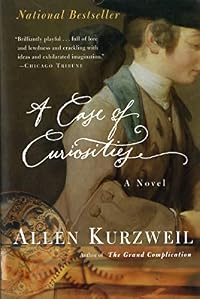
A Case of Curiosities
by Allen Kurzweil
On This Page
Description
This tale of an ambitious inventor in France as the Revolution looms is "brilliantly playful...full of lore and lewdness" ( Chicago Tribune ). "A portrait of a young mechanical genius in 18th-century France, delivered along with a gallimaufry of odd and intriguing facts and a rich, lusty picture of society in that time and place." - Publishers Weekly In France, on the eve of the Revolution, a young man named Claude Page sets out to become the most ingenious and daring inventor of his time. show more Over the course of a career filled with violence and passion, Claude learns the arts of enameling and watchmaking from an irascible, defrocked abbe , then apprentices himself to a pornographic bookseller and applies his erotic erudition to the seduction of the wife of an impotent wigmaker. But it is Claude's greatest device-a talking mechanical head-that both crowns his career and leads to an execution as tragic as that of Marie Antoinette, and far more bizarre. "Like a joint effort by Henry Fielding and John Barth" ( Chicago Tribune ), this "captivating novel" ( San Francisco Chronicle ) marked the debut of one of the finest literary artists of our time. " A Case of Curiosities ... really is brilliant. Also witty, learned, ingenious, sly, and bawdy." - Entertainment Weekly "What John Fowles did for the 19th century with The French Lieutenant's Woman and Umberto Eco did for the 14th with The Name of the Rose ... Kurzweil now does for the late 18th century." - San Francisco Chronicle show lessTags
Recommendations































Member Reviews
A great read: French history, watch- and gadget-making (and all books are one book: it and the just-read Invention of Hugo Cabret each deal with automata). Pleasantly geeky, with cases of curiosities and commonplace books. The kind of faux literary-historical novel that delights me.
My reaction to this book was rather mixed. Set in 18th-century France, it's the tale of Claude Page, son of an herbalist/healer, whose initial notoriety is that he bears a wart on his hand that resembles the king. A physician offers to remove it--but takes Claude's finger as well. Claude is sent to live with the Abbé, an atheistic dilettante, who recognizes the boy's talent for drawing and promises to educate him. However, Claude's main duties involve painting risqué scenes inside watch cases for the Abbé's clientele. When he discovers a talent for mechanical movement, he longs to be free to study the craft. Eventually, he ends up in Paris--but things do not work out quite as planned.
I found many of the characters to be both quirky show more and unique, but the overall pacing seems to be off. I was engaged in Claude's life in Tournay and his early employment with the Abbé, but there were times when the story dragged or felt repetitive. Things picked up when he got to Paris, but, again, I found myself getting bored, especially with all the descriptions of mechanical devices and equipment. show less
I found many of the characters to be both quirky show more and unique, but the overall pacing seems to be off. I was engaged in Claude's life in Tournay and his early employment with the Abbé, but there were times when the story dragged or felt repetitive. Things picked up when he got to Paris, but, again, I found myself getting bored, especially with all the descriptions of mechanical devices and equipment. show less
The aptly named author (Kurzweil, German and Jewish (Ashkenazic): nickname for a joker, from German Kurzweil 'pastime') crafts a rich tale whose protagonist, mechanician/pornographer Claude Page is only one of many curious characters. In short, it reads like a semi-pornographic Great Expectations set in the stink and song of Pre-Revolutionary France. Although the gears of the plot sometimes show through, it is ultimately delivered by its sheer cleverness.
This playful tale, of a young boy who is a mechanist, a pornographer, and an assistant bookseller in 18th century Europe, France in particular, is beautiful in both style and substance. Kurzweil creates a cast of memorable characters, richly portrayed, who are emotionally relatable even as the tale, ostensibly historical fiction, veers into wild and almost imaginary territory. An enjoyable read and one that will reward re-reading.
I found this book tried to be too clever. I thought maybe it's just my age, and that i might have enjoyed it more 20 years ago when i knew less and was more impressed by clever things - but i found a bookmark from 20 years ago which reminded me that back then i didn't have the patience for the slow pace.
Allen is a cousin of Ray Kurtweil, a true genius. This book pretends to be a retelling of the journal and collection of a genius from a century ago, but it isn't careful enough to feel like history, and it isn't smart enough to feel like genius.
I liked the characters though. Nobody there to fall in love with, nothing happened to be afraid about, but they would have been great friends to hang out with in 19th century Paris.
Allen is a cousin of Ray Kurtweil, a true genius. This book pretends to be a retelling of the journal and collection of a genius from a century ago, but it isn't careful enough to feel like history, and it isn't smart enough to feel like genius.
I liked the characters though. Nobody there to fall in love with, nothing happened to be afraid about, but they would have been great friends to hang out with in 19th century Paris.
Some books can only be described as food is described; this one piquent, long aftertaste of not quite soft pear. Young Page, growing up in France just before the revolution, has a gift for creating mechanical, fanciful works. He started with watches and crowned his career with the creation of a talking, mechanical Turk. Claude Page is interesting enough; but the characters surrounding him are also , helping and hindering, brilliantly alive, Just yummy.
Kurzweil presents a chaotic 18th century, convulsed by social change, revolution and scientific discovery, in which various people seek frameworks for understanding their world. Now we use the Linnaean system for plants or the democracy / autocracy / theocracy etc system of distinction for governance without too much thought about the derivation of these easy frameworks or of their relevance or utility. It is useful to have them and we use them. This novel is structured around one such framework, a box with several chambers, each containing an artefact representative of an important phase in a person's life, in this case of Claude's life, the novel's main character. This is a well written, interesting and informative novel, one that I show more found captivating in many ways. Why didn't I give it 5 stars - I don't really know; perhaps I'll return to increase this rating on consideration, it really is that good. show less
Members
- Recently Added By
Author Information

7+ Works 2,570 Members
Allen Kurzweil is the author of A Case of Curiosities and The Grand Complication. He lives with his wife and son in Providence, Rhode Island
Some Editions
Series
Belongs to Publisher Series
Common Knowledge
- Canonical title
- A Case of Curiosities
- Original title
- A Case of Curiosities
- Original publication date
- 1992
- People/Characters
- Claude Page
- Important places
- Paris, France; Tournay, Occitanie, France
- Dedication
- For Nangala
- First words
- The case of curiosities came into my possession at a Paris auction in the spring of 1983.
- Last words
- (Click to show. Warning: May contain spoilers.)I let the facts take hold of me.
- Original language*
- Engels
*Some information comes from Common Knowledge in other languages. Click "Edit" for more information.
Classifications
Statistics
- Members
- 811
- Popularity
- 33,934
- Reviews
- 14
- Rating
- (3.79)
- Languages
- 10 — Dutch, English, Finnish, French, German, Italian, Japanese, Portuguese, Spanish, Swedish
- Media
- Paper, Ebook
- ISBNs
- 27
- ASINs
- 8