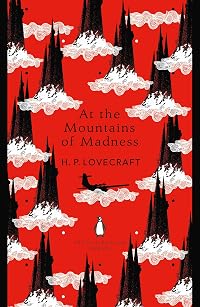
At the Mountains of Madness [novella]
by H. P. Lovecraft
On This Page
Description
A large scale and much publicized expedition to Antarctica is about to take place. While excitement runs high in the scientific community over this expedition, one geologist tries his hardest to stop the trip from ever happening. This is because William Dyer has been to Antarctica on an expedition before, and knows of the unspeakable horrors that lie in its frigid terrain. Dyer goes into explaining that during his last trip, he and another small group led by Professor Lake, encountered show more ancient alien life forms dubbed The Elder Things. Told from Dyers perspective, this story goes into detail of Dyer's fatal encounters with the aliens in Antarctica and how this new expedition will surely end in nothing but more tragedy. show lessTags
Recommendations


































Member Recommendations
MarcusH H.P. Lovecraft's novella calls about the desolation of the Antarctic to create a sense of terror in the reader. Simmons' novel also calls upon the desolation of the Arctic to create a similar sense of suspense. Simmons' novel is much lengthier and does not rely on fantasy as Lovecraft does. The Terror is more horror, but it still shares the great tradition of suspense with Lovecraft's writing.

artturnerjr An important (albeit somewhat lightweight) precursor to the classic Lovecraft tale.


artturnerjr Smith's tale seems to have been at least partly inspired by his friend Lovecraft's novel, which he read in manuscript before it was published.
Member Reviews
One of the most complete feeling Lovecraft stories, but still falls into the trap of being a post-event narration which although a common contemporary format to Lovecraft, serves to diffuse most of the tension of the story itself. The cosmic horror is supposed to come from the revelations of powerful forces beyond our comprehension hiding beneath a thin veil of ignorance, ready to reclaim the earth and level mankind's petty accomplishments. Unfortunately for the horror, the eldritch horror at the core of this story is sympathetic, and even the narrator points this out.
"At the Mountains of Acute Boredom" wäre der passendere Titel gewesen. Ich liebe die mir bekannten Kurzgeschichten Lovecrafts, aber das hier ist ein Desaster durch und durch. Ich hatte stellenweise den Eindruck, die Broschüre eines Maklers für Wohnungen in Monsterhausen zu lesen, dermaßen geschwätzig überdetailliert habe ich die Beschreibungen (die sich in ständigen Wiederholungen ergehen) der Stadt in den Bergen empfunden (die Passagen zu Beginn der Expedition waren auch nicht viel besser). Auf soetwas wie Atmosphäre, interessante Handlung etc. habe ich dagegen leider vergeblich gewartet, vor lauter Innenarchitektur wurden diese Aspekte der Geschichte wohl total vergessen. Den Abbruch hab ich mir nur verkniffen, weil ich ob des show more großen Autors bis kurz vor Schluß auf einen Moment gehofft habe, für den die Quälerei sich gelohnt hätte. Vergeblich, wie ich feststellen musste. show less
A fellow DEEP ONES reader suggested "At the Mountains of Madness" is the central Mythos tale, providing the most consistent and comprehensive alternative history of Earth as envisioned by HPL. After reading, I admit to a more favourable impression with the "deep time" history than with the tale itself, though I did enjoy acquainting myself with a classic of the genre. The expedition's visit to the austral plateau, not to mention the tomb-like ruined city, did have its share of memorable moments. The strongest impression was less of horror than of pathos from watching a fellow human driven insane.
A central point of tension operating in the story: Dyer must provide sufficient detail and force of argument to persuade other expeditions that show more further investigation is too dangerous. Yet the better he meets this objective, the more he contradicts his purpose in that the threat becomes that much more alluring a mystery! All of this telegraphs an insidious message to the reader: of course humanity won't be able to resist, of course we will unleash this horror upon all of us, we're all doomed. I think that's quite clever of HPL, actually, another layer of horror behind the "splashy" horror of direct description, and more effective.
I was unfamiliar with Nicholas Roerich, whose paintings HPL remarks several times in the story. They do have a suggestion of the sublime about them, conveyed even through online images. show less
A central point of tension operating in the story: Dyer must provide sufficient detail and force of argument to persuade other expeditions that show more further investigation is too dangerous. Yet the better he meets this objective, the more he contradicts his purpose in that the threat becomes that much more alluring a mystery! All of this telegraphs an insidious message to the reader: of course humanity won't be able to resist, of course we will unleash this horror upon all of us, we're all doomed. I think that's quite clever of HPL, actually, another layer of horror behind the "splashy" horror of direct description, and more effective.
I was unfamiliar with Nicholas Roerich, whose paintings HPL remarks several times in the story. They do have a suggestion of the sublime about them, conveyed even through online images. show less
As with every book in the category A Book That Scares You: no, it didn't. Plenty of movies have made me jump and kept me awake at night; I've yet to experience the same level of fear from a book.
It may just be me, because At the Mountains of Madness is a well-written story filled with mythological creatures and darkly hinted at dangers. Tension builds through deliberate pacing and rich details which divert attention from the unfolding horror. H.P. Lovecraft builds a fantastical world at the South Pole and sends a naive team of university scientists there on a geological survey in 1930. Their ensuing disaster is recounted by Dr. William Dyer, one of the survivors, and takes the form of a plea against subsequent trips.
Dr. Dyer provides show more many of the facts hidden from the public when the team's discovery of an ancient civilization was first broadcast to the world. His account conveys first the excitement, then the terror, as most of the team is mysteriously killed at a remote site. He and the survivors fly to the scene of the tragedy to investigate what is at first described as a windstorm of horrific destructive power. Leaving part of the team there, Dyer and a graduate student named Danforth fly further into the mountains, where they spend sixteen harrowing hours in what they believe to be a deserted city of rock. As they descend into the underground labyrinth, they interpret the murals which both decorate the city and tell its history. Despite the revelation of the dangers ahead, the men push on, driven by morbid curiosity. Danforth is so traumatized by their final encounter that he suffers a nervous breakdown and leaves us maddeningly ignorant of what he saw.
Despite its novella length, At the Mountains of Madness is rich in details and ideas and better written than much of the science fiction I've read. show less
It may just be me, because At the Mountains of Madness is a well-written story filled with mythological creatures and darkly hinted at dangers. Tension builds through deliberate pacing and rich details which divert attention from the unfolding horror. H.P. Lovecraft builds a fantastical world at the South Pole and sends a naive team of university scientists there on a geological survey in 1930. Their ensuing disaster is recounted by Dr. William Dyer, one of the survivors, and takes the form of a plea against subsequent trips.
Dr. Dyer provides show more many of the facts hidden from the public when the team's discovery of an ancient civilization was first broadcast to the world. His account conveys first the excitement, then the terror, as most of the team is mysteriously killed at a remote site. He and the survivors fly to the scene of the tragedy to investigate what is at first described as a windstorm of horrific destructive power. Leaving part of the team there, Dyer and a graduate student named Danforth fly further into the mountains, where they spend sixteen harrowing hours in what they believe to be a deserted city of rock. As they descend into the underground labyrinth, they interpret the murals which both decorate the city and tell its history. Despite the revelation of the dangers ahead, the men push on, driven by morbid curiosity. Danforth is so traumatized by their final encounter that he suffers a nervous breakdown and leaves us maddeningly ignorant of what he saw.
Despite its novella length, At the Mountains of Madness is rich in details and ideas and better written than much of the science fiction I've read. show less
Up to now, I had avoided reading (or in this case, listening to) Lovecraft, mainly because I thought he probably fell into the 'cheesy' &/or grisly horror genre. True, he writes horror, but I was very pleasantly surprised at how erudite his writing is. I know he is traditionally well-loved among geeky circles & now I see why -- his writing is smart, filled with scientific references (making the horror of his stories seem scientifically-authenticated), & quite compelling. I thoroughly enjoyed his extension of Poe's Pym novel (to which he makes direct reference) & thought he brought the story through a very satisfying arc & ending. Definitely recommended, esp. if you've read Poe's Pym or are looking for a sort-of 1920s/1930s throwback show more story of adventure/science/horror. I plan to read more of Lovecraft's work. show less
Having now read this, I can see the inspiration for at least two horror films. The first is The Thing which, in terms of its Antarctic setting, terror of the inexplicable and decimation of an expedition, is a simple copy of the book. The second is Alien with its terrifying depiction of another world which, to the detriment of those who discover it, is not quite as dead as it first appears. For such a short book, it wields some weight.
The narrator is attempting to warn a forthcoming Antarctic expedition of the annihilation that almost certainly awaits them should they venture where he himself has gone before. He has not spoken in detail of his horrifying experiences before out of fear, doubt and sheer unspeakability. But now, with his show more fellow explorers preparing for a trek to their doom, he feels he has to speak out and tell what befell all but a few of those who explored the Mountains of Madness.
Had this been written 50 years earlier than its 1931 publication, it would have been less convincing. But by the time Lovecraft wrote it, not only had the South Pole been reached, horror literature had shed a little more of its Gothic trappings. Of course, H.G. Wells should be credited with inspiring almost an entire body of literature with his superb canon, but Lovecraft writes with a lucid reality that evokes the very real terror you can feel in later horror writers with Stephen King’s The Shining a prime example.
Discovering inadvertently frozen alien beings and a mountain range surpassing anything hitherto known on earth, a forward party of the narrator’s expedition retires for the night. They are never heard from again. The narrator journeys to discover the truth: all have perished in mysterious circumstances. Exploring the mountains themselves, the narrator manages to cross the range via a pass in his aircraft. This brings him to what appears to be a deserted city the like of which he can barely describe. Exploring this brings him and his companion face to face with their worst nightmares…
I was prepared for something much more drearily verbose and mundane and was pleased to find that this was just about the right length and that Lovecraft had done an excellent job at telling just enough of the detail to keep me turning page after page. Very influential and highly readable. What’s more, it provided me with one of the most esoteric quotes I think I’ve ever collected: “The penguins alone could not have saved us…” show less
The narrator is attempting to warn a forthcoming Antarctic expedition of the annihilation that almost certainly awaits them should they venture where he himself has gone before. He has not spoken in detail of his horrifying experiences before out of fear, doubt and sheer unspeakability. But now, with his show more fellow explorers preparing for a trek to their doom, he feels he has to speak out and tell what befell all but a few of those who explored the Mountains of Madness.
Had this been written 50 years earlier than its 1931 publication, it would have been less convincing. But by the time Lovecraft wrote it, not only had the South Pole been reached, horror literature had shed a little more of its Gothic trappings. Of course, H.G. Wells should be credited with inspiring almost an entire body of literature with his superb canon, but Lovecraft writes with a lucid reality that evokes the very real terror you can feel in later horror writers with Stephen King’s The Shining a prime example.
Discovering inadvertently frozen alien beings and a mountain range surpassing anything hitherto known on earth, a forward party of the narrator’s expedition retires for the night. They are never heard from again. The narrator journeys to discover the truth: all have perished in mysterious circumstances. Exploring the mountains themselves, the narrator manages to cross the range via a pass in his aircraft. This brings him to what appears to be a deserted city the like of which he can barely describe. Exploring this brings him and his companion face to face with their worst nightmares…
I was prepared for something much more drearily verbose and mundane and was pleased to find that this was just about the right length and that Lovecraft had done an excellent job at telling just enough of the detail to keep me turning page after page. Very influential and highly readable. What’s more, it provided me with one of the most esoteric quotes I think I’ve ever collected: “The penguins alone could not have saved us…” show less
I got about a 1/3rd of the way through this before I lost my mind. Not because of cthulhu horrors, but because the way its written drove me crazy. I swear HP spent 3-4 pages describing a building, and like he just used a thesaurus for every neat word he could think of and crammed it into the sentence. It was mind numbingly bored. I was too confused, bored, and distracted to be scared. I do not recommend this, sadly. I read that some people love it, I am not one of those people.
Members
- Recently Added By
Lists

Best Horror Books
281 works; 85 members

Best Science Fiction Novels
816 works; 430 members

Weird and Weirder Fiction
270 works; 33 members

NPR Reader Poll: 100 Best Horror Novels and Stories
100 works; 20 members

Scary Stories for the Season
160 works; 94 members

A Syllabus and Book List for Novice Students of Science Fiction Literature
25 works; 11 members
Survey of Classic Science Fiction
171 works; 48 members

Top Five Books of 2013
1,562 works; 715 members
Stephen King's Biggest Influences
46 works; 3 members
Cawthorn and Moorcock's Fantasy: The 100 Best Books
110 works; 7 members
Paste's 50 Best Horror Novels of All time
50 works; 6 members

The 5 Parsec Shelf
50 works; 7 members
Reedsydiscovery 100 Best Horror Books of All Time
100 works; 5 members

Winter Books
127 works; 16 members

Isaac Arthur’s Book Recommendations
98 works; 3 members

Genre Benders: Science Fiction + Horror
15 works; 4 members

Literary and artistic references in HBO's Lovecraft Country
32 works; 1 member

The League of Extraordinary Gentlemen
87 works; 4 members
Horror Writers Association Reading List (1996)
40 works; 3 members

Favourite Books
1,819 works; 309 members

Books Read in 2014
2,343 works; 89 members

1,001 BYMRBYD Concensus
723 works; 27 members

1930s
262 works; 5 members

Books Read in 2021
5,361 works; 114 members
Overdue Podcast
806 works; 9 members

Books Read in 2020
4,379 works; 124 members

Blue Pyramid 1,276 Best Books of All Time
1,248 works; 32 members

Books Cited in Wasteland by W. Scott Poole
120 works; 1 member

Best Horror Mega-List
342 works; 6 members
Talk Discussions
Past Discussions
At the Mountains of Madness DLE (Signed by the Illustrator) in Easton Press Collectors (September 2022)
Author Information

1,925+ Works 73,892 Members
Howard Phillips Lovecraft, 1890 - 1937 H. P. Lovecraft was born on August 20, 1890 in Providence, Rhode Island. His mother was Sarah Susan Phillips Lovecraft and his father was Winfield Scott Lovecraft, a traveling salesman for Gorham & Co. Silversmtihs. Lovecraft was reciting poetry at the age of two and when he was three years old, his father show more suffered a mental breakdown and was admitted to Butler Hospital. He spent five years there before dying on July 19, 1898 of paresis, a form of neurosyphillis. During those five years, Lovecraft was told that his father was paralyzed and in a coma, which was not the case. His mother, two aunts and grandfather were now bringing up Lovecraft. He suffered from frequent illnesses as a boy, many of which were psychological. He began writing between the ages of six and seven and, at about the age of eight, he discovered science. He began to produce the hectographed journals, "The Scientific Gazette" (1899-1907) and "The Rhode Island Journal of Astronomy" (1903-07). His first appearance in print happened, in 1906, when he wrote a letter on an astronomical matter to The Providence Sunday Journal. A short time later, he began writing a monthly astronomy column for The Pawtuxet Valley Gleaner - a rural paper. He also wrote columns for The Providence Tribune (1906-08), The Providence Evening News (1914-18), The Asheville (N.C.) Gazette-News (1915). In 1904, his grandfather died and the family suffered severe financial difficulties, which forced him and his mother to move out of their Victorian home. Devastated by this, he apparently contemplated suicide. In 1908, before graduating from high school, he suffered a nervous breakdown. He didn't receive a diploma and failed to get into Brown University, both of which caused him great shame. Lovecraft was not heard from for five years, re-emerging because of a letter he wrote in protest to Fred Jackson's love story in The Argosy. His letter was published in 1913 and caused great controversy, which was noted by Edward F. Daas, President of the United Amateur Press Association (UAPA). Daas invited Lovecraft to join the UAPA, which he did in early 1914. He eventually became President and Official Editor of the UAPA and served briefly as President of the rival National Amateur Press Association (NAPA). He published thirteen issues of his own paper, The Conservative (1915-23) and contributed poetry and essays to other journals. He also wrote some fiction which titles include "The Beast in the Cave" (1905), "The Alchemist" (1908), "The Tomb" and "Dagon" (1917). In 1919, Lovecraft's mother was deteriorating, mentally and physically, and was admitted to Butler Hospital. On May 24, 1921, his mother died from a gall bladder operation. While attending an amateur journalism convention in Boston, Lovecraft met his future wife Sonia Haft Greene, a Russian Jew. They were married on March 3, 1924 and Lovecraft moved to her apartment in Brooklyn. Sonia had a shop on Fifth Avenue that went bankrupt. In 1925, Sonia went to Cleveland for a job and Lovecraft moved to a smaller apartment in the Red Hook district of Brooklyn. In 1926, he decided to move back to Providence. Lovecraft had his aunts bar his wife, Sonia, from going to Providence to start a business because he couldn't have the stigma of a tradeswoman wife. They were divorced in 1929. After his return to Providence, he wrote his greatest fiction, which included the titles "The Call of Cthulhu" (1926), "At the Mountains of Madness" (1931), and "The Shadow Out of Time" (1934-35). In 1932, his aunt, Mrs. Clark, died; and he moved in with his other aunt, Mrs. Gamwell, in 1933. Suffering from cancer of the intestine, Lovecraft was admitted to Jane Brown Memorial Hospital and on March 15, 1937 he died. (Bowker Author Biography) show less
Some Editions
Awards and Honors
Notable Lists
Greatest Books algorithm (1362)
Series
Belongs to Publisher Series
Biblioteca HPL (2)
Work Relationships
Is contained in
H. P. Lovecraft, Gesammelte Werke: Gebunden in feingeprägter Leinenstruktur auf Naturpapier aus Bayern. Mit Goldprägung (Anaconda Gesammelte Werke 45) (German Edition) by H. P. Lovecraft (indirect)
The Arkham Edition of H. P. Lovecraft: Five Classics of Horror and the Supernatural by H. P. Lovecraft (indirect)
At the Mountains of Madness and Other Weird Tales (Barnes & Noble Library of Essential Reading) by H. P. Lovecraft
Is retold in
Has the adaptation
Was inspired by
Inspired
Common Knowledge
- Canonical title
- At the Mountains of Madness [novella]
- Original title
- At the Mountains of Madness
- Original publication date
- 1936
- People/Characters
- William Dyer (geologist/leader, Pabodie Antarctic Expedition); Danforth (graduate student, Pabodie Antarctic Expedition); Frank H. Pabodie (engineer, Pabodie Antarctic Expedition); Lake (biologist, Pabodie Antarctic Expedition); Atwood (physicist/meteorologist, Pabodie Antarctic Expedition); J. B. Douglas (Captain of the brig "Arkham") (show all 7); Georg Thorfinnsen (Captain of the barque "Miskatonic")
- Important places
- Antarctica; Ross Island, Antarctica
- Important events
- Pabodie Antarctic Expedition (1931-1932)
- First words
- I am forced into speech because men of science have refused to follow my advice without knowing why.
- Quotations*
- Hunde werden unruhig, während wir arbeiten, empfinden anscheinend Abscheu vor Speckstein.
- Last words
- (Click to show. Warning: May contain spoilers.)At the time, his shrieks were confined to the repetition of a single, mad word of all too obvious source: "Tekeli-li! Tekeli-li!".
- Original language
- English
- Canonical DDC/MDS
- 813.52
- Canonical LCC
- PS3523.O833
- Disambiguation notice
- This work is for the standalone novella. Please do not combine with works containing collections of other stories.
*Some information comes from Common Knowledge in other languages. Click "Edit" for more information.
Classifications
Statistics
- Members
- 1,506
- Popularity
- 15,334
- Reviews
- 53
- Rating
- (3.64)
- Languages
- 16 — Catalan, Czech, Danish, Dutch, English, Estonian, French, German, Greek, Hungarian, Italian, Polish, Portuguese, Spanish, Swedish, Turkish
- Media
- Paper, Audiobook, Ebook
- ISBNs
- 165
- UPCs
- 1
- ASINs
- 59