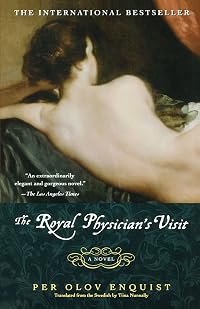
The Royal Physician's Visit
by Per Olov Enquist
On This Page
Description
A handsome doctor stirs up scandal in the eighteenth-century Danish royal court in this "extraordinarily elegant and gorgeous novel" (Los Angeles Times).The Royal Physician's Visit magnificently recasts the dramatic era of Danish history when Johann Friedrich Struensee—court physician to mad young King Christian—stepped through an aperture in history and became the holder of absolute power in Denmark. His is a gripping tale of power, sex, love, and the life of the mind, and it is show more superbly rendered here by Sweden's most acclaimed writer.
A charismatic German doctor and brilliant intellectual, Struensee used his influence to introduce hundreds of reforms in Denmark in the 1760s and had a tender and erotic affair with Queen Caroline Mathilde, who was unsatisfied by her unstable, childlike husband. And yet, his ambitions ultimately led to tragedy. This novel, perfect for book clubs, is a compelling look into the intrigues of an Enlightenment court and the life of a singular man.
"An enthralling fable of the temptations of power—and a surprisingly poignant love story," —Time
"Realized with a vividness and subtlety that place the book in the front ranks of contemporary literary fiction," —The New York Times Book Review
"The Swedish novelist's method is to begin 10 years after Struensee's fall, then retrace the "Struensee era," as it came to be called, by probing the characters of four principal players—Christian, Guldberg, Struensee, and Queen Caroline Mathilde—each of whose perspectives, even the king's, he makes intelligible and occasionally even sympathetic. A towering achievement," —Booklist. show less
Tags
Recommendations
























Member Recommendations

rrmmff2000 Covers another later period of Danish royal history, complete with its own machinations and intrigues.


Member Reviews
The life of the unfortunate Christian VII of Denmark (1749-1808) has long excited the curiosity of writers of all complexions, from Goethe to Dario Fo, although - despite the fact that one of the main characters was British - it doesn't seem to have been done very often in English yet (The lost queen (1969), by Norah Lofts is the only English version mentioned in the list on Wikipedia).
As Enquist tells it, the central characters are Christian himself, an intermittently lucid, mentally-disturbed young man who has become king at the age of 16 and been married shortly thereafter to an even younger English princess in whom he has no interest whatsoever; the queen, who is making up for a very sheltered upbringing by discovering the sexual show more power she can exert in her new role; Struensee, the idealistic young German physician (keen reader of Holberg and Rousseau) who accidentally finds himself in a position to deputise for the king, both in the queen's bed and in attempting to drag the backward and corrupt kingdom of Denmark kicking and screaming into the 18th century; and - naturally - an éminence grise, Guldberg, who is scheming against all of them. And equally naturally, it all ends in tears, as Enquist is clearly expecting it to.
Enquist is particularly interested in the opposition between the open, optimistic, and politically-naive Struensee and the secretive, vengeful and moralistic Guldberg, as expressed in the ways that both of them establish bonds with the confused and frightened Christian and react in their different ways to the potent sexuality (Enquist clearly insists on there being potent sexuality, even if that's not something you normally associate with Hannoverians...) of Caroline Matilda. This all gets tied in clever ways into the political currents of late 18th century Europe - the lofty ideals of the Enlightenment philosophes compromised by their association with people like Catherine of Russia and Frederick of Prussia, the cynical aristocrats who run Denmark for their own benefit and are happy to have a powerless king, the peasants whom nobody really cares about in practice...
Entertaining and well-written, but maybe a bit too predictable. show less
As Enquist tells it, the central characters are Christian himself, an intermittently lucid, mentally-disturbed young man who has become king at the age of 16 and been married shortly thereafter to an even younger English princess in whom he has no interest whatsoever; the queen, who is making up for a very sheltered upbringing by discovering the sexual show more power she can exert in her new role; Struensee, the idealistic young German physician (keen reader of Holberg and Rousseau) who accidentally finds himself in a position to deputise for the king, both in the queen's bed and in attempting to drag the backward and corrupt kingdom of Denmark kicking and screaming into the 18th century; and - naturally - an éminence grise, Guldberg, who is scheming against all of them. And equally naturally, it all ends in tears, as Enquist is clearly expecting it to.
Enquist is particularly interested in the opposition between the open, optimistic, and politically-naive Struensee and the secretive, vengeful and moralistic Guldberg, as expressed in the ways that both of them establish bonds with the confused and frightened Christian and react in their different ways to the potent sexuality (Enquist clearly insists on there being potent sexuality, even if that's not something you normally associate with Hannoverians...) of Caroline Matilda. This all gets tied in clever ways into the political currents of late 18th century Europe - the lofty ideals of the Enlightenment philosophes compromised by their association with people like Catherine of Russia and Frederick of Prussia, the cynical aristocrats who run Denmark for their own benefit and are happy to have a powerless king, the peasants whom nobody really cares about in practice...
Entertaining and well-written, but maybe a bit too predictable. show less
The royal physician of the title is a man called Struensee, and the visit refers to the time he spent as effective regent of Denmark in 1771 and 1772, pushing through a vast swathe of Enlightenment-inspired reforms.
I knew nothing about this period of history before reading this. But even so I could tell that this was an inspired reimagining. Enqvist takes the dry historical record, and adds the passion back in - fear, betrayal, guilt. (The book is full of madness of different kinds, from broken-willed feeble-mindedness to a lust for power and control.) The narrative is laced with references to contemporary records which each give us glimpses of the extreme and chaotic events, but it's the passion and madness and theatre which start to show more make sense of them.
This might make the book sound like a historical romp, which it isn't. It's dense with images and metaphor, yet Enqvist maintains a dry and oracular tone throughout, as if he is trying to make rational sense of what happened - even though the book as a whole suggests that nothing in history makes sense if you ignore the human emotions involved. show less
I knew nothing about this period of history before reading this. But even so I could tell that this was an inspired reimagining. Enqvist takes the dry historical record, and adds the passion back in - fear, betrayal, guilt. (The book is full of madness of different kinds, from broken-willed feeble-mindedness to a lust for power and control.) The narrative is laced with references to contemporary records which each give us glimpses of the extreme and chaotic events, but it's the passion and madness and theatre which start to show more make sense of them.
This might make the book sound like a historical romp, which it isn't. It's dense with images and metaphor, yet Enqvist maintains a dry and oracular tone throughout, as if he is trying to make rational sense of what happened - even though the book as a whole suggests that nothing in history makes sense if you ignore the human emotions involved. show less
[The Royal Physician's Visit] by [[Per Olov Enquist]]
This was a very interesting historical fiction novel about 18th century Denmark. King Christian is not quite right in the head and married off to young Caroline Mathilde, sister to King George III of England. Because of his madness, there is a power vacuum around him and a German doctor, Struensee, who is brought in to tend to his illness ends up taking the reins. Struensee is an avid believer in the Enlightenment movement. The King ends up trusting him and signing hundreds of documents changing the government to reflect Enlightenment principles. Struensee also ends up having an affair, and a child, with the young Queen. This all happens over the course of a few years. Of course, no show more one who isn't the King can wield that much power alone without repercussions. Struensee sees it coming, but isn't able to stop it.
I always like good historical fiction and this qualifies. I particularly liked the tone of this book. It's written in terse, reporter-like sentences. The short sentences give a lot of forward momentum and also opportunities for brief and often wry observations. The tone stays rather cold through all the heated politics and the rather steamy affair. I really liked the contrast between the dramatic events and, for lack of a better term, cold writing. I imagine it might not be for everyone, but it worked for me. show less
This was a very interesting historical fiction novel about 18th century Denmark. King Christian is not quite right in the head and married off to young Caroline Mathilde, sister to King George III of England. Because of his madness, there is a power vacuum around him and a German doctor, Struensee, who is brought in to tend to his illness ends up taking the reins. Struensee is an avid believer in the Enlightenment movement. The King ends up trusting him and signing hundreds of documents changing the government to reflect Enlightenment principles. Struensee also ends up having an affair, and a child, with the young Queen. This all happens over the course of a few years. Of course, no show more one who isn't the King can wield that much power alone without repercussions. Struensee sees it coming, but isn't able to stop it.
I always like good historical fiction and this qualifies. I particularly liked the tone of this book. It's written in terse, reporter-like sentences. The short sentences give a lot of forward momentum and also opportunities for brief and often wry observations. The tone stays rather cold through all the heated politics and the rather steamy affair. I really liked the contrast between the dramatic events and, for lack of a better term, cold writing. I imagine it might not be for everyone, but it worked for me. show less
Reading historical novels like this one, I find myself wondering why I don’t delve into this genre more often. Enqvist’s book is well-researched, opens up a part of my regional history I had no idea of - and reads like a thriller.
In Denmark in the middle of the 18th century, the nobility is holding the power. A string of weak kings, more interested in drinking and sleeping around than ruling, have in practice left the reins to the people around them. Strong powers of course wishes things remain this way. Therefor focus on the upbringing of the young Christian is on breaking him down. It’s quite horrid the brutal and contradictory treatment he goes through, and by the time he as a teenager inherits the throne he is psychotic and show more paranoid, broken and scared.
A Royal Physician is hired, with the specific task of looking after the king. The German Struensee is reluctant at first, but soon realizes the potential in this spot. Struensee is very involved in the Enlightenment movement, and after winning the king’s trust and channeling it through him, he quietly and methodically starts a Danish Revolution from his desk. He is changing things radically – cutting down funds for the army, giving legal rights to bastard children, reducing taxes, intorcucing freedom of speech. And he strikes up a strange friendship with the troubled young king, who is all too thankful to have someone else doing the ruling.
The other two major players in this novel are the young queen Caroline Mathilde, youngest sister to the mad king George of England, who is thrown into this retarded little backwater country and given a husband who is insane – but who realizes she is both capable and eager to exercise power. She becomes Struensee’s strongest ally, and his lover. And finally Guldberg, an upstart at the court, from common background like Struensee, but one who is working his influence on the other side of things. The reaction that is bound to come towards the ungodly conduct of the dirty English harlot and her German lover. The future, when everything is to be set right again.
Enqvist has a tone telling this mind-boggling story of philosophy, madness, idealism and power that invokes absolute confidence. There's no doubt this book is very well researched. But even when he must be guessing, he is utterly believable in his low-key matter of fact style, which still lends itself to a kind of poetry. The characters are wonderfully drawn in frailty and complexity. And the plot itself is often nail-biting and chilling suspense, even if the inevitable, tragic outcome is clear from the get-go.
A warning that there are some disturbing elements here –including cruelty to children. But if that doesn’t deter you, this is a read I’ll heartily recommend to anyone interested in historical fiction. show less
In Denmark in the middle of the 18th century, the nobility is holding the power. A string of weak kings, more interested in drinking and sleeping around than ruling, have in practice left the reins to the people around them. Strong powers of course wishes things remain this way. Therefor focus on the upbringing of the young Christian is on breaking him down. It’s quite horrid the brutal and contradictory treatment he goes through, and by the time he as a teenager inherits the throne he is psychotic and show more paranoid, broken and scared.
A Royal Physician is hired, with the specific task of looking after the king. The German Struensee is reluctant at first, but soon realizes the potential in this spot. Struensee is very involved in the Enlightenment movement, and after winning the king’s trust and channeling it through him, he quietly and methodically starts a Danish Revolution from his desk. He is changing things radically – cutting down funds for the army, giving legal rights to bastard children, reducing taxes, intorcucing freedom of speech. And he strikes up a strange friendship with the troubled young king, who is all too thankful to have someone else doing the ruling.
The other two major players in this novel are the young queen Caroline Mathilde, youngest sister to the mad king George of England, who is thrown into this retarded little backwater country and given a husband who is insane – but who realizes she is both capable and eager to exercise power. She becomes Struensee’s strongest ally, and his lover. And finally Guldberg, an upstart at the court, from common background like Struensee, but one who is working his influence on the other side of things. The reaction that is bound to come towards the ungodly conduct of the dirty English harlot and her German lover. The future, when everything is to be set right again.
Enqvist has a tone telling this mind-boggling story of philosophy, madness, idealism and power that invokes absolute confidence. There's no doubt this book is very well researched. But even when he must be guessing, he is utterly believable in his low-key matter of fact style, which still lends itself to a kind of poetry. The characters are wonderfully drawn in frailty and complexity. And the plot itself is often nail-biting and chilling suspense, even if the inevitable, tragic outcome is clear from the get-go.
A warning that there are some disturbing elements here –including cruelty to children. But if that doesn’t deter you, this is a read I’ll heartily recommend to anyone interested in historical fiction. show less
This is an historical novel set in Denmark in the 1760s during the time when supporters of the Enlightenment where trying to overcome the stultifying effects of feudalism and the divine right of kings. Christian VII is a half-wit, reduced and beaten as a child to the point where he cannot distinguish reality from theatre and can only live when secure in the lines that he has been given. As a child he is married to a younger sister, Caroline Mathilde, (then 15) of George III for whom he plucks up the courage to "service" just once. The two great protagonists are Struensee, a German who becomes the court physician and embodies the ideals of the Enlightenment, and Guldberg, a scheming religious fanatic who embodies everything that the show more Enightenment opposes.
Struensee becomes the confident of the king and is given authority to issue decrees in the king's name, thus the means to effect a revolution in Denmark with the introduction of enlightened laws across the board. Struensee also becomes the lover of the Queen thus providing the opening for those opposed to his ideas, principally Guldberg and opening the way to his dowfall and execution.
Enquist has a very simple style of writing; mainly short, declaratory sentences. It complements or reflects well the stark, simple, but harsh life in Denmark in the 1700s while the effect is one of an accummulated rhythm and pace and movement to the story. It is a story of political ambition, naievity in the face of power and the effects of political turmoil, forbidden love that crosses the boundary of safety and prudence and exacts a very high price, betrayal, the diminishment, active and systemic, of human potential, and the effects of power vaccuums on a small circle of pretenders with the prize of almost unlimited power.
Each side in the larger political debate is convinced of the rightness of its position to the point that each could use the same metaphors. So, Guldberg interprets the ideas of the enlightenment as, "The black light from the torch could thus be viewed as an image of the Enemise of Purity, those who spoke of enightenment, those who spoke of light but created darkness ...the filth of life from a dream of light". While Struensee, and others, would have seen themselves very much as bringing the light of reason and humanism to the darkness of a benighted world. Struensee's greatest weakness, as the Queen comes to realize, is that he is an idealist who thinks the goodness of his actions and motives should be manifest in and of themselves and therefore joyfully accepted for the benefits they bring. He reckons without two things: the effect of sudden liberties on downtroden and uneducated masses, and the realities of political power that must underpin his efforts. As the Queen muses, "How could someone conquer the world if he was only good, and lacked the courage to be evil? How then was it possible to put a lever under the house of the world?...'Oh keep me innocent, make others great'". Even Guldberg has a moment of doubt when he realizes that though he is, in his eyes, exacting justice and vengeance in God's name in quashing the ideas of the enlightenment, there is no love nor mercy; but he overcomes that moment and continues on his path. He does, however, come to recognize that his victory is a hollow one of temporal value only as great ideas, once unleashed, cannot be quashed forever. show less
Struensee becomes the confident of the king and is given authority to issue decrees in the king's name, thus the means to effect a revolution in Denmark with the introduction of enlightened laws across the board. Struensee also becomes the lover of the Queen thus providing the opening for those opposed to his ideas, principally Guldberg and opening the way to his dowfall and execution.
Enquist has a very simple style of writing; mainly short, declaratory sentences. It complements or reflects well the stark, simple, but harsh life in Denmark in the 1700s while the effect is one of an accummulated rhythm and pace and movement to the story. It is a story of political ambition, naievity in the face of power and the effects of political turmoil, forbidden love that crosses the boundary of safety and prudence and exacts a very high price, betrayal, the diminishment, active and systemic, of human potential, and the effects of power vaccuums on a small circle of pretenders with the prize of almost unlimited power.
Each side in the larger political debate is convinced of the rightness of its position to the point that each could use the same metaphors. So, Guldberg interprets the ideas of the enlightenment as, "The black light from the torch could thus be viewed as an image of the Enemise of Purity, those who spoke of enightenment, those who spoke of light but created darkness ...the filth of life from a dream of light". While Struensee, and others, would have seen themselves very much as bringing the light of reason and humanism to the darkness of a benighted world. Struensee's greatest weakness, as the Queen comes to realize, is that he is an idealist who thinks the goodness of his actions and motives should be manifest in and of themselves and therefore joyfully accepted for the benefits they bring. He reckons without two things: the effect of sudden liberties on downtroden and uneducated masses, and the realities of political power that must underpin his efforts. As the Queen muses, "How could someone conquer the world if he was only good, and lacked the courage to be evil? How then was it possible to put a lever under the house of the world?...'Oh keep me innocent, make others great'". Even Guldberg has a moment of doubt when he realizes that though he is, in his eyes, exacting justice and vengeance in God's name in quashing the ideas of the enlightenment, there is no love nor mercy; but he overcomes that moment and continues on his path. He does, however, come to recognize that his victory is a hollow one of temporal value only as great ideas, once unleashed, cannot be quashed forever. show less
I don't know anything about the history of this novel. I can't compare it to anything factual, and I can't criticize what facts are or aren't included in the story. What I can do is look at this book as a reader and try to describe what a joy it was to read. I found the characters to be real, with the goodness or flaws of any normal human being throughout time. I found good events and bad and was faced with things happening to characters that I couldn't at all agree with, but there were also triumphs within the characters that occasionally made me smile with pride or pleasure.
I loved the writing style, putting you in to a history that your mind usually sees with detachment. It isn't often that you can read a historical novel and show more experience what is written as if it had happened before your eyes or in your recent memory, especially when there are torments and trouble involved. The Royal Physician's Visit does an excellent job bringing the feelings of the past back into the history we so often cast aside as an unemotional piece of writing on a dusty shelf. I enjoyed every page of this book. show less
I loved the writing style, putting you in to a history that your mind usually sees with detachment. It isn't often that you can read a historical novel and show more experience what is written as if it had happened before your eyes or in your recent memory, especially when there are torments and trouble involved. The Royal Physician's Visit does an excellent job bringing the feelings of the past back into the history we so often cast aside as an unemotional piece of writing on a dusty shelf. I enjoyed every page of this book. show less
4.5 Stars.
I love books that bring history to life and what an utterly fascinating and compelling read based on historical fact The Royal Phsician's Visit was. It tells the story of King Christian VII of Denmark, his young Queen Caroline Mathilda of England and his Physician Johann Friedrich Struensee and the Royal Affair that that rocked the Danish Court and brought the kingdom to the brink of revolution
In 1768, a magnetic and handsome German Physician by the name of Struensee became the physician to King Christian VII of Denmark who has been suffering from some kind of "madness" and Struensee's responsibility is to look after the king and ensure he does not appear too "mad" in public, after a short period ot time Struensee becomes the show more Kings confidant and manages to gain responsibility for reformation of the state much to the court and the Dowager Queen's dismay, however when he embarks on affair with the young Queen the whispering and rumours begin and the Royal Affair becomes the talk of Copenhagen and action needs to be taken.
I have read very little about Danish history but one book leads to another and while discussing [b:Number the Stars|47281|Number the Stars|Lois Lowry|https://images.gr-assets.com/books/1370917812s/47281.jpg|2677305] with a friend one day she recommended I watch a movie called "The Royal Affair" I am not a one for movies so I googled and found this book called the The Royal Physician's Visit and after reading the blurb I knew I had to find out more.
The story is compelling and so well researched. The account is strongly based on fact but the author does fill in the blanks quite convincingly with believable fictional dialogue and descriptions that leaves the reader in no double that he has done his research on this period in history and created a wonderful sense of time and place and a gripping tale of court intrigue, power struggles and royal affairs.
The book is translated from Swedish to English and there were a few times when I had to re-read scentances just to make sense of them and I think perhaps this may be down to the translation from Swedish to English. Having said that it didn't affect the overall enjoyment of the story.
A terrific read and a nice insight into Danish history that left me wanting more.
I did watch the film The Royal Affair after completing the book and it was superb. show less
I love books that bring history to life and what an utterly fascinating and compelling read based on historical fact The Royal Phsician's Visit was. It tells the story of King Christian VII of Denmark, his young Queen Caroline Mathilda of England and his Physician Johann Friedrich Struensee and the Royal Affair that that rocked the Danish Court and brought the kingdom to the brink of revolution
In 1768, a magnetic and handsome German Physician by the name of Struensee became the physician to King Christian VII of Denmark who has been suffering from some kind of "madness" and Struensee's responsibility is to look after the king and ensure he does not appear too "mad" in public, after a short period ot time Struensee becomes the show more Kings confidant and manages to gain responsibility for reformation of the state much to the court and the Dowager Queen's dismay, however when he embarks on affair with the young Queen the whispering and rumours begin and the Royal Affair becomes the talk of Copenhagen and action needs to be taken.
I have read very little about Danish history but one book leads to another and while discussing [b:Number the Stars|47281|Number the Stars|Lois Lowry|https://images.gr-assets.com/books/1370917812s/47281.jpg|2677305] with a friend one day she recommended I watch a movie called "The Royal Affair" I am not a one for movies so I googled and found this book called the The Royal Physician's Visit and after reading the blurb I knew I had to find out more.
The story is compelling and so well researched. The account is strongly based on fact but the author does fill in the blanks quite convincingly with believable fictional dialogue and descriptions that leaves the reader in no double that he has done his research on this period in history and created a wonderful sense of time and place and a gripping tale of court intrigue, power struggles and royal affairs.
The book is translated from Swedish to English and there were a few times when I had to re-read scentances just to make sense of them and I think perhaps this may be down to the translation from Swedish to English. Having said that it didn't affect the overall enjoyment of the story.
A terrific read and a nice insight into Danish history that left me wanting more.
I did watch the film The Royal Affair after completing the book and it was superb. show less
Members
- Recently Added By
Published Reviews
ThingScore 75
Er beleuchtet jede noch so dunkle Kammer seiner Figuren und bleibt selbst im Verborgenen. Er steht auf der Seite der Aufklärung und liebt dennoch das schaurige Geheimnis jeder seiner Personen. Denn was sollte das Licht der Rationalität anderes beleuchten wollen als sein Gegenteil: die Nacht der menschlichen Seele. Deren Faszination macht auch diesen neuen Roman Enquists zu einem wunderbaren show more Leseabenteuer, bei dem Grusel und Lust, rationale Analyse und Rausch nicht zu unterscheiden sind. show less
added by Indy133
Lists

1001 Books You Must Read Before You Die
1,448 works; 1,136 members

International IMPAC Dublin Literary Award
179 works; 6 members

Books Read in 2023
5,638 works; 147 members
Author Information

57+ Works 3,946 Members
Enquist's writing is characterized by political consciousness and an interest in the past as it affects or reflects the present. During the politicized 1960s, Enquist was a principle practitioner of documentarism. He is both an important playwright and a novelist. (Bowker Author Biography) Per Olov Enquist is one of Sweden's most acclaimed show more writers; a novelist, playwright and poet with works published in 26 countries. (Bowker Author Biography) show less
Some Editions
Awards and Honors
Awards
Distinctions
Series
Belongs to Publisher Series
Common Knowledge
- Canonical title
- The Royal Physician's Visit
- Original title
- Livläkarens besök
- Original publication date
- 1999 (Zweeds) (Zweeds)
- People/Characters
- Johan Frederic Struensee; Christian VII, King of Denmark; Caroline Matilda, Queen Consort of Denmark; Ove Høegh-Guldberg
- Important places
- Copenhagen, Denmark; Hillerød, Hovedstaden, Denmark; Hamburg, Germany; Altona, Hamburg, Germany
- Epigraph
- "Oplysning er menneskets udgang af dets selvforskyldte umyndighed. Umyndighed er manglen på evne til at bruge sin egen forstand uden en andens vejledning. Selvforskyldt er denne umyndighed, når årsagen ikke er mangel på f... (show all)orstand, men mangel på mod til at bruge forstanden. Til oplysning fordres intet andet end frihed, den frihed som indebærer i alle henseender at gøre offentlig brug af sin fornuft. Thi det er ethvert menneskes kald at tænke selv." (Immanuel Kant, 1784)
- First words
- Johan Friedrich Struensee was appointed Royal Physician to King Christian VII on April 5, 1768, and four years later he was executed.
- Quotations
- It would be a long night. First dinner. Then tea. After that the masked ball. Then the coup d’état. (Ch.14)
- Last words
- (Click to show. Warning: May contain spoilers.)And he kew that she was the Sovereign of the Universe, that she was his benefactress that she had time for him, that she had all time and that she was time.
(Click to show. Warning: May contain spoilers.)Cristiano sapeva che lei era la Sovrana dell'Universo, che era la sua benefattrice, che aveva tempo per lui, che lei aveva tutto il tempo, che lei era il tempo. - Original language
- Swedish
Classifications
- Genres
- Fiction and Literature, General Fiction, Historical Fiction
- DDC/MDS
- 839.7374 — Literature & rhetoric German & related literatures Other Germanic literatures Swedish literature Swedish fiction 1900-1999 1945-1999
- LCC
- PT9876.15 .N78 .L5813 — Language and Literature German, Dutch and Scandinavian literatures Swedish literature Individual authors or works 1961-2000
- BISAC
Statistics
- Members
- 1,367
- Popularity
- 17,499
- Reviews
- 41
- Rating
- (3.67)
- Languages
- 21 — Arabic, Czech, Danish, Dutch, English, Estonian, Finnish, French, German, Icelandic, Italian, Japanese, Korean, Latvian, Norwegian (Bokmål), Norwegian, Polish, Portuguese, Russian, Spanish, Swedish
- Media
- Paper, Audiobook, Ebook
- ISBNs
- 75
- ASINs
- 9