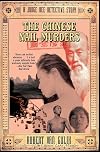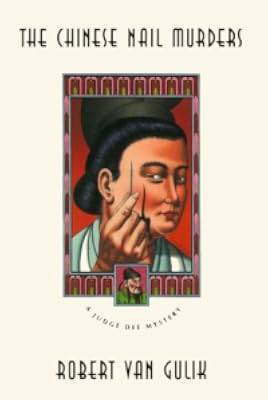
The Chinese Nail Murders
by Robert van Gulik
Judge Dee: Publication order (5), Judge Dee: Chronological order (12)
On This Page
Description
Judge Dee and his four helpers solve the murders of an honored merchant, a kindly boxing master, and a paper merchant's wife, whose corpse has no head. They succeed in spite of strong pressure on Judge Dee from higher-ups to bring his investigation, which has temporarily generated unrest among the populace, rapidly to an end or face dismissal and serious punishment. The case of the headless corpse is based on a thirteenth-century Chinese casebook; the nail murder, one of the most famous show more motifs in Chinese crime literature, is first described in the same text. "So scrupulously in the classic Chinese manner yet so nicely equipped with everything to satisfy the modern reader."—New York Times Robert Van Gulik (1910-67) was a Dutch diplomat and an authority on Chinese history and culture. He drew his plots from the whole body of Chinese literature, especially from the popular detective novels that first appeared in the seventeenth century. show lessTags
Recommendations







































Member Reviews
Robert van Gulik's Judge novels so reward the reader that it's nearly impossible to pick a favorite; however, I think that The Chinese Nail Murders may be my favorite so far.
In The Chinese Nail Murders, Judge Dee presides at the last magisterial post of his career before being promoted to the capital. That post, Pei-chow, is a bitterly frigid bastion on the untamed northern frontier of the Chinese Empire. In the novel’s first chapter, Judge Dee hears the complaint from two brothers that their sister has been beheaded and murdered by her husband, a curios merchant. Not to spoil the plot, let’s just say the case isn’t nearly as simple as that. All Judge Dee mysteries are supposed to consist of three cases, but this one actually show more includes four: two more unrelated murders — that of a cotton merchant and a boxer — and the case of a missing fiancée with some blackmail thrown in for good measure, although the crimes are intertwined. Near the end of the novel, Judge Dee’s own life becomes endangered and yet another, previously unknown crime comes to light. With so many subplots crissing and crossing, The Chinese Nail Murders gets quite suspenseful — especially the last 50 pages!
The ancient Chinese game of Seven Board plays a recurring role in the novel. In one of the cases, it even provides the solution to one of the murders.
In a rare move by author Robert van Gulik, he casts The Chinese Nail Murders, the sixth book in the Judge Dee mystery series, as a story told about Judge Dee’s exploits during the 7th century T’ang Dynasty to one brother by another, the latter the magistrate of the same district as Dee, centuries later during the Ming Dynasty. That element, with some supernatural overtones, doesn’t add anything to the main storyline.
The Chinese Nail Murders proves to be yet another delightful Judge Dee mystery. For those saddened at the thought that this novel marks the van Gulik’s final Judge Dee novel, fear not! Judge Dee novels aren’t in chronological order, so you needn’t despair that his novel — despite being set at the end of Judge Dee’s career — will be the last. Fear not! There are plenty more novels that follow! show less
In The Chinese Nail Murders, Judge Dee presides at the last magisterial post of his career before being promoted to the capital. That post, Pei-chow, is a bitterly frigid bastion on the untamed northern frontier of the Chinese Empire. In the novel’s first chapter, Judge Dee hears the complaint from two brothers that their sister has been beheaded and murdered by her husband, a curios merchant. Not to spoil the plot, let’s just say the case isn’t nearly as simple as that. All Judge Dee mysteries are supposed to consist of three cases, but this one actually show more includes four: two more unrelated murders — that of a cotton merchant and a boxer — and the case of a missing fiancée with some blackmail thrown in for good measure, although the crimes are intertwined. Near the end of the novel, Judge Dee’s own life becomes endangered and yet another, previously unknown crime comes to light. With so many subplots crissing and crossing, The Chinese Nail Murders gets quite suspenseful — especially the last 50 pages!
The ancient Chinese game of Seven Board plays a recurring role in the novel. In one of the cases, it even provides the solution to one of the murders.
In a rare move by author Robert van Gulik, he casts The Chinese Nail Murders, the sixth book in the Judge Dee mystery series, as a story told about Judge Dee’s exploits during the 7th century T’ang Dynasty to one brother by another, the latter the magistrate of the same district as Dee, centuries later during the Ming Dynasty. That element, with some supernatural overtones, doesn’t add anything to the main storyline.
The Chinese Nail Murders proves to be yet another delightful Judge Dee mystery. For those saddened at the thought that this novel marks the van Gulik’s final Judge Dee novel, fear not! Judge Dee novels aren’t in chronological order, so you needn’t despair that his novel — despite being set at the end of Judge Dee’s career — will be the last. Fear not! There are plenty more novels that follow! show less
This book is part of a delightful series. Most readers of Van Gulik read these books again: they abound in details on Chinese medieval life and the plots are always clever. This is the only book where the judge is tempted by another woman. Usually, you see him content, enjoying the company of his several wives in his courtyard, practicing calligraphy or some peaceful activity. In this book, he is more confused and less wise than in the others. So, you find Judge Dee to be less regal than usual, but the end will leave you with a touch of sadness. Hence, only 4 stars, but don't miss it.
This is a change of pace, a reread of a book I first read over 30 years ago. The Judge Dee series centers around a Chinese magistrate who lived from 630 to 700 c.e., in the Tang dynasty. The magistrate was the all purpose ruler of an area similar to a county in the United States. The regular characters in the series include Sergeant Hoong who took care of Dee since childhood, Ma Joong, Chiao Tai and Tao Gan all criminals who were won over by Judge Dee's strong character and became his lieutenants.
The series each contain three mysteries, a customary format in Chinese detective stories. The first mystery in this book concerns the headless corpse of a woman. Her brothers accused her husband of the murder but he quickly proved his show more innocence. The second mystery involves the murder by poisoning of a famous boxing master. The third murder is that of a local merchant in a case five months old.
Judge Dee has a confrontation with formidable opponent in Mrs. Loo the widow of the murdered merchant. She is as clever as she is evil. Judge Dee exhumes the body of her husband but is unable to prove the man was murdered. This is a serious error for a magistrate and Judge Dee wrote his resignation and prepared to face the death penalty. There is another Judge Dee book after this one so obviously Judge Dee was able to avoid the death penalty. The confrontation between Judge Dee and Mrs. Loo provides a fine example of the Confucian system in operation. What seem to be fair and humane laws produce a harsh result.
Without giving away the ending I can only say that there is another character with a hidden evil side which when discovered provides the answer to one of the mysteries. In solving the murder of the merchant another crime no one suspected is solved leading to another tragedy.
The Judge Dee mysteries are very good historical fiction. The mysteries are well written with surprise endings and characters who often are not who they seem to be. Details in the stories provide examples of what day to day life was like in Imperial China. The workings of the Imperial system and the application of Confucian principles are vividly illustrated as the mysteries are solved and justice meted out. show less
The series each contain three mysteries, a customary format in Chinese detective stories. The first mystery in this book concerns the headless corpse of a woman. Her brothers accused her husband of the murder but he quickly proved his show more innocence. The second mystery involves the murder by poisoning of a famous boxing master. The third murder is that of a local merchant in a case five months old.
Judge Dee has a confrontation with formidable opponent in Mrs. Loo the widow of the murdered merchant. She is as clever as she is evil. Judge Dee exhumes the body of her husband but is unable to prove the man was murdered. This is a serious error for a magistrate and Judge Dee wrote his resignation and prepared to face the death penalty. There is another Judge Dee book after this one so obviously Judge Dee was able to avoid the death penalty. The confrontation between Judge Dee and Mrs. Loo provides a fine example of the Confucian system in operation. What seem to be fair and humane laws produce a harsh result.
Without giving away the ending I can only say that there is another character with a hidden evil side which when discovered provides the answer to one of the mysteries. In solving the murder of the merchant another crime no one suspected is solved leading to another tragedy.
The Judge Dee mysteries are very good historical fiction. The mysteries are well written with surprise endings and characters who often are not who they seem to be. Details in the stories provide examples of what day to day life was like in Imperial China. The workings of the Imperial system and the application of Confucian principles are vividly illustrated as the mysteries are solved and justice meted out. show less
#6 in the Judge Dee series.
In this installment, Judge Dee, along with his indispensable staff, find themselves with three different crimes: the death of a merchant, that of the headless corpse, and one involving a martial-arts master. This one is little more gruesome in nature than most...the crime itself is really horrendous, but as always, after veering off on tangents and putting himself and his colleagues in danger, the great Judge comes to the rescue and solves each mystery, even though he's been told by his higher-ups to stop his investigating.
This series I cannot recommend highly enough, especially for those who enjoy historical mysteries or books set in China. Don't begin with this one, though; start with the first.
In this installment, Judge Dee, along with his indispensable staff, find themselves with three different crimes: the death of a merchant, that of the headless corpse, and one involving a martial-arts master. This one is little more gruesome in nature than most...the crime itself is really horrendous, but as always, after veering off on tangents and putting himself and his colleagues in danger, the great Judge comes to the rescue and solves each mystery, even though he's been told by his higher-ups to stop his investigating.
This series I cannot recommend highly enough, especially for those who enjoy historical mysteries or books set in China. Don't begin with this one, though; start with the first.
The three mysteries are based upon legends of the Chinese magistrate, Judge Dee, made twice as interesting by their setting in Imperial China.
Extremely enjoying - Life was difficult ,but duty to tradition prevailed. Excellent read
Two entries: two copies? or duplicate entry?
Members
- Recently Added By
Lists

Anthony Boucher's Best Crime Fiction of the Year
115 works; 5 members

Stories set in China
10 works; 2 members

Books Read in 2017
4,249 works; 130 members

1960s
281 works; 16 members

Books Read in 2008
336 works; 8 members

Literary Works Read in College
316 works; 15 members

Global Reads: Books Set in East Asia
139 works; 12 members

Books You Read For University
184 works; 3 members
Author Information

112+ Works 10,336 Members
Robert H. Van Gulik was born in the Netherlands on August 9, 1910. He joined the Dutch Foreign Service in 1935. From 1942-1945, he was secretary for the Dutch mission to Chiang Kai-shek's Nationalist government in Chongqing, China. During this time, he translated a number of Chinese texts including Celebrated Cases of Judge Dee (Dee Goong An). He show more proceeded to write sixteen of his own Judge Dee novels. His scholarly works included Siddham: An Essay on the History of Sanskrit Studies in China and Japan, Hayagriva: Horse Cult in Asia, and Sexual Life in Ancient China. He died on September 24, 1967. (Bowker Author Biography) show less
Some Editions
Awards and Honors
Distinctions
Series


Belongs to Publisher Series
Grands détectives, 10/18 (1723)
Work Relationships
Common Knowledge
- Canonical title
- The Chinese Nail Murders
- Original title
- The Chinese Nail Murders
- Alternate titles*
- Убийство по-китайски: Смертоносные гвозди
- Original publication date
- 1959
- People/Characters
- Judge Dee; Hoong Liang; Ma Joong; Chiao Tai; Mrs. Kuo
- Important places
- Pei-chow, China
- Important events
- Tang Dynasty (618 | 907)
- First words
- A judge must brave the foaming billows of hate, deceit, and doubt,
The only bridge across is straight and narrow as a rapier's edge. - Last words
- (Click to show. Warning: May contain spoilers.)Taking Tao Gan in their midst, they marched him off to the main gate.
- Original language*
- Anglais
*Some information comes from Common Knowledge in other languages. Click "Edit" for more information.
Classifications
Statistics
- Members
- 621
- Popularity
- 47,066
- Reviews
- 9
- Rating
- (4.03)
- Languages
- 15 — Chinese, Czech, Danish, Dutch, English, Estonian, Finnish, French, German, Greek, Italian, Polish, Russian, Spanish, Swedish
- Media
- Paper, Audiobook, Ebook
- ISBNs
- 32
- UPCs
- 1
- ASINs
- 15