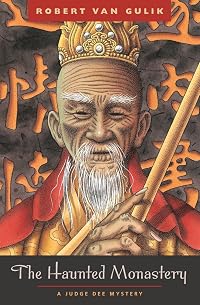
The Haunted Monastery
by Robert van Gulik
Judge Dee: Chronological order (4), Judge Dee: Publication order (6)
On This Page
Description
Judge Dee and his entourage, seeking refuge from a mountain storm, become trapped in a Taoist monastery, where the Abbott Jade mysteriously dies after delivering an ecstatic sermon. The monks call it a supernatural experience, but the judge calls it murder. Recalling the allegedly accidental deaths of three young women in the same monastery, Judge Dee seeks clues in the eyes of a cat to solve cases of impersonation and murder. A painting by one of the victims reveals the truth about the show more killings, propelling the judge on a quest for justice and revenge. "Entertaining, instructive, and impressive."-Times Literary Supplement. show lessTags
Recommendations






































Member Reviews
Author Robert van Gulik, an accomplished Dutch diplomat, linguist, and Orientalist, yet again proves himself a great writer as well with The Haunted Monastery, the fifth book in the wonderful Judge Dee mystery series. In this short book, set in western China (in what is modern-day Sichuan Province) in A.D. 666, Judge Dee takes refuge during a terrible rainstorm in the Monastery of the Morning Clouds. Judge Dee, had been traveling home with his entourage, when the cart broke an axle. Judge Dee, uneasy because of three mysterious deaths at the Taoist monastery the previous year, takes advantage of his ill luck to investigate the deaths and some other strange goings-on. His decision leads to a close brush with death as the perpetrators show more panic when Judge Dee starts getting too close. Most Judge Dee novels demand to be devoured, but this one is even more exciting than most!
Van Gulik, staying true to Chinese tradition, sprinkles three mysteries into The Haunted Monastery; as is less usual, the three are intertwined in this case. In the end, Judge Dee not only solves the requisite three mysteries, but he also makes it possible for two couples to fall in love and marry -- despite being uncharacteristically cranky throughout the novel because of a head cold! The novel also contains much information on ancient Taoist monasteries, customs, and beliefs; T'ang Dynasty politics, the lives of actors and acrobats of the time, and the ancient Chinese's rather enlightened attitude toward homosexuality. (The latter must have appeared quite shocking to Western readers who read The Haunted Monastery in 1961, when it was first published.)
Judge Dee was a real-life Chinese magistrate during the T'ang Dynasty named Ti Jen-chieh. The 7th century jurist became noted for his incisive mind and quest for justice for all. Simplifying the magistrate's name to Judge Dee Jen-djieh, van Gulik introduced the world to Celebrated Cases of Judge Dee, first published in 1949 (although not translated into English until 1976), which was based on 18th century Chinese mystery novels. Van Gulik's ensuing Judge Dee books, while original, always included aspects the author gleaned from ancient records or other 18th century Chinese mysteries. In this case, van Gulik included the Confucianist view of Taoism as less than savory albeit better than the despised imported religion, Buddhism, and the biggest clue in the Case of the Embalmed Abbot. show less
Van Gulik, staying true to Chinese tradition, sprinkles three mysteries into The Haunted Monastery; as is less usual, the three are intertwined in this case. In the end, Judge Dee not only solves the requisite three mysteries, but he also makes it possible for two couples to fall in love and marry -- despite being uncharacteristically cranky throughout the novel because of a head cold! The novel also contains much information on ancient Taoist monasteries, customs, and beliefs; T'ang Dynasty politics, the lives of actors and acrobats of the time, and the ancient Chinese's rather enlightened attitude toward homosexuality. (The latter must have appeared quite shocking to Western readers who read The Haunted Monastery in 1961, when it was first published.)
Judge Dee was a real-life Chinese magistrate during the T'ang Dynasty named Ti Jen-chieh. The 7th century jurist became noted for his incisive mind and quest for justice for all. Simplifying the magistrate's name to Judge Dee Jen-djieh, van Gulik introduced the world to Celebrated Cases of Judge Dee, first published in 1949 (although not translated into English until 1976), which was based on 18th century Chinese mystery novels. Van Gulik's ensuing Judge Dee books, while original, always included aspects the author gleaned from ancient records or other 18th century Chinese mysteries. In this case, van Gulik included the Confucianist view of Taoism as less than savory albeit better than the despised imported religion, Buddhism, and the biggest clue in the Case of the Embalmed Abbot. show less
Judge Dee is traveling with his three wives when the weather takes a sudden turn for the worse, forcing him to seek shelter at a Taoist monastery. When a gust of wind blows open the window in his room, Dee witnesses a possible crime: a man in a helmet attacking a naked one-armed woman. However, when he asks to see the part of the monastery where the crime occurred, not only is there no trace of the man and woman, there's also no window. The only window it could have been was bricked up long ago.
The weather has given Judge Dee the beginnings of a terrible cold, so he wonders whether the scene he saw was an hallucination, or possibly even ghosts. However, as he meets the Abbot and the other visitors at the monastery, he strongly suspects show more that his vision might be connected to the three relatively recent deaths that occurred at this same monastery, all involving young women.
I had previously read van Gulik's translation of Celebrated Cases of Judge Dee and enjoyed it much more than I had expected to, so I was curious to see what his original Judge Dee mysteries would be like. This is the first one I've tried. Although it wasn't bad, I was left feeling a bit disappointed. One of the best things about Celebrated Cases of Judge Dee was van Gulik's analysis of its legal aspects, and I had hoped that this original mystery would work in some similarly fascinating details. Unfortunately, that wasn't really the case, and van Gulik's postscript was brief.
One thing I did find interesting, and that I wish van Gulik had thought worth talking about in his postscript, was Judge Dee's reaction to a female character who was questioning her sexuality and asked Dee for advice. He was much more open-minded than I'd have expected, telling her to take her time and make whatever decision felt best to her. Although I doubted he'd have approved of her being in a lesbian relationship, since he didn't approve of nuns due to his belief that women were meant to marry and bear children, he made it clear that the decisions of consenting adults who didn't have minors or dependents to worry about weren't his or the law's concern. (FYI,don't read this part of my review and go into this expecting a lesbian relationship. Things are not what they seem.)
The mystery was so-so, and somewhat tamer than I expected based on what I'd remembered of Celebrated Cases of Judge Dee. No torture or beatings at all - I suppose van Gulik felt he should scale that sort of thing that back in his original mysteries. There was one instance of "justice accomplished via gruesome murder," though, and the monastery had a Gallery of Horrors, statues depicting the various ways sinners could expect to be punished.
It seemed like most of this mystery just sort of fell into place as Judge Dee ran up and down stairs from one room to another, trying not to look as sick as he felt (until he magically stopped feeling sick). There were a few details I liked, and Miss Ting was a nice character, but overall this wasn't particularly memorable. I do still want to read van Gulik's other Judge Dee mysteries, though.
Extras:
Several black-and-white illustrations by the author, done in an imitation of 6th-century Chinese blockprints, a list of the characters (which I just noticed van Gulik grouped together according to the mysteries they were involved in, even though all the mysterious goings on in this book were pretty well blended together), a map of the monastery, and a brief postscript by the author.
(Original review posted on A Library Girl's Familiar Diversions.) show less
The weather has given Judge Dee the beginnings of a terrible cold, so he wonders whether the scene he saw was an hallucination, or possibly even ghosts. However, as he meets the Abbot and the other visitors at the monastery, he strongly suspects show more that his vision might be connected to the three relatively recent deaths that occurred at this same monastery, all involving young women.
I had previously read van Gulik's translation of Celebrated Cases of Judge Dee and enjoyed it much more than I had expected to, so I was curious to see what his original Judge Dee mysteries would be like. This is the first one I've tried. Although it wasn't bad, I was left feeling a bit disappointed. One of the best things about Celebrated Cases of Judge Dee was van Gulik's analysis of its legal aspects, and I had hoped that this original mystery would work in some similarly fascinating details. Unfortunately, that wasn't really the case, and van Gulik's postscript was brief.
One thing I did find interesting, and that I wish van Gulik had thought worth talking about in his postscript, was Judge Dee's reaction to a female character who was questioning her sexuality and asked Dee for advice. He was much more open-minded than I'd have expected, telling her to take her time and make whatever decision felt best to her. Although I doubted he'd have approved of her being in a lesbian relationship, since he didn't approve of nuns due to his belief that women were meant to marry and bear children, he made it clear that the decisions of consenting adults who didn't have minors or dependents to worry about weren't his or the law's concern. (FYI,
The mystery was so-so, and somewhat tamer than I expected based on what I'd remembered of Celebrated Cases of Judge Dee. No torture or beatings at all - I suppose van Gulik felt he should scale that sort of thing that back in his original mysteries. There was one instance of "justice accomplished via gruesome murder," though, and the monastery had a Gallery of Horrors, statues depicting the various ways sinners could expect to be punished.
It seemed like most of this mystery just sort of fell into place as Judge Dee ran up and down stairs from one room to another, trying not to look as sick as he felt (until he magically stopped feeling sick). There were a few details I liked, and Miss Ting was a nice character, but overall this wasn't particularly memorable. I do still want to read van Gulik's other Judge Dee mysteries, though.
Extras:
Several black-and-white illustrations by the author, done in an imitation of 6th-century Chinese blockprints, a list of the characters (which I just noticed van Gulik grouped together according to the mysteries they were involved in, even though all the mysterious goings on in this book were pretty well blended together), a map of the monastery, and a brief postscript by the author.
(Original review posted on A Library Girl's Familiar Diversions.) show less
Fresh off the case of [b:The Chinese Gold Murders|1038898|The Chinese Gold Murders|Robert van Gulik|https://images.gr-assets.com/books/1407707924s/1038898.jpg|1025259], I was rather looking forward to another of Judge Dee's adventures. Judge Dee and his retinue are returning from their travels when they are confronted with a terrible storm that will surely dump their carts off the mountainside if they try and shelter in place. The best spot to spend the night is the nearby Morning Cloud Monastery, already on the Judge's mental list for an upcoming visit for the deaths of three young women. Unfortunately, it's cold and rainy, and the Judge had caught a cold. There's nothing quite like reading descriptions of someone's crankiness, I must show more say; I found myself growing as grumpy as the Judge with his pounding headache.
"The judge tugged angrily at his beard. The ghostly voice had disturbed him more than he cared to admit. Then he took hold of himself. Probably some monks were talking about him in another room or passage near there. Often the echo played queer tricks in such old building. He stood listening for a while, but did not hear anything. The whispers had ceased."
Though published in 1961, Van Gulik tried to balance a tale that would appeal to modern mystery tastes with that of more traditional Chinese mystery stories. Traditional stories often relied on supernatural elements, were frequently highly judgemental towards both Taoism and Buddhism and usually gave away the villain at the start. Though Van Gulik avoids going so far as to share the identity of the villain, he does enjoy creating the feel of pre-communist 7th century China.
As the Judge and his retinue arrive at the monastery, the Judge glimpses a man throttling a one-armed, naked woman, but before he really understand what he is seeing, the shutters crash close and he is unable to see more. As he tries to find the room where the possible crime is committed, the monastery is celebrating its two hundred and third birthday, and the monks are enjoying the work of a performing artist troupe and their bear. Also among the guests are an older established woman who is bringing a charge to the monastery to become a nun. In a move familiar to Shakespeare fans, one of the performers mocks the senior abbot, implying his personal gain from the untimely 'ascension' of his predecessor. It doesn't become a comedy of errors, sadly, so much as a peevish man trying to find a solution to a missing woman, a strange vision and the death of the prior abbot.
This all sounds rather interesting, of course, but various puzzles are solved less by cleverness than blind luck and perseverance.While I did enjoy parts of the tour through China past, I think the gestalt didn't balance out nearly as well as it did in The Gold Murders. It was hard for the writing to overcome the prejudices of the Judge, and of his frustration with the weather and the layout of the monastery. Luckily for the reader, Van Gulik provided both building and floor maps along with cast of characters. What was particularly interesting about the Judge in this one is that while he definitely had a religious intolerance, he was particularly tolerant with unwed relationships and lesbian relationships. Despite all that, I found myself falling asleep unfortunately often for a mystery, so take that for what you will.
The edition I read (combined with the Chinese Maze Murders) also had a number of plates drawn by Van Gulik "in the style of 16th century Chinese illustrated blockprints," in Ming dynasty style, but since block printing is a rather simplistic style, it didn't feel like they brought any depth to the story.
Two-and-a-half-stars, rounding up show less
"The judge tugged angrily at his beard. The ghostly voice had disturbed him more than he cared to admit. Then he took hold of himself. Probably some monks were talking about him in another room or passage near there. Often the echo played queer tricks in such old building. He stood listening for a while, but did not hear anything. The whispers had ceased."
Though published in 1961, Van Gulik tried to balance a tale that would appeal to modern mystery tastes with that of more traditional Chinese mystery stories. Traditional stories often relied on supernatural elements, were frequently highly judgemental towards both Taoism and Buddhism and usually gave away the villain at the start. Though Van Gulik avoids going so far as to share the identity of the villain, he does enjoy creating the feel of pre-communist 7th century China.
As the Judge and his retinue arrive at the monastery, the Judge glimpses a man throttling a one-armed, naked woman, but before he really understand what he is seeing, the shutters crash close and he is unable to see more. As he tries to find the room where the possible crime is committed, the monastery is celebrating its two hundred and third birthday, and the monks are enjoying the work of a performing artist troupe and their bear. Also among the guests are an older established woman who is bringing a charge to the monastery to become a nun. In a move familiar to Shakespeare fans, one of the performers mocks the senior abbot, implying his personal gain from the untimely 'ascension' of his predecessor. It doesn't become a comedy of errors, sadly, so much as a peevish man trying to find a solution to a missing woman, a strange vision and the death of the prior abbot.
This all sounds rather interesting, of course, but various puzzles are solved less by cleverness than blind luck and perseverance.While I did enjoy parts of the tour through China past, I think the gestalt didn't balance out nearly as well as it did in The Gold Murders. It was hard for the writing to overcome the prejudices of the Judge, and of his frustration with the weather and the layout of the monastery. Luckily for the reader, Van Gulik provided both building and floor maps along with cast of characters. What was particularly interesting about the Judge in this one is that while he definitely had a religious intolerance, he was particularly tolerant with unwed relationships and lesbian relationships. Despite all that, I found myself falling asleep unfortunately often for a mystery, so take that for what you will.
The edition I read (combined with the Chinese Maze Murders) also had a number of plates drawn by Van Gulik "in the style of 16th century Chinese illustrated blockprints," in Ming dynasty style, but since block printing is a rather simplistic style, it didn't feel like they brought any depth to the story.
Two-and-a-half-stars, rounding up show less
When Judge Dee gets stuck in a rain storm, the only place of shelter is a mysterious Taoist Monastery built in the mountains. He is asked to look into the deaths of a number of young women - some who died by accident, others by illness. Of course, there is a love story, and evil monks.
The story was short and well written, but I found it to be rather flat. Part of that comes from when the story was written in 1961, but part of it was that I found it be a fairly standard, run of the mill mystery.
I'm glad I read it, but its not a series I need to keep reading.
The story was short and well written, but I found it to be rather flat. Part of that comes from when the story was written in 1961, but part of it was that I found it be a fairly standard, run of the mill mystery.
I'm glad I read it, but its not a series I need to keep reading.
My personal favorite, this one is #5 in the series. Judge Dee, along with several wives and households finds himself trapped by a storm in in the mountains, and forced to take refuge in a Daoist monastery. Of course, as usual, the magistrate finds several mysteries awaiting him.
The final denouement is one of the most vivid I've read in a mystery. I'd recommend this book to people who enjoy historical mysteries or stories set in China.
The final denouement is one of the most vivid I've read in a mystery. I'd recommend this book to people who enjoy historical mysteries or stories set in China.
Very loosely adapted into a pilot movie for a TV series (unsold, sadly). The movie was quite good, capturing Judge Dee's character completely. (At one point, having discovered yet another sub-plot involving false monks, Dee exasperatedly comments, 'Does no one in this monastery meditate?')
Judge Dee discovers murder in Taoist monastery taken over by perverted monk
Members
- Recently Added By
Lists

Books featuring monks and/or nuns
166 works; 33 members

Books Read in 2017
4,249 works; 130 members
Author Information

Robert H. Van Gulik was born in the Netherlands on August 9, 1910. He joined the Dutch Foreign Service in 1935. From 1942-1945, he was secretary for the Dutch mission to Chiang Kai-shek's Nationalist government in Chongqing, China. During this time, he translated a number of Chinese texts including Celebrated Cases of Judge Dee (Dee Goong An). He show more proceeded to write sixteen of his own Judge Dee novels. His scholarly works included Siddham: An Essay on the History of Sanskrit Studies in China and Japan, Hayagriva: Horse Cult in Asia, and Sexual Life in Ancient China. He died on September 24, 1967. (Bowker Author Biography) show less
Some Editions
Series


Belongs to Publisher Series
Work Relationships
Is contained in
Common Knowledge
- Canonical title
- The Haunted Monastery
- Original title
- The Haunted Monastery
- Original publication date
- 1961
- People/Characters
- Judge Dee; Tao Gan
- Important places
- Han-yuan, China
- Important events
- Tang Dynasty (618 | 907)
- Related movies
- Judge Dee and the Monastery Murders (1974)
- First words*
- Molemmat miehet jotka istuivat lähekkäin eristetyssä huonessa, ylhäällä vanhan luostarin tornissa, kuuntelivat hetken äänettöminä pimeillä vuorilla raivoavan myrskyn ulvontaa.
- Quotations
- I should give up being a magistrate and become a matchmaker!
- Last words*
- (Click to show. Warning: May contain spoilers.)"Tulee kaunis päivä!"
- Original language*
- Engels
*Some information comes from Common Knowledge in other languages. Click "Edit" for more information.
Classifications
Statistics
- Members
- 486
- Popularity
- 61,734
- Reviews
- 10
- Rating
- (3.93)
- Languages
- 13 — Chinese, Czech, Danish, Dutch, English, Estonian, Finnish, French, German, Greek, Italian, Polish, Spanish
- Media
- Paper, Audiobook, Ebook
- ISBNs
- 34
- ASINs
- 17