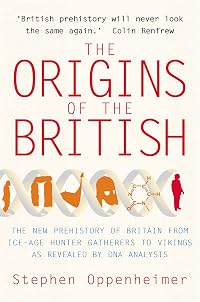
The Origins of the British
by Stephen Oppenheimer
On This Page
Description
Stephen Oppenheimer's extraordinary scientific detective story combining genetics, linguistics, archaeology and historical record shatters the myths we have come to live by. It demonstrates that the Anglo-Saxon invasions contributed just a tiny fraction (5%) to the English gene pool. Two thirds of the English people reveal an unbroken line of genetic descent from south-western Europeans arriving long before the first farmers. The bulk of the remaining third arrived between 7,000 and 3,000 show more years ago as part of long-term north-west European trade and immigration, especially from Scandinavia - and may have brought with them the earliest forms of English language. As for the Celts - the Irish, Scots and Welsh - history has traditionally placed their origins in Iron Age Central Europe. Oppenheimer's genetic synthesis shows them to have arrived via the Atlantic coastal route from Ice Age refuges including the Basque country; with the modern languages we call Celtic arriving later. There is indeed a deep divide between the English and the rest of the British. But as this book reveals the division is many thousands of years older than previously thought. show lessTags
Recommendations








Member Reviews
Although now over a decade old, this rethinking of the origins of the inhabitants of the British Isles deserves to be widely read. I am not sure its radical shattering of the standard view of our history has percolated far enough into the general public's vision of its own history.
It was so radical that initially I thought I might have picked up something closer to Bauval and Hancock but, no, this gets endorsements from luminaries such as Renfrew and Gamble and it is clear that the author has undertaken his own research and engaged with other serious researchers.
He terms it a book of 'popular science' but be warned that it is not a simple read and the art of 'skimming' a lot of technical genetic detail proved useful. And, of course, he show more is open about some of the speculative aspects of his work with another decade since to refine or refute by others.
I am not expert but my understanding is that refining is precisely what has been going on and that there has not been a great deal of refutation. Rather than say what is regarded as true in 2018, it might be best to summarise what Oppenheimer proposed from the genetics of over ten years ago.
The book is complex . My summary will not do it justice. I hope not to deter others from reading it and then following up with their own research. But here goes ...
The core proposition is that the vast bulk of the British population is much older in origins, although there is a cut-off date because of climatic conditions at the Last Glacial Maximum, than widely believed.
A key finding is that every historical political or military invasion (Anglo-Saxon, Viking, Norman and implicitly the migrations in the modern era) have had much less impact on the nature of the population in general than supposed by some archaeologists.
This fits with the theses of those archaeologists who see continuities in population from their reading of the artefact record. They suggest that each invasion was more of an elite takeover than a mass movement of peoples.
Oppenheimer endorses this general thrust, based on genetic evidence, suggesting that elite invasions tended to be takeovers of populations rather like themselves genetically. There were thus continuities of place as well as of time.
So where did the bulk of the population come from? One interesting finding is that there is a natural difference between what we call Celts and what we call English in the very broadest sense - or rather between the population of the Western seaways and those coming from the continent.
I think we are stuck with the terms Celts for political reasons even though it represents a wholly misguided nineteenth century origin legend but I would quite like to think of their rivals in these islands as 'Anglians'. We are stuck now with English.
This difference is ultimately expressed as two genetic lines coming from two Ice Age refuges - one in North East Spain (of which the Basques are a relict) and one in the Ukraine and Balkans. As the ice melted populations expanded northwards.
The Western line is actually the genetically dominant one, working its way up the seaways, so that perhaps two thirds of us British have ancestral origins in a settler community which expanded on the back of a neolithic culture (cardial ware) that was ultimately Mediterranean.
This is the one that underpins the genetics of what we call Celts but here Oppenheimer has a card to play. Just as he diminishes the idea of ethnic cleansing by Saxons, Vikings and Normans so he does the same to another cherished myth - the Celtic homeland in Europe.
He points out that language and culture are not genetics. Although cultural forms flowed into Britain from mainland Europe that we now link to Celticism, the culture that arrived amongst the 'Celts' (as we know them) was imported on a different genetic base.
There is much that is more speculative in the book on the Indo-European languages of which the Celtic languages are a part. Oppenheimer seems to follow Renfrew in postulating that these language families flowed across Europe via the expansion of the Anatolian neolithic.
However, it has to be said that the book was not easy to follow at this point (the depth of detail makes it easy to allow attention to lapse at times) so these sections might require a second reading - I won't try to summarise what I imperfectly understand.
So, we have a largely neolithic (though there are mesolithic aspects of the case) settling the Western sea ways and moving up the South Coast where they then meet a separate settlement process coming from Europe linked back to the Linearbandkeramik of Germany.
This latter takes over the North European plain and spreads north-westwards to meet the Cardial Ware settlers along the South Coast where it is no accident perhaps that Wessex, centred on Stonehenge, becomes prosperous on trade. Trade is what the British do after all.
With the chains of mountains dividing West and East and cultures dependent on waterways and avoiding forests until absolutely necessary, a different genetic stock, perhaps a third of the British today, peoples Eastern England and Scotland. These are our 'Anglians'.
There is a third wave linked back ultimately to the Ukrainian refuge which arrives, again along sea routes, from Northern Scandinavia to people the northern parts of the Western seaways - perhaps a reddish-haired strain moving down via the Orkneys and Shetlands.
Everyone starts to get mixed up through further mutations, secondary settlements, slaving, trade and war as well as the imposition of warriors, traders and various hangers-on from elite struggles for booty and advantage but the core lines derive from these primary neolithic movements.
The peoples who suffered under the Romans, Saxon warlords, Vikings and Normans were pretty well the same (genetically) as those who existed long before the Iron Age with the suggestion (beneath the later complexities) of two main genetic zones underpinning 'British' culture.
These two genetic zones seem to have a surprising cultural continuity throughout history with the Celtic and English speaking zones following the pattern even today regardless of the vicissitudes of subsequent history.
This raises the language question again because Oppenheimer is tempted to suggest that the peoples who pre-existed various warlord invaders might have had far more long term continuity in how they spoke than believed until recently.
His suggestion is that warlords (at least in the earlier period) arrived in part because they were already culturally like a population and that Roman Britain for example was perhaps not 'Celtic' at all but either Belgic and Germanic (North Sea).
The South Coast Saxons were in fact blood brothers to the Belgic and Frankish communities of Northern Gaul and North Sea Germany and the 'English' pre-existed as Anglians who were blood brothers to other North Sea peoples. Saxons were perhaps just later variants of Belgae.
Furthermore (though this is very speculative) such people spoke languages close to those of their continental neighbours and it is in this that English originated. There are, of course, other speculations on the Picts but the speculations are always well argued and plausible.
So, the British are divided naturally into their two halves, east and west, and then are further divided by geography within or just outside those categories north and south. Those divisions are very ancient and pre-date our historical records.
This raises an interesting question about 'race' because genetics increasingly is being shown to be linked to personality characteristics and cultures may be built on such predispositions - perhaps the free-born Englishman really is psychologically pre-set in that direction!
Oppenheimer is interesting on his own position. His name suggests German-Jewish ancestry and that is where it comes from but, in fact, his own Britishness represents by far the majority of his genetic code because incomers generally get overwhelmed by native genes as they marry in.
He has also done what I have done - married into an entirely different East Asian genetic heritage so his children, like mine (though mine have genetic antecedents from Europe through colonisation), are genetically diverse but the Asian will attenuate over time as they reproduce.
This raises interesting political questions about migration and Celt identity. Recent migration, for example from the Comonwealth and the EU, is not an invasion by warlords but a settlement process and these migrants often (though not invariably) reproduce within their community.
What we have (in England) is a core people going back to neolithic time battered periodically by elites (nothing changes in that respect) being faced by a quantitatively different intrusion where the levels of integration are ambiguous and the new settlers are concentrated in particular areas.
This might explain the unease of many English indigenes both about the fact of the matter and the lack of control or interest in their instinctive fears by elites (who, of course, see the majority around them as, basically, plunder, to all intents and purposes).
The reality is not as alarming as nativists fear but cannot be swept under the carpet. Many migrants will simply be happily absorbed into Englishness (though it is called Britishness to keep the Celts on side in a United Kingdom) but others will create new sub-groups of localised genetic difference.
This does not matter in the long run (though being identifiably different has caused problems in the past) but it does need managing. Successive Governments had and have an appalling record at matching sufficient cultural and linguistic integration with respect for indigenous concerns.
We must remember that whiteness really is an unusual mutation from the 'norm' of humanity, one which has had enormous global success in spreading for whatever mysterious reasons. But it is a marker and as the new genetics spreads into the population, its 'factness' may re-emerge.
We should be very wary of the new genetic history fuelling genuinely inappropriate interpretations of the data to suggest a 'white' community in danger. There is fortunately no sign of this at the moment but only because the English are notoriously easy-going and tolerant.
We cannot deny a genetic base to 'whiteness' or that it has some cultural meaning and the determined attempt to remove all meaning from it while giving dramatic cultural meaning to blackness and brownness has proved dangerously counter-productive in recent years.
Another political issue arises out of a debate about the Celts. The post-modern question is whether there is such a people as the Celts. The recent answer in archaeology has been in the negative but the genetics seem to suggest otherwise but within the revisionist framework.
The trend in the last few decades had been to dismiss the very existence of the Celts except as modern nationalist creations because the archaeology has disposed of the link between the La Tene and Hallstatt cultures and Britain.
La Tene and Hallstatt are now seen as elite cultural influences. The claim is that the people of the Western seaways were recipients of ideas but not linked with Central Europe's Iron Age Celts as described by the Romans. Oppenheimer suggests that we are dealing with a very red herring here.
He accepts fully the disconnection of Iron Age Europe from the modern day Celts but his genetic work demonstrates the distinctiveness of the people of the Western seaways (even in looks) and suggests a language base that gives the Celts genuine reason to consider themselves a people.
So we have two 'races' (to use an unpopular word), perhaps three if we take the Scandinavian neolithic entry into the north, who are biologically a little distinctive with different cultural attitudes formed by different environments. And if the 'Celts' exist then so do the 'Anglians'.
Of course, racialising and politicising all this is nonsense except that the history of elite struggles over these islands is the story of the domination of the seaways peoples by the 'Anglians' and then one of the Anglian elites abandoning their own people to build an Empire.
A gross over-simplification, to be sure, but there is a truth in it. The fraught politics of petty nationalism and the deep and growing resentments of the 'Anglians' who are not part of the elite within what is still an 'imperial' United Kingdom are derived from the working out of this history.
The political dynamic is thus a little different from what we have been led to expect - one not of ethnic cleansing but of successive elite replacements. The moral link between elites and mass, lord and peasant, starts to weaken as genetics show not race but power relations in operation.
Oppenheimer has an irritable introduction about ignorant media misinterpretation of his work and he is right to be concerned. The conclusion of the genetics is that difference is a fact but not a politically determinative one unless we allow it to be.
If a population has been in one place for a very very long time and absorbed elite invaders and traders rather than been displaced by them it suggests a basic resilience and tolerance. It also suggests that history has treated it as a tool and resource for highly organised out-groups.
This genetic work should be encouraged but it requires a determined effort to stop any nineteenth century racial interpretation emerging at the expense of one based on the political dynamic of native masses, uninterested in difference, being manipulated by cosmopolitan elites.
I cannot resist bringing Brexit into the argument as a paradox. The ancient history shows the 'Anglians' as the people most linked to the Continent by cultural ties and genetics and the Celts as independent seafarers building their own unique trading culture covering the known world.
Yet the position on the European Union has become the exact opposite because of the intrusion of imperial history. The English want out of the continental entanglement and the Celts equally tend to want immersion in it as guarantor of their own identity over and against the 'Anglians'.
This shows us both that the genetic base lines are still quietly working their way through our history, that underlying differences can be quite intractable and that particular positions are merely occasions for difference based on more recent history.
The book raises a question about the very concept of an elite-driven United Kingdom if it cannot balance the interests within it. The elite lost Ireland and may yet lose Scotland. The English often feel that they are culturally sucked dry for an empire. Neither side is very happy at the moment.
We can overdo this interpretation but this book is an intelligent and humane contribution to the debate on who we British are, in a country where ancestry has become a national pastime. It is welcome and should be read more widely.
Positive outcomes might be a renewed respect for the people we happen to have ended up calling Celts but also respect for the long-suffering English too, historically treated as cannon fodder in wars and milch cows for taxation. That worm may yet turn! show less
It was so radical that initially I thought I might have picked up something closer to Bauval and Hancock but, no, this gets endorsements from luminaries such as Renfrew and Gamble and it is clear that the author has undertaken his own research and engaged with other serious researchers.
He terms it a book of 'popular science' but be warned that it is not a simple read and the art of 'skimming' a lot of technical genetic detail proved useful. And, of course, he show more is open about some of the speculative aspects of his work with another decade since to refine or refute by others.
I am not expert but my understanding is that refining is precisely what has been going on and that there has not been a great deal of refutation. Rather than say what is regarded as true in 2018, it might be best to summarise what Oppenheimer proposed from the genetics of over ten years ago.
The book is complex . My summary will not do it justice. I hope not to deter others from reading it and then following up with their own research. But here goes ...
The core proposition is that the vast bulk of the British population is much older in origins, although there is a cut-off date because of climatic conditions at the Last Glacial Maximum, than widely believed.
A key finding is that every historical political or military invasion (Anglo-Saxon, Viking, Norman and implicitly the migrations in the modern era) have had much less impact on the nature of the population in general than supposed by some archaeologists.
This fits with the theses of those archaeologists who see continuities in population from their reading of the artefact record. They suggest that each invasion was more of an elite takeover than a mass movement of peoples.
Oppenheimer endorses this general thrust, based on genetic evidence, suggesting that elite invasions tended to be takeovers of populations rather like themselves genetically. There were thus continuities of place as well as of time.
So where did the bulk of the population come from? One interesting finding is that there is a natural difference between what we call Celts and what we call English in the very broadest sense - or rather between the population of the Western seaways and those coming from the continent.
I think we are stuck with the terms Celts for political reasons even though it represents a wholly misguided nineteenth century origin legend but I would quite like to think of their rivals in these islands as 'Anglians'. We are stuck now with English.
This difference is ultimately expressed as two genetic lines coming from two Ice Age refuges - one in North East Spain (of which the Basques are a relict) and one in the Ukraine and Balkans. As the ice melted populations expanded northwards.
The Western line is actually the genetically dominant one, working its way up the seaways, so that perhaps two thirds of us British have ancestral origins in a settler community which expanded on the back of a neolithic culture (cardial ware) that was ultimately Mediterranean.
This is the one that underpins the genetics of what we call Celts but here Oppenheimer has a card to play. Just as he diminishes the idea of ethnic cleansing by Saxons, Vikings and Normans so he does the same to another cherished myth - the Celtic homeland in Europe.
He points out that language and culture are not genetics. Although cultural forms flowed into Britain from mainland Europe that we now link to Celticism, the culture that arrived amongst the 'Celts' (as we know them) was imported on a different genetic base.
There is much that is more speculative in the book on the Indo-European languages of which the Celtic languages are a part. Oppenheimer seems to follow Renfrew in postulating that these language families flowed across Europe via the expansion of the Anatolian neolithic.
However, it has to be said that the book was not easy to follow at this point (the depth of detail makes it easy to allow attention to lapse at times) so these sections might require a second reading - I won't try to summarise what I imperfectly understand.
So, we have a largely neolithic (though there are mesolithic aspects of the case) settling the Western sea ways and moving up the South Coast where they then meet a separate settlement process coming from Europe linked back to the Linearbandkeramik of Germany.
This latter takes over the North European plain and spreads north-westwards to meet the Cardial Ware settlers along the South Coast where it is no accident perhaps that Wessex, centred on Stonehenge, becomes prosperous on trade. Trade is what the British do after all.
With the chains of mountains dividing West and East and cultures dependent on waterways and avoiding forests until absolutely necessary, a different genetic stock, perhaps a third of the British today, peoples Eastern England and Scotland. These are our 'Anglians'.
There is a third wave linked back ultimately to the Ukrainian refuge which arrives, again along sea routes, from Northern Scandinavia to people the northern parts of the Western seaways - perhaps a reddish-haired strain moving down via the Orkneys and Shetlands.
Everyone starts to get mixed up through further mutations, secondary settlements, slaving, trade and war as well as the imposition of warriors, traders and various hangers-on from elite struggles for booty and advantage but the core lines derive from these primary neolithic movements.
The peoples who suffered under the Romans, Saxon warlords, Vikings and Normans were pretty well the same (genetically) as those who existed long before the Iron Age with the suggestion (beneath the later complexities) of two main genetic zones underpinning 'British' culture.
These two genetic zones seem to have a surprising cultural continuity throughout history with the Celtic and English speaking zones following the pattern even today regardless of the vicissitudes of subsequent history.
This raises the language question again because Oppenheimer is tempted to suggest that the peoples who pre-existed various warlord invaders might have had far more long term continuity in how they spoke than believed until recently.
His suggestion is that warlords (at least in the earlier period) arrived in part because they were already culturally like a population and that Roman Britain for example was perhaps not 'Celtic' at all but either Belgic and Germanic (North Sea).
The South Coast Saxons were in fact blood brothers to the Belgic and Frankish communities of Northern Gaul and North Sea Germany and the 'English' pre-existed as Anglians who were blood brothers to other North Sea peoples. Saxons were perhaps just later variants of Belgae.
Furthermore (though this is very speculative) such people spoke languages close to those of their continental neighbours and it is in this that English originated. There are, of course, other speculations on the Picts but the speculations are always well argued and plausible.
So, the British are divided naturally into their two halves, east and west, and then are further divided by geography within or just outside those categories north and south. Those divisions are very ancient and pre-date our historical records.
This raises an interesting question about 'race' because genetics increasingly is being shown to be linked to personality characteristics and cultures may be built on such predispositions - perhaps the free-born Englishman really is psychologically pre-set in that direction!
Oppenheimer is interesting on his own position. His name suggests German-Jewish ancestry and that is where it comes from but, in fact, his own Britishness represents by far the majority of his genetic code because incomers generally get overwhelmed by native genes as they marry in.
He has also done what I have done - married into an entirely different East Asian genetic heritage so his children, like mine (though mine have genetic antecedents from Europe through colonisation), are genetically diverse but the Asian will attenuate over time as they reproduce.
This raises interesting political questions about migration and Celt identity. Recent migration, for example from the Comonwealth and the EU, is not an invasion by warlords but a settlement process and these migrants often (though not invariably) reproduce within their community.
What we have (in England) is a core people going back to neolithic time battered periodically by elites (nothing changes in that respect) being faced by a quantitatively different intrusion where the levels of integration are ambiguous and the new settlers are concentrated in particular areas.
This might explain the unease of many English indigenes both about the fact of the matter and the lack of control or interest in their instinctive fears by elites (who, of course, see the majority around them as, basically, plunder, to all intents and purposes).
The reality is not as alarming as nativists fear but cannot be swept under the carpet. Many migrants will simply be happily absorbed into Englishness (though it is called Britishness to keep the Celts on side in a United Kingdom) but others will create new sub-groups of localised genetic difference.
This does not matter in the long run (though being identifiably different has caused problems in the past) but it does need managing. Successive Governments had and have an appalling record at matching sufficient cultural and linguistic integration with respect for indigenous concerns.
We must remember that whiteness really is an unusual mutation from the 'norm' of humanity, one which has had enormous global success in spreading for whatever mysterious reasons. But it is a marker and as the new genetics spreads into the population, its 'factness' may re-emerge.
We should be very wary of the new genetic history fuelling genuinely inappropriate interpretations of the data to suggest a 'white' community in danger. There is fortunately no sign of this at the moment but only because the English are notoriously easy-going and tolerant.
We cannot deny a genetic base to 'whiteness' or that it has some cultural meaning and the determined attempt to remove all meaning from it while giving dramatic cultural meaning to blackness and brownness has proved dangerously counter-productive in recent years.
Another political issue arises out of a debate about the Celts. The post-modern question is whether there is such a people as the Celts. The recent answer in archaeology has been in the negative but the genetics seem to suggest otherwise but within the revisionist framework.
The trend in the last few decades had been to dismiss the very existence of the Celts except as modern nationalist creations because the archaeology has disposed of the link between the La Tene and Hallstatt cultures and Britain.
La Tene and Hallstatt are now seen as elite cultural influences. The claim is that the people of the Western seaways were recipients of ideas but not linked with Central Europe's Iron Age Celts as described by the Romans. Oppenheimer suggests that we are dealing with a very red herring here.
He accepts fully the disconnection of Iron Age Europe from the modern day Celts but his genetic work demonstrates the distinctiveness of the people of the Western seaways (even in looks) and suggests a language base that gives the Celts genuine reason to consider themselves a people.
So we have two 'races' (to use an unpopular word), perhaps three if we take the Scandinavian neolithic entry into the north, who are biologically a little distinctive with different cultural attitudes formed by different environments. And if the 'Celts' exist then so do the 'Anglians'.
Of course, racialising and politicising all this is nonsense except that the history of elite struggles over these islands is the story of the domination of the seaways peoples by the 'Anglians' and then one of the Anglian elites abandoning their own people to build an Empire.
A gross over-simplification, to be sure, but there is a truth in it. The fraught politics of petty nationalism and the deep and growing resentments of the 'Anglians' who are not part of the elite within what is still an 'imperial' United Kingdom are derived from the working out of this history.
The political dynamic is thus a little different from what we have been led to expect - one not of ethnic cleansing but of successive elite replacements. The moral link between elites and mass, lord and peasant, starts to weaken as genetics show not race but power relations in operation.
Oppenheimer has an irritable introduction about ignorant media misinterpretation of his work and he is right to be concerned. The conclusion of the genetics is that difference is a fact but not a politically determinative one unless we allow it to be.
If a population has been in one place for a very very long time and absorbed elite invaders and traders rather than been displaced by them it suggests a basic resilience and tolerance. It also suggests that history has treated it as a tool and resource for highly organised out-groups.
This genetic work should be encouraged but it requires a determined effort to stop any nineteenth century racial interpretation emerging at the expense of one based on the political dynamic of native masses, uninterested in difference, being manipulated by cosmopolitan elites.
I cannot resist bringing Brexit into the argument as a paradox. The ancient history shows the 'Anglians' as the people most linked to the Continent by cultural ties and genetics and the Celts as independent seafarers building their own unique trading culture covering the known world.
Yet the position on the European Union has become the exact opposite because of the intrusion of imperial history. The English want out of the continental entanglement and the Celts equally tend to want immersion in it as guarantor of their own identity over and against the 'Anglians'.
This shows us both that the genetic base lines are still quietly working their way through our history, that underlying differences can be quite intractable and that particular positions are merely occasions for difference based on more recent history.
The book raises a question about the very concept of an elite-driven United Kingdom if it cannot balance the interests within it. The elite lost Ireland and may yet lose Scotland. The English often feel that they are culturally sucked dry for an empire. Neither side is very happy at the moment.
We can overdo this interpretation but this book is an intelligent and humane contribution to the debate on who we British are, in a country where ancestry has become a national pastime. It is welcome and should be read more widely.
Positive outcomes might be a renewed respect for the people we happen to have ended up calling Celts but also respect for the long-suffering English too, historically treated as cannon fodder in wars and milch cows for taxation. That worm may yet turn! show less
The Origins of the British still make for contentious and fascinating debate amongst the people of these isles and this work adds strongly to the discussion. The purpose of the book appears to be to establish genetic analysis to the existing archaelogical and linguistic history built up over the centuries. Genetics is clearly still in it's infancy but it is a massive step forward in understanding the past.
Oppenheimer's work lays out the genetic influences of the British population (excluding post-WWII immigration) and his findings are well worth knowing. The genetic analysis sets out the post-Ice Age colonisation phases and the most significant plus points of the book are the genetic debunking of wipeout theories and the co-existance show more of Germanic, Scandinavian, and Celtic peoples in Britain.
The spread of western European peoples from Ice Age refuges and the development of culture and language inevitably means that the peoples of those countries are somewhat similar. What Oppenheimer's analysis of the genetic research shows is that there are observable differences and that those differences can trace a history of Britain that has had far less intrusion from overseas than is typically suggested.
There are two issues that I have with the book - the writing is not of the highest quality and the genetics themselves are not well explained. The writing does not flow and is tough going, I did feel as though I was reading a dissertation at times and not an especially well written one. This is not really popular science and the logical chain is not easy to follow as Oppenheimer leaps into asides and tangents.
I really do though wish that the genetics had been better and more fully exposed. Traditional history is interesting but hardly new. The movement of genes deserved a fuller treatment and there is not one point in Oppenheimer's work in which he lays out explicitly the genetic map of Britain.
Overall, this is the sort of book to read if you really do want to delve into some of the science and the emerging picture that genetics paints of north western Europe. It is not a light read and it raises more questions than it answers but the broad overview that the detail conjures is a great platform for better understanding who we British are. show less
Oppenheimer's work lays out the genetic influences of the British population (excluding post-WWII immigration) and his findings are well worth knowing. The genetic analysis sets out the post-Ice Age colonisation phases and the most significant plus points of the book are the genetic debunking of wipeout theories and the co-existance show more of Germanic, Scandinavian, and Celtic peoples in Britain.
The spread of western European peoples from Ice Age refuges and the development of culture and language inevitably means that the peoples of those countries are somewhat similar. What Oppenheimer's analysis of the genetic research shows is that there are observable differences and that those differences can trace a history of Britain that has had far less intrusion from overseas than is typically suggested.
There are two issues that I have with the book - the writing is not of the highest quality and the genetics themselves are not well explained. The writing does not flow and is tough going, I did feel as though I was reading a dissertation at times and not an especially well written one. This is not really popular science and the logical chain is not easy to follow as Oppenheimer leaps into asides and tangents.
I really do though wish that the genetics had been better and more fully exposed. Traditional history is interesting but hardly new. The movement of genes deserved a fuller treatment and there is not one point in Oppenheimer's work in which he lays out explicitly the genetic map of Britain.
Overall, this is the sort of book to read if you really do want to delve into some of the science and the emerging picture that genetics paints of north western Europe. It is not a light read and it raises more questions than it answers but the broad overview that the detail conjures is a great platform for better understanding who we British are. show less
Interesting content, but drowning in details. The epilogue brought it all together but only after many many pages.
So, much of the repopulation of Britain and Ireland after the ice ages came from Iberia, Basque and southern France, and much of the subsequent people movements came from Denmark and Norway. The Angles and the Saxons and the Jutes seem to be of very limited impact.
So, much of the repopulation of Britain and Ireland after the ice ages came from Iberia, Basque and southern France, and much of the subsequent people movements came from Denmark and Norway. The Angles and the Saxons and the Jutes seem to be of very limited impact.
Big fat book on an interesting topic , but fails to get off the ground. Too many references, not enough narrative, I got about halfway through and jumped to the conclusion. Which is, more or less, that the original incomers are still around; more recent arrivals, be they Viking or Saxon or Celtic, were relatively few in number, making only slight contributions to the gene pool. But even that gets blurred by delving into the differences between areas, Wales is not the same as Yorkshire - surprised? ,
The genetic core of the book is completely unintelligible to me. He raises some very interesting questions about the existence of germanic speaking peoples in South East Britain prior to (and during) the Roman Occupation. He brings in some interesting linguistic, archaeological and historical evidence in support of his theories; but this is pretty selective and I am not sure how careful he has been with it. He certainly can't be bothered to check how Tess Durbeyfield spelt her name.
I should like to see how he explains the accounts of the arrival of South Saxons under Aelle and his sons.
It's also annoying that he talks about England and Wessex &c. anachronistically. Still maybe GK Chesterton actually knew something when he wrote
"Before show more the Roman came to Rye or out to Severn strode,
The rolling English drunkard made the rolling English road." show less
I should like to see how he explains the accounts of the arrival of South Saxons under Aelle and his sons.
It's also annoying that he talks about England and Wessex &c. anachronistically. Still maybe GK Chesterton actually knew something when he wrote
"Before show more the Roman came to Rye or out to Severn strode,
The rolling English drunkard made the rolling English road." show less
Book argues that three entry sites into the UK after the last ice age. Founder populations in the west from Spain, south east, Germanic and north west from north east Europe set the pattern which other cultural/linguistic movements followed. But a tad over technical for a general book
And the English language reflects the pre and Roman period German roots and not evidence of a Celtic ethnic cleansing.So you Celts are really escaped from Spain and were not driven out of England by the post Romans invasions...so there!
And the English language reflects the pre and Roman period German roots and not evidence of a Celtic ethnic cleansing.So you Celts are really escaped from Spain and were not driven out of England by the post Romans invasions...so there!
Oppenheimer advances a theory of the origin of the British people based on analysis of genetics. His analysis bring him to say that most of the Irish, Welsh, Scottish and English people arrived just after the ice age, and that Celtic and Saxons and Angles were not a major invasion; Celtics were not from southern Germany and were never in England. If he is right quite a number of other books needs to be rewritten! Oppenheimer bases much of his argument on his own analysis of y-chromosome distribution across Europe. He seems to identify his own haplotypes - that are not described in detail. Furthermore he uses some kind of kernel density modeling where it is not apparent how much variation in the estimate there is.
Members
- Recently Added By
Author Information

5+ Works 745 Members
Common Knowledge
- Canonical title
- The Origins of the British
- Original publication date
- 2006
- People/Characters
- Peter Duncan; Barry Cunliffe; Tristan; Isolde; Colin Renfrew; Simon James (show all 47); Edward Lhuyd; St. Gildas; Bede, 673-735 (Venerable Bede); Strabo; Belgae; Asterix; Obelix; Paul-Yves Pezron; George Buchanan; Herodotus; Himilco; Pytheas; Avenius; Julius Caesar; Paul Broca; John Collis; Amedee Thierry; Henri d'Arbois de Jubainville; Carvetti; Antonio Torroni; Zoe Rosser; Siiri Rootsi; Peter Forster; Martin Richards; Luigi Luca Cavalli-Sforza; Ptolemy; Patrick Sims-Williams; Commius; Commios; Carausius; Procopius; King Alfred; Saxo Grammaticus; Raedwald, King of East Anglia; Francis Pryor; Michael Weale; Cristian Capelli; Jim Wilson; Julian Richards; Jeremy Paxman; Woden
- Important places
- United Kingdom; Liguria, Italy; Cornwall, England, UK; France; Narbonne, Occitanie, France; Hallstatt, Upper Austria, Austria (show all 19); La Tène, Neuchâtel, Switzerland; Finland; Lapland (a.k.a. Sápmi); Poland; Russia; Ireland; Borneo; Abergele, Conwy, Wales, UK; Wessex, England, UK; Mucking, Essex, England, UK; Watchfield, Oxfordshire, England, UK; Badon Hill, England, UK (exact location unknown); Sutton Hoo, Suffolk, England, UK
- Dedication
- In memory of David Oppenheim, classicist, composer, clinician and father
- First words
- Most people living in the British Isles today believe that until the ancestors of the English arrived, the aboriginal population of these islands were Celts.
- Last words
- (Click to show. Warning: May contain spoilers.)In the Early Mesolithic, that shallow strip of water was of course a landbridge, and East Anglia was merely a western continuation of the North European Plain.
(Click to show. Warning: May contain spoilers.)Epilogue
After all, Celts, Angles, Jutes, Saxons, Vikings, Normans and others, we are all minorities compared with the first unnamed pioneers, who ventured into the empty, chilly lands so recently vacated by the great ice sheets. - Original language
- English
Classifications
- Genres
- Anthropology, Science & Nature, History, Nonfiction, General Nonfiction
- DDC/MDS
- 936.1 — History & geography History of ancient world (to ca. 499) Europe north and west of Italian Peninsula to ca. 499 British Isles to 410
- LCC
- DA120 .O67 — History of Europe, Asia, Africa and Oceania Great Britain History of Great Britain England History Antiquities. Social life and customs. Ethnography
- BISAC
Statistics
- Members
- 323
- Popularity
- 98,473
- Reviews
- 10
- Rating
- (3.63)
- Languages
- English
- Media
- Paper, Ebook
- ISBNs
- 4
- ASINs
- 3