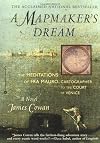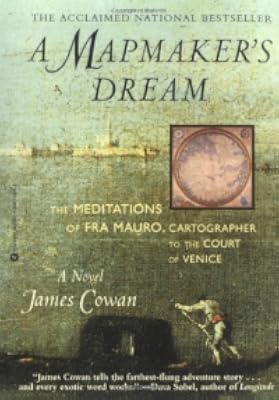
A Mapmaker's Dream: The Meditations of Fra Mauro, Cartographer to the Court of Venice
by James Cowan
On This Page
Description
In sixteenth-century Venice, in an island monastery, a cloistered monk experiences the adventure of a lifetime—all within the confines of his cell. Part historical fiction, part philosophical mystery, A Mapmaker's Dream tells the story of Fra Mauro and his struggle to realize his life's work: to make a perfect map—one that represents the full breadth of Creation. News of Mauro's projects attracts explorers, pilgrims, travelers, and merchants, all eager to contribute their accounts of show more faraway people and places. As he listens to the tales of the strange and fantastic things they've seen, Mauro comes to regard the world as much more than continents and kingdoms: that it is also made up of a vast and equally real interior landscape of beliefs, aspirations, and dreams. Mauro's map grows and takes shape, becoming both more complete and incomprehensible. In the process, the boundaries of Mauro's world are pushed to the extreme, raising questions about the relationship between representation, imagination, and the nature of reality itself. show lessTags
Recommendations
















Member Recommendations
Member Reviews
I enjoyed this book very much, but wonder at the author's notes - he says he found the manuscript at the monestary, and that the book is a translation of the original. I hate it when such claim are used to create verisimilitude, but if that is true, it adds an interesting dimension to the story.
It is easily verified that Frau Mauro was a cartographer in the period mentioned, but not so easy to verify the manuscript claimed by the author.
It is easily verified that Frau Mauro was a cartographer in the period mentioned, but not so easy to verify the manuscript claimed by the author.
I find it difficult to describe this quirky little novel. It essentially has no plot although you could argue that there is some character development as the one recurring character, Fra Mauro, seems to grow and develop as he processes the information that is brought to him. The sub-title is "The Meditations of Fra Mauro, cartographer to the Court of Venice." The basis of the story is that Fr Mauro lives in a cloistered monastery on an island near Venice and he wants to draw a completely accurate map of the world including not just the boundaries and geographic features of the lands but also all the inhabitants, creatures, culture-in short, everything about each country. Since he cannot and does not wish to leave his sanctuary travelers show more of all sorts come to him and describe what they have gleaned from their voyages. Each chapter is the story a traveler tells and Fra Mauro's impressions about what he has heard. At first I found the book rather irritating-a mishmash of unrelated and often seemingly outlandish ideas. I found, however, if I slowed down and read only one or two chapters at a time and tried to put myself into the time period of Fra Mauro-very early explorations and the making of the trade routes-that this was really fascinating. Some stories were fantastic-but don't travelers often have fantastic ideas when they see strange things? Some resonated with me as ways in which I sometimes perceive the world. Fra Mauro tried to keep an open mind when receiving all these ideas and images-and I did, too. One of the thoughts that occurred to me is that in today's information age we often feel bombarded with more ideas and images that we can process-much as Mauro must have felt. We, too, are surrounded with a myriad of ideas and world views that need to be considered. This is a book to expand your mind and to consider other ways of viewing the world-there is enough variety in these approximately 150 pages that every reader should find as least one idea that gives you that "aha!" moment. There is also enough to disagree with that this would make a good discussion book-as long as your group can vehemently disagree about ideas without getting personal or having it affect your relationships. Caveat: if you prefer to read only ideas that support your own world view this is not the book for you. If you enjoy expanding your mind to consider ideas foreign to you without feeling threatened by them, this is a delightful book-just take it in small doses. show less
Jim Harrison blurbs that this book should be read with a glass of red wine -- maybe several would help. The fictionalized account of Fra Mauro, could be called "Let me do my work!". It wasn't quite what I was hoping it would be, but there are still gems to be mined. One thing I did not like was that the Renaissance narrative breaks down a bit stylistically about 2/3 through the book and stops reading like a translated text, which I liked in the beginning. It is aptly titled Dream.... Meditations.... there is sadly no speculation as to the more interesting and mysterious aspects of Mauro's famous map.
This book gives a fascinating insight into another world. It was amazing to think that the mapmaker never actually travelled but was able to create a maps of the world based on the word of mouth of travellers that he met. His enthusiasm was just wonderful. What a pleasure it was to be able to read a translation of his journal.
I "found" this book sitting on my shelf unread and sort of forgotten since 1996 when I presumably purchased it. It carries with it a certain amount of enchantment as small books often do.
A Mapmaker's Dream purports to be a translation of one Fra Mauro's meditations on the creation of a new mappa mundi by which he intended to eclipse all such preceding cartographic efforts. Fra Mauro was indeed a famous cartographer to the Venetian court circa 1450. One of his maps can be seen here.
http://en.wikipedia.org/wiki/Fra_Mauro_map
When we think of maps today, we think of a chart that accurately depicts the details of the Earth or a specific locality. But on the contrary, the so-called mappae mundi, which appear primitive and inaccurate to the show more modern eye, were never meant to be used as navigational charts, and they make no pretense of showing the relative areas of land and water. Rather, they were schematic or diagramatic and meant to illustrate classical learning. Immediately one thinks of the art of memory for which such visually rich constructs might be viewed as a kind of teaching aid conveying the idea of the Earth as a sphere with its climate zones, the cardinal directions, distant lands, Bible stories, history, mythology, flora, fauna and exotic races. Some mappae mundi were regarded as compendiums of medieval knowledge.
It is helpful to have this background while reading A Mapmaker's Dream so that Fra Mauro's meditations don't appear quite so strange and seemingly unrelated to the production of a really useful navigational chart. It is quite clear throughout that this is the kind of map for which he is gathering intelligence. We are treated to his descriptions of visitors from far and wide who have come to him to add their exotic experiences to his map.
In the end, when his map is complete, Mauro says:
There is not much more to do. My map is a masterpiece, even if I do say so. I am well satisfied. With the help of others I have completed the world. It now has a form that is both physical and—dare I say it?—immaterial at once. Perhaps, yes, even mystical. show less
A Mapmaker's Dream purports to be a translation of one Fra Mauro's meditations on the creation of a new mappa mundi by which he intended to eclipse all such preceding cartographic efforts. Fra Mauro was indeed a famous cartographer to the Venetian court circa 1450. One of his maps can be seen here.
http://en.wikipedia.org/wiki/Fra_Mauro_map
When we think of maps today, we think of a chart that accurately depicts the details of the Earth or a specific locality. But on the contrary, the so-called mappae mundi, which appear primitive and inaccurate to the show more modern eye, were never meant to be used as navigational charts, and they make no pretense of showing the relative areas of land and water. Rather, they were schematic or diagramatic and meant to illustrate classical learning. Immediately one thinks of the art of memory for which such visually rich constructs might be viewed as a kind of teaching aid conveying the idea of the Earth as a sphere with its climate zones, the cardinal directions, distant lands, Bible stories, history, mythology, flora, fauna and exotic races. Some mappae mundi were regarded as compendiums of medieval knowledge.
It is helpful to have this background while reading A Mapmaker's Dream so that Fra Mauro's meditations don't appear quite so strange and seemingly unrelated to the production of a really useful navigational chart. It is quite clear throughout that this is the kind of map for which he is gathering intelligence. We are treated to his descriptions of visitors from far and wide who have come to him to add their exotic experiences to his map.
In the end, when his map is complete, Mauro says:
There is not much more to do. My map is a masterpiece, even if I do say so. I am well satisfied. With the help of others I have completed the world. It now has a form that is both physical and—dare I say it?—immaterial at once. Perhaps, yes, even mystical. show less
To be blunt, I didn't get this book. Perhaps this is because I have never really read books like this. I don't see the point of repeated musings of visitors coming to speak about their experiences to a Monk who is making a map.
The main question I found posed by this book is that of how one searches for the truth and what the truth is. As the book progresses, the main character becomes more unsure of himself and his place in his mission of creating a map. Can he faithfully create a map that represents the truth in the world? How can he tell when he relies only upon the stories that are sent to him? Does he experience truth from his "cell", as he puts it?
These are good meditation questions, so perhaps that's the point of the book. I did show more find my mind wandering quite a bit while reading it.
I do think of this book as a challenge. I needed to look up words every 5 - 10 pages, which is quite unusual for me, and I enjoyed expanding my vocabulary. This book had no plot, and that resulted in a story that was difficult for me to follow. Hopefully the next book I read like this will be more understandable. show less
The main question I found posed by this book is that of how one searches for the truth and what the truth is. As the book progresses, the main character becomes more unsure of himself and his place in his mission of creating a map. Can he faithfully create a map that represents the truth in the world? How can he tell when he relies only upon the stories that are sent to him? Does he experience truth from his "cell", as he puts it?
These are good meditation questions, so perhaps that's the point of the book. I did show more find my mind wandering quite a bit while reading it.
I do think of this book as a challenge. I needed to look up words every 5 - 10 pages, which is quite unusual for me, and I enjoyed expanding my vocabulary. This book had no plot, and that resulted in a story that was difficult for me to follow. Hopefully the next book I read like this will be more understandable. show less
An interesting read detailing the discoveries of a monk who sets out to create a map of the known world from the stories of travellers who come to visit him. But he ends up learning so much more than he expected creating more of an atlas of personal enlightenment than a simple map. I thoroughly enjoyed this short, but very worthwhile novel.
Members
- Recently Added By
Lists

Roads not travelled
11 works; 2 members
Author Information
27 Works 1,300 Members
Some Editions
Awards and Honors
Awards
Series
Belongs to Publisher Series
Empúries Narrativa (65)
Common Knowledge
- Canonical title*
- De droom van een kaartenmaker
- Original title
- A Mapmaker's Dream: Meditations of Fra Mauro, Cartographer to the Court of Venice
- Alternate titles*
- De droom van een kaartenmaker : de bespiegelingen van Fra Mauro, cartograaf aan het hof van Venetië
- Original publication date
- 1996
- People/Characters*
- Fra Mauro
- Important places
- Venice, Veneto, Italy
- Blurbers
- Harrison, Jim
- Original language*
- Engels
*Some information comes from Common Knowledge in other languages. Click "Edit" for more information.
Classifications
Statistics
- Members
- 646
- Popularity
- 44,949
- Reviews
- 14
- Rating
- (3.36)
- Languages
- 9 — Catalan, Dutch, English, French, German, Italian, Portuguese, Spanish, Turkish
- Media
- Paper
- ISBNs
- 19
- ASINs
- 6