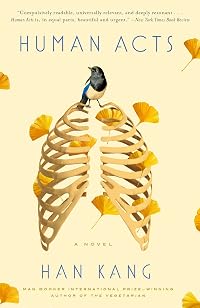
Human Acts
by Kang Han
On This Page
Description
Follows the aftermath of a young boy's shocking death during a violent student uprising as told from the perspectives of the event's victims and their loved ones. When a young boy named Dong-ho is shockingly killed in the midst of a violent student uprising in South Korea, the victims and the bereaved encounter suppression, denial, and the echoing agony of the massacre. Through their collective heartbreak and acts of hope unfolds the tale of a brutalized people in search of a voice.Tags
Recommendations





Member Reviews
This book wrecked me. That doesn't happen too often.
Where shall I go? I asked myself.
Go to your sister.
But where is she?
Go to those who killed you, then.
But where are they?
Kang takes on a harsh subject, the Gwangju Uprising in 1980, which left hundreds - possibly thousands - dead. Starting with bodies. Rotting corpses piled high in a school gymnasium, watched over by teenagers who barely know what they're fighting for, wrapping the corpses in the Korean flag for their families (if they're identified), waiting for the soldiers to arrive and put the uprising down for good. The first one we meet is Dong-ho, 15, still in middle school, looking for his friend who was gunned down in the street. Soon he will be dead too. And he will haunt show more the narrative as Kang follows her characters forward in time, through dictatorship, censorship, torture, prison, democratization, remembrance.
Conscience.
Conscience, the most terrifying thing in the world.
I'd say it's a novel shot through with PTSD, except of course it can't be, since for most of it, the events that kicked it off never officially happened. You can't be post-traumatic if the trauma isn't acknowledge. Things get to fester. Violence erupts - suddenly, now or in memories - sharp, uncompromising, and with very real effects. Seriously, it's a very violent novel, all the more so because Kang doesn't shy away, but she (and her translator) have the story so perfectly in hand it never feels sensationalist or maudlin. She keeps returning to the "you" - the second-person narration, Dong-ho, the kid who only wanted to know what happened to his friend, making the story whirl faster around itself even as the events shrink into the supposed past.
And yet, that's not what really gets me about the book.
Is it true that human beings are fundamentally cruel? Is the experience of cruelty the only thing we share as a species? Is the dignity that we cling to nothing but self-delusion, masking from ourselves this single truth: that each one of us is capable of being reduced to an insect, a ravening beast, a lump of meat?
And she keeps coming back to the other side of it. The people who refused to go home, as misguided as they may have been. The loved ones who cling to something for decades. The townspeople who lined up to give blood even as the troops closed in. The ones who find ways to speak up even when the act of speaking was illegal. Throughout the entire novel, counterbalancing all those putrefying corpses, the question of what a soul might be, just which side of us is the most human. Not necessarily in a religious sense, mind you, but some way of explaining all those acts of kindness and mercy, love and friendship - and their flipsides, guilt, pride, and inability to forgive. Nobody said having a soul, whatever it might be, made life easier. That's the bit that still hurts long after your fingernails have grown back, after all. But still. What are we?
We may be the ones who remember. Who may, or may not, choose to know why we remember.
Please, write your book so that nobody will ever be able to desecrate my brother's memory again.
This book wrecked me. show less
Where shall I go? I asked myself.
Go to your sister.
But where is she?
Go to those who killed you, then.
But where are they?
Kang takes on a harsh subject, the Gwangju Uprising in 1980, which left hundreds - possibly thousands - dead. Starting with bodies. Rotting corpses piled high in a school gymnasium, watched over by teenagers who barely know what they're fighting for, wrapping the corpses in the Korean flag for their families (if they're identified), waiting for the soldiers to arrive and put the uprising down for good. The first one we meet is Dong-ho, 15, still in middle school, looking for his friend who was gunned down in the street. Soon he will be dead too. And he will haunt show more the narrative as Kang follows her characters forward in time, through dictatorship, censorship, torture, prison, democratization, remembrance.
Conscience.
Conscience, the most terrifying thing in the world.
I'd say it's a novel shot through with PTSD, except of course it can't be, since for most of it, the events that kicked it off never officially happened. You can't be post-traumatic if the trauma isn't acknowledge. Things get to fester. Violence erupts - suddenly, now or in memories - sharp, uncompromising, and with very real effects. Seriously, it's a very violent novel, all the more so because Kang doesn't shy away, but she (and her translator) have the story so perfectly in hand it never feels sensationalist or maudlin. She keeps returning to the "you" - the second-person narration, Dong-ho, the kid who only wanted to know what happened to his friend, making the story whirl faster around itself even as the events shrink into the supposed past.
And yet, that's not what really gets me about the book.
Is it true that human beings are fundamentally cruel? Is the experience of cruelty the only thing we share as a species? Is the dignity that we cling to nothing but self-delusion, masking from ourselves this single truth: that each one of us is capable of being reduced to an insect, a ravening beast, a lump of meat?
And she keeps coming back to the other side of it. The people who refused to go home, as misguided as they may have been. The loved ones who cling to something for decades. The townspeople who lined up to give blood even as the troops closed in. The ones who find ways to speak up even when the act of speaking was illegal. Throughout the entire novel, counterbalancing all those putrefying corpses, the question of what a soul might be, just which side of us is the most human. Not necessarily in a religious sense, mind you, but some way of explaining all those acts of kindness and mercy, love and friendship - and their flipsides, guilt, pride, and inability to forgive. Nobody said having a soul, whatever it might be, made life easier. That's the bit that still hurts long after your fingernails have grown back, after all. But still. What are we?
We may be the ones who remember. Who may, or may not, choose to know why we remember.
Please, write your book so that nobody will ever be able to desecrate my brother's memory again.
This book wrecked me. show less
Han Kang, through an English translation by Deborah Smith, has written an important testament to the Gwangju Uprising of 1980, in South Korea. The book portrays the brutal suppression of a student uprising by the military. Be forewarned that it includes graphic descriptions of killings, torture, and decomposition.
It opens with the bodies. Dong-ho, a 15-year-old boy, is searching for the corpse of his best friend. He meets two young women and a young man, college age students, and joins them in voluntarily taking care of the bodies of the victims until they are identified by next of kin. The six subsequent chapters contain interwoven threads related to Dong-ho.
This book takes on universal themes such as:
• Does the soul exist show more independently from the body?
• How do we creatively overcome censorship?
• Do survivors have an obligation to revisit traumatic memories to ensure society remembers?
• Is humankind tethered irrevocably to the darkest side of human nature?
• What is the ongoing impact of a government’s act of violence against its citizens?
The author conveys an eloquent and fluid style, even when describing barbarism. The author has chosen to use a variety of perspectives, including first person, second person and third person, which may be problematic for some readers. Also, some of the narrative jumps from one topic to the next without establishing the larger context. Aside from these minor issues, it is a superbly written and memorable book. While not easy to read due to the horrific subject matter, it relates an important story that needed to be told, as many people in this day are unaware it ever took place. From a purely personal perspective, I would love to see what the author could do with a less morbid subject matter in her future writings.
According to the Epilogue, the author desired to tell the story that would do justice to Dong-ho. On this point, I believe, she has succeeded.
Memorable quotes:
“How long do souls linger by the side of their bodies? Do they really flutter away like some kind of bird?”
“No one had ever taught me how to address a person’s soul.”
“There was only one, distant point of light, where I saw a succession of flares shooting up, glittering shards of light being scattered from the barrels of guns.”
“Ever since the uprising began, I’d felt something coursing through me, as overwhelming as any army. Conscience. Conscience, the most terrifying thing in the world.”
“It was only when we were shattered that we proved we had souls. That what we really were was humans made of glass.” show less
It opens with the bodies. Dong-ho, a 15-year-old boy, is searching for the corpse of his best friend. He meets two young women and a young man, college age students, and joins them in voluntarily taking care of the bodies of the victims until they are identified by next of kin. The six subsequent chapters contain interwoven threads related to Dong-ho.
This book takes on universal themes such as:
• Does the soul exist show more independently from the body?
• How do we creatively overcome censorship?
• Do survivors have an obligation to revisit traumatic memories to ensure society remembers?
• Is humankind tethered irrevocably to the darkest side of human nature?
• What is the ongoing impact of a government’s act of violence against its citizens?
The author conveys an eloquent and fluid style, even when describing barbarism. The author has chosen to use a variety of perspectives, including first person, second person and third person, which may be problematic for some readers. Also, some of the narrative jumps from one topic to the next without establishing the larger context. Aside from these minor issues, it is a superbly written and memorable book. While not easy to read due to the horrific subject matter, it relates an important story that needed to be told, as many people in this day are unaware it ever took place. From a purely personal perspective, I would love to see what the author could do with a less morbid subject matter in her future writings.
According to the Epilogue, the author desired to tell the story that would do justice to Dong-ho. On this point, I believe, she has succeeded.
Memorable quotes:
“How long do souls linger by the side of their bodies? Do they really flutter away like some kind of bird?”
“No one had ever taught me how to address a person’s soul.”
“There was only one, distant point of light, where I saw a succession of flares shooting up, glittering shards of light being scattered from the barrels of guns.”
“Ever since the uprising began, I’d felt something coursing through me, as overwhelming as any army. Conscience. Conscience, the most terrifying thing in the world.”
“It was only when we were shattered that we proved we had souls. That what we really were was humans made of glass.” show less
Dong-ho is a middle school student living in Gwangju who gets caught up in the labour and student unrest that took place there in May, 1980. The brutal repression of those clamouring for democratic rights and labour justice was devastating. Its effects live on, both in the lives of those directly touched by these experiences and those who only experience the ripple effect. Like radioactive fallout, the half-life of government sponsored terror permeates everything with which it comes into contact. Dong-ho, however, is one of those who never got a chance to live even half a life. Along with friends, relatives, and others he serves as an ongoing reminder of the acts we as humans are capable of inflicting on others.
Dong-ho’s story is told show more from various perspectives and at different points in time. Often the narrative is written in second person, though whom the “you” is addressing is not always clear. Initially we see events from the point of view of Dung-ho and his boyhood friend. Years later, an editor at a publishing house is touched by the events of that day and its ongoing effects. We see the later life of one of those taken prisoner during the repression, though “life” is probably an over-statement. And we hear the story of a young female factory worker who participated in the protest, and what her involvement has done to her life. Lastly there is the story of Dong-ho’s mother, who never stops fighting for a recognition of the harm that was done to him. The book is rounded out with a section with the voice of “the writer”. Each of these sections could almost stand alone. They have distinctly different styles. I was especially struck by the section from the editor which is fashioned as an attempt to forget the seven vicious slaps she has received from the secret police. But each is devastatingly poignant in its own way.
Han Kang has created a masterful means of bringing Dong-ho to life. Her writing is so spare and judicious that it reads like unsentimental journalism, even when the narrative voice is that of a disembodied spirit still clinging to his bodily remains. But be aware that this is heavy going. You will find it almost impossible not to be moved. It is writing that feels both essential and, one fears, dangerous.
Certainly recommended. show less
Dong-ho’s story is told show more from various perspectives and at different points in time. Often the narrative is written in second person, though whom the “you” is addressing is not always clear. Initially we see events from the point of view of Dung-ho and his boyhood friend. Years later, an editor at a publishing house is touched by the events of that day and its ongoing effects. We see the later life of one of those taken prisoner during the repression, though “life” is probably an over-statement. And we hear the story of a young female factory worker who participated in the protest, and what her involvement has done to her life. Lastly there is the story of Dong-ho’s mother, who never stops fighting for a recognition of the harm that was done to him. The book is rounded out with a section with the voice of “the writer”. Each of these sections could almost stand alone. They have distinctly different styles. I was especially struck by the section from the editor which is fashioned as an attempt to forget the seven vicious slaps she has received from the secret police. But each is devastatingly poignant in its own way.
Han Kang has created a masterful means of bringing Dong-ho to life. Her writing is so spare and judicious that it reads like unsentimental journalism, even when the narrative voice is that of a disembodied spirit still clinging to his bodily remains. But be aware that this is heavy going. You will find it almost impossible not to be moved. It is writing that feels both essential and, one fears, dangerous.
Certainly recommended. show less
[Human Acts] tells the story of the 1980 massacre of protestors in the city of Gwangju, a city in southern South Korea. Told from various points of view of people who participated in or who were affected by the massacre and its aftermath, this is a heartbreaking story that is, as the translator Deborah Smith says, "a reminder of the human acts of which we are all capable."
Han Kang's poetic writing makes the scenes of brutality and torture all the more shocking. One protestor remembers what prompted his participation: "Those snapshot moments, when it seemed we'd all performed the miracle of stepping outside the shell of our own selves, one person's tender skin coming into grazed contact with another, felt as though they were rethreading show more the sinews of that world heart, patching up the fissures from which blood had flowed, making it beat again."
Each voice, from that of the middle school student and his mother, to the young women factory worker, to the writer trying to make sense of what happened, each adds to the story, revealing a crime that the world should recognize. An important, breathtaking novel. show less
Han Kang's poetic writing makes the scenes of brutality and torture all the more shocking. One protestor remembers what prompted his participation: "Those snapshot moments, when it seemed we'd all performed the miracle of stepping outside the shell of our own selves, one person's tender skin coming into grazed contact with another, felt as though they were rethreading show more the sinews of that world heart, patching up the fissures from which blood had flowed, making it beat again."
Each voice, from that of the middle school student and his mother, to the young women factory worker, to the writer trying to make sense of what happened, each adds to the story, revealing a crime that the world should recognize. An important, breathtaking novel. show less
 This review was written for LibraryThing Early Reviewers.
The novel at first felt fragmentary, stuttering, hesitant, and understated, but as I read along every sentence, every thought built upon the last, until the story became not only a interwoven chronicle of wrenching human happenings, but also an examination of how humans behave toward one another; how people behave in crowds; how human beings survive trauma (or not); and how they find meaning in the aftermath of unrelenting tragedy.
There was nothing cinematic about the treatment of the Gwangju massacre here. There is not much resembling what you might call a 'scene.' Instead the story builds on one small detail after another. The voices interweave in surprising ways. The structure serves to graphically illustrate the interconnection of show more human beings, as well as the fragility of these connections--people are separated by death, by experience, by class and gender and age, no matter how much they try to remain connected.
I was very surprised at how this novel worked--surprised that it worked at all. I was surprised at how gut-punchingly sad the revelations in the second chapter were, even though the chapter was narrated by a ghost, and the tragedy the ghost tells is told obliquely, not graphically; even so the story in this chapter left me defenseless when it came to the unexpected death of one of the characters.
The nature of obligation and conscience and of right and wrong kept prodding my thinking as I read. Characters wonder aloud about humanity's ability to be inhumane; about their ability to be compassionate.
I cried a few times.
The final chapter was for me a masterful way of wrenching the story from the realm of fiction and into the real world, where it belongs. show less
There was nothing cinematic about the treatment of the Gwangju massacre here. There is not much resembling what you might call a 'scene.' Instead the story builds on one small detail after another. The voices interweave in surprising ways. The structure serves to graphically illustrate the interconnection of show more human beings, as well as the fragility of these connections--people are separated by death, by experience, by class and gender and age, no matter how much they try to remain connected.
I was very surprised at how this novel worked--surprised that it worked at all. I was surprised at how gut-punchingly sad the revelations in the second chapter were, even though the chapter was narrated by a ghost, and the tragedy the ghost tells is told obliquely, not graphically; even so the story in this chapter left me defenseless when it came to the unexpected death of one of the characters.
The nature of obligation and conscience and of right and wrong kept prodding my thinking as I read. Characters wonder aloud about humanity's ability to be inhumane; about their ability to be compassionate.
I cried a few times.
The final chapter was for me a masterful way of wrenching the story from the realm of fiction and into the real world, where it belongs. show less
I read this right after reading Han Kang's 'Vegetarian' and I can see after reading this one where Han Kang might have got the idea. I first must admit I've never heard of the Gwangju Uprising in South Korea in 1980. (If it didn't involve America in some way, there was a slim chance teachers would have discussed it. But I should be reading more about world history for that reason.) Basically the government starts indiscriminately killing anyone during peaceful protests of unarmed civilians. Everything in Han Kang's book here is heartbreaking and overwhelming, especially as it begins with school students trying to organize and prepare the recently massacred for burial with an impending attack from the government. The book starts with show more Dong-Ho, a young boy looking for his friend he saw shot and decides to work taking care of the dead until he finds him. The novel here is separated into seven sections from the time of the uprising in 1980 to 2013. Each section is from a different point of view -- most of the characters mentioned in the first section and connected to the young boy Dong-Ho in some way. There is also an epilogue written from "the writer's" point of view. I'm not sure how autobiographical this is from Han Kang, but I loved that it is included at the end. I wanted to see her perspective, even though her family was lucky and moved out of Gwangju right before the massacre, resulting in her family having survivor's guilt which is heartbreaking in itself. My heart just fills reading each section of the book. These characters could not have been given more heart and I think that was Han Kang's intent. These are the human acts that must be remembered (both good and bad) because they certainly will be by the survivors. I also appreciated Deborah Smith's helpful introduction and wonderful translation. It is mentioned in the book that it was easier for the soldiers to attack their own people because of what they did in Vietnam. Any brutality can have everlasting repercussions that keep perpetuating and it is important to remember and hold on to dignity and humanity. show less
This review was written for LibraryThing Early Reviewers.Wow. Seriously, wow.
Kang's writing is superbly powerful and evocative. Once again, I feel the ignorant-American let down by schooling, as I had no idea about these events in South Korea. I suppose the government there did try to keep it quiet for a while, but still. I opened the book and started reading the short introduction that provides a little background to the events to follow, and sat there puzzled. How, why, did I not know?
Well, I know now.
I'm almost glad I didn't know anything before. Because Kang did a brilliant job at elucidating these horrific events - learning of them any other way would have paled. She put them snugly into the form of a novel, comprised of a small handful of chapters with unique narrators, rather than show more making a dry historic record. She placed her characters (and therefore you, dear reader) right in the thick of it all; the characters really came alive, and her method of weaving the stories loosely around each other was simply perfect. This novel is infuriating, and sweet, and heartbreaking. It is fantastic.
I challenge anyone to read this and not mourn Dong-ho. To read this and not be emotionally invested. Go on, I dare you. show less
Kang's writing is superbly powerful and evocative. Once again, I feel the ignorant-American let down by schooling, as I had no idea about these events in South Korea. I suppose the government there did try to keep it quiet for a while, but still. I opened the book and started reading the short introduction that provides a little background to the events to follow, and sat there puzzled. How, why, did I not know?
Well, I know now.
I'm almost glad I didn't know anything before. Because Kang did a brilliant job at elucidating these horrific events - learning of them any other way would have paled. She put them snugly into the form of a novel, comprised of a small handful of chapters with unique narrators, rather than show more making a dry historic record. She placed her characters (and therefore you, dear reader) right in the thick of it all; the characters really came alive, and her method of weaving the stories loosely around each other was simply perfect. This novel is infuriating, and sweet, and heartbreaking. It is fantastic.
I challenge anyone to read this and not mourn Dong-ho. To read this and not be emotionally invested. Go on, I dare you. show less
This review was written for LibraryThing Early Reviewers.Members
- Recently Added By
Published Reviews
ThingScore 93
Human Acts is an easy book to admire but not an easy one to read.
added by ScattershotSteph
The result is nothing short of breathtaking. It’s also brutally honest, graphic in its depiction of death and torture (waterboarding, a wooden ruler shoved into a character’s vagina, you name it), and unrelentingly bleak.
added by ScattershotSteph
Human Acts grapples with the fallout of a massacre and questions what humans are willing to die for and in turn what they must live through. Kang approaches these difficult and inexorable queries with originality and fearlessness, making Human Acts a must-read for 2017.
added by ScattershotSteph
Lists

Female Author
1,234 works; 67 members

Top Five Books of 2021
604 works; 181 members

Top Five Books of 2016
795 works; 229 members

2018 Notable Books for Adults
26 works; 4 members

Books Read in 2017
4,249 works; 130 members

Books Nikki Read in 2017
16 works; 1 member

Kirkus Starred Fiction Reviews of Books Published in 2017
412 works; 7 members
World Books
51 works; 4 members

Want to Read... Asian Authors
11 works; 1 member

Korean literature
68 works; 5 members

Books Read in 2024
4,727 works; 128 members

The LonesomeReader Book Club
36 works; 1 member

Global Reads: Books Set in East Asia
139 works; 12 members

Wishlist
48 works; 1 member
Author Information

Some Editions
Awards and Honors
Awards
Distinctions
Notable Lists
RUSA CODES Listen List (Listen-Alike – Listen-Alike to “A Burning: A Novel” by Megha Majumdar – 2021)
Common Knowledge
- Canonical title
- Human Acts
- Original title
- 소년이 온다
- Alternate titles
- The boy is coming
- Original publication date
- 2014; 2016 (English translation) (English translation)
- Important places
- Gwangju, South Korea
- Important events
- Gwangju uprising (1980)
- First words
- In early 1980, South Korea was a heap of dry tinder waiting for a spark. Only a few months previously Park Chung-hee, the military strongman who'd ruled since his coup in 1961, had been assassinated by the director of his own... (show all) security services. Presiding over the so-called Miracle on the Han river - South Korea's rapid transformation from dirt-poor and war-shattered into a fully industrialized economic powerhouse - had gained Park support from some quarters, though numerous human rights abuses meant he was never truly popular. Recently, he'd succumbed to the classic authoritarian temptation to institute increasingly repressive measures, including scrapping the old constitution and having a new one drawn up making his rule a de factor dictatorship. By 1979 things were fraying at the edges, and Park's declaration of martial law in response to demonstrations in the far south was, to some, a sign that something had to give. -Introduction, Deborah Smith
"Looks like rain," you mutter to yourself.
What'll we do if it really chucks it down?
You open your eyes so that only a slender crack of light seeps in, and peer at the gingko trees in front of the Provin... (show all)cial Office. As though there, between those branches, the wind is about to take on visible form. As though the raindrops suspended in the air, held breath before the plunge, are on the cusp of trembling down, glittering like jewels. -Chapter 1, The Boy, 1980 - Quotations
- I never let myself forget that every single person I meet is a member of this human race.
It was also strange to see the Taegukgi, the national flag, being spread over each coffin and tied tightly in place. Why would you sing the national anthem for people who had been killed by soldiers? Why cover the coffin with... (show all) the Taegukgi? As though it wasn't the nation itself that murdered them.
“The soldiers are the scary ones,” you said with a half-smile. “What's frightening about the dead?”
How can anyone go up against a gun with nothing but an empty fist?
Our soldiers are shooting. They're shooting at us.
Somehow or other, I needed to make sense of what I'd experienced.
Is it true that human beings are fundamentally cruel? Is the experience of cruelty the only thing we share as a species? Is the dignity that we cling to nothing but self-delusion, masking from ourselves this single truth: tha... (show all)t each one of us is capable of being reduced to an insect, a ravening beast, a lump of meat? To be degraded, damaged, slaughtered—is this the essential fate of humankind, one that history has confirmed as inevitable?
There must've been around a hundred policeman, heavily armed with helmets and shields. Lightweight combat vehicles whose every window was covered with wire mesh. The thought flashed through your mind: what do they need all... (show all) that for? We can't fight, we don't have any weapons.
The government's official report stated that she had cut her own wrists with the shards from a bottle of Sprite and jumped from the third floor. You didn't believe a word of it. Like piecing together a puzzle, you had to peer... (show all) closely at the photographs that were carried in the government-controlled papers, to read between the lines of the editorials, which condemned the uprising in incensed, strident tones. - Last words
- (Click to show. Warning: May contain spoilers.)I stared, mute, at that flame's wavering outline, fluttering like a bird's translucent wing.
- Blurbers
- McInerney, Lisa; Ryan, Shawna Yang
- Original language
- Korean
- Canonical DDC/MDS
- 895.73
- Canonical LCC
- 9781101906729
Classifications
- Genres
- Fiction and Literature, General Fiction, Historical Fiction
- DDC/MDS
- 895.73 — Literature & rhetoric Literatures of other languages Literatures of East and Southeast Asia Korean Korean fiction
- LCC
- PL992.26 .K36 .S6613 — Language and Literature Languages and literatures of Eastern Asia, Africa, Oceania Languages of Eastern Asia, Africa, Oceania Korean language and literature Korean literature Individual authors and works
- BISAC
Statistics
- Members
- 2,378
- Popularity
- 8,263
- Reviews
- 218
- Rating
- (4.20)
- Languages
- 18 — Catalan, Czech, Danish, Dutch, English, Finnish, French, German, Hungarian, Italian, Korean, Norwegian, Polish, Spanish, Swedish, Turkish, Vietnamese, Portuguese (Portugal)
- Media
- Paper, Audiobook, Ebook
- ISBNs
- 53
- ASINs
- 14
