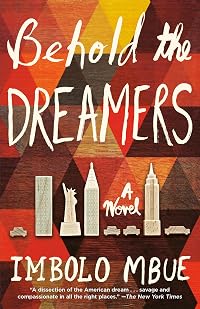
Behold the Dreamers
by Imbolo Mbue
On This Page
Description
In the fall of 2007, Jende Jonga, a Cameroonian immigrant living in Harlem, lands a job as a chauffeur for Clark Edwards, a senior executive at Lehman Brothers. Their situation only improves when Jende's wife Neni is hired as household help. But in the course of their work, Jende and Neni begin to witness infidelities, skirmishes, and family secrets. Then, with the 2008 collapse of Lehman Brothers, a tragedy changes all four lives forever, and the Jongas must decide whether to continue show more fighting to stay in a recession-ravaged America or give up and return home to Cameroon. show lessTags
Recommendations








Member Reviews
As a new immigrant in the United States, Jende is hoping to give his family a standard of living and opportunities they would never have had in their native Cameroon. His wife Neni is now attending college, and he has landed an agreeable job as a chauffeur for a Wall Street executive. Things are going well, but Jende never breathes too easily, because his legal status in the country isn't yet secure.
Both heartbreaking and inspiring, Mbue's work provides a glimpse into the lives and thought processes of immigrants to this country, how hard they are willing to work, how much they are willing to sacrifice (materially and psychologically), and the risks they are willing to take for the promise of all this country appears to offer. I have to show more say that for me the story provoked feelings of dread throughout — I was constantly on edge, waiting for the worst thing to happen. I also half-expected the Edwards family to be stereotypically evil-rich, but to my relief they were painted with a more nuanced brush stroke, though certainly not altruistic. An exquisitely-written and important book. show less
Both heartbreaking and inspiring, Mbue's work provides a glimpse into the lives and thought processes of immigrants to this country, how hard they are willing to work, how much they are willing to sacrifice (materially and psychologically), and the risks they are willing to take for the promise of all this country appears to offer. I have to show more say that for me the story provoked feelings of dread throughout — I was constantly on edge, waiting for the worst thing to happen. I also half-expected the Edwards family to be stereotypically evil-rich, but to my relief they were painted with a more nuanced brush stroke, though certainly not altruistic. An exquisitely-written and important book. show less
2017 NEWS! THIS 5-STAR READ IS A FINALIST FOR THE PEN/FAULKNER AWARD!
Rating: 5* of five
The Publisher Says: Jende Jonga, a Cameroonian immigrant living in Harlem, has come to the United States to provide a better life for himself, his wife, Neni, and their six-year-old son. In the fall of 2007, Jende can hardly believe his luck when he lands a job as a chauffeur for Clark Edwards, a senior executive at Lehman Brothers. Clark demands punctuality, discretion, and loyalty—and Jende is eager to please. Clark’s wife, Cindy, even offers Neni temporary work at the Edwardses’ summer home in the Hamptons. With these opportunities, Jende and Neni can at last gain a foothold in America and imagine a brighter future.
However, the world of great show more power and privilege conceals troubling secrets, and soon Jende and Neni notice cracks in their employers’ façades.
When the financial world is rocked by the collapse of Lehman Brothers, the Jongas are desperate to keep Jende’s job—even as their marriage threatens to fall apart. As all four lives are dramatically upended, Jende and Neni are forced to make an impossible choice.
My Review: I voted for this book in the 2016 Goodreads Choice Awards. I read somewhere on the internet that this just might be The Great American Novel. I agree.
Nothing is more American, in my experience of being a life-long one, than rooting for the underdog. Nothing is more American than relishing, with unabashed schadenfreude, the fall of the mighty and greedy.
Followed by:
These two fundamental American character traits intersect in this well-crafted debut novel. (This is the author's debut novel, but I will bet large sums of cash money that it's not her first...this is an accomplished, polished, beautiful piece of writing and plotting, and it has numerous older siblings in the "recycle" folder on her hard drive or I'm your maiden auntie.)
Don't waste time reading reviews, go get the book and read it! Now! Quick sticks, possums, don't deprive yourselves of this pleasure. show less
Rating: 5* of five
The Publisher Says: Jende Jonga, a Cameroonian immigrant living in Harlem, has come to the United States to provide a better life for himself, his wife, Neni, and their six-year-old son. In the fall of 2007, Jende can hardly believe his luck when he lands a job as a chauffeur for Clark Edwards, a senior executive at Lehman Brothers. Clark demands punctuality, discretion, and loyalty—and Jende is eager to please. Clark’s wife, Cindy, even offers Neni temporary work at the Edwardses’ summer home in the Hamptons. With these opportunities, Jende and Neni can at last gain a foothold in America and imagine a brighter future.
However, the world of great show more power and privilege conceals troubling secrets, and soon Jende and Neni notice cracks in their employers’ façades.
When the financial world is rocked by the collapse of Lehman Brothers, the Jongas are desperate to keep Jende’s job—even as their marriage threatens to fall apart. As all four lives are dramatically upended, Jende and Neni are forced to make an impossible choice.
My Review: I voted for this book in the 2016 Goodreads Choice Awards. I read somewhere on the internet that this just might be The Great American Novel. I agree.
My advice to someone like you is to always stay close to the gray area and keep yourself and your family safe. Stay away from any place where you can run into police—that's the advice I give to you and to all young black men in this country. The police is for the protection of white people, my brother. Maybe black women and black children sometimes, but not black men. Never black men. Black men and police are palm oil and water. You understand me, eh?
Nothing is more American, in my experience of being a life-long one, than rooting for the underdog. Nothing is more American than relishing, with unabashed schadenfreude, the fall of the mighty and greedy.
Anyone can go to the shop and buy anything and give to anyone, he told Liomi when the boy asked him for the umpteenth time why he couldn’t get even a little toy truck. The true measure of whether somebody really loves you, he lectured, is what they do for you with their hands and say to you with their mouth and think of you in their heart.
Followed by:
“That’s exactly the problem! People don’t want to open their eyes and see the Truth because the illusion suits them. As long as they’re fed whatever lies they want to hear they’re happy, because the Truth means nothing to them. Look at my parents—they’re struggling under the weight of so many pointless pressures, but if they could ever free themselves from this self-inflicted oppression they would find genuine happiness. Instead, they continue to go down a path of achievements and accomplishments and material success and shit that means nothing because that’s what America’s all about, and now they’re trapped. And they don’t get it!”
These two fundamental American character traits intersect in this well-crafted debut novel. (This is the author's debut novel, but I will bet large sums of cash money that it's not her first...this is an accomplished, polished, beautiful piece of writing and plotting, and it has numerous older siblings in the "recycle" folder on her hard drive or I'm your maiden auntie.)
Don't waste time reading reviews, go get the book and read it! Now! Quick sticks, possums, don't deprive yourselves of this pleasure. show less
Jende Jonga und seine Frau Neni haben es geschafft: Sie sind in New York, USA, dem Land der unbegrenzten Möglichkeiten. In Kamerun, woher sie beide stammen, gab es zum Einen keine Möglichkeit für sie, gemeinsam zu leben. Und zum Anderen waren ihre Zukunftsaussichten alles andere als rosig. Arbeit gibt es dort so gut wie keine und wenn, sind es schlecht bezahlte Hilfsarbeiten. Um auf's College zu gehen oder eine der wenigen gut bezahlten Stellen zu erhalten, muss man Beziehungen und Geld haben - Jende und Neni haben beides nicht. Doch dank seines Cousins haben sie es in die USA geschafft: Jende hat eine gute Stelle als Chauffeur bei einem Wallstreet-Banker und Neni macht ihren Abschluss, um danach Pharmazie zu studieren. Alles ist show more wunderbar, doch dann kommt die Bankenkrise und das Leben der Jongas ändert sich.
Die Geschichte wird vollständig aus der Sicht der Jongas erzählt: Jende, der den Großteil seiner Zeit als Chauffeuer mit seinem Arbeitgeber Mr. Edwards verbringt, einem leitenden Manager bei Lehman Brothers. Und Neni, die im Sommer für Mr. Edwards Frau in den Hamptons arbeitet. Beide erhalten unweigerlich einen tiefen Einblick in diese Familie, die so reich ist, dass es die Jongas kaum glauben können. Doch nie gibt es ein Wort oder einen Gedanken des Neides - stattdessen sind Jende und Neni den Edwards überaus dankbar, auch wenn diese sich kaum für ihre Angestellten interessieren. Typisch, könnte man nun meinen. Diese reiche, egoistische und egozentrische High-Society, die den Bezug zum normalen Leben so gut wie verloren hat. Doch so leicht macht es die Autorin den Lesenden in ihrem Erstlingswerk nicht. Auch die Edwards haben ihr Päckchen zu tragen und nicht alle Banker denken ausschließlich an ihren eigenen Profit.
Imbolo Mbue, die selbst aus Kamerun stammt und nun in den USA lebt, hat nach meinem Empfinden ein ungemein realitätsnahes Werk geschaffen, dass vermutlich die Hoffnungen und Ängste vieler Einwanderer (nicht nur derjenigen aus Afrika) nachvollziehbar widerspiegelt. Dass sie bei der Darstellung des amerikanischen Gegenübers nicht in Klischees verfällt, ist ein weiterer großer Pluspunkt für diese unterhaltsame, etwas traurige aber auch amüsante Geschichte. Sehr sehr lesenswert! show less
Die Geschichte wird vollständig aus der Sicht der Jongas erzählt: Jende, der den Großteil seiner Zeit als Chauffeuer mit seinem Arbeitgeber Mr. Edwards verbringt, einem leitenden Manager bei Lehman Brothers. Und Neni, die im Sommer für Mr. Edwards Frau in den Hamptons arbeitet. Beide erhalten unweigerlich einen tiefen Einblick in diese Familie, die so reich ist, dass es die Jongas kaum glauben können. Doch nie gibt es ein Wort oder einen Gedanken des Neides - stattdessen sind Jende und Neni den Edwards überaus dankbar, auch wenn diese sich kaum für ihre Angestellten interessieren. Typisch, könnte man nun meinen. Diese reiche, egoistische und egozentrische High-Society, die den Bezug zum normalen Leben so gut wie verloren hat. Doch so leicht macht es die Autorin den Lesenden in ihrem Erstlingswerk nicht. Auch die Edwards haben ihr Päckchen zu tragen und nicht alle Banker denken ausschließlich an ihren eigenen Profit.
Imbolo Mbue, die selbst aus Kamerun stammt und nun in den USA lebt, hat nach meinem Empfinden ein ungemein realitätsnahes Werk geschaffen, dass vermutlich die Hoffnungen und Ängste vieler Einwanderer (nicht nur derjenigen aus Afrika) nachvollziehbar widerspiegelt. Dass sie bei der Darstellung des amerikanischen Gegenübers nicht in Klischees verfällt, ist ein weiterer großer Pluspunkt für diese unterhaltsame, etwas traurige aber auch amüsante Geschichte. Sehr sehr lesenswert! show less
Book on CD performed by Prentice Onayemi
Mbue explores the “American Dream” through an immigrant family’s experiences. Jende Jonga comes from Cameroon with his wife, Neni, and his young son. His hope is to provide for his family, to allow his wife to finish school to become a pharmacist, and to give his son the advantages that are not available in their hometown of Limbe, Cameroon. It is 2007, and Jenda has been blessed to land a job as a chauffeur to Clark Edwards, a rising star at Lehman Brothers. Clark demands promptness, professionalism and discretion, and Jende is up to the task. Clark’s wife, Cindy, even employs Neni at their summer home in the Hamptons. So, they are well on their way to the American Dream, saving money, show more learning the ways of America, hoping for a bright future. And then Lehman Brothers collapses, and the Jongas are desperate to keep their hold on the dream.
What a powerful and insightful look at the immigrant experience. I was particularly impressed by Neni and the strength she showed when push came to shove, and her family’s future was at stake. But cultural expectations, even when far from home, are hard to ignore. Her desire to keep her children in America cannot fully and fairly compete with the ingrained behaviors of their homeland.
Mbue gives us complex characters, fully realized, with all their gifts and faults. At times I sympathized even with the “villains” of the story. Mbue made me think about the complexity of immigration policy. In the end, though, my money is on the Jonga family. They are more than dreamers. They are winners.
Prentice Onayemi does a superb job of narrating the audiobook. I was particularly impressed by how he voiced Jende and Neni. show less
Mbue explores the “American Dream” through an immigrant family’s experiences. Jende Jonga comes from Cameroon with his wife, Neni, and his young son. His hope is to provide for his family, to allow his wife to finish school to become a pharmacist, and to give his son the advantages that are not available in their hometown of Limbe, Cameroon. It is 2007, and Jenda has been blessed to land a job as a chauffeur to Clark Edwards, a rising star at Lehman Brothers. Clark demands promptness, professionalism and discretion, and Jende is up to the task. Clark’s wife, Cindy, even employs Neni at their summer home in the Hamptons. So, they are well on their way to the American Dream, saving money, show more learning the ways of America, hoping for a bright future. And then Lehman Brothers collapses, and the Jongas are desperate to keep their hold on the dream.
What a powerful and insightful look at the immigrant experience. I was particularly impressed by Neni and the strength she showed when push came to shove, and her family’s future was at stake. But cultural expectations, even when far from home, are hard to ignore. Her desire to keep her children in America cannot fully and fairly compete with the ingrained behaviors of their homeland.
Mbue gives us complex characters, fully realized, with all their gifts and faults. At times I sympathized even with the “villains” of the story. Mbue made me think about the complexity of immigration policy. In the end, though, my money is on the Jonga family. They are more than dreamers. They are winners.
Prentice Onayemi does a superb job of narrating the audiobook. I was particularly impressed by how he voiced Jende and Neni. show less
This book tells the story of two families living in the New York City during the lead-up to the financial crisis of 2008. Jende Jonga, a Cameroonian immigrant, becomes a chauffeur for Clark Edwards, a Lehman Brothers executive. Jende brings his wife, Neni, and son, Liomi, to New York from Cameroon, hoping to take advantage of the “American Dream.” The story follows the lives of these two families, contrasting their triumphs and challenges. One family is pursuing the dream, working hard, saving and sacrificing, to create a life of opportunity for themselves and their children. The other has achieved the dream, but at a substantial cost to their well-being. As the story unfolds, these two families become more interdependent, and face show more difficult ethical decisions, both personally and professionally. Themes include dreams, family, social class, marriage, and immigration.
This book brought home to me the reality of the many difficulties faced by immigrants – navigating the complicated government bureaucracy over visas and residency, court appearances and costs, language and cultural barriers, working multiple jobs to make ends meet, and sending money to relatives back home. The dream often comes face to face with the reality that there is only so much one can control through hard work and perseverance. The book is well crafted and conveys a sense of time and place. The writing is straightforward, and the characters are vivid. I think the primary strength lies in the interactions among the characters. They come across as flawed individuals but empathetic in unexpected ways. It is not a “happy” book, but it struck me as authentic, and gave me much food for thought. I think it would make an excellent choice for a book club discussion. This book is a strong debut by Mbue, and I look forward to reading more from her in the future. show less
This book brought home to me the reality of the many difficulties faced by immigrants – navigating the complicated government bureaucracy over visas and residency, court appearances and costs, language and cultural barriers, working multiple jobs to make ends meet, and sending money to relatives back home. The dream often comes face to face with the reality that there is only so much one can control through hard work and perseverance. The book is well crafted and conveys a sense of time and place. The writing is straightforward, and the characters are vivid. I think the primary strength lies in the interactions among the characters. They come across as flawed individuals but empathetic in unexpected ways. It is not a “happy” book, but it struck me as authentic, and gave me much food for thought. I think it would make an excellent choice for a book club discussion. This book is a strong debut by Mbue, and I look forward to reading more from her in the future. show less
This story begins in 2007, when Obama was running for president on a campaign of hope and realizing one's dreams, and the world was as yet unaware that the global economy was about to be thrown into turmoil.
The worst financial crisis since 1929 began after large Wall Street banks created huge amounts of esoteric debt instruments composed of bundles of risky (subprime) home mortgages. [A "debt instrument" is legally enforceable evidence of a financial debt and the promise of timely repayment of the principal, plus any interest. A "subprime loan" is a loan to individuals who have been turned down by traditional lenders because of their low credit ratings or other factors suggesting they have a reasonable chance of defaulting on the debt show more repayment.] Theoretically, the risk associated with subprime loans was mitigated by pooling large numbers of them together, then selling the packages to other investors. [Somehow, in spite of the alleged decreased risk, the big banking houses were more than eager to offload them.]
People who thought they could never escape apartment living recklessly heeded the siren call of realizing "the American dream." Easy credit allowed them to purchase homes without down-payments, even when they could not realistically ensure they could pay their mortgages. This in turn enhanced the demand for housing, creating a temporary "bubble" in real estate prices. When many mortgagees found that they owed more on their houses than those houses were worth, and/or that their incomes were not high enough to pay their mortgage rates (often raised by the secondary purchasers of the mortgage packages), they began to default on their loans in record numbers.
Relatively sophisticated large investors [also "dreamers" - of more wealth] found themselves with greatly devalued or worthless paper. Bear Stearns faced insolvency first, followed by Lehman Brothers, an even bigger investment bank. The Lehman bankruptcy roiled financial markets for months thereafter.
Among those hardest hit by the collapse were recent migrants, who had come to America seeking a better life for themselves and their children.
The main protagonist in this book, Jende Jonga, 37, was just such an immigrant from Cameroon. He arrived in Harlem in 2004, and worked hard to save enough money to bring over his wife Neni, 33, and son Liomi, now six years old. Both Jende and Neni longed to stay in America. Neni wanted to become a pharmacist, which was not a realistic goal in her home country. Jende explained to his new employer that while he, like Neni, loved his home back in Cameroon:
“…my country is no good, sir…. It is nothing like America. I stay in my country, I would have become nothing. My son will grow up and be poor like me, just like I was poor like my father. But in America, sir? I can become something. I can even become a respectable man. My son can become a respectable man.”
Jende still didn’t have papers to stay permanently, but had a somewhat-shady immigration lawyer helping him. He hadn’t made much money either from driving a taxi, what with not only trying to save some of his wages, but to send what he could to his family in Cameroon. That situation changed when he got a well-paying job as a chauffeur for Clark Edwards, an executive at Lehman Brothers. Jende was also tasked with driving around Clark’s wife Cindy and their little boy Mighty.
Meanwhile, the mortgage crisis was building, unbeknownst to the holders of loans. Jende overheard Clark in phone conversations worrying about the future of Lehman, but Jende didn’t understand the complex financial instruments being discussed, nor what it implied for the rest of the country.
Jende did come to understand that in spite of all the money, privilege, connections, and benefits available to the Edwards family, they had their own sources of fears and heartaches. While Mbue presents these with sympathy, she occasionally can’t resist some wry social commentary, as when the wealthy friends of the Edwards worry that a financial downturn meant they might have to fly coach, sell their lavish vacation homes, or - the biggest nightmare - clean their own homes!
Mbue also uses the character of Vince Edwards, who is Mighty’s older brother, to act as a "Greek chorus." Vince claims to deplore the injustice of the capitalist system and the mindlessness of the masses who (literally) buy into it:
“People sit on their couches and watch garbage interrupted by messages to buy garbage which will create a desire for more garbage. They go to their computers and order from incredibly horrible corporations that are enslaving their fellow humans and pretty much destroying any chance of children growing up in a world where they can be truly free. But hey, we have our material comforts and we’re saving money and corporations are creating sixty-hour-a-week jobs with sick leave so what does it matter if we’re complicit?”
Somewhat ironically, Vince’s lifestyle, as anti-establishment as it is, is only possible because of his privilege. And somewhat humorously, Jende just dismisses Vince's rants as a product of Vince's resentment that his father isn’t home more.
Then the characters’ dreams all seem to go bust at once. The Lehman Brothers disaster ripples down from the very top, as demonstrated by the effects on the Edwards family, extending to those at the bottom, some of whom, like Jende, relied on employment by the rich.
While the author does show suffering from the fallout of the financial crisis at both ends of the socioeconomic spectrum, in that particular dimension of the story she pays more attention to those at the top. She wrote in an Afterword that she had to push herself to develop empathy for the Edwards while writing the book, and I think her emphasis on them reflects that effort.
In any event, Jende’s family is much more affected by their immigration status than by the financial upheaval, and by the byzantine world of immigration law. This thorny subject gets fair treatment by the author, with her inclusion of both positive and negative behaviors by all relevant actors.
On the other hand, she largely elides over the effects of the financial crisis outside of how they touched these two families. She does not mention - even through Vince - the profound injustice of the government’s extension of rescue measures to those with huge assets, while leaving “average” Americans to find their own way out of the holes dug for them. What happened to their dreams? How much, the reader might wonder, did that contribute to the bitter outcome of the 2016 election?
But all of that is undoubtedly beyond the purview of this story. For those looking for insight into the lives and struggles of immigrants, however, which remains a salient issue in the present day, this book provides an excellent way to gain insight.
Discussion: The writing in this book is excellent. The author successfully shows multiple sides of the debate raised by immigration and by disparity of wealth, without seeming to inject bias. It is up to the reader to decide how to distribute sympathy or blame.
It is also a story about power relationships, and how they can shift, not only in society generally, but especially with respect to the roles of women - within and without the bonds of marriage. Perhaps the most poignant aspect of this story is the impotency felt by both Neni and Cindy, and their reactions to that unfairness.
The author plumbs other power relationships as well - between rich and poor, white and black, and fathers and sons - but only obliquely. The reader must do the work, making it more satisfying than a book that hammers in its messages.
Is this book tragic? In part. But it also offers readers a balm in the form of the redemptive power that can come from the bonds of family. Additionally, it shows the ability of at least some characters to pick themselves up after getting kicked down. Dreams may crash and die, but for those with hope, gumption, and perhaps luck, new dreams can take their place.
Evaluation: This beautifully written book was a joy to read, for its literary qualities as well as for the engrossing story. It well deserves the awards it received, including the Andrew Carnegie Medal for Excellence in Fiction Longlist, PEN Open Book Award Longlist, PEN/Faulkner Award, and ALA Notable Books for Adults for 2017. show less
The worst financial crisis since 1929 began after large Wall Street banks created huge amounts of esoteric debt instruments composed of bundles of risky (subprime) home mortgages. [A "debt instrument" is legally enforceable evidence of a financial debt and the promise of timely repayment of the principal, plus any interest. A "subprime loan" is a loan to individuals who have been turned down by traditional lenders because of their low credit ratings or other factors suggesting they have a reasonable chance of defaulting on the debt show more repayment.] Theoretically, the risk associated with subprime loans was mitigated by pooling large numbers of them together, then selling the packages to other investors. [Somehow, in spite of the alleged decreased risk, the big banking houses were more than eager to offload them.]
People who thought they could never escape apartment living recklessly heeded the siren call of realizing "the American dream." Easy credit allowed them to purchase homes without down-payments, even when they could not realistically ensure they could pay their mortgages. This in turn enhanced the demand for housing, creating a temporary "bubble" in real estate prices. When many mortgagees found that they owed more on their houses than those houses were worth, and/or that their incomes were not high enough to pay their mortgage rates (often raised by the secondary purchasers of the mortgage packages), they began to default on their loans in record numbers.
Relatively sophisticated large investors [also "dreamers" - of more wealth] found themselves with greatly devalued or worthless paper. Bear Stearns faced insolvency first, followed by Lehman Brothers, an even bigger investment bank. The Lehman bankruptcy roiled financial markets for months thereafter.
Among those hardest hit by the collapse were recent migrants, who had come to America seeking a better life for themselves and their children.
The main protagonist in this book, Jende Jonga, 37, was just such an immigrant from Cameroon. He arrived in Harlem in 2004, and worked hard to save enough money to bring over his wife Neni, 33, and son Liomi, now six years old. Both Jende and Neni longed to stay in America. Neni wanted to become a pharmacist, which was not a realistic goal in her home country. Jende explained to his new employer that while he, like Neni, loved his home back in Cameroon:
“…my country is no good, sir…. It is nothing like America. I stay in my country, I would have become nothing. My son will grow up and be poor like me, just like I was poor like my father. But in America, sir? I can become something. I can even become a respectable man. My son can become a respectable man.”
Jende still didn’t have papers to stay permanently, but had a somewhat-shady immigration lawyer helping him. He hadn’t made much money either from driving a taxi, what with not only trying to save some of his wages, but to send what he could to his family in Cameroon. That situation changed when he got a well-paying job as a chauffeur for Clark Edwards, an executive at Lehman Brothers. Jende was also tasked with driving around Clark’s wife Cindy and their little boy Mighty.
Meanwhile, the mortgage crisis was building, unbeknownst to the holders of loans. Jende overheard Clark in phone conversations worrying about the future of Lehman, but Jende didn’t understand the complex financial instruments being discussed, nor what it implied for the rest of the country.
Jende did come to understand that in spite of all the money, privilege, connections, and benefits available to the Edwards family, they had their own sources of fears and heartaches. While Mbue presents these with sympathy, she occasionally can’t resist some wry social commentary, as when the wealthy friends of the Edwards worry that a financial downturn meant they might have to fly coach, sell their lavish vacation homes, or - the biggest nightmare - clean their own homes!
Mbue also uses the character of Vince Edwards, who is Mighty’s older brother, to act as a "Greek chorus." Vince claims to deplore the injustice of the capitalist system and the mindlessness of the masses who (literally) buy into it:
“People sit on their couches and watch garbage interrupted by messages to buy garbage which will create a desire for more garbage. They go to their computers and order from incredibly horrible corporations that are enslaving their fellow humans and pretty much destroying any chance of children growing up in a world where they can be truly free. But hey, we have our material comforts and we’re saving money and corporations are creating sixty-hour-a-week jobs with sick leave so what does it matter if we’re complicit?”
Somewhat ironically, Vince’s lifestyle, as anti-establishment as it is, is only possible because of his privilege. And somewhat humorously, Jende just dismisses Vince's rants as a product of Vince's resentment that his father isn’t home more.
Then the characters’ dreams all seem to go bust at once. The Lehman Brothers disaster ripples down from the very top, as demonstrated by the effects on the Edwards family, extending to those at the bottom, some of whom, like Jende, relied on employment by the rich.
While the author does show suffering from the fallout of the financial crisis at both ends of the socioeconomic spectrum, in that particular dimension of the story she pays more attention to those at the top. She wrote in an Afterword that she had to push herself to develop empathy for the Edwards while writing the book, and I think her emphasis on them reflects that effort.
In any event, Jende’s family is much more affected by their immigration status than by the financial upheaval, and by the byzantine world of immigration law. This thorny subject gets fair treatment by the author, with her inclusion of both positive and negative behaviors by all relevant actors.
On the other hand, she largely elides over the effects of the financial crisis outside of how they touched these two families. She does not mention - even through Vince - the profound injustice of the government’s extension of rescue measures to those with huge assets, while leaving “average” Americans to find their own way out of the holes dug for them. What happened to their dreams? How much, the reader might wonder, did that contribute to the bitter outcome of the 2016 election?
But all of that is undoubtedly beyond the purview of this story. For those looking for insight into the lives and struggles of immigrants, however, which remains a salient issue in the present day, this book provides an excellent way to gain insight.
Discussion: The writing in this book is excellent. The author successfully shows multiple sides of the debate raised by immigration and by disparity of wealth, without seeming to inject bias. It is up to the reader to decide how to distribute sympathy or blame.
It is also a story about power relationships, and how they can shift, not only in society generally, but especially with respect to the roles of women - within and without the bonds of marriage. Perhaps the most poignant aspect of this story is the impotency felt by both Neni and Cindy, and their reactions to that unfairness.
The author plumbs other power relationships as well - between rich and poor, white and black, and fathers and sons - but only obliquely. The reader must do the work, making it more satisfying than a book that hammers in its messages.
Is this book tragic? In part. But it also offers readers a balm in the form of the redemptive power that can come from the bonds of family. Additionally, it shows the ability of at least some characters to pick themselves up after getting kicked down. Dreams may crash and die, but for those with hope, gumption, and perhaps luck, new dreams can take their place.
Evaluation: This beautifully written book was a joy to read, for its literary qualities as well as for the engrossing story. It well deserves the awards it received, including the Andrew Carnegie Medal for Excellence in Fiction Longlist, PEN Open Book Award Longlist, PEN/Faulkner Award, and ALA Notable Books for Adults for 2017. show less
Behold the Dreamers by Imbolo Mbue is very thought provoking and made me wonder about the roots of violence and crime. This book comes out when one of the presidential candidates is making immigration or the prevention of it the cornerstone of his campaign. What about white collar crime? Who and how much does it harm the country? There are many unsolved immigration problems that need to be worked out. What is moral and immoral? What is the gray of morality?
A family from the Cameroons in Africa immigrated to United States. They settled in Harlem. Jende Jonga came to the US for a better life for his family. His home country had no path for someone poor who had to quit school at an early age. He was working so hard to pay the fees of his show more immigration lawyer. What do a lot of undocumented immigrants do? Work for cash, like washing dishes for restaurants and as working as a livery cab driver. Jende’s wife came over on a student visa. She too had an education cut short but she was determined to be a pharmacist. Neni was a very determined woman, like Jende working hard for a better future for her son. They had a son named Liomi.
One day, Jende is on top of the world, he got hired to be a chauffeur for Clark Edwards, an executive at Lehman Brothers. His income rose to $35,000 a year, he felt that everything was possible. His dream of being an American citizen, supporting his family, getting a great education for his son, buying a house in a good neighborhood could all come true. You really want for this loving family to succeed. Jende was surprised to learn as he drove Clark to his appointments to learn of the difficulties looming ahead for Lehman Brothers. It was hard to understand but he knew it was not good. Also Clark would spend time with another woman than his wife. He also heard Clark’s wife on her cell phone and knew that she was not stable. As time went on, interactions between the two families increased up to the time that Lehman Brothers fell. Like a house of cards, the two families fell down.
From the first page, I could not stop reading. The writing was beautiful, heartbreaking, bewildering and strong. The contrast between the United States and the Cameroons is great as it was between the successful business man and the man with a green card. It made me think about so many immigration issues that are simply not addressed by our immigration laws.
I very highly recommend Behold the Dreamers by Imbolo Mbue and would be very excited to read morebooks by her. I learned so much from this book.
I received an advanced copy of this book from the Publisher as a win from FirstReads but that in no way made a difference in my thoughts or feelings in this review show less
A family from the Cameroons in Africa immigrated to United States. They settled in Harlem. Jende Jonga came to the US for a better life for his family. His home country had no path for someone poor who had to quit school at an early age. He was working so hard to pay the fees of his show more immigration lawyer. What do a lot of undocumented immigrants do? Work for cash, like washing dishes for restaurants and as working as a livery cab driver. Jende’s wife came over on a student visa. She too had an education cut short but she was determined to be a pharmacist. Neni was a very determined woman, like Jende working hard for a better future for her son. They had a son named Liomi.
One day, Jende is on top of the world, he got hired to be a chauffeur for Clark Edwards, an executive at Lehman Brothers. His income rose to $35,000 a year, he felt that everything was possible. His dream of being an American citizen, supporting his family, getting a great education for his son, buying a house in a good neighborhood could all come true. You really want for this loving family to succeed. Jende was surprised to learn as he drove Clark to his appointments to learn of the difficulties looming ahead for Lehman Brothers. It was hard to understand but he knew it was not good. Also Clark would spend time with another woman than his wife. He also heard Clark’s wife on her cell phone and knew that she was not stable. As time went on, interactions between the two families increased up to the time that Lehman Brothers fell. Like a house of cards, the two families fell down.
From the first page, I could not stop reading. The writing was beautiful, heartbreaking, bewildering and strong. The contrast between the United States and the Cameroons is great as it was between the successful business man and the man with a green card. It made me think about so many immigration issues that are simply not addressed by our immigration laws.
I very highly recommend Behold the Dreamers by Imbolo Mbue and would be very excited to read morebooks by her. I learned so much from this book.
I received an advanced copy of this book from the Publisher as a win from FirstReads but that in no way made a difference in my thoughts or feelings in this review show less
Members
- Recently Added By
Lists

Oprah's Book Club (original and 2.0)
91 works; 21 members

College Reads (Lit Edition)
75 works; 5 members

Books Set in New York State
65 works; 11 members

Black Authors
386 works; 28 members

2017 Notable Books for Adults
26 works; 5 members

Overdue Podcast
808 works; 9 members

Africa
109 works; 8 members

High School Novels about Immigration
40 works; 1 member

Books Read in 2021
5,361 works; 113 members

Big Jubilee List
70 works; 3 members
Author Information

4+ Works 3,245 Members
Imbolo Mbue was born in Limbe, Cameroon in 1982. She has been a resident in the U.S. for more than 10 years. She earned her B.S. from Rutgers University and an M.A. from Columbia University. She won the PEN/Faulkner Award for her novel Behold the Dreamers in 2017 which was also chosen by Oprah Winfrey to be in her book club. (Bowker Author show more Biography) show less
Some Editions
Awards and Honors
Awards
Distinctions
Oprah's Book Club 2.0 (2017-06 – 2017)
Common Knowledge
- Canonical title
- Behold the Dreamers
- Original title
- Behold the dreamers
- Original publication date
- 2016
- People/Characters
- Jende Jonga; Neni Jonga; Liomi Jonga; Clark Edwards; Cindy Edwards; Winston Avera (show all 8); Mighty Edwards; Vince Edwards
- Important places
- Cameroon; New York, New York, USA; Limbe, Cameroon
- Important events
- Financial Crisis of 2008
- Epigraph
- For the Lord your God is bringing you into a good land—a land with streams and pools of water, with springs flowing in the valleys and hills, a land with wheat and barley, vines and fig-trees, pomegranates, olive oil and ho... (show all)ney; a land where bread will not be scarce and you will lack nothing; a land where the rocks are iron and you can dig copper out of the hills.
Deuteronomy 8:7-9 - First words
- He'd never been asked to wear a suit to a job interview. Never been told to bring along a copy of his resume.
- Last words
- (Click to show. Warning: May contain spoilers.)The boy opened his eyes and said, "Home?"
- Blurbers
- Nazario, Sonia; Flournoy, Angela; Franzen, Jonathan; Selasi, Taiye; Burton, Jessie; Stradal, J. Ryan (show all 10); Ryan, Shawna Yang; Kline, Christina Baker; Waldman, Ayelet; Woodson, Jacqueline
Classifications
Statistics
- Members
- 2,403
- Popularity
- 8,186
- Reviews
- 117
- Rating
- (3.94)
- Languages
- 7 — Czech, Danish, Dutch, English, French, German, Portuguese
- Media
- Paper, Audiobook, Ebook
- ISBNs
- 40
- ASINs
- 12