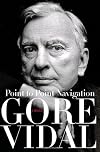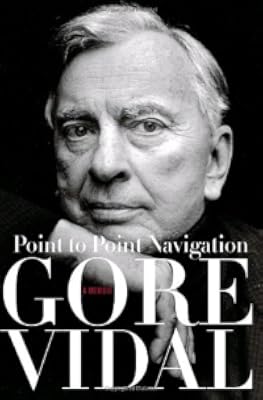
Point to Point Navigation: A Memoir
by Gore Vidal
On This Page
Description
Celebrated novelist, essayist, critic, and controversialist Vidal ranges freely over his remarkable life with the signature wit and literary elegance that is uniquely his. From his desks in Ravello and the Hollywood Hills, Gore Vidal travels in memory through the arenas of literature, television, film, theater, politics, and international society, where he has cut a broad swath, recounting achievements and defeats, friends and enemies made and lost. Among the gathering of notables to be show more found in these pages are Jack and Jacqueline Kennedy, Tennessee Williams ("the Glorious Bird"), Eleanor Roosevelt, Orson Welles, Johnny Carson, Greta Garbo, Federico Fellini, Rudolph Nureyev, Elia Kazan, and Francis Ford Coppola. Some of the book's most moving pages are devoted to the illness and death of his partner of five decades, Howard Austen, and indeed the book is, among other things, a meditation on mortality written in the spirit of Montaigne.--From publisher description. show lessTags
Recommendations














Member Reviews
This isn't a chronological biography or memoir but really just a collection of mostly short chapters with Vidal telling various and often funny anecdotes about writers such as Truman Capote and Tennessee (The Bird) Williams and other famous people such as Rudolph Nureyev and Princess Margaret. I listened to the audiobook version which has the added benefit of Vidal doing his Capote and Williams imitation voices and that of others such as Jack Kennedy. So that probably an extra point or two just for the entertainment of the narration.
It seemed to jump the shark when the climax is built around Vidal advocating for the mob-hit / CIA cover-up version of the Kennedy assassination conspiracy and using as his source Lamar Waldron's Ultimate show more Sacrifice: John and Robert Kennedy, the Plan for a Coup in Cuba, and the Murder of JFK. That seemed to be the totally wrong note to go out on.
His earlier thoughts on mortality and the passing of his companion Howard Austen were more moving. show less
It seemed to jump the shark when the climax is built around Vidal advocating for the mob-hit / CIA cover-up version of the Kennedy assassination conspiracy and using as his source Lamar Waldron's Ultimate show more Sacrifice: John and Robert Kennedy, the Plan for a Coup in Cuba, and the Murder of JFK. That seemed to be the totally wrong note to go out on.
His earlier thoughts on mortality and the passing of his companion Howard Austen were more moving. show less
Wonderful to read this in 2019 when "Lo! thy dread empire, CHAOS is restor'd..." has come to pass in the country he loved.
Less a memoir than a collection of tales about the author's life, but never less than enthralling.
Aside from the fact that this is the first book I was able to enter into LibraryThing with an old CueCat (Mac OS 10.4.9) with no mods, it's more Gore. Not more than you asked for; Gore so that you don't want to ever lose this voice. Even when his views don't agree with yours, you can't deny his education, pedigree, or erudition. Americans such as Gore don't come along often. Treasure him.
Terminei há dias a leitura de Point to Point Navigation, a segunda parte das memórias do escritor Gore Vidal. Eu já tinha lido Palimpsest, o primeiro volume das memórias, mas foi já há alguns anos e numa circunstancia particular da minha vida, em que andava muito distraído e desatento de leituras, e o próprio volume do livro (fui confirmar, é incomparavelmente maior do que este), tudo isso faz com que a lembrança dessa leitura seja a de uma coisa um pouco arrastada e por vezes até penosa.
Bom, nada disso neste Point to Point Navigation. Acho que o livro se pode resumir em duas palavras: inteligência e elegância. Uma escrita trabalhada, fluente, nem sempre fácil e simplista, mas sempre simples, carregada de humor, ao show more serviço das memórias e das observações do autor, que mesmo quando são tendenciosas ou mesmo maldosas, são sempre hábeis e elaboradas.
Como devem ser as memórias, o livro não segue uma estrita linha cronológica (não é uma auto-biografia), e mistura as recordações com as próprias vivências do escritor enquanto as escreve. Isto torna o livro muito vivo, como se estivéssemos a ouvir, numa longa conversa, o autor discorrer sobre a sua vida, contando episódios, propondo reflexões, sendo simpático para umas personagens e impiedoso para outras, saltando de história em história. Vidal fala da América, claro, sempre, da política americana, fala de cinema, de ‘socialites’, de colegas escritores, das suas casas, e fala, muito, mas sempre com pudor e subtileza, de Howard Auster, o homem com quem viveu mais de cinquenta anos, e de cuja relação esta memória é uma espécie de relatório e contas, como se Vidal devesse a Howard este ponto de ordem, este arrumar de casa, antes de conseguir, ele próprio e agora sozinho, prosseguir com a sua própria vida. show less
Bom, nada disso neste Point to Point Navigation. Acho que o livro se pode resumir em duas palavras: inteligência e elegância. Uma escrita trabalhada, fluente, nem sempre fácil e simplista, mas sempre simples, carregada de humor, ao show more serviço das memórias e das observações do autor, que mesmo quando são tendenciosas ou mesmo maldosas, são sempre hábeis e elaboradas.
Como devem ser as memórias, o livro não segue uma estrita linha cronológica (não é uma auto-biografia), e mistura as recordações com as próprias vivências do escritor enquanto as escreve. Isto torna o livro muito vivo, como se estivéssemos a ouvir, numa longa conversa, o autor discorrer sobre a sua vida, contando episódios, propondo reflexões, sendo simpático para umas personagens e impiedoso para outras, saltando de história em história. Vidal fala da América, claro, sempre, da política americana, fala de cinema, de ‘socialites’, de colegas escritores, das suas casas, e fala, muito, mas sempre com pudor e subtileza, de Howard Auster, o homem com quem viveu mais de cinquenta anos, e de cuja relação esta memória é uma espécie de relatório e contas, como se Vidal devesse a Howard este ponto de ordem, este arrumar de casa, antes de conseguir, ele próprio e agora sozinho, prosseguir com a sua própria vida. show less
May 13, 2008Portuguese
Ratings
Members
- Recently Added By
Lists

LGBTQ Memoir/Biography
52 works; 4 members

BBC Radio 4 Bookclub
341 works; 13 members

Books Read in 2024
4,727 works; 128 members
Author Information

168+ Works 31,282 Members
Gore Vidal was born Eugene Luther Gore Vidal Jr. on October 3, 1925 at the U.S. Military Academy at West Point, New York. He did not go to college but attended St. Albans School in Washington and graduated from Phillips Exeter Academy in New Hampshire in 1943. He enlisted in the Army, where he became first mate on a freight supply ship in the show more Aleutian Islands. His first novel, Williwaw, was published in 1946 when he was twenty-one years old and working as an associate editor at the publishing company E. P. Dutton. The City and the Pillar was about a handsome, athletic young Virginia man who gradually discovers that he is homosexual, which caused controversy in the publishing world. The New York Times refused to advertise the novel and gave a negative review of it and future novels. He had such trouble getting subsequent novels reviewed that he turned to writing mysteries under the pseudonym Edgar Box and then gave up novel-writing altogether for a time. Once he moved to Hollywood, he wrote television dramas, screenplays, and plays. His films included I Accuse, Suddenly Last Summer with Tennessee Williams, Is Paris Burning? with Francis Ford Coppola, and Ben-Hur. His most successful play was The Best Man, which he also adapted into a film. He started writing novels again in the 1960's including Julian, Washington, D.C., Myra Breckenridge, Burr, Myron, 1876, Lincoln, Hollywood, Live From Golgotha: The Gospel According to Gore Vidal, and The Golden Age. He also published two collections of essays entitled The Second American Revolution, which won the National Book Critics Circle Award for criticism in 1982 and United States: Essays 1952-1992. In 2009, he received the National Book Awards lifetime achievement award. He died from complications of pneumonia on July 31, 2012 at the age of 86. (Bowker Author Biography) show less
Common Knowledge
- People/Characters
- Gore Vidal
- First words
- As I now move, graciously I hope, toward the door marked Exit, it occurs to me that the only thing I ever really liked to do was go to the movies.
- Last words
- (Click to show. Warning: May contain spoilers.)And so it is today, January 1, 2006.
Classifications
- Genres
- Biography & Memoir, Literature Studies and Criticism
- DDC/MDS
- 818.5409 — Literature & rhetoric American literature in English American miscellaneous writings in English 20th Century 1945-1999
- LCC
- PS3543 .I26 .Z475 — Language and Literature American literature American literature Individual authors 1900-1960
- BISAC
Statistics
- Members
- 512
- Popularity
- 58,728
- Reviews
- 5
- Rating
- (3.64)
- Languages
- 5 — English, French, Italian, Portuguese, Spanish
- Media
- Paper, Audiobook, Ebook
- ISBNs
- 21
- ASINs
- 3