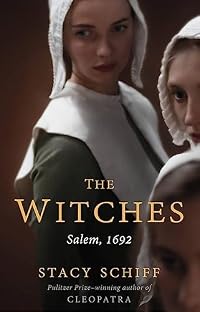
The Witches: Salem, 1692
by Stacy Schiff
On This Page
Description
It began in 1692, over an exceptionally raw Massachusetts winter, when a minister's daughter began to scream and convulse. It ended less than a year later, but not before 19 men and women had been hanged and an 80-year-old man crushed to death. The panic spread quickly, involving the most educated men and prominent politicians in the colony. Neighbors accused neighbors, parents and children each other. Aside from suffrage, the Salem Witch Trials represent the only moment when women played show more the central role in American history. In curious ways, the trials would shape the future republic.As psychologically thrilling as it is historically seminal, THE WITCHES is Stacy Schiff's account of this fantastical story-the first great American mystery unveiled fully for the first time by one of our most acclaimed historians. show lessTags
Recommendations












Member Recommendations
Member Reviews
Parts enthralling, parts cumbersome. Schiff dazzles, and then she overwhelms. Sometimes it's quite exasperating. She throws around countless references - without further elaboration on the meaning. And then is overly detailed about the dozens of people who it is hard to keep track of. Yet ...Schiff recreates the times of the Salem Witch Trials in a way that makes you feel that you are there and you feel close to understanding them as a people from our American past. And while she can be tedious some of her many details are welcome (if only she toned it down a bit!) She even brings wit and playfulness to a historical period of Puritan seriousness and such an era of violence, fear and hardship. So many in Salem were swept up by the show more hysteria that they were afraid to speak out lest they be accused. The modern phrase witch hunt conjures these feelings. Schiff's context weaves together the history in such a way that the history feels ever-present and real. She retells the stories from all sides. The magistrates and ministers bear the most responsibility for enabling these baseless claims and for not providing fair trials- favoring the accusers who were almost always teenagers. They fanned the flames of hysteria to perpetuate their own unchecked fanaticism.
The Witch Trials is still one of the most important lessons in American history. For we as a people are not as far removed from the Salem villagers as we may like to see ourselves. show less
The Witch Trials is still one of the most important lessons in American history. For we as a people are not as far removed from the Salem villagers as we may like to see ourselves. show less
Ms. Eliza Foss' narration enhanced Ms. Stacy Schiff's excellent The Witches : Salem, 1692. Time didn't hang while listening to its fifteen compact discs. It's not as if I haven't read about the Salem Witchcraft trials before in books I own. In fact, that's why I checked this book out from my local library.
I very much enjoyed the more recent information Ms. Schiff provided, although I wish she had checked out the Miss Gulch footage posted on YouTube in 2010 or watched a copy of the MGM 'The Wizard of Oz' movie before she wrote what she did about Aunt Em and Miss Gulch. As shown here, it's not Miss Gulch's wealth that prevents Aunt Em from telling her what she thinks of her. Aunt Em is held in check by her Christianity -- either because show more her opinion would be best expressed in foul language or that opinion is too far from the principle of Christian love. https://www.youtube.com/watch?v=AldxVQ8z5FQ
The section on the questioning and death of Giles Corey was particularly interesting because it contradicted something I had believed about him.
If you suffer from hypertension, be sure to take your blood pressure medication before listening. The behavior of the 'justices' (I get a bad taste in my mouth just typing that word for those men) is absolutely appalling! I found myself indulging in a fantasy of letting them know what their future reputations would be based upon their judicial murders of 19 persons. Another fantasy was if I had the telepathic and telekinetic powers of Jean Grey of the X-Men, I would have used them to make the girls accuse the justices, particularly, their chief, William Stoughton. I wonder how long the trials would have gone on then.
It was frightening how even being a person of good reputation couldn't save one from accusation. George Burroughs was a minister and he still hanged. This was definitely a situation where one was presumed guilty and left in a disgusting jail, manacled, for months while awaiting trial -- not to mention having to pay the costs of your imprisonment. You could also expect to have your possessions confiscated if you were convicted -- even if that left your children to starve.
The extent to which Salem tried to cover up their evil hysteria afterward made me angry, too.
To repeat, this is absorbing history, but you might want to watch some comedy every few CDs to calm you down. There's also a lesson to be taken from what learned and intelligent persons 'prove' using logic because their logic is influenced by their beliefs. (That cuts both ways, theists and atheists.)
I heartily recommend this book to persons interested in the Salem Witch Trials, American history, or examples of miscarriages of justice. show less
I very much enjoyed the more recent information Ms. Schiff provided, although I wish she had checked out the Miss Gulch footage posted on YouTube in 2010 or watched a copy of the MGM 'The Wizard of Oz' movie before she wrote what she did about Aunt Em and Miss Gulch. As shown here, it's not Miss Gulch's wealth that prevents Aunt Em from telling her what she thinks of her. Aunt Em is held in check by her Christianity -- either because show more her opinion would be best expressed in foul language or that opinion is too far from the principle of Christian love. https://www.youtube.com/watch?v=AldxVQ8z5FQ
The section on the questioning and death of Giles Corey was particularly interesting because it contradicted something I had believed about him.
If you suffer from hypertension, be sure to take your blood pressure medication before listening. The behavior of the 'justices' (I get a bad taste in my mouth just typing that word for those men) is absolutely appalling! I found myself indulging in a fantasy of letting them know what their future reputations would be based upon their judicial murders of 19 persons. Another fantasy was if I had the telepathic and telekinetic powers of Jean Grey of the X-Men, I would have used them to make the girls accuse the justices, particularly, their chief, William Stoughton. I wonder how long the trials would have gone on then.
It was frightening how even being a person of good reputation couldn't save one from accusation. George Burroughs was a minister and he still hanged. This was definitely a situation where one was presumed guilty and left in a disgusting jail, manacled, for months while awaiting trial -- not to mention having to pay the costs of your imprisonment. You could also expect to have your possessions confiscated if you were convicted -- even if that left your children to starve.
The extent to which Salem tried to cover up their evil hysteria afterward made me angry, too.
To repeat, this is absorbing history, but you might want to watch some comedy every few CDs to calm you down. There's also a lesson to be taken from what learned and intelligent persons 'prove' using logic because their logic is influenced by their beliefs. (That cuts both ways, theists and atheists.)
I heartily recommend this book to persons interested in the Salem Witch Trials, American history, or examples of miscarriages of justice. show less
Stacy Schiff attempts to set the record straight on the witch hysteria of 1692, something that has been defined for modern people by how it is depicted in movies, plays, and books. This is partially due to the efforts of those who lived through the crisis to erase the witch madness from the collective memory (for example, noted diarists of the period have blank spaces for the 9 months of the trials). Schiff relies on the official court transcripts for much of her narrative providing a relentless account of accusations, denials, questionable judicial practices, confessions, and further accusations. The repetition of the process would be tedious if it weren't so terrifying. The psychological effects of the hysteria are laid clear in show more written accounts of the accused who actually came to believe that they may in fact be witches. Over the course of time the crisis spirals out of Salem Village to Andover and Boston and threatens to undermine the economy and government of New England.
Schiff does a great job of establishing the context of the witch trials, with the understanding of witchcraft and previous crises including a dramatically large one in Sweden in 1675. Other events of the time that had an effect on the New Englander's psyche was the recent King Phillip's War (and continuing scuffles with natives and French settlers on the frontiers) and the revolt against New England royal governor Edmund Andros in 1689. The adoption of a new charter for the province and the arrival of a new governor for Massachusetts are events happening concurrently with the witch trials. Closer to home, Schiff examines the relationships of the residents of Salem Village. It's pretty clear that if you lived in Salem Village in 1692, you had some asshole neighbors, and the resentments informed the underlying tensions related to the witchcraft accusations. In the final chapters, Schiff also examines some theories behind why the witchcraft hysteria occurred, especially the psychology of the "afflicted" girls who's accusations were the tipping point. It's an interesting and accessible history of a horrendous atrocity and miscarriage of justice in American history. show less
Schiff does a great job of establishing the context of the witch trials, with the understanding of witchcraft and previous crises including a dramatically large one in Sweden in 1675. Other events of the time that had an effect on the New Englander's psyche was the recent King Phillip's War (and continuing scuffles with natives and French settlers on the frontiers) and the revolt against New England royal governor Edmund Andros in 1689. The adoption of a new charter for the province and the arrival of a new governor for Massachusetts are events happening concurrently with the witch trials. Closer to home, Schiff examines the relationships of the residents of Salem Village. It's pretty clear that if you lived in Salem Village in 1692, you had some asshole neighbors, and the resentments informed the underlying tensions related to the witchcraft accusations. In the final chapters, Schiff also examines some theories behind why the witchcraft hysteria occurred, especially the psychology of the "afflicted" girls who's accusations were the tipping point. It's an interesting and accessible history of a horrendous atrocity and miscarriage of justice in American history. show less
A thorough and thoroughly interesting look at the Salem witch trials and the possible motives behind the frenzied turns it took. It's well-written and just as nicely researched. Recommended, if you're looking to read about the event, this is a great option.
While there's a lot out there about the Salem witch trials, so much of it has been layered over with myth and confusion. As the author herself points out, there's very little by way of first-person eyewitness accounts of 1692 in Salem, as if the whole town collectively decided to erase the history. This thoroughly researched account takes you through 1692 from January when the strange behavior of a couple of girls and accusations first began, through the summer of trials and hangings, and the fall when the tide began to turn once again.
Schiff's account is detailed and evenhanded. By turns fascinating and tragic - especially stories my like own relative, Rebecca Nurse, who was an old woman and mostly deaf and so pious that most likely show more her excommunication was the most difficult part of the whole proceedings - most of the time the pages turn quickly, though there are a few times when the narrative gets bogged down by the very fact of how complicated piecing together what happened in chronological order can get and introducing all the main players. I had to look back at the list at the beginning more than once to remember who was who, accuser or accusee, and how one person was related to another. The bulk of the narrative simply takes you through the chronology of events, only at the end trying to make sense of what may have caused the girls to behave or accuse the way they did. I learned a lot and would love to learn more. show less
Schiff's account is detailed and evenhanded. By turns fascinating and tragic - especially stories my like own relative, Rebecca Nurse, who was an old woman and mostly deaf and so pious that most likely show more her excommunication was the most difficult part of the whole proceedings - most of the time the pages turn quickly, though there are a few times when the narrative gets bogged down by the very fact of how complicated piecing together what happened in chronological order can get and introducing all the main players. I had to look back at the list at the beginning more than once to remember who was who, accuser or accusee, and how one person was related to another. The bulk of the narrative simply takes you through the chronology of events, only at the end trying to make sense of what may have caused the girls to behave or accuse the way they did. I learned a lot and would love to learn more. show less
It felt like this book would never end.
I like nonfiction, I love historical nonfiction. I also love details. Give me lots and lots of details and send me hopping down the rabbit hole on a research adventure and I'm a happy girl.
What I don't like is constant repetition of said details and nearly obsessive reiteration of scant sources that makes their scantiness blazingly obvious. I also don't want to hear over and over again how little there was to work with. I think it was primarily this last bit that grated so much about Schiff's writing. It came off as a college student's haphazardly cobbled together thesis with some passive remarks tossed in as if Schiff felt coerced into writing rather than any desire to expound upon its show more historical importance, cultural ramifications, reasons, or, at the very least, personal perspectives on available explanations floating around in the void. Such as the tensions brought to the fore by Paul Boyer and Stephen Nissenbaum in Salem Possessed. Or any number of later authors that have worked on cracking the surrounding membrane of Salem and its trials.
During the first two chapters I found myself debating the validity of never quitting on a book; I just couldn't get into Schiff's writing style. It seemed so jumbled and wordy. By the third chapter things started looking up and I began to enjoy bits. Unfortunately I found the book drifting back into the jumbled territory of the first two chapters more and more as it progressed.
I haven't read anything by Schiff before so I don't consider myself adequately versed in her writing style. I was wary of this work because I saw it had quite a lot of poor to flat out awful reviews but I had also seen so many great reviews on her Cleopatra project. So I figured it was just the weight of the detailing that put people off Witches and, as mentioned before, details make me a happy girl, so how bad could it be?
It was bad. For the most part, bad.
Schiff sets the scene pretty well for our foray into the depths of 1692 Salem and the political unrest engulfing it. She also pries out a great amount of character study, suppositional character study to be taken with a pinch of salt but a large amount nonetheless.
It's the delivery that kept falling flat for me. It was pandering, stuttering, anachronistic, and often offensive. (An indigenous warrior as "the swarthy terrorist in the backyard," really?) It felt as if Schiff was more than happy to slip in and out of dramatic biographical ramblings instead of "keeping the plot" and giving us anything fresh on Salem and its people. Making it seem much more risible than relevant in the whole. show less
I like nonfiction, I love historical nonfiction. I also love details. Give me lots and lots of details and send me hopping down the rabbit hole on a research adventure and I'm a happy girl.
What I don't like is constant repetition of said details and nearly obsessive reiteration of scant sources that makes their scantiness blazingly obvious. I also don't want to hear over and over again how little there was to work with. I think it was primarily this last bit that grated so much about Schiff's writing. It came off as a college student's haphazardly cobbled together thesis with some passive remarks tossed in as if Schiff felt coerced into writing rather than any desire to expound upon its show more historical importance, cultural ramifications, reasons, or, at the very least, personal perspectives on available explanations floating around in the void. Such as the tensions brought to the fore by Paul Boyer and Stephen Nissenbaum in Salem Possessed. Or any number of later authors that have worked on cracking the surrounding membrane of Salem and its trials.
During the first two chapters I found myself debating the validity of never quitting on a book; I just couldn't get into Schiff's writing style. It seemed so jumbled and wordy. By the third chapter things started looking up and I began to enjoy bits. Unfortunately I found the book drifting back into the jumbled territory of the first two chapters more and more as it progressed.
I haven't read anything by Schiff before so I don't consider myself adequately versed in her writing style. I was wary of this work because I saw it had quite a lot of poor to flat out awful reviews but I had also seen so many great reviews on her Cleopatra project. So I figured it was just the weight of the detailing that put people off Witches and, as mentioned before, details make me a happy girl, so how bad could it be?
It was bad. For the most part, bad.
Schiff sets the scene pretty well for our foray into the depths of 1692 Salem and the political unrest engulfing it. She also pries out a great amount of character study, suppositional character study to be taken with a pinch of salt but a large amount nonetheless.
It's the delivery that kept falling flat for me. It was pandering, stuttering, anachronistic, and often offensive. (An indigenous warrior as "the swarthy terrorist in the backyard," really?) It felt as if Schiff was more than happy to slip in and out of dramatic biographical ramblings instead of "keeping the plot" and giving us anything fresh on Salem and its people. Making it seem much more risible than relevant in the whole. show less
I couldn’t put this one down. Not like a typical scholarly work. Informative, yes. But you feel as though you’re being told the story as if you’re there, not just reading an account of what transpired all those years ago.
Now, I knew people had some crazy views back then, but putting yourself into the contextual setting of these people really made me take a step back and try to empathize with them. Why would young women say they were possessed or were witches doing satan’s bidding? Why would you confess, even when you know it means prison and/or death? One entry hit the nail on the head I think, stating that “if I denied a thousand times, he would never believe me, if I confess once, he will stop the trial”. And the fact that show more Cotton Mathers moved on to inoculation. I don’t know how I never read (or maybe I did and just didn’t retain it) that.
Overall, my favorite historical account so far due to how immersive it was. What an absolutely insane, hysteria, terror filled time in our history. show less
Now, I knew people had some crazy views back then, but putting yourself into the contextual setting of these people really made me take a step back and try to empathize with them. Why would young women say they were possessed or were witches doing satan’s bidding? Why would you confess, even when you know it means prison and/or death? One entry hit the nail on the head I think, stating that “if I denied a thousand times, he would never believe me, if I confess once, he will stop the trial”. And the fact that show more Cotton Mathers moved on to inoculation. I don’t know how I never read (or maybe I did and just didn’t retain it) that.
Overall, my favorite historical account so far due to how immersive it was. What an absolutely insane, hysteria, terror filled time in our history. show less
Members
- Recently Added By
Published Reviews
ThingScore 91
added by DoctorDebt
added by DoctorDebt
These are upsetting tales and Schiff writes movingly as well as wittily; this is a work of riveting storytelling as well as an authoritative history. Schiff’s explanations for the events are convincing. She identifies the symptoms of the supposedly bewitched with those neurologist Jean-Martin Charcot listed in his studies of hysteria (twitching, stammering and grimacing) and she suggests show more that in a repressed, puritanical society, people found this an easy outlet both for boredom and for an uneasy conscience. There were also questions of power at stake: land disputes; sexual and professional rivalries. “Vengeance is walking Salem,” cries Miller’s John Proctor; “the little crazy children are jangling the keys of the kingdom, and common vengeance writes the law!” show less
added by DoctorDebt — edited by souloftherose
Lists

Chronological 2022
3 works; 1 member

History and Biography Read in 2016
20 works; 3 members

Feminism
167 works; 4 members

Books Read in 2016
4,666 works; 197 members

Books You Couldn't Finish
202 works; 32 members

Witchy Fiction
253 works; 126 members

Reading Glasses Podcast
410 works; 3 members

In Our Time books
4,934 works; 2 members
Author Information

10+ Works 10,875 Members
Stacy Schiff was born on October 26, 1961 in Adams, Massachusetts. She received a B.A. degree from Williams College in 1982. She was a Senior Editor at Simon and Schuster until 1990. She is the author of several nonfiction books including Saint-Exupéry: A Biography about Antoine de Saint Exupéry, Cleopatra: A Life, and The Witches: Salem 1692. show more She won the Pulitzer Prize for biography for Véra: Mrs. Vladimir Nabokov in 2000. (Bowker Author Biography) show less
Some Editions
Awards and Honors
Awards
Distinctions
The Guardian Book of the Day (2015-11-02)
Common Knowledge
- Original title
- The Witches: Salem, 1692
- Original publication date
- 2015-10-27
- People/Characters
- Ann Foster; Martha Carrier; Sarah Osborne; Samuel Parris; Abigail Williams; Betty Parris (show all 80); John Hale; Mary Sibley; Nathaniel Putnam; Cotton Mather; Sarah Good; William Good; Tituba; John Hathorne; Edward Putnam; Ezekiel Cheever; Martha Corey; Deodat Lawson; Mary Wacott; Rebecca Nurse; Bathshua Pope; Nicholas Noyes; Elizabeth Hubbard; Dorothy Good; Sarah Cloyce; Mercy Lewis; Elizabeth Proctor; Edmund Andros; John Higginson; Thomas Danforth; Benjamin Hutchinson; Sarah Wilds; Deliverance Hobbs; John Proctor; Bridget Bishop; Mary Warren; Abigail Hobbs; George Burroughs; Shubael Dummer; George Jacobs; Sarah Churchill; John Willard; Bray Wilkins; Daniel Wilkins; Samuel Sewall; Betty Sewall; Samuel Willard; Dorcas Hoar; Susannah Sheldon; Susannah Martin; William Phips; Mary Esty; Nathaniel Cary; Elizabeth Cary; Bartholomew Gedney; Thomas Newton; John Alden; John Louder; Ann Dolliver; Sarah Bibber; Nathaniel Saltonstall; Elizabeth How; Ephraim Wilds; William Stoughton; Mary Lacey; Mary Lacey Jr.; Andrew Camer; Richard Camer; Joshua Moody; Elizabeth Colson; Martha Tyler; Philip English; Mary English; Mary Toothaker; Samuel Wardwell; Robert Pike; Rebecca Eames; Sarah Cloyce; Ann Winthrop; John Richards
- Important places
- Salem, Massachusetts, USA; Andover, Massachusetts, USA; Ipswich, Massachusetts, USA; Boston, Massachusetts, USA; Casco Bay, Maine, USA; York, Maine, USA (show all 9); Wells, Maine, USA; Billerica, Massachusetts, USA; Danvers, Massachusetts, USA
- Important events
- Salem witch trials (1692); King Philip's War (1675 | 1676); Wells Massacre (1692-06-11); 17th century
- Dedication
- For Wendy Belzberg
- First words
- I
The Diseases of Astonishment
We will declare frankly that nothing is clear in this world. Only fools and charlatans know and understand everything.
—Anton Chekhov
In 1692 The Massachusetts Bay Colon... (show all)y executed fourteen women, five men, and two dogs for witchcraft. The sorcery materialized in January. The first hanging took place in June, the last in September, a stark, stunned silence followed. What discomfited those who survived the ordeal was not the cunning practice of witchcraft but the clumsy administration of justice. Innocents indeed appeared to have hanged. But guilty parties had escaped. There was no vow never to forget; consigning nine months to obliviion seemed a more appropriate response. It worked, for a generation. We have been conjuring with Salem—our national nightmare, the undercooked, overripe tabloid episode, the dystopian chapter in our past—ever since. It crackles, flickers, and jolts its way through American history and literature. - Quotations
- "A witch is one who can do or seems to do strange things, beyond the known power of art and ordinary nature, by virtue of a confederacy with evil spirits." - Joseph Glanvill
"Salem is in part the story of what happens when a set of unanswerable questions meets a set of unquestioned answers."
In the anxious murk, religion sometimes seemed a kind of halfway house between reason and superstition.
I observe the law to be very much like a lottery - great charge, little benefit.
Oh! You are liars, and God will stop the mouth of liars...I will speak the truth as long as I live. - Dorcas Hoar
If you are not for Christ and his works, you are against him. - Samuel Parris (show all 10)
You are not what you think you are...you are what we think you are.
And if you take away my life, God will give you blood to drink. - Sarah Good
To see a man taking his last steps, and going to the place of execution (though worthily) moves everyone whose heart is not harder than adamant. - Parris
Just as everyone had known a victim of King Philip's War, everyone now knew an accused witch. - Last words
- (Click to show. Warning: May contain spoilers.)"I do not think they are."
- Blurbers
- Ellis, Joseph J.; Harrison, Kathryn; Massie, Robert K.; Cornwell, Patricia; Rosenthal, Bernard; Marshall, Megan (show all 7); Hall, David D.
- Original language
- English US
- Canonical DDC/MDS
- 364.18809744
- Canonical LCC
- KFM2478.8.W5
Classifications
- Genres
- History, General Nonfiction, Nonfiction, Religion & Spirituality
- DDC/MDS
- 364.18809744 — Society, Government, and Culture Social problems and social services Crime Criminal offenses Other offenses Offenses against religion Standard subdivisions History, geographic treatment, biography North America Northeastern United States (New England and Middle Atlantic states) Massachusetts
- LCC
- KFM2478.8 .W5 — Law Law of Maine Law of Maine
- BISAC
Statistics
- Members
- 3,277
- Popularity
- 5,175
- Reviews
- 76
- Rating
- (3.46)
- Languages
- English, Polish, Spanish, Portuguese (Portugal)
- Media
- Paper, Audiobook, Ebook
- ISBNs
- 23
- ASINs
- 7