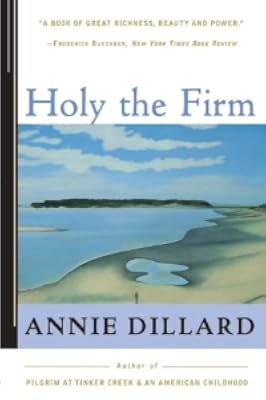
Holy the Firm
by Annie Dillard
On This Page
Description
In 1975 Annie Dillard took up residence on an island in Puget Sound in a wooded room furnished with "one enormous window, one cat, one spider and one person." For the next two years she asked herself questions about time, reality, sacrifice death, and the will of God. In Holy the Firm she writes about a moth consumed in a candle flame, about a seven-year-old girl burned in an airplane accident, about a baptism on a cold beach. But behind the moving curtain of what she calls "the hard things show more -- rock mountain and salt sea," she sees, sometimes far off and sometimes as close by as a veil or air, the power play of holy fire. This is a profound book about the natural world -- both its beauty and its cruelty -- the Pulitzer Prize-winning Dillard knows so well. show lessTags
Recommendations




Member Reviews
In 1975 Annie Dillard took up residence on an island in Puget Sound in a wooded room furnished with "one enormous window, one cat, one spider and one person." For the next two years she asked herself questions about time, reality, sacrifice death, and the will of God. In Holy the Firm she writes about a moth consumed in a candle flame, about a seven-year-old girl burned in an airplane accident, about a baptism on a cold beach. But behind the moving curtain of what she calls "the hard things -- rock mountain and salt sea," she sees, sometimes far off and sometimes as close by as a veil or air, the power play of holy fire.This is a profound book about the natural world -- both its beauty and its cruelty -- the Pulitzer Prize-winning show more Dillard knows so well. show less
So, I was shelf-reading in the stacks today at work when I came upon this book. Someone had recently recommended Annie Dillard to me, and so I took this as a sure sign that I should read the book. These things, after all, don't happen as coincidences. Books come to you and you have to agree to read them.
The book is less than 80 pages, but it says more than most 300-page books I've read. In fact, I probably need to read it a couple of more times. This is deeply poetic prose that gets under your skin in an uncomfortably urgent way. Dillard was living on an island in Puget Sound by herself when she wrote it, in a wooden room with a cat named Small and a spider in the corner of the bathroom behind the toilet. This is a book that wonders and show more probes at the nature of God in the context of little girls with burned faces and moths burning bright in candle flames. It's not easy reading, but it is rich and earthy and strangely cleansing.
We are most deeply asleep at the switch when we fancy we control any switches at all. We sleep to time's hurdy-gurdy; we wake, if we ever wake, to the silence of God. And then, when we wake to the deep shores of light uncreated, then when the dazzling dark breaks over the far slopes of time, then it's time to toss things, like our reason, and our will; then it's time to break our necks for home.The library's copy is a first edition from 1977. As my fingers turned the pages of that high quality paper not found in books anymore, I knew I was just glimpsing a sliver of Dillard's roaming mind, and I was excited at the thought of what I might find in other books of hers that I now know I have no choice but to read. show less
When I read [Pilgrim at Tinker Creek] by [[Dillard]], I knew I wanted more. The line that stayed with me from that first book was Dillard talking about the oneness of all of life. She is so clearly taken with and in love with that idea and with nature. She said that if people falling out of airplanes that were crashing understood that oneness and continuity, they would be falling through the sky saying "Thank you God! Thank you!" knowing that what came next would be wonderful also, whatever it was. That was published in 1974. [Holy the Firm] was published three years later in 1977 and includes a story of a little girl who was in an airplane crash. The child was severely burned when some type of fuel gel stuck on her face causing show more excruciating pain and destroying her face. [Holy the Firm] describes other instances of the cruelty and horror of life, as well as its beauty. Can these extremes of beauty and pain possibly be all of one cloth? This is one of the main questions Dillard explores in this lovely and beautifully written book. It reminded me of driving through forests in Alaska and realizing that it was the combination, the togetherness, of both the dead and the living trees that was making this forest so beautiful. Once again, Dillard's use of language is spectacular. The part of this book that will stick with me is her description of a few moments of her experience living alone in a cabin in the Pacific Northwest. She is overwhelmed by the beauty of the world as she stands looking at the Cascades Mountain range and is stunned. Then she says to herself, "Oh my God there is more!" and turns around and faces the Puget Sound and is knocked out by its beauty, water, clouds, islands, mist. It reminds me of driving up the east coast of the south island of New Zealand and being stunned by the beauty on both sides, mountains on one side, ocean on the other, where to look? Because there is always more, isn't there? show less
Annie Dillard writes boldly and brings the same devoted attention to a dusty beetle carcass or a weather pattern that she brings to the mutilation of a child, to human relations and to god. She is earnest in a rare, humble and humorous fashion, never flippant or cheap and occasionally riveting and wise. Because of the passages that she gets right, I don't feel like ripping apart the weaker places in this book where she seems to fall short, channeling, for instance, the least exceptional moments of Walt Whitman or Hart Crane or the passages where, for one reason or another, I don't wrestle along beside her with whatever tragedy or injustice she spends pages piling objects and experiences around.
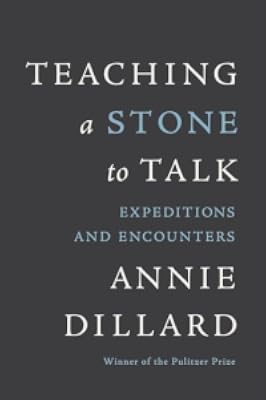
I have patience for her because she has at show more least three distinct ways of getting it right: Her focus on small things generally seems warranted, even when she doesn't tax her subjects with becoming metaphors that help her assemble spiritual thoughts. To me, such passages can be a useful reminder to slow down and pay attention; to get outside of myself. And they are written nicely, reminding me of Francis Ponge, "There is a spider, too, in the bathroom, with whom I keep a sort of company. Her little outfit always reminds me of a certain moth I helped to kill. The spider herself is of uncertain lineage, bulbous at the abdomen and drab. Her six-inch mess of a web works, works somehow, works miraculously, to keep her alive and me amazed. The web itself is in a corner behind the toilet, connecting the tile wall to tile wall and floor, in a place where there is, I would have thought, scant traffic. Yet under the web are sixteen or so corpses that she has tossed to the floor." When she admits other humans into her narrative, she treats them with tender care and assembles, quite deliberately, the circumstances that make them sensible, "She saw me watching her and we exchanged a look, a very conscious and self-conscious look--because we look a bit alike and we both knew it; because she was still short and I grown; because I was stuck kneeling before the cider pail, looking at her sidewise over my shoulder; because she was carrying the cat so oddly, so that she had to walk with her long legs parted; because it was my cat, and she'd dressed it, and it looked like a nun; and because she knew I'd been watching her, and how fondly, all along." And she inevitably (at least in her works that are not novels, in which she can comfortably announce, "Nothing is going to happen in this book") gets to talking about god or about divinity or immanence or transcendence, or whatever she is comfortable calling it. She forages through the mystic tradition of various religions unearthing salient little quotation gems (though mostly from Judeo-Christian sources) and unflinchingly adds her own prerogative, which is reliably unorthodox in a fashion that is both critical and accepting. She is also more than comfortable launching small attacks against god and theology: "Did Christ descend once and for all to no purpose, in a kind of divine and kenotic suicide, or ascend once and for all, pulling his cross up after him like a rope ladder home?" I can imagine her utterances about God proving abrasive to some readers and a real cynic might associate some of her musings with a thinly elevated chicken soup for the soul sort of pocket philosophy; but I don't think that Dillard is trying to write manuals or aphorisms and I like that she is unashamed to mix her personal doubts and struggles into the thoughts and observations that she is good enough to share. This book is scarcely fifty pages long and it is not nearly as good as "Teaching a Stone to Talk." show less
I have patience for her because she has at show more least three distinct ways of getting it right: Her focus on small things generally seems warranted, even when she doesn't tax her subjects with becoming metaphors that help her assemble spiritual thoughts. To me, such passages can be a useful reminder to slow down and pay attention; to get outside of myself. And they are written nicely, reminding me of Francis Ponge, "There is a spider, too, in the bathroom, with whom I keep a sort of company. Her little outfit always reminds me of a certain moth I helped to kill. The spider herself is of uncertain lineage, bulbous at the abdomen and drab. Her six-inch mess of a web works, works somehow, works miraculously, to keep her alive and me amazed. The web itself is in a corner behind the toilet, connecting the tile wall to tile wall and floor, in a place where there is, I would have thought, scant traffic. Yet under the web are sixteen or so corpses that she has tossed to the floor." When she admits other humans into her narrative, she treats them with tender care and assembles, quite deliberately, the circumstances that make them sensible, "She saw me watching her and we exchanged a look, a very conscious and self-conscious look--because we look a bit alike and we both knew it; because she was still short and I grown; because I was stuck kneeling before the cider pail, looking at her sidewise over my shoulder; because she was carrying the cat so oddly, so that she had to walk with her long legs parted; because it was my cat, and she'd dressed it, and it looked like a nun; and because she knew I'd been watching her, and how fondly, all along." And she inevitably (at least in her works that are not novels, in which she can comfortably announce, "Nothing is going to happen in this book") gets to talking about god or about divinity or immanence or transcendence, or whatever she is comfortable calling it. She forages through the mystic tradition of various religions unearthing salient little quotation gems (though mostly from Judeo-Christian sources) and unflinchingly adds her own prerogative, which is reliably unorthodox in a fashion that is both critical and accepting. She is also more than comfortable launching small attacks against god and theology: "Did Christ descend once and for all to no purpose, in a kind of divine and kenotic suicide, or ascend once and for all, pulling his cross up after him like a rope ladder home?" I can imagine her utterances about God proving abrasive to some readers and a real cynic might associate some of her musings with a thinly elevated chicken soup for the soul sort of pocket philosophy; but I don't think that Dillard is trying to write manuals or aphorisms and I like that she is unashamed to mix her personal doubts and struggles into the thoughts and observations that she is good enough to share. This book is scarcely fifty pages long and it is not nearly as good as "Teaching a Stone to Talk." show less
Interesting book but kind of overwritten. Her Rimbaud influence is obvious, and a Rimbaud influence should never be obvious. It's worth reading.
Interesting exploration of what is holy, what is good, what is certain. Didn't love the style, but there were a couple of lines that hit perfectly for me. Worth the short investment of time, most definitely.
Reread: 2023 - Still not a huge fan, but I enjoyed it more, this time as an exploration of what part of spirituality the humans play for themselves... from a Christian perspective as the eternal son, working to understand the mystery of the holy spirit, while trying to contain frustration at the father.
Reread: 2023 - Still not a huge fan, but I enjoyed it more, this time as an exploration of what part of spirituality the humans play for themselves... from a Christian perspective as the eternal son, working to understand the mystery of the holy spirit, while trying to contain frustration at the father.
Yesterday I felt like going to the Arboretum and reading some Annie Dillard, so I chose this book and a lovely maple to sit by and enjoyed both very much. I won't explain here what this book is about, because finding out what it is about was part of what made this short book so enjoyable. Dillard wrote this book while she was living in Puget Sound and, like in [b:Pilgrim at Tinker Creek|12527|Pilgrim at Tinker Creek|Annie Dillard|http://d202m5krfqbpi5.cloudfront.net/books/1348121945s/12527.jpg|2280883], writes a clever mixture of reflections on nature, God, and various fascinating facts that she has read about the world and/or philosophy. This combination wouldn't work for most authors, but she is so great at it that it really works. show more The book is moving and profound, but written in such an earthy way that it didn't feel pretentious. I recommend it as a good afternoon or short vacation read. show less
Members
- Recently Added By
Lists

Deathreads
78 works; 2 members

Mo's Reading List
218 works; 1 member

Maybe This Year? Books to Look Forward To
412 works; 9 members
Author Information

32+ Works 22,197 Members
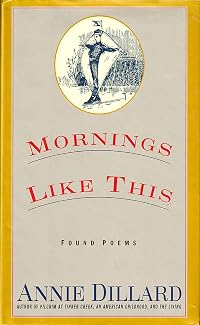
Annie Dillard was born Annie Doak in Pittsburgh, Pennsylvania on April 30, 1945. She received a B.A and an M.A. in English from Hollins College. She writes both fiction and nonfiction books including Tickets for a Prayer Wheel, Holy the Firm, Teaching a Stone to Talk, The Living, and Mornings Like This: Found Poems. She won the 1975 Pulitzer Prize show more for General Nonfiction for Pilgrim at Tinker Creek. She wrote an autobiography entitled An American Childhood. Her work also has appeared in such periodicals as The Atlantic, Harper's Magazine, The Christian Science Monitor, and Cosmopolitan. She taught for 21 years in the English department of Wesleyan University. (Bowker Author Biography) show less
Awards and Honors
Awards
Common Knowledge
- Original publication date
- 1977
- Last words
- (Click to show. Warning: May contain spoilers.)I am now.
Classifications
- Genres
- Nonfiction, Religion & Spirituality, Biography & Memoir
- DDC/MDS
- 242 — Religion Christian practice & observance Devotional literature
- LCC
- BV4832.2 .D54 — Philosophy, Psychology and Religion Practical Theology Practical Theology Practical religion. The Christian life Works of meditation and devotion
- BISAC
Statistics
- Members
- 1,290
- Popularity
- 18,975
- Reviews
- 24
- Rating
- (4.15)
- Languages
- English, Swedish
- Media
- Paper, Ebook
- ISBNs
- 10
- ASINs
- 8