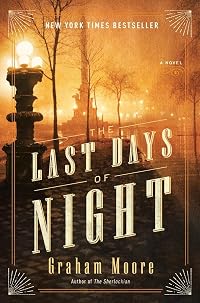
The Last Days of Night
by Graham Moore
On This Page
Description
NEW YORK TIMES BESTSELLER • “A world of invention and skulduggery, populated by the likes of Edison, Westinghouse, and Tesla.”—Erik Larson“A model of superior historical fiction . . . an exciting, sometimes astonishing story.”—The Washington Post
From Graham Moore, the Oscar-winning screenwriter of The Imitation Game and New York Times bestselling author of The Sherlockian, comes a thrilling novel—based on actual events—about the nature of genius, the cost of show more ambition, and the battle to electrify America.
New York, 1888. Gas lamps still flicker in the city streets, but the miracle of electric light is in its infancy. The person who controls the means to turn night into day will make history—and a vast fortune. A young untested lawyer named Paul Cravath, fresh out of Columbia Law School, takes a case that seems impossible to win. Paul’s client, George Westinghouse, has been sued by Thomas Edison over a billion-dollar question: Who invented the light bulb and holds the right to power the country?
The case affords Paul entry to the heady world of high society—the glittering parties in Gramercy Park mansions, and the more insidious dealings done behind closed doors. The task facing him is beyond daunting. Edison is a wily, dangerous opponent with vast resources at his disposal—private spies, newspapers in his pocket, and the backing of J. P. Morgan himself. Yet this unknown lawyer shares with his famous adversary a compulsion to win at all costs. How will he do it?
In obsessive pursuit of victory, Paul crosses paths with Nikola Tesla, an eccentric, brilliant inventor who may hold the key to defeating Edison, and with Agnes Huntington, a beautiful opera singer who proves to be a flawless performer on stage and off. As Paul takes greater and greater risks, he’ll find that everyone in his path is playing their own game, and no one is quite who they seem.
NAMED ONE OF THE BEST BOOKS OF THE YEAR BY THE WASHINGTON POST AND THE PHILADELPHIA INQUIRER
“A satisfying romp . . . Takes place against a backdrop rich with period detail . . . Works wonderfully as an entertainment . . . As it charges forward, the novel leaves no dot unconnected.”—Noah Hawley, The New York Times Book Review. show less
Tags
Recommendations








Member Reviews
After a memorable opening scene followed by a somewhat sluggish set-up period, Graham Moore’s ‘The Last Days of Night’ builds to an intriguing inner-workings story of a clash between two turn-of-the-century American titans.
This fictionalized retelling of the feud between George Westinghouse and Thomas Edison, which also entangled the enigmatic Nikola Tesla ends up being a moving and exciting story, even though its bedrock has to do with lawsuits and patents for the electrical systems and devices that would light up 20th century America. From this rather unpromising raw material, Moore has managed to extract a tale of industrial espionage, arson, dirty dealings, collusion, and monumental egos, most of which is played out from the show more viewpoint of yet another historical personage, attorney Paul Cravath, who represented Westinghouse and who also managed to develop the template on which most large law practices are now built (while simultaneously courting a notorious opera singer).
If that sounds like a lot to cram into one novel, it is. But Moore has selectively moved a few events around to smooth things out, makes some reasonable assumptions about his characters’ inner lives, and sculpts a fascinating story. (For the historical purist, an author’s end-note specifies the liberties taken with the timeline and who-probably-knew-what-when details.)
Readers seeking a comprehensive biographies of Westinghouse, Edison, or Tesla will have to look elsewhere (though Tesla gets the most ink when it comes to the details of his creative life), and Edison, particularly, gets some of the gloss knocked off his legend. Moore has also, without belaboring the fact, led many chapters with quotes from men whose lives wrought equally massive changes in our lives a hundred years later – Bill Gates and Steve Jobs. If there are specific parallels to be drawn, it’s up to the reader to draw them. show less
This fictionalized retelling of the feud between George Westinghouse and Thomas Edison, which also entangled the enigmatic Nikola Tesla ends up being a moving and exciting story, even though its bedrock has to do with lawsuits and patents for the electrical systems and devices that would light up 20th century America. From this rather unpromising raw material, Moore has managed to extract a tale of industrial espionage, arson, dirty dealings, collusion, and monumental egos, most of which is played out from the show more viewpoint of yet another historical personage, attorney Paul Cravath, who represented Westinghouse and who also managed to develop the template on which most large law practices are now built (while simultaneously courting a notorious opera singer).
If that sounds like a lot to cram into one novel, it is. But Moore has selectively moved a few events around to smooth things out, makes some reasonable assumptions about his characters’ inner lives, and sculpts a fascinating story. (For the historical purist, an author’s end-note specifies the liberties taken with the timeline and who-probably-knew-what-when details.)
Readers seeking a comprehensive biographies of Westinghouse, Edison, or Tesla will have to look elsewhere (though Tesla gets the most ink when it comes to the details of his creative life), and Edison, particularly, gets some of the gloss knocked off his legend. Moore has also, without belaboring the fact, led many chapters with quotes from men whose lives wrought equally massive changes in our lives a hundred years later – Bill Gates and Steve Jobs. If there are specific parallels to be drawn, it’s up to the reader to draw them. show less
Set in New York and Pittsburgh in the late 1800s, this historical fiction tells the story of the (real) rivalry between George Westinghouse (proponent of alternating current) and Thomas Edison (proponent of direct current) in their battle over the establishment of an American standard electrical infrastructure. It covers the invention of the incandescent bulb, the largest patent lawsuit in history, and the story of the creation of General Electric. The protagonist is George Westinghouse’s lawyer, Paul Cravath. Other key players include inventor Nikola Tesla, financial magnate J.P. Morgan, and opera singer Agnes Huntington. (These characters are all real people of history.)
As the story opens, Cravath is a twenty-six-year-old attorney show more and a recent graduate of law school. Cravath is hired by Westinghouse to prosecute a patent-related lawsuit against Edison to prevent a monopoly on electric lighting. The central question to be answered in this legal dispute is: “Who invented the light bulb?” By the date of the lawsusit, 1878, low-quality lighting systems were being sold to cities and towns throughout the US, but gas lighting was much safer and more attractive. There was a huge potential market for an invention of a better lighting system so the results of the lawsuit would lead to great gains for the winner and great losses for the loser.
Edison’s side believed his patent covered any type of light bulb, and Cravath was charged with convincing the judge that Edison patented a specific lightbulb. One of the best characterizations in the novel is that of Nikola Tesla, who displays the eccentricities of genius. At one time Tesla worked for Edison, but left due to a falling out, and was hired by Westinghouse to design a better bulb. Tesla ultimately invented alternating current and the bulb that operated on it. This led to an escalation of the battle between Westinghouse and Edison over the rights to electricity generation and distribution. Eventually J.P. Morgan became involved in a clandestine deal that ended the debate.
This is one of those rare books that takes a business issue and its corresponding legal wranglings and turns it into a riveting story. In the Afterword, the author states that it is based on real events, but the author also engaged in educated guesses, dialogue fabrication, timeline compression, and dramatic renderings. It covers so much ground, including a new legal practice designed by Cravath, that became a model for future legal teams.
This book shows how close America came to using an inferior system. The characters of Edison, Westinghouse and Tesla, are very well crafted. It was easy to envision Edison’s grandstanding, Westinghouse’s devotion to quality, and Tesla’s laser focus on ideas. Even though they were far from cooperative team, the resulting electrical solution was a product of their combined interactions.
The writing is strong, creating dramatic scenes that are easy to envision. I found this book engrossing, and recommend it highly to those interested in business, history, invention, law, science, or technology. It was a trifecta for me – I love books that combine science, history, and compelling storytelling. show less
As the story opens, Cravath is a twenty-six-year-old attorney show more and a recent graduate of law school. Cravath is hired by Westinghouse to prosecute a patent-related lawsuit against Edison to prevent a monopoly on electric lighting. The central question to be answered in this legal dispute is: “Who invented the light bulb?” By the date of the lawsusit, 1878, low-quality lighting systems were being sold to cities and towns throughout the US, but gas lighting was much safer and more attractive. There was a huge potential market for an invention of a better lighting system so the results of the lawsuit would lead to great gains for the winner and great losses for the loser.
Edison’s side believed his patent covered any type of light bulb, and Cravath was charged with convincing the judge that Edison patented a specific lightbulb. One of the best characterizations in the novel is that of Nikola Tesla, who displays the eccentricities of genius. At one time Tesla worked for Edison, but left due to a falling out, and was hired by Westinghouse to design a better bulb. Tesla ultimately invented alternating current and the bulb that operated on it. This led to an escalation of the battle between Westinghouse and Edison over the rights to electricity generation and distribution. Eventually J.P. Morgan became involved in a clandestine deal that ended the debate.
This is one of those rare books that takes a business issue and its corresponding legal wranglings and turns it into a riveting story. In the Afterword, the author states that it is based on real events, but the author also engaged in educated guesses, dialogue fabrication, timeline compression, and dramatic renderings. It covers so much ground, including a new legal practice designed by Cravath, that became a model for future legal teams.
This book shows how close America came to using an inferior system. The characters of Edison, Westinghouse and Tesla, are very well crafted. It was easy to envision Edison’s grandstanding, Westinghouse’s devotion to quality, and Tesla’s laser focus on ideas. Even though they were far from cooperative team, the resulting electrical solution was a product of their combined interactions.
The writing is strong, creating dramatic scenes that are easy to envision. I found this book engrossing, and recommend it highly to those interested in business, history, invention, law, science, or technology. It was a trifecta for me – I love books that combine science, history, and compelling storytelling. show less
I became aware of Graham Moore’s book, “The Last Days of Night,” through what I thought was the ambiguously and poorly named film version of it (The film in question turned out to be based on a different book about Tesla and Edison). I had intended to use my normal process of watching the movie first, then reading the book as I find that a good movie (or sometimes even a mediocre one) can lead one to a better book, but the reverse is rarely possible. Books give the author so much more room than a typical movie that the reader is usually a disappointed viewer as scenes are removed, compressed, and casting choices can rob us of our own imagined characters. (Tom Cruise is a perfectly acceptable Jack Reacher unless you’ve read any show more of the books.)
As it happens, I read the first few pages of Moore’s novel and was too hooked to stop. It’s a rare opening sentence that is enough for me, but, “On the day he would first meet Thomas Edison, Paul watched a man burn alive in the sky above Broadway,” is quite the hook. I was vaguely familiar with the outlines of the Edison/Westinghouse feud in which Tesla was a pivotal figure, but not in any detail, and some of what I “knew” is wrong. I am greatly impressed by the Author’s Note at the end, where Moore lays out what is true, what is conjecture on his part, what the real timeline was, and what facts he moved or enhanced for dramatic purposes. That impresses even more than just naming the list of biographies, contemporary news sources, and diaries he researched to try to get as many of the facts straight as possible. As a writer, I was blown away by his clever rendering of Tesla’s speech by mangling his syntax rather than attempting a phonetic rendering of his accent.
Even more astounding is Moore’s ability to sympathetically and, I believe, realistically portray the varying labor and perspectives of inventors, entrepreneurs, lawyers, and businessmen. One of the highlights for me, is his rendering of what it is like to work with a genius. I have worked with a couple over the course of my career and heard many second-hand tales of a few others. Though none match Tesla in his eccentricities, I couldn’t help but smile in recognition at the difficulties and rewards of working with a genius.
As a novel, it has the readability, plot twists, hidden conspiracies, and clever heroics that would make any thriller writer proud.
The parallels between the early days of the electrification wars and the Gates/Jobs rivalry and internet revolution that I lived and worked through were made explicit by some of the quotations with which he introduces each chapter, and I couldn’t help but think of that when I read his imagined conversation between Edison, Westinghouse, Tesla, and his main character at the end of the book:
“Our age of invention,” explained Edison. “These days of handcrafted miracles…they won’t last much longer. Does that ever worry any of you? Light bulbs. Electricity. It seems likely that ours will be the last generation to ever gaze, wide-eyed, at something truly novel. That our kind will be the last to ever stare in disbelief at a man-made thing that could not possibly exist. We made wonders, boys. I only wonder how many of them are left to make.”
Yet, I lived during the transition of esoteric, room-sized, number-crunching machines to desktop, laptop, and hand-held devices that contain or have access to almost everything ever written. I was even the equivalent of a spear-carrier at Marathon during our own monumental battle to transform the world into an online marvel that only the wildest of Science Fiction writers imagined. Reading “The Last Days of Night’ made me feel like my own life had refuted Edison’s worry, and there’s no better reason for a book to exist. show less
As it happens, I read the first few pages of Moore’s novel and was too hooked to stop. It’s a rare opening sentence that is enough for me, but, “On the day he would first meet Thomas Edison, Paul watched a man burn alive in the sky above Broadway,” is quite the hook. I was vaguely familiar with the outlines of the Edison/Westinghouse feud in which Tesla was a pivotal figure, but not in any detail, and some of what I “knew” is wrong. I am greatly impressed by the Author’s Note at the end, where Moore lays out what is true, what is conjecture on his part, what the real timeline was, and what facts he moved or enhanced for dramatic purposes. That impresses even more than just naming the list of biographies, contemporary news sources, and diaries he researched to try to get as many of the facts straight as possible. As a writer, I was blown away by his clever rendering of Tesla’s speech by mangling his syntax rather than attempting a phonetic rendering of his accent.
Even more astounding is Moore’s ability to sympathetically and, I believe, realistically portray the varying labor and perspectives of inventors, entrepreneurs, lawyers, and businessmen. One of the highlights for me, is his rendering of what it is like to work with a genius. I have worked with a couple over the course of my career and heard many second-hand tales of a few others. Though none match Tesla in his eccentricities, I couldn’t help but smile in recognition at the difficulties and rewards of working with a genius.
As a novel, it has the readability, plot twists, hidden conspiracies, and clever heroics that would make any thriller writer proud.
The parallels between the early days of the electrification wars and the Gates/Jobs rivalry and internet revolution that I lived and worked through were made explicit by some of the quotations with which he introduces each chapter, and I couldn’t help but think of that when I read his imagined conversation between Edison, Westinghouse, Tesla, and his main character at the end of the book:
“Our age of invention,” explained Edison. “These days of handcrafted miracles…they won’t last much longer. Does that ever worry any of you? Light bulbs. Electricity. It seems likely that ours will be the last generation to ever gaze, wide-eyed, at something truly novel. That our kind will be the last to ever stare in disbelief at a man-made thing that could not possibly exist. We made wonders, boys. I only wonder how many of them are left to make.”
Yet, I lived during the transition of esoteric, room-sized, number-crunching machines to desktop, laptop, and hand-held devices that contain or have access to almost everything ever written. I was even the equivalent of a spear-carrier at Marathon during our own monumental battle to transform the world into an online marvel that only the wildest of Science Fiction writers imagined. Reading “The Last Days of Night’ made me feel like my own life had refuted Edison’s worry, and there’s no better reason for a book to exist. show less
A battle to invalidate Edison's patent for the light bulb. The debate over the safety of alternating current (AC). The birth of the modern law firm. Can an author were these events together into a compelling novel? In this case, absolutely yes. With a real life cast of larger-than-life characters led by Thomas Edison, George Westinghouse, and Nikola Tesla and a strong grounding in well-explicated science, this novel does just that. Throw in the struggle of the young lawyer taking on an impossible case and his alliance with a beautiful, intelligent, and seemingly unreachable singer-actress and you have a page turner of the highest quality. The background is very well drawn, recreating late 19th Century America with all its high points show more (Delmonico's, for one) and low points (such as class snobbery and racism). The author does take some liberties with history--compressing events, fleshing out characters whose full biographies are unclear, and putting his protagonist in places he wasn't. But there is probably more truth here than in reputed non-fiction such as Midnight in the Garden of Good and Evil. And in a nice postscript, the author explains the liberties he has taken and his speculations.
As the story unfolds, we see things through the lawyer's eyes as he discovers that his initial impressions of the geniuses with whom he is dealing are far from accurate. Edison begins as a villain, but by the end of the story he is humanized and we can appreciate the magnitude of his achievements, although they were more the work of a factory than of individual genius. George Westinghouse gets his due here as a visionary without whom the arrival of modern America would have been delayed. As for Tesla, he spends much of the book in a semi-incoherent state, but emerges as a sympathetic genius who puts pure science over any thoughts of its commercial application.
I could go on--but spend no more time reading this review. Go out and read this marvelously entertaining (and dare I say educational?) book right now. show less
As the story unfolds, we see things through the lawyer's eyes as he discovers that his initial impressions of the geniuses with whom he is dealing are far from accurate. Edison begins as a villain, but by the end of the story he is humanized and we can appreciate the magnitude of his achievements, although they were more the work of a factory than of individual genius. George Westinghouse gets his due here as a visionary without whom the arrival of modern America would have been delayed. As for Tesla, he spends much of the book in a semi-incoherent state, but emerges as a sympathetic genius who puts pure science over any thoughts of its commercial application.
I could go on--but spend no more time reading this review. Go out and read this marvelously entertaining (and dare I say educational?) book right now. show less
The billion dollar lawsuit and epic battle between the powerful corporations of Westinghouse and Edison to capture the nation’s electrical future seems to hinge on a beautiful liar, the unreliable ramblings of the genius Nikola Tesla and the inexperienced fumbling of an untried lawyer, and yet things are not always as they seem. In this David and Goliath versus Goliath and David story, there are tragedies and triumphs, hand-wringing, angry outbursts, and laugh out loud moments with a lot of well-researched history, beautifully written scenes, and not a moment that was dry and boring.
Graham Moore successfully transports the reader to the era of gaslight and cobblestone, where rich Wall St. men wield unimaginable power over their peers, show more diamond encrusted beautiful women of society must always perform, and the brutal pressures exerted by the powerful are the same as in every generation, everywhere. Moore makes it very entertaining.
A copy was received by the publisher in exchange for an honest review. This review and more at annevolmering.com. show less
Graham Moore successfully transports the reader to the era of gaslight and cobblestone, where rich Wall St. men wield unimaginable power over their peers, show more diamond encrusted beautiful women of society must always perform, and the brutal pressures exerted by the powerful are the same as in every generation, everywhere. Moore makes it very entertaining.
A copy was received by the publisher in exchange for an honest review. This review and more at annevolmering.com. show less
Last Days of Night-Graham Moore
Audio performance by Johnathan McClain
4 stars
My favorite parts of this book may well have been the quotes that appeared at the beginning of each chapter. While telling a story of a late 19th century technology and business rivalry, these epigrams connected a long history of scientific achievement. Graham Moore drew a clear line to the 21st century with quotes from Einstein, Carl Sagan, Bill Gates, and frequently, Steve Jobs. Comparisons are intended and inevitable.
The book is fiction, but judging from the author’s notes, well grounded in fact. I liked the young lawyer, Paul Cravath. Moore may have stretched the facts to give Paul so much influence in Westinghouse’s legal concerns, but he was a good show more choice as protagonist in this fiction. I became invested in the tedious saga of law suits, countersuits, sabotage and dirty dealing, because I wanted Paul to triumph. Paul’s perspective allowed Moore to present the contrasting personalities of the competing inventors, Westinghouse, Edison, and Tesla. I also enjoyed the cameo perspective of Alexander Graham Bell who invented, but would not own, a telephone. show less
Audio performance by Johnathan McClain
4 stars
My favorite parts of this book may well have been the quotes that appeared at the beginning of each chapter. While telling a story of a late 19th century technology and business rivalry, these epigrams connected a long history of scientific achievement. Graham Moore drew a clear line to the 21st century with quotes from Einstein, Carl Sagan, Bill Gates, and frequently, Steve Jobs. Comparisons are intended and inevitable.
The book is fiction, but judging from the author’s notes, well grounded in fact. I liked the young lawyer, Paul Cravath. Moore may have stretched the facts to give Paul so much influence in Westinghouse’s legal concerns, but he was a good show more choice as protagonist in this fiction. I became invested in the tedious saga of law suits, countersuits, sabotage and dirty dealing, because I wanted Paul to triumph. Paul’s perspective allowed Moore to present the contrasting personalities of the competing inventors, Westinghouse, Edison, and Tesla. I also enjoyed the cameo perspective of Alexander Graham Bell who invented, but would not own, a telephone. show less
Der Name Thomas Edison dürfte vermutlich den meisten Menschen geläufig sein, George Westinghouse wahrscheinlich eher weniger. Dass diese beiden Herren sich gegen Ende des 19. Jahrhunderts eine irrsinnige Fehde lieferten, um ihre jeweiligen favorisierten Techniken der Stromversorgung als Standard durchzusetzen, dürfte vermutlich noch unbekannter sein (mir war es das zumindest). Wobei diese Schlacht, bekannt als 'Stromkrieg', alle bekannten feindseligen Übernahmen der Neuzeit locker in den Schatten stellt. So ist es nicht verwunderlich, dass diese Auseinandersetzung Thema eines Romans wurde; eher schon, weshalb es nicht bereits viel früher geschah.
Erzählt wird diese Geschichte aus der Sicht des jungen Anwalts Paul Cravath, der von show more Westinghouse das Mandat übertragen bekommt, die Verfahren gegen Edison zu führen. Für ihn, der praktisch keine Berufserfahrung hat, ist es der Eintritt in ein neues Leben. Seine ganze Zeit widmet er diesem 'Krieg' voller Engagement und Enthusiasmus, auch wenn die Erfolge auf sich warten lassen. Er lernt das Wesen der Erfinder kennen: Menschen wie beispielsweise Nikola Tesla, die nur für ihre Arbeit leben. Es ist eine völlig andere Welt als die ihm bisher bekannte.
Graham Moore, der Autor, versteht es, eine Szenerie zu entwerfen, die ich beim Lesen buchstäblich vor Augen hatte. Das noch schwach elektrifizierte New York; das Leben auf den Straßen; die Atmosphäre bei den Dinnern der Strom-High-Society - es ist fast schon ein Film, der sich da vor mir abspielte. Kein Wunder, denn der Autor ist auch als Drehbuchautor erfolgreich und erhielt bereits für 'Ein streng geheimes Leben' einen Oscar. So dürfte es nicht überraschen, das 'Die letzten Tage der Nacht' verfilmt werden. Doch die Schilderung der historischen Ereignisse (nebst fiktiven Ergänzungen und Verfremdungen), die so spannend wie ein Krimi sind (es wird spioniert, intrigiert, bestochen undundund), machen nicht allein den Reiz des Buches aus. Ganz nebenbei wird ein Grundwissen der Elektrizität vermittelt, das wirklich für Alle (auch für mich! - und das will was heißen ;-)) verständlich ist wie auch Begrifflichkeiten der Juristerei.
Dennoch, ein Manko gibt es: So gut es Moore versteht, diese Geschichte bildhaft darzustellen - seinem Protagonisten Paul Cravath kam ich nicht nahe. Meist lebe und leide ich mit der Hauptfigur mit, aber dies gelang mir hier nicht. Die Distanz zu ihm blieb während der ganzen Lektüre. Und so las ich das Buch wie einen spannenden, lehrreichen historischen Film. Ich bin gespannt, wie der Film dann wirklich ist. show less
Erzählt wird diese Geschichte aus der Sicht des jungen Anwalts Paul Cravath, der von show more Westinghouse das Mandat übertragen bekommt, die Verfahren gegen Edison zu führen. Für ihn, der praktisch keine Berufserfahrung hat, ist es der Eintritt in ein neues Leben. Seine ganze Zeit widmet er diesem 'Krieg' voller Engagement und Enthusiasmus, auch wenn die Erfolge auf sich warten lassen. Er lernt das Wesen der Erfinder kennen: Menschen wie beispielsweise Nikola Tesla, die nur für ihre Arbeit leben. Es ist eine völlig andere Welt als die ihm bisher bekannte.
Graham Moore, der Autor, versteht es, eine Szenerie zu entwerfen, die ich beim Lesen buchstäblich vor Augen hatte. Das noch schwach elektrifizierte New York; das Leben auf den Straßen; die Atmosphäre bei den Dinnern der Strom-High-Society - es ist fast schon ein Film, der sich da vor mir abspielte. Kein Wunder, denn der Autor ist auch als Drehbuchautor erfolgreich und erhielt bereits für 'Ein streng geheimes Leben' einen Oscar. So dürfte es nicht überraschen, das 'Die letzten Tage der Nacht' verfilmt werden. Doch die Schilderung der historischen Ereignisse (nebst fiktiven Ergänzungen und Verfremdungen), die so spannend wie ein Krimi sind (es wird spioniert, intrigiert, bestochen undundund), machen nicht allein den Reiz des Buches aus. Ganz nebenbei wird ein Grundwissen der Elektrizität vermittelt, das wirklich für Alle (auch für mich! - und das will was heißen ;-)) verständlich ist wie auch Begrifflichkeiten der Juristerei.
Dennoch, ein Manko gibt es: So gut es Moore versteht, diese Geschichte bildhaft darzustellen - seinem Protagonisten Paul Cravath kam ich nicht nahe. Meist lebe und leide ich mit der Hauptfigur mit, aber dies gelang mir hier nicht. Die Distanz zu ihm blieb während der ganzen Lektüre. Und so las ich das Buch wie einen spannenden, lehrreichen historischen Film. Ich bin gespannt, wie der Film dann wirklich ist. show less
Members
- Recently Added By
Published Reviews
The author of The Sherlockian (2010) presents another twisty historical novel set at the end of the gaslight era. This time the story takes place in a New York City perched on the very precipice of electricity. The book's central focus is on American ingenuity as the basis for commercial success and the so-called war of currents waged between ThomasEdison, George Westinghouse, and NikolaTesla show more over the creation of the lightbulb. Paul Cravath, the brilliant but inexperienced lawyer hired by Westinghouse to countersue the pugnacious Edison for copyright infringement, unscrupulous behavior, and even violence, provides a first-person perspective. Legal battles and the rancor between scientists drive the pace, while a curious romance unmasks yet another underhanded charade. Woven into this complex drama is a philosophical question about invention: Who is the inventor: the one with the idea, the one who makes a working model, or the one to obtain the patent? Who really did invent the lightbulb? show less
added by kthomp25
Lists

Best Historical Fiction
620 works; 261 members

ALA The Reading List
490 works; 28 members

Pleasant Surprises: Books That Exceeded Our Expectations
418 works; 143 members

Books Set in New York City
127 works; 21 members

Top Five Books of 2022
736 works; 272 members

Books Read in 2016
4,666 works; 199 members

Books Read in 2020
4,379 works; 124 members

To Read
617 works; 7 members

Historical Figures in Fiction
51 works; 5 members

Books Read in 2018
4,360 works; 110 members

Books With Time Words in the Title
160 works; 4 members

Top Ten Books of 2022
10 works; 1 member

read in 2026
20 works; 1 member
Author Information

10 Works 4,508 Members
Awards and Honors
Common Knowledge
- Canonical title
- The Last Days of Night
- Original title
- The last days of night
- Original publication date
- 2016
- People/Characters
- Thomas Edison; George Westinghouse; Nikola Tesla; J. P. Morgan; Reginald Fessenden; Paul Cravath (show all 20); Agnes Gouge Huntington; Fitz Porter; Alexander Graham Bell; Lemuel Serrell; Erastus Cravath; Fannie Gouge Huntington; W. H. Foster; Harold Brown; Ruth Cravath; Stanford White; William Kemmler; Mabel Bell; Charles Coffin; Charles Batchelor
- Important places
- New York, New York, USA; Delmonico's, New York, New York, USA; Metropolitan Opera, New York, New York, USA; Pittsburgh, Pennsylvania, USA; Nashville, Tennessee, USA; Buffalo, New York, USA (show all 10); Auburn, New York, USA; Cape Breton, Nova Scotia, Canada; Lynn, Massachusetts, USA; Kalamazoo, Michigan, USA
- Epigraph
- I have not failed. I've just found ten thousand ways that don't work. —Thomas Edison
People don't know what they want until you show it to them. —Steve Jobs
Don't you understand that Steve doesn't know anything about technology? He's just a super salesman.... He doesn't know anything about engineering, and 99 percent of what he says and thinks is wrong. —Bill Gates
No rational argument will have a rational effect on a man who does not want to adopt a rational attitude. —Karl Popper
Whoever lives for the sake of combating an enemy has an interest in the enemy's staying alive. —Friedrich Nietzsche
In this business, by the time you realize you're in trouble, it's too late to save yourself. Unless you're running scared all the time, you're gone. —Bill Gates (show all 9)
Deciding what not to do is as important as deciding what to do. —Steve Jobs
The good thing about science is that it's true whether or not you believe in it. —Neil DeGrasse Tyson
Before anything else, preparation is the key to success. —Alexander Graham Bell - Dedication
- FOR MY GRANDFATHER, DR. CHARLIE STEINER,
who first taught me to revere science on a trip to
Bell Laboratories when I was nine years old. He set an
example of intelligence, kindness, and decency to which I aspire ever... (show all)y day. - First words
- On the day that he would first meet Thomas Edison, Paul watched a man burn alive in the sky above Broadway.
- Quotations
- The Western Union man was attempting to untangle the two sets of wires. He looked like a child flummoxed by enormous shoelaces.
Paul felt not only that the lights were new, but that he was. A spark of the filament, and he had been revealed as something he never thought he might be.
None of these early iterations were fit for the home—no wife in America would sanction the installation of a lamp that was confusing to use, expensive to repair, and more likely than not to set the drapes on fire.
That spring, the light-bulb lawsuits descended like locusts upon the land.
"It's one thing to design something, kid. Thomas Edison designs all manner of junk. It's another thing entirely to design something that can be practically built. A thing that will work. That is what a real inventor does. He ... (show all)designs manufacturable devices."
He had no idea what he was to make of this mysterious Mr. Tesla. But any enemy of Edison's was bound to be a friend of Westinghouse's.
While Paul hoped that Westinghouse would not get impenetrably technical, any explanation he provided would still be more comprehensible than the buckshot of white chalk lines Tesla continued to spread across the blackboard.
Marguerite strained what looked to be every muscle upon her face to keep a smile in place.
Westinghouse seemed to think of himself as the father of a large clan of eager children; he would famously grace them with presents at holidays, and had in fact been the first employer in America to reduce his employees' work... (show all)week to six days.
Westinghouse found himself impotent in the face of Tesla's willful insubordination for the simple reason that he needed Tesla, while Tesla only found Westinghouse to be vaguely useful.
That attorneys labored with pens rather than shovels did not dignify their position in the eyes of Rockefellers and Morgans and Roosevelts. It only made their attempts at society life all the more quaint.
She was among the smallest women Paul had ever seen, but fit a double-sized personality into a squat bullet of a frame. She was a rifle shell. Hardened and cool, packed and loaded, ever ready to explode. How this mother had b... (show all)red this daughter was a question for Mr. Darwin.
That she felt no need to prove anything to him, while he felt such desire to prove much to her, only accentuated the continent of social distance between them.
Even the alcohol in this place was the color of money.
"Nobody ever won a game they didn't play."
"You should share these devices with the world. Tell people what you're working on. Tell someone." ¶ "Am I not telling you, Mr. Paul Cravath?" ¶ "You are. But I'm not a scientist." ¶ "Perhaps that is the very reason I can ... (show all)be telling you," said Tesla with a smile. "You could not steal my ideas even if you wanted to." ¶ "I suppose that counts as trust in our business," said Paul.
Serrell raised an eyebrow. He was the sort of man who knew the communicative value of a carefully raised eyebrow.
To think of the scenes that took place nightly between those chairs. The backstabbing, the social climbing, the bitter family feuds played out at every intermission. The drama among the audience was famously more intense than... (show all) what was performed upon the stage. Empty in the quiet morning, the house seemed pregnant with the promise of the night's warfare.
It occurred to Paul that he had met two very different Agnes Huntingtons, between her mother's house and the Players' Club. Would he find a third at the Metropolitan Opera?
Strange how this unaccountable man found himself so often in the lap of luxury.
"You don't trust me?" said Agnes. ¶ "I trust you a little," said Paul. "You're asking me to trust you a lot."
"Well, I'll tell you an awful secret about the opera," said Agnes as she rang the bell from a stagehand. "It's the same show every night."
The winter wind slapped hard against the thick windows, providing a low accompaniment to their quiet conversation.
"You're hallucinating, Nikola," said Paul. ¶ "No," replied Tesla with the first smile that Paul had seen on his face in a long time. "I'm inventing."
Paul brought mounds of paper into his firm's offices and stared at them as an experienced climber might regard the distant cliffs of Everest. What man could accomplish the trek alone?
Thomas Edison was not, Paul thought, the first man to become rich by inventing something clever. Rather, he was the first man to build a factory for harnessing cleverness. Eli Whitney and Alexander Graham Bell had each made h... (show all)is name by inventing one brilliant thing. Edison had formed a laboratory that had invented a system of invention.
Though Columbia was one of the oldest universities in the country, it still had its baby fat.
The notables of New York bounced against one another like the fizzy bubbles in the champagne flutes.
Money was a far more predictable motivator than legacy, or fame, or love, or whatever else might rouse a man from his bedsheets. An artist—or an inventor—was a far more dangerous partner than a businessman. The latter's b... (show all)etrayal could be planned for, even depended upon.
Paul felt suddenly naked, his thoughts and plans and seemingly clever moves over the past years now revealed to be but a pathetic sham. Edison had been outplaying them from the very start.
"Scientists. You ask one hundred of them a simple question, you get one hundred different answers. They're a necessary annoyance in the industrial business, I suppose."
"Poor people all think they deserve to be rich," he continued. "Rich people live every day with the uneasy knowledge that we do not." ¶ Morgan spoke as if they were the same class of men. As if Morgan were Paul's own reflect... (show all)ion in a darkened mirror.
Just because a man is able to draw his line in the sand, it doesn’t mean he’ll know what to do when his only course of action requires crossing it.
If one has never suffered for want of a thing, one has no conception of the trade-offs required for getting it.
One doesn’t lie down with a lion and get to act surprised if one finds oneself devoured.
“Poor people all think they deserve to be rich,” he continued. “Rich people live every day with the uneasy knowledge that we do not.”
“The moment you stop bargaining is the last in which you’re ever given a thing.”
“‘General Electric.’ It has a rather nice ring to it, doesn’t it?” - Last words
- (Click to show. Warning: May contain spoilers.)He turned away, descending the stairwell into the darkening shadow of a country that was just becoming America.
- Blurbers
- Flynn, Gillian; Larson, Erik; Turow, Scott
- Original language
- English
Classifications
Statistics
- Members
- 1,495
- Popularity
- 15,553
- Reviews
- 94
- Rating
- (4.07)
- Languages
- 11 — Czech, Dutch, English, French, German, Greek, Hungarian, Polish, Spanish, Turkish, Portuguese (Portugal)
- Media
- Paper, Audiobook, Ebook
- ISBNs
- 40
- ASINs
- 9