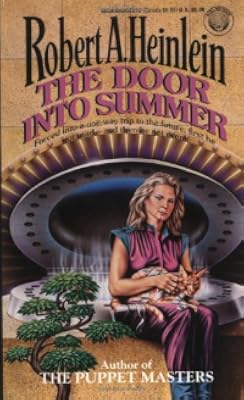
The Door into Summer
by Robert A. Heinlein
On This Page
Description
Dan Davis, an electronics engineer, had finally made the invention of a lifetime: a household robot that could do almost anything. Wild success was within reach—and Dan's life was ruined. In a plot to steal his business, his greedy partner and greedier fiancée tricked him into taking the "long sleep"—suspended animation for thirty years.But when he awoke in the far different world of AD 2000, he made an amazing discovery. And suddenly Dan had the means to travel back in time—and get show more his revenge.
Once again, grand master Robert Heinlein's genius shines through, illustrating why his books have sold millions of copies and won countless awards.
. show less
Tags
Recommendations















Member Recommendations
Member Reviews
What can I say? This book was charming. Except for one little (kind of not little, actually pretty creepy) quibble, which I will get to later. This is Heinlein, no doubt about it. It has all the trappings: libertarian leanings; benign, rather than openly hostile, sexism (though I wouldn't call this feminist by any means, at least there are female characters who say things and have feelings, even if they ultimately are accessories rather than full people); an eye-rolling horror of the aging female form. I mean, I could go on but we know Heinlein, so I won't.
And yet, I loved this book a lot more than any other Heinlein I've read, and not just for what I am pretty sure was a little friendly jab at Asimov about a third of the way in. I show more loved this book because at its heart, it's a love story between a man and a cat. A kind of douchy but ultimately pretty ok man, and a very cantankerous but extremely lovable cat. And it's a pretty fun and satisfying time travel story, where pretty much everything works out the way you want it to. Also, both 1970 and 2000 are hilarious in their conception.
And yet. Here's that quibble.The relationship between Ricky and Dan disturbs me at best, horrifies me at worst. This is a man who got a young girl who idolizes him and calls him "Uncle Danny" to put herself in cold sleep at the tender age of 21 so that he can marry this perfect paragon who he has groomed. He stays spotless in her memory because he puts himself in cold sleep while she's a little girl, and although it's set up to be her choice whether or not she decides to go into cold sleep and wake up in the future to marry her "Uncle Danny," come ON. It's kind of like if The Doctor had actually married Amy Pond, except in addition to being a constant presence in her childhood he also was a family friend, which: ew.
So...it was a fun time-travel novel and Pete's the best but...that final thing just kind of has ruined it for me. Damnit, Heinlein. show less
And yet, I loved this book a lot more than any other Heinlein I've read, and not just for what I am pretty sure was a little friendly jab at Asimov about a third of the way in. I show more loved this book because at its heart, it's a love story between a man and a cat. A kind of douchy but ultimately pretty ok man, and a very cantankerous but extremely lovable cat. And it's a pretty fun and satisfying time travel story, where pretty much everything works out the way you want it to. Also, both 1970 and 2000 are hilarious in their conception.
And yet. Here's that quibble.
So...it was a fun time-travel novel and Pete's the best but...that final thing just kind of has ruined it for me. Damnit, Heinlein. show less
The Door into Summer is a cutesy, if somewhat alarming time-travel story. Daniel Boone Davis is a brilliant engineer who has his home automation company stolen out from under him by his greedier partner and even worse ex-fiance. In a fit of pique, he decides to have himself cryonically preserved and thawed out in the year 2000. While he tries to clear up loose ends in the future, he finds that several vital technologies were just as he was planning on inventing back in the 1970s, and that the designer was a mysterious 'D.B. Davis.' There's a rat loose, which turns out to be a classified-but-working method of time travel invented by a disgraced physicist. Davis goes back to 1970, sets everything right, and then returns to the future to show more live a perfect life.
What works is the paradox-less timetravel, although not to the sheer density of "All you zombies." Time travel to the future is a old story, and future shock of this sort was made standard by H.G. Wells in "The Sleeper Awakens", but on the plus side this story came out a good five years before Ettinger's The Prospect of Immortality gave cryonics its first mainstream success. Some of the gadgets Heinlein predicted exist in some form; robotic vacuums and 3D drafting tools. Even wrong predictions about the future can be amusing. And while I am not a cat person at all, this is the best book about a cat that I know.
Where this goes wrong is hints of the weird 'late-phase Heinlein.' Much of Davis's character is driven by his love of his 11 year old "niece" Ricky (not a biological relationship), and the idea that her life might have gone terribly wrong when he had himself frozen. Well, there's lot to love about brave little girls, but proposing marriage to them and playing it as a positive emotional climax is just wrong even with various forms of time-travel. It's really moving, but the context of marrying an 11-year old who calls you "Uncle" is just too weird, and knocks this story down to three stars. show less
What works is the paradox-less timetravel, although not to the sheer density of "All you zombies." Time travel to the future is a old story, and future shock of this sort was made standard by H.G. Wells in "The Sleeper Awakens", but on the plus side this story came out a good five years before Ettinger's The Prospect of Immortality gave cryonics its first mainstream success. Some of the gadgets Heinlein predicted exist in some form; robotic vacuums and 3D drafting tools. Even wrong predictions about the future can be amusing. And while I am not a cat person at all, this is the best book about a cat that I know.
Where this goes wrong is hints of the weird 'late-phase Heinlein.' Much of Davis's character is driven by his love of his 11 year old "niece" Ricky (not a biological relationship), and the idea that her life might have gone terribly wrong when he had himself frozen. Well, there's lot to love about brave little girls, but proposing marriage to them and playing it as a positive emotional climax is just wrong even with various forms of time-travel. It's really moving, but the context of marrying an 11-year old who calls you "Uncle" is just too weird, and knocks this story down to three stars. show less
This week, I'm reading novels published in 1957, the year I was born. I picked Heinlein's novel because I sometimes like his stuff and because I hadn't read this one before.
It did not go well. Sometimes Heinlein's books are like that. He was a man of strong opinions that he liked to express extravagently and at length.
Heinlein was, amongst other things, an aeronautical engineer and in this novel, he's used the main character, Dan Davis, to unleash his 'I'm an engineer, which makes me the brightest person in the room' inner demon. Ar length. I've worked with a few Dan Davis types. The character is entirely believable, but that doesn't mean I care about what happens to him or that I want to spend any time with him.
The novel is written show more entirely from Dan Davis's point of view. Dan didn't make a good first impression on me. Here's what I wrote when I was seven per cent through the novel
"I've only just started, but I already dislike Dan Davis. He's an aggressive wiseacre with a chip on his shoulder, who thinks the world's against him, but expects to get his way with his superior brain and his loud mouth. He assesses women as if they were pieces of equipment and is an expert in self-pity. His only redeeming feature so far is that he cares about his cat. The cat seems wise enough not to reciprocate."
There were some good things about the book. Dan really understands cats. I think he'd like to be one... but probably only if he was the only cat around and could move freely from house to house, demanding to be fed. The inventions that Dan thinks up and his approach to how they should be engineered are impressive, especially as he's talking about engineering semi-autonomous robots in 1957. The scheme that Dan falls prey to, without the sexual element, would be familiar to anyone who knows how Silicon Valley works.
There was a point when Dan sobered up and decided to confront his problems rather than drowning them in a bottle or running away, where I thought the plot might carry me along. Except that, the more I understood Dan's problems, the more I disliked Dan. He's a man who has no use or respect for women but whose lust pulls all the blood from his brain. He's arrogant, proud of his ignorance about business, hates collaborating with others and is absolutely certain that he can solve any problem if people would just leave him alone and do what he tells them to do.
Because the book is written from Dan's point of view, it felt to me like a rant. The kind of thing that, in the early days of the Internet, would have been posted to a Bulletin Board entirely in CAPITAL LETTERS:, probably by an engineer with a tagline like FASTEST BRAIN IN THE WEST:
By 30%, when Dan and his verbal aggression and misplaced self-confidence had gotten him in serious trouble, I'd had enough. I couldn't listen to Dan's ain't-it-awful braying anymore. I didn't care how, or if he solved his problems (although I hoped his cat would be OK) so I set this book aside.
I listened to the audiobook, narrated by Jeff Harding, who captures the braying tone of the text perfectly. Click on the YouTube link below to hear a sample.
https://www.youtube.com/watch?v=oWe9ZXYg_CA show less
It did not go well. Sometimes Heinlein's books are like that. He was a man of strong opinions that he liked to express extravagently and at length.
Heinlein was, amongst other things, an aeronautical engineer and in this novel, he's used the main character, Dan Davis, to unleash his 'I'm an engineer, which makes me the brightest person in the room' inner demon. Ar length. I've worked with a few Dan Davis types. The character is entirely believable, but that doesn't mean I care about what happens to him or that I want to spend any time with him.
The novel is written show more entirely from Dan Davis's point of view. Dan didn't make a good first impression on me. Here's what I wrote when I was seven per cent through the novel
"I've only just started, but I already dislike Dan Davis. He's an aggressive wiseacre with a chip on his shoulder, who thinks the world's against him, but expects to get his way with his superior brain and his loud mouth. He assesses women as if they were pieces of equipment and is an expert in self-pity. His only redeeming feature so far is that he cares about his cat. The cat seems wise enough not to reciprocate."
There were some good things about the book. Dan really understands cats. I think he'd like to be one... but probably only if he was the only cat around and could move freely from house to house, demanding to be fed. The inventions that Dan thinks up and his approach to how they should be engineered are impressive, especially as he's talking about engineering semi-autonomous robots in 1957. The scheme that Dan falls prey to, without the sexual element, would be familiar to anyone who knows how Silicon Valley works.
There was a point when Dan sobered up and decided to confront his problems rather than drowning them in a bottle or running away, where I thought the plot might carry me along. Except that, the more I understood Dan's problems, the more I disliked Dan. He's a man who has no use or respect for women but whose lust pulls all the blood from his brain. He's arrogant, proud of his ignorance about business, hates collaborating with others and is absolutely certain that he can solve any problem if people would just leave him alone and do what he tells them to do.
Because the book is written from Dan's point of view, it felt to me like a rant. The kind of thing that, in the early days of the Internet, would have been posted to a Bulletin Board entirely in CAPITAL LETTERS:, probably by an engineer with a tagline like FASTEST BRAIN IN THE WEST:
By 30%, when Dan and his verbal aggression and misplaced self-confidence had gotten him in serious trouble, I'd had enough. I couldn't listen to Dan's ain't-it-awful braying anymore. I didn't care how, or if he solved his problems (although I hoped his cat would be OK) so I set this book aside.
I listened to the audiobook, narrated by Jeff Harding, who captures the braying tone of the text perfectly. Click on the YouTube link below to hear a sample.
https://www.youtube.com/watch?v=oWe9ZXYg_CA show less
Heinlein was without a doubt a misogynistic old letcher with cradle-snatching tendencies. His characters convey this too consistently to point to anything other than self-gratification through his writing.
So why do I read his books? And why do I happily recommend them to anyone, regardless of gender?
Because his books are so very entertaining. That's why.
Let's face it, the man could spin a yarn.
The Door into Summer is no exception. It's well written and thought provoking, and enjoyable throughout, if you don't dwell too much on the second love interest in the book.
The story was written in the 50s, and set in the 70s and the year 2000/1, and it's fun too see what Heinlein predicted correctly and what he got terribly, terribly wrong. most show more of the "wrong" is derived from the fact that Heinlein did not foresee a world run by computers - not a terrible failing on his part considering that computers weren't exactly in the public eye much in the 50s, and personal computers were unheard of - and while that didn't impact things too much in his view of the 70s, it predictably threw the year 2000 completely out of recognition with how it really was.
Of course, in true Heinlein style, he did give us flying cars and futuristic clothes without zips... enough to make one wish they could visit this time he had imagined for a little while.
So if you can look past the idea that women should be young, pretty and love doing dishes, The Door into Summer is something I can heartily recommend. If you can't, then I'm afraid Heinlein really isn't for you. show less
So why do I read his books? And why do I happily recommend them to anyone, regardless of gender?
Because his books are so very entertaining. That's why.
Let's face it, the man could spin a yarn.
The Door into Summer is no exception. It's well written and thought provoking, and enjoyable throughout, if you don't dwell too much on the second love interest in the book.
The story was written in the 50s, and set in the 70s and the year 2000/1, and it's fun too see what Heinlein predicted correctly and what he got terribly, terribly wrong. most show more of the "wrong" is derived from the fact that Heinlein did not foresee a world run by computers - not a terrible failing on his part considering that computers weren't exactly in the public eye much in the 50s, and personal computers were unheard of - and while that didn't impact things too much in his view of the 70s, it predictably threw the year 2000 completely out of recognition with how it really was.
Of course, in true Heinlein style, he did give us flying cars and futuristic clothes without zips... enough to make one wish they could visit this time he had imagined for a little while.
So if you can look past the idea that women should be young, pretty and love doing dishes, The Door into Summer is something I can heartily recommend. If you can't, then I'm afraid Heinlein really isn't for you. show less
If you are going to indulge yourself in reading 1950's science fiction, you can't avoid Heinlein. I have previously read four books by him. Two collections of short stories and two novels: [The Puppet Masters] and [Double Star], were both fast moving science fiction tales that relied very much on storytelling rather than characterisation. The Door into Summer is very much of the same vein, but this time there is an excellent story to tell and Pete the cat is the best character.
The novel was published in 1957, but Heinlein imagines an America in 1970 and again in the year 2000. Our hero Daniel Boone Davis is an engineer and inventor, and a typical character of much 1950's science fiction, he has a great sense of personal liberty and show more self reliance; an individual who does things his own way, not afraid to kick against corporate authority and not afraid to take risks. He invents a series of household aids that become successful, he is cheated out of the profits of his company by his secretary and his business manager and is tricked by them into taking the big sleep (suspended animation) for a thirty year period. He awakes in 2000 still infused with a need to use his engineering skills, but the world has moved on. He gets a job in an off shoot of the company he started and is intrigued that the original patents for their best selling machines still bear his name. He discovers that time travel has been successfully attempted and tricks his way into going back to 1970 to discover what happened and to collect Pete his cat.
It is an intricate tale of time travel forwards and backwards first by cryogenic suspended animation and then by a time machine, but the story evolves around D B Davis's attempts to put things right back in 1970 and to get the girl he loves. His main motive however is that he wants to continue working with his beloved inventions, but has discovered he much prefers the future 2000, rather than the more dull 1970. Fixing things back in the past while preserving a better future has long been a theme of science fiction writers and while Heinlein spends a little time on theories of time travel, it is really only a plot device. The meat of the book is Davis's attempts to fix things for his own advantage. Heinlein has to invent two scenarios Great Los Angeles in 1970 and Denver the new seat of government of the USA in 2000. He manages this pretty well and the worlds that he describes bear some relation to the worlds that we recognises today. This is such a good story that we can forgive Heinlein almost anything as his tale rushes onwards. It is inventive, funny and full of wonder and it even has a scene in a naturist colony: Heinlein loves the characters in his books to get naked. (although being 1950 he rarely does anything with them).
Last night I started the novel and found I was three quarters of the way through at 1.30 am - what to do? finish or go to bed. The fact that I even thought about finishing it shows what a good page turner it is. 5 stars. show less
The novel was published in 1957, but Heinlein imagines an America in 1970 and again in the year 2000. Our hero Daniel Boone Davis is an engineer and inventor, and a typical character of much 1950's science fiction, he has a great sense of personal liberty and show more self reliance; an individual who does things his own way, not afraid to kick against corporate authority and not afraid to take risks. He invents a series of household aids that become successful, he is cheated out of the profits of his company by his secretary and his business manager and is tricked by them into taking the big sleep (suspended animation) for a thirty year period. He awakes in 2000 still infused with a need to use his engineering skills, but the world has moved on. He gets a job in an off shoot of the company he started and is intrigued that the original patents for their best selling machines still bear his name. He discovers that time travel has been successfully attempted and tricks his way into going back to 1970 to discover what happened and to collect Pete his cat.
It is an intricate tale of time travel forwards and backwards first by cryogenic suspended animation and then by a time machine, but the story evolves around D B Davis's attempts to put things right back in 1970 and to get the girl he loves. His main motive however is that he wants to continue working with his beloved inventions, but has discovered he much prefers the future 2000, rather than the more dull 1970. Fixing things back in the past while preserving a better future has long been a theme of science fiction writers and while Heinlein spends a little time on theories of time travel, it is really only a plot device. The meat of the book is Davis's attempts to fix things for his own advantage. Heinlein has to invent two scenarios Great Los Angeles in 1970 and Denver the new seat of government of the USA in 2000. He manages this pretty well and the worlds that he describes bear some relation to the worlds that we recognises today. This is such a good story that we can forgive Heinlein almost anything as his tale rushes onwards. It is inventive, funny and full of wonder and it even has a scene in a naturist colony: Heinlein loves the characters in his books to get naked. (although being 1950 he rarely does anything with them).
Last night I started the novel and found I was three quarters of the way through at 1.30 am - what to do? finish or go to bed. The fact that I even thought about finishing it shows what a good page turner it is. 5 stars. show less
Known as one of Heinlein's classics, this adventure is fun and compulsively readable, full of humor and great characters. It is hilariously dated, as the character jumps forward from 1970 to 2000, and Heinlein's vision of 2000 isn't any more accurate than you'd expect, but this is still my favorite of the time-travel novels I've wandered through. Heinlein's plots and characters are perfectly balanced, and the narrative is fast-moving without losing any of the character depth that comes with a great story. While the ending of one sub-plot made me cringe a bit, it didn't come near ruining the novel, and I'd recommend this on to any readers curious about Heinlein's work or just looking for a fast-paced good story.
Recommended.
Recommended.
This story is definitely amusing fluff, which seems right for a short sci-fi novel written in the 1950's. I best liked Pete the cat and that the story does not take itself too seriously. Its attitude toward its female characters is pretty awful, though, even taking into account that was written in the 50's. I have the uncomfortable feeling that RAH was a founding member of the MRA society. The ladies are all evaluated first on their physical attractiveness, and I say "ladies" loosely because this also applies to an 11 year old girl. The only smart woman is a "man-eater" caricature, who gets her just desserts as she ends up old, ugly, man-less, and poor, but still desperately trying to work her wiles on the main character, so that he show more can give her the full rejection. And the attitude toward the little girl is just creepy, as she is primarily described in terms of her future desirability as a sexual companion. She and the main character (a man in his 30's), get "engaged" just before he goes into suspended animation, and he gives her instructions to also put herself into suspended animation when she's 21 so they can wake up together and get married. Which they both do. And even then, she's treated as though she's still that little girl, only with a sexy adult body. Gross.
Audiobook, borrowed from my public library via Overdrive. The performance by Patrick Lawlor is excellent - he reads with just the right amount of self-aware amusement - and dragged this book back up to 3 stars to redeem it from its miserable female characters. show less
Audiobook, borrowed from my public library via Overdrive. The performance by Patrick Lawlor is excellent - he reads with just the right amount of self-aware amusement - and dragged this book back up to 3 stars to redeem it from its miserable female characters. show less
Members
- Recently Added By
Lists

Best Science Fiction Novels
816 works; 426 members
Survey of Classic Science Fiction
171 works; 48 members

Best Time Travel Novels
165 works; 125 members

Best time travel books
56 works; 22 members

S.F. Masterworks (Complete)
229 works; 15 members

David Pringle's Science Fiction: The 100 Best Novels
101 works; 9 members

SF Masterworks
193 works; 8 members

What Makes This Book So Great
102 works; 16 members

LibraryThingers' 1001 Books You Must Read Before You Die
442 works; 30 members

Books With Time Words in the Title
160 works; 4 members

Books Read in 2021
5,361 works; 113 members
Time Travel Stories
64 works; 6 members

Protagonists - Men
32 works; 2 members

La Bibliothèque idéale de la SF (Éditions Albin Michel, 1988)
52 works; 1 member

Books Read in 2017
4,249 works; 130 members

Books We Want To Read Again For The First Time
384 works; 160 members

#ReadingBingo2020
25 works; 1 member

My E-Book Collection - Opinions Welcome
92 works; 10 members

Books Read in 2016
4,666 works; 197 members

Allie's Wishlist
217 works; 2 members

Fiction For Men
142 works; 11 members

Books Set in Los Angeles
40 works; 8 members

XB-1: Osobnosti zanru doporucuji
67 works; 1 member
Stories Featuring Passages, Gateways and Doors
39 works; 11 members

Favorite Childhood Books
1,646 works; 518 members

Books Read in 2012
816 works; 34 members

Summer Books
82 works; 9 members
1950s
340 works; 22 members
Favourite Books
1,819 works; 310 members
Favorite Science Fiction
456 works; 218 members
Author Information

456+ Works 174,195 Members
Robert Anson Heinlein was born on July 7, 1907 in Butler, Mo. The son of Rex Ivar and Bam Lyle Heinlein, Robert Heinlein had two older brothers, one younger brother, and three younger sisters. Moving to Kansas City, Mo., at a young age, Heinlein graduated from Central High School in 1924 and attended one year of college at Kansas City Community show more College. Following in his older brother's footsteps, Heinlein entered the Navel Academy in 1925. After contracting pulmonary tuberculosis, of which he was later cured, Heinlein retired from the Navy and married Leslyn MacDonald. Heinlein was said to have held jobs in real estate and photography, before he began working as a staff writer for Upton Sinclair's EPIC News in 1938. Still needing money desperately, Heinlein entered a writing contest sponsored by the science fiction magazine Thrilling Wonder Stories. Heinlein wrote and submitted the story "Life-Line," which went on to win the contest. This guaranteed Heinlein a future in writing. Using his real name and the pen names Caleb Saunders, Anson MacDonald, Lyle Monroe, John Riverside, and Simon York, Heinlein wrote numerous novels including For Us the Living, Methuselah's Children, and Starship Troopers, which was adapted into a big-budget film for Tri-Star Pictures in 1997. The Science Fiction Writers of America named Heinlein its first Grand Master in 1974, presented 1975. Officers and past presidents of the Association select a living writer for lifetime achievement. Also, the Science Fiction and Fantasy Hall of Fame inducted Heinlein in 1998. Heinlein died in 1988 from emphysema and other related health problems. Heinlein's remains were scattered from the stern of a Navy warship off the coast of California. (Bowker Author Biography) show less
Some Editions
Awards and Honors
Distinctions
Series
Belongs to Publisher Series
Pan Science Fiction (The Door into Summer)
Caminho de Bolso (41)
ハヤカワ文庫 SF (345)
Sündmuste horisont (45)
Bastei Science Fiction-Special (24176)
SF Masterworks (New design)
Goldmann Science Fiction (23351)
Work Relationships
Common Knowledge
- Canonical title*
- Une porte sur l'été
- Original title
- The Door into Summer
- Original publication date
- 1957; 1956
- People/Characters
- Dan Davis; Belle S. Darkin; Pete; John Sutton; Jenny Sutton; Frederica Virginia Gentry (show all 8); Miles Gentry; Chuck Freudenberg
- Important places
- Los Angeles, California, USA; Colorado, USA
- Dedication
- For
A. P. and Phyllis
Mick and Annette
Aelurophiles All - First words
- One winter shortly before the Six Weeks War my, tomcat, Petronius the Arbiter, and I lived in an old farmhouse in Connecticut.
- Quotations
- Le suicide est une expérience trop définitive, même en des circonstances mathématiquement intrigantes.
Despite the crepehangers, romanticists, and anti-intellectuals, the world steadily grows better because the human mind, applying itself to environment, makes it better. With hands...with tools...with horse sense and science a... (show all)nd engineering. - Last words
- (Click to show. Warning: May contain spoilers.)You know, I think he is right.
- Original language
- English
*Some information comes from Common Knowledge in other languages. Click "Edit" for more information.
Classifications
Statistics
- Members
- 4,389
- Popularity
- 3,399
- Reviews
- 89
- Rating
- (3.84)
- Languages
- 14 — Czech, Dutch, English, Estonian, French, German, Italian, Japanese, Polish, Portuguese, Russian, Croatian, Spanish, Swedish
- Media
- Paper, Audiobook, Ebook
- ISBNs
- 64
- ASINs
- 48