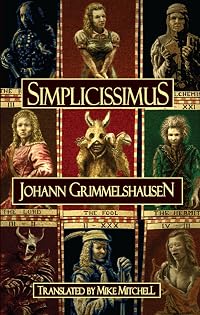
Simplicissimus
by Johann Jakob Christoffel von Grimmelshausen
On This Page
Description
'Simplicius Simplicissimus' - the towering achievement of H.J.C. von Grimmelshausen, one of the earliest novelists in the German language - charts the adventures of its hero, Simplicius, through the horrors of battle, murder, fire and famine, offering an invaluable eyewitness account of the Thirty Years War and showing how humanity can, in the end, triumph over brutality. A work of great poetical beauty and satirical strength, and a lasting historical document of timeless value, 'Simplicius show more Simplicissimus' is presented here in the only edition available in the English language, based on the original text of 1669. show lessTags
Recommendations













Member Recommendations



Member Reviews
Simplicissimus is the best-known German prose work of the baroque period. Like all great picaresque novels, it's made up of an unapologetically random succession of events, so many that between them they cover just about every possible literary mood - bucolic, military, nautical, comic, tragic, allegorical, satirical, didactic, fantastic, contemplative, religious, atheistic, luxurious, ascetic - everything from fart-jokes to scholarly discourses about the evils of worldly goods, not excluding battles, journeys to the centre of the earth, shipwrecks on desert islands, Miltonic debates between the devils in Hell, a witches' sabbath, and a Parisian erotic episode that seems to have been lifted from a 1970s French porn film. And then there show more are the two chapters in which a piece of toilet paper tells our narrator its life-story, illustrating the labour theory of value...
Essentially, it's the life-story of a small boy cast adrift in life when a random party of soldiers robs and destroys the farm in the Spessart on which he's grown up. He's taken in by a friendly hermit, who is amused to discover that the little shepherd-boy doesn't even know his own name - he's always just been "der Bub" (the lad). The hermit decides that the only fitting name to give him is Simplicius. Later, when the boy finds himself in the army for the first time, he needs a surname as well, and becomes Simplicius Simplicissimus. But by that time he isn't quite so simple any more.
Even though it's around 750 pages long, the pace is sometimes pretty hectic, and you will be doing quite well if you can keep track of how many times he is obliged to change sides between the Swedish and Imperial armies. Things are at their craziest in Book V, Chapter XXII, where, after the narrator has spent a couple of chapters doing nothing in Moscow (Moscow?!? - how on earth did he end up there?) waiting for the Czar to give him a job, in the space of two pages at the end of the chapter he is captured by Tatars, sent to the Far East and sold to the King of Korea, makes his way back West via Japan and Macao, but is captured in the Indian Ocean by Moslem pirates, sent to serve as a galley-slave in the Mediterranean, set free after a battle with the Venetians, and returns home to the Black Forest after making a pilgrimage to Rome. (The original 1668 book ended shortly after this, rather out of breath, but Grimmelshausen then added a sixth book, the Continuatio, where things get even more out of control.)
Fortunately it isn't always quite that extreme, especially when Grimmelshausen happens to be writing about something he knows about personally. Or has a detailed source to crib from - plagiarism was not so much frowned upon then as it is now, so even the battles we know he fought in himself are often described in the words of other writers.
Of course, all that colour, hectic movement and the remoteness of the baroque world he is writing about make it a fascinating read for us, but the thing that really sets it apart is the sheer energy and down-to-earthness of much of the language. When he's not putting on the voice of some hypothetical scholar - even then, it's often hard to tell when he's showing off his erudition and when he's mocking the way scholars see the world - Grimmelshausen talks to us exactly as you would expect someone from the depths of rural Germany to do. Hard, fast, simple prose, as few French or Latin words as possible, and plenty of earthy dialect expressions. Thomas Mann considered Simplicissimus a narrative work of extraordinary genius, and if you look at it sideways with one eye half closed you can convince yourself you can see something of what he took from it - Mann's discursive randomness is much more focussed and targeted than Grimmelshausen's, but it's obviously a development of the same way of seeing the progression of a story. Interesting! But pretty crazy, really. show less
Essentially, it's the life-story of a small boy cast adrift in life when a random party of soldiers robs and destroys the farm in the Spessart on which he's grown up. He's taken in by a friendly hermit, who is amused to discover that the little shepherd-boy doesn't even know his own name - he's always just been "der Bub" (the lad). The hermit decides that the only fitting name to give him is Simplicius. Later, when the boy finds himself in the army for the first time, he needs a surname as well, and becomes Simplicius Simplicissimus. But by that time he isn't quite so simple any more.
Even though it's around 750 pages long, the pace is sometimes pretty hectic, and you will be doing quite well if you can keep track of how many times he is obliged to change sides between the Swedish and Imperial armies. Things are at their craziest in Book V, Chapter XXII, where, after the narrator has spent a couple of chapters doing nothing in Moscow (Moscow?!? - how on earth did he end up there?) waiting for the Czar to give him a job, in the space of two pages at the end of the chapter he is captured by Tatars, sent to the Far East and sold to the King of Korea, makes his way back West via Japan and Macao, but is captured in the Indian Ocean by Moslem pirates, sent to serve as a galley-slave in the Mediterranean, set free after a battle with the Venetians, and returns home to the Black Forest after making a pilgrimage to Rome. (The original 1668 book ended shortly after this, rather out of breath, but Grimmelshausen then added a sixth book, the Continuatio, where things get even more out of control.)
Fortunately it isn't always quite that extreme, especially when Grimmelshausen happens to be writing about something he knows about personally. Or has a detailed source to crib from - plagiarism was not so much frowned upon then as it is now, so even the battles we know he fought in himself are often described in the words of other writers.
Of course, all that colour, hectic movement and the remoteness of the baroque world he is writing about make it a fascinating read for us, but the thing that really sets it apart is the sheer energy and down-to-earthness of much of the language. When he's not putting on the voice of some hypothetical scholar - even then, it's often hard to tell when he's showing off his erudition and when he's mocking the way scholars see the world - Grimmelshausen talks to us exactly as you would expect someone from the depths of rural Germany to do. Hard, fast, simple prose, as few French or Latin words as possible, and plenty of earthy dialect expressions. Thomas Mann considered Simplicissimus a narrative work of extraordinary genius, and if you look at it sideways with one eye half closed you can convince yourself you can see something of what he took from it - Mann's discursive randomness is much more focussed and targeted than Grimmelshausen's, but it's obviously a development of the same way of seeing the progression of a story. Interesting! But pretty crazy, really. show less
Sometimes described as the first great German novel, Simplicissimus is a big, flatulent, romping picaresque that careens its way across the patchwork of German states at the height of the Thirty Years War. In its mixture of realist war commentary, knockabout scatology, and magic-realist flights of fancy, it comes across as something like Rabelais meets Goya's Disasters of War.
Our eponymous hero – nicknamed for his naïveté – is born in the Spessart, and grows up in a little farming hamlet which is unfortunate enough to be in the path of some marauding soldiers, who promptly kill the men in a variety of inventive ways before raping the women. Simplicissimus, as a child, is spared long enough to escape to live wild in the forest. The show more harsh naturalism of these early scenes, and others like them throughout the book, is still genuinely shocking, and has a documentary interest; much of it is thought to be autobiographical. From there, our ingenuous hero travels up to Westphalia and down to the Breisgau, with excursions to France, Switzerland, and the centre of the earth, fighting at various times on both sides of the conflict.
Like many picaresque novels, Simplicissimus presents the world as a place of endless opportunity, novelty and adventure; and yet the wartime realities give it a grounding in real life, and a consequent seriousness, that I find somewhat missing in, say, its more famous contemporary Don Quixote. Though occasionally moralistic, it's never boring, if only because the genre shifts almost as often as the setting – from satire to fantasy to religious allegory to shaggy-dog story. One minute he's expatiating on the importance of Christian virtues, the next he's devoting a whole chapter to how he farted at an inopportune moment.
At times too it is fascinatingly subversive. Despite all the fighting, the only real description of wartime combat we get is a parodic one, when Simplicissimus goes off alone into the woods to kill the lice infesting his body:
I took off the cuirass, even though others put one on before going into battle and started such a massacre that soon my two swords – my thumb-nails – were dripping with blood and covered in dead bodies. Those I could not kill I sent into exile, wandering under the tree.
And his status as eternal innocent allows him to ask the religious questions that no one else can; when a Reformed minister demands that he recognise the truth of his denomination, Simplicissimus objects immediately:
‘But, pastor,’ I answered, ‘that is what all the other churches say of their faith as well. Which one should I believe? […] Which one should I join when each is screaming that the others are the work of the devil?’
The translation from Mike Mitchell is just fantastic, employing a complex, often specialist vocabulary which reads completely fluently while also giving plenty of seventeenth century flavour. (Unfortunately, there are some editing mistakes – ‘gaol’ has been replaced by ‘goal’ in every instance, apparently by some overzealous spellchecker, and similarly we read more than once of someone getting their ‘just desserts’, which rather puts me in mind of people being punished with bowls of Angel Delight.) In any case, this strange and exuberant novel is of much more than historical interest – full of life, and learning, and delights that have been snatched from a capricious world. A world closer to us than we sometimes remember. show less
Our eponymous hero – nicknamed for his naïveté – is born in the Spessart, and grows up in a little farming hamlet which is unfortunate enough to be in the path of some marauding soldiers, who promptly kill the men in a variety of inventive ways before raping the women. Simplicissimus, as a child, is spared long enough to escape to live wild in the forest. The show more harsh naturalism of these early scenes, and others like them throughout the book, is still genuinely shocking, and has a documentary interest; much of it is thought to be autobiographical. From there, our ingenuous hero travels up to Westphalia and down to the Breisgau, with excursions to France, Switzerland, and the centre of the earth, fighting at various times on both sides of the conflict.
Like many picaresque novels, Simplicissimus presents the world as a place of endless opportunity, novelty and adventure; and yet the wartime realities give it a grounding in real life, and a consequent seriousness, that I find somewhat missing in, say, its more famous contemporary Don Quixote. Though occasionally moralistic, it's never boring, if only because the genre shifts almost as often as the setting – from satire to fantasy to religious allegory to shaggy-dog story. One minute he's expatiating on the importance of Christian virtues, the next he's devoting a whole chapter to how he farted at an inopportune moment.
At times too it is fascinatingly subversive. Despite all the fighting, the only real description of wartime combat we get is a parodic one, when Simplicissimus goes off alone into the woods to kill the lice infesting his body:
I took off the cuirass, even though others put one on before going into battle and started such a massacre that soon my two swords – my thumb-nails – were dripping with blood and covered in dead bodies. Those I could not kill I sent into exile, wandering under the tree.
And his status as eternal innocent allows him to ask the religious questions that no one else can; when a Reformed minister demands that he recognise the truth of his denomination, Simplicissimus objects immediately:
‘But, pastor,’ I answered, ‘that is what all the other churches say of their faith as well. Which one should I believe? […] Which one should I join when each is screaming that the others are the work of the devil?’
The translation from Mike Mitchell is just fantastic, employing a complex, often specialist vocabulary which reads completely fluently while also giving plenty of seventeenth century flavour. (Unfortunately, there are some editing mistakes – ‘gaol’ has been replaced by ‘goal’ in every instance, apparently by some overzealous spellchecker, and similarly we read more than once of someone getting their ‘just desserts’, which rather puts me in mind of people being punished with bowls of Angel Delight.) In any case, this strange and exuberant novel is of much more than historical interest – full of life, and learning, and delights that have been snatched from a capricious world. A world closer to us than we sometimes remember. show less
An amazing book. A picaresque study of futility, fidelity and the innocent abroad; a mournful account of the irredeemable brutishness of man entwined with a comic catalogue of his follies. Very few books articulate the bewilderment, the unanswerableness of war as well as this one does. And there are flights of fantasy which take you wholly by surprise.
I read a recent translation by Mike Mitchell which managed to modernise the language without occluding the temper of the time (although bizarrely "gaol" was copy-edited to "goal" throughout). Ought to be much more widely-read: it's not a difficult read by any means.
I read a recent translation by Mike Mitchell which managed to modernise the language without occluding the temper of the time (although bizarrely "gaol" was copy-edited to "goal" throughout). Ought to be much more widely-read: it's not a difficult read by any means.
A very mixed bag of story. Its split into five sections plus some extra stories which we'll call the appendix but before getting into the parts a brief general overview.
So the writings good and very easy to read at least in the translation i had. I think the translator is a 'William Heinemann' but that could be the publisher, i got it from Project Gutenberg.
Its mostly a biography and history with satire and comedy elements, there tends to be some quite witty lines every so often.
One of the best things is the sprinkling of whackiness, once in a while a wizard, fortune teller, ghost, witch or other bizarre character will show up in this otherwise normal story, which for me was always a pleasent experience.
Sidenote, the version i had show more skipped a couple of pieces, one involving our hero seducing some women and the other a trip to an underwater kingdom! Really! of all the stuff that could have been left out of this he skips the fish people.. that was annoying.
Oh yes before i forget this is set during the Thirty Years War which i know nothing about. However based on this book it seems to have involved at least two factions of germans as well as the Swedes, and a little bit of involvement from some croatians and maybe some Swiss, possibly some French aswell.
One of the odd things is that no one here seems to be fighting for a cause they switch sides at the drop of the hat. Theres no patriotism, its a very in the trenches viewpoint which is pretty intresting.
Lastly the protagonists personality and especially his religious tendencies vacillate wildly and ridiculously throughout.
Anyway on to the individual parts/books:
Book 1: Out hero starts off as a lovable idiot like Forest Gump or the [b:The Good Soldier Švejk|7629|The Good Soldier Švejk|Jaroslav Hašek|https://images.gr-assets.com/books/1468884268s/7629.jpg|318160], which allows him (and the reader) to get through some truly horrific war scenes. The term 'rape and pillage' doesn't even come close.
By far the most brutal and interesting parts of the story.
Book 2: Our hero changes from lovable idiot to an innocent and religious savant , like an Omish Sheldon Cooper.
Book 3: Another change this time into a military genius, like some combination of Sharp, Robin Hood and Omar Little from 'the Wire'. I did not see that coming.
Also all of the horrors of war are now completely forgotten about since our hero is now a soldier. It becomes the most Disneyfied version of a military conflict.
Book 4: Retiring mostly from the army our hero takes on about every job known at this time of history. Its a bit of a mess but there is some good satire here and there.
Book 5: The story continues to drift about and seems to get faster and faster. Seriously, at one point we end up back in the army promoted, fight in a battle, wounded, retired again and moved to Switzerland; in the space of about 2 pages.
I guess the author must have been getting as impatient to end this thing as i was.
Appendices: But later a few additional stories were found, the main one being a desert island adventure. I kind of skimmed these but the island story does have some more of those wacky moments which i like.
Overall, a lot of little bits of stories strung together, the early books probably superior to the latter ones but the author has a lot of neat bits scattered throughout. show less
So the writings good and very easy to read at least in the translation i had. I think the translator is a 'William Heinemann' but that could be the publisher, i got it from Project Gutenberg.
Its mostly a biography and history with satire and comedy elements, there tends to be some quite witty lines every so often.
One of the best things is the sprinkling of whackiness, once in a while a wizard, fortune teller, ghost, witch or other bizarre character will show up in this otherwise normal story, which for me was always a pleasent experience.
Sidenote, the version i had show more skipped a couple of pieces, one involving our hero seducing some women and the other a trip to an underwater kingdom! Really! of all the stuff that could have been left out of this he skips the fish people.. that was annoying.
Oh yes before i forget this is set during the Thirty Years War which i know nothing about. However based on this book it seems to have involved at least two factions of germans as well as the Swedes, and a little bit of involvement from some croatians and maybe some Swiss, possibly some French aswell.
One of the odd things is that no one here seems to be fighting for a cause they switch sides at the drop of the hat. Theres no patriotism, its a very in the trenches viewpoint which is pretty intresting.
Lastly the protagonists personality and especially his religious tendencies vacillate wildly and ridiculously throughout.
Anyway on to the individual parts/books:
Book 1: Out hero starts off as a lovable idiot like Forest Gump or the [b:The Good Soldier Švejk|7629|The Good Soldier Švejk|Jaroslav Hašek|https://images.gr-assets.com/books/1468884268s/7629.jpg|318160], which allows him (and the reader) to get through some truly horrific war scenes. The term 'rape and pillage' doesn't even come close.
By far the most brutal and interesting parts of the story.
Book 2: Our hero changes from lovable idiot to an innocent and religious savant , like an Omish Sheldon Cooper.
Book 3: Another change this time into a military genius, like some combination of Sharp, Robin Hood and Omar Little from 'the Wire'. I did not see that coming.
Also all of the horrors of war are now completely forgotten about since our hero is now a soldier. It becomes the most Disneyfied version of a military conflict.
Book 4: Retiring mostly from the army our hero takes on about every job known at this time of history. Its a bit of a mess but there is some good satire here and there.
Book 5: The story continues to drift about and seems to get faster and faster. Seriously, at one point we end up back in the army promoted, fight in a battle, wounded, retired again and moved to Switzerland; in the space of about 2 pages.
I guess the author must have been getting as impatient to end this thing as i was.
Appendices: But later a few additional stories were found, the main one being a desert island adventure. I kind of skimmed these but the island story does have some more of those wacky moments which i like.
Overall, a lot of little bits of stories strung together, the early books probably superior to the latter ones but the author has a lot of neat bits scattered throughout. show less
This is the tale of the orphaned Simplicissimus, living during the 30 year war, very much at the mercy of changing circumstances. The casual way he deals with such things as being robbed of all worldly goods or gaining fame and wealth as a bandit or being beaten within an inch of his life is amazing. Some of the thought felt astonishingly modern and the social commentary could in a large part be transferred to our times with few adjustments. I enjoyed the comic aspects but found it a bit repetitive at times.
I listened to a new 'translation' into a more modern German by Reinhard Kaiser. This update and the narration are both very well done and made the book more accessible to me without losing the historic feel.
I listened to a new 'translation' into a more modern German by Reinhard Kaiser. This update and the narration are both very well done and made the book more accessible to me without losing the historic feel.
Very disturbing accounts of the Thirty Years' War in Germany told from the point of view of a child, who grows up and continues life as one who takes advantage of situations as they come up. This and Mother Courage are works that authors such as Bertolt Brecht and Gunter Grass draw from in their own works.
This is an abridgement of the German original, but -- AFAICT -- the only really viable translation into English. _Simplicius_ is one of the great picaresque novels, basically the only near-contemporary fictional account of the Thirty Years' War, and one of a few (at least commonly translated) major and really effective depictions of that conflict's distinctive atmosphere. And for all that, it's extremely readable; strongly recommended, with _Mother Courage and her Children_ as a companion piece. (And perhaps _The Runagate Courage_ as a reference work for the latter. Be sure to at least hear about that one...)
Members
- Recently Added By
Lists

German Literature
518 works; 56 members

100 Books to Read in a Lifetime (That Are Older Than 200 Years)
415 works; 174 members

Philip Ward's Lifetime Reading Plan
592 works; 22 members

Picaresque Novels
22 works; 9 members

Unreliable Narrators
170 works; 43 members

Books Set in Germany
74 works; 12 members

Stories of War and Revolution
146 works; 55 members

My list of 100 books to read next
100 works; 4 members

Novels of Great Adventures
34 works; 6 members

My TBR
371 works; 3 members
All Things Germany
321 works; 4 members

DigitalDreamDoor top 300
300 works; 4 members
Author Information

84+ Works 1,901 Members
A popular didactic novel of the Reformation period, Grimmelshausen's Simplicissimus (Adventures of a Simpleton) (1669) is largely responsible for establishing the novel as an important genre in German literature. It is an early example of the picaresque genre. The hero of the novel, who shares some of his creator's adventures, is no conventional show more "fool" reflecting on the follies of mankind, but a real soldier of fortune in the Thirty Years War. The misery he experiences forces him to search for an answer to the riddle of human existence. One of the sequels to Simplicissimus is Landstortzerin Courasche (1669), a bawdy, picaresque tale of a woman camp follower in an ugly world, "a symbol of the age and a lively individual [who] comes out on top in any situation with unimpaired self-assurance if not virtue" (LJ). The False Messiah (1672), in which a thief poses as the Prophet Elijah, "paints an equally grotesque picture of the world" (SR). Drawing a parallel between the devastation experienced in Germany during the Thirty Years War and during World War II, Gunter Grass found the work of Grimmelshausen a great source of inspiration. The combination of earnest moralism and cynicism renders the work of Grimmelshausen relatively modern, and it is open to a very wide range of interpretations. (Bowker Author Biography) show less
Some Editions
Awards and Honors
Awards
Notable Lists
Series
Belongs to Publisher Series
Bibliothek der frühen Neuzeit (Band 16/1)
Volksboek (287)
Ravensburger Taschenbuch (132)
Winkler Weltliteratur Dünndruckausgabe (Grimmelshausen)
Die Andere Bibliothek (296/297)
A tot vent (363)
Work Relationships
Is contained in
Has the adaptation
Is abridged in
Has as a student's study guide
Abenteuerlicher Simplicius Simplicissimus: Ausführliche, unerdichtete und recht memorable Lebensbeschreibung eines einfältigen, wunderlichen und seltsamen Vaganten. by Johann Jakob Christoffel von Grimmelshausen
Lesen und Üben : Johann Jacob Christoph von Grimmelshausen : Simplicius Simplicissimus [book + sound recording] by CIDEB
Common Knowledge
- Canonical title*
- Der abenteuerliche Simplicissimus
- Original title
- Der abenteuerliche Simplicissimus Teutsch; Der Abenteuerliche Simplicissimus Teutsch
- Alternate titles
- Simplicius Simplicissimus
- Original publication date
- 1668; 1669
- People/Characters
- Simplicius Simplicissimus; Mother Courage
- Important places
- Gelnhausen, Hesse, Germany; Holy Roman Empire; Hanau, Hesse, Germany; Fulda, Hesse, Germany; Paris, France; Russia
- Important events
- Thirty Years' War
- Related movies
- Des Christoffel von Grimmelshausen abenteuerlicher Simplicissimus (1975 | IMDb)
- First words*
- Es verbreitet sich in dieser unserer Zeit (von welcher man glaubt, dass es die letzte sei) unter einfachen Leuten eine merkwürdige Sucht: Patienten, die daran krank liegen und gerade so viel erschachert haben, dass sie sich ... (show all)ausser ein paar Hellern im Beutel ein närrisches Kleid nach der neuen Mode mit tausenderlei seidenden Bändern leisten können oder die durch irgendeinen Glücksfall bekannt geworden sind, wollen gleich rittermässige Herren und Adlige aus uraltem Geschlecht sein. (Barbara Gehrts)
- Last words*
- (Click to show. Warning: May contain spoilers.)Gott verleihe uns allen seine Gnade, dass wir allesamt dasjenige von ihm erlangen, woran uns am meisten gelegen, nämlich ein seliges Ende. (Barbara Gehrts)
- Original language
- German
*Some information comes from Common Knowledge in other languages. Click "Edit" for more information.
Classifications
- Genres
- Fiction and Literature, General Fiction, Historical Fiction
- DDC/MDS
- 833.5 — Literature & rhetoric German & related literatures German fiction 1625–1749 : baroque period
- LCC
- PT1731 .A7 .E5 — Language and Literature German, Dutch and Scandinavian literatures German literature Individual authors or works 1500-ca. 1700
- BISAC
Statistics
- Members
- 1,395
- Popularity
- 17,051
- Reviews
- 20
- Rating
- (3.79)
- Languages
- 16 — Catalan, Czech, Dutch, English, Finnish, French, German, Hungarian, Italian, Multiple languages, Norwegian (Bokmål), Portuguese, Russian, Serbian, Spanish, Swedish
- Media
- Paper, Audiobook, Ebook
- ISBNs
- 106
- ASINs
- 66