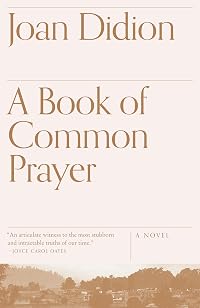
A Book of Common Prayer
by Joan Didion
On This Page
Description
A shimmering novel of innocence and evil: the gripping story of two American women in a failing Central American nation, from the bestselling, award-winning author of The Year of Magical Thinking and Let Me Tell You What I Mean"[Didion's] most ambitious project in fiction, and her most successful ... glows with a golden aura of well-wrought classical tragedy.” —Los Angeles Times Book Review
Grace Strasser-Mendana controls much of Boca Grande's wealth and knows virtually all of its show more secrets; Charlotte Douglas knows far too little. "Immaculate of history, innocent of politics," Charlotte has come to Boca Grande vaguely and vainly hoping to be reunited with her fugitive daughter. As imagined by Didion, her fate is at once utterly particular and fearfully emblematic of an age of conscienceless authority and unfathomable violence.
A Book of Common Prayer is written with the...
. show less
Tags
Recommendations










































Member Reviews
I will try to be Joan Didion's witness regarding A Book of Common Prayer (1977). It is a great, ambitious novel. It is not common. Even despite its title, none of its characters have a prayer. A not uncommon trait afflicting the characters of Joan Didion's novels. That's just Joan being Joan. Cynical and ironic. Master of irony. Cynic's mistress. Joan Didion. Making me ruefully laugh calling her third novel A Book of Common Prayer. Amen.
A trait uncommon, I should amend, in the three novels I've so far read of the five novels of Joan Didion. The other novel's by Joan Didion I've read being A Book of Common Prayer's predecessor, Play It As It Lays (1970), and Prayer's follow-up, Democracy (1984). Perhaps they are common traits in the two show more novels by Joan Didion I've not yet read; her debut, Run River (1963) and most recent, though published nearly two decades ago around the time Clinton began his second term, The Last Thing He Wanted (1996). Maybe the characters inhabiting those novels have prayers. But I doubt it. Knowing Joan Didion as I do from what I've read by her, I know she plays it dark. Dims the lights on hopes. Draws the blinds on dreams. Embodies delusions.
Or wait. I'm being unfair to Joan Didion. Joan Didion's characters, I should clarify, by their choices, have ruined their hopes and dreams, remained true to their delusions, and not Joan Didion. I need to make that distinction clear. I do not want to make the same mistake as Charlotte Douglas, waning starlet and society girl who is A Book of Common's Prayer's star. Or more precisely, A Book of Common's Prayer's black hole. The black hole whom, according to the narrator of the novel, Grace Strasser Mendana, "did not make enough distinctions in her life". Grace Strasser Mendana would know. She is a scientist, but also "a student of delusion" investigating its very DNA. A Book of Common Prayer is essentially Grace's case study of Charlotte Douglas' puzzling DNA and demise. But it's also a study of guilt. Grace's guilt, not Charlotte's. But that is the subject perhaps of another novel by Joan Didion, maybe of Democracy, or maybe not.
We know Charlotte is already dead on page one.
We know that Grace will soon be dead a few pages later, after learning that Charlotte is dead and that the narrative is a remembrance. A liturgy paying homage to delusion, to Charlotte's in particular, "who dreamed her life" away. Who believed even as machine guns got her in their sights, that everything in the country of Boca Grande would turn out all right.
We know, as I already said, though it bears repeating, that no one has a prayer in A Book of Common Prayer. Pardon my redundancy, but Joan Didion says the same words and phrases twice, thrice, four times. Sometimes, Joan Didion says the same words and phrases twice, thrice, four times in italics. When Joan Didion says the same words and phrases twice, thrice, four times in italics, she is not merely doing so for emphasis. But to characterize the longing or the loss in memory. Or for social or political commentary. Or to set a mood. To evoke gravitas in her prose. For effect, powerful effect, her poignant motifs. Much has been made of Joan Didion's much-emulated style. Ask Bret Easton Ellis, Joan Didion's copycat in style. Or don't. He might not like being reminded that the style he's made famous was never his to begin with. But Joan's. Read Joan Didion yourself and see. Be her witness.
We know that even those who do not die in A Book of Common Prayer will not survive. I like that paradox. It is a representative paradox of the kind Joan Didion might write in order to imply something weightier than words. The power in Joan Didion's prose is evident beyond her singular style and terse technique. How she craftily imbues her prose with implication upon implication makes her svelte novels feel heavy in your hands like doorstopper tomes. One ruminates on, as much as reads, Joan Didion.
We know that Charlotte and her first husband, Warren Bogart, have an estranged daughter, Marin, raised by Charlotte and her second husband, Leonard Douglas, wanted by the F.B.I. for her terrorism. She's nineteen in most of Grace Strasser Mendana's remembrance of Charlotte Douglas. Nineteen, the same age as the youngest of the two Boston Marathon bombers. But Marin didn't blow up the Boston Marathon. Marin blew up the Transamerica building in San Francisco. Left behind a tape explaining why. The way a rebel parrot might explain why.
"All class enemies must suffer exemplary punishment. When the fascist police think we are near we will be far away. When the fascist police think we are far away we will be near ... We shall reply to repression with liberation. We shall reply to the terrorism of the dictatorship with the terrorism of the revolutions," Marin intoned, and with a lisp we are told by Charlotte, from the tape.
We know that Marin caught the pungent whiff of revolucion when her parents lived in the fictitious, Central American nation of Boca Grande and let the house staff tend to her rearing. Not to mention her reading. Citizens of Boca Grande raising a norte americana child. Countries of constant rot and impending riot.
We know Marin's parents, Charlotte and Leonard, were probably arms dealers disguised as U.S. diplomats. Except Charlotte, being Charlotte, wasn't cognizant of the fairly obvious fact that her second husband, Leonard, was involved in shady back room dealings with the power brokers of Boca Grande, supplying weapons and obfuscation under the watchful auspices of the U.S. government attempting to install by dubious means another regime in Central America. Read Salvador sometime, Didion's later take on real life moral rot and political riot in Central America.
We know that Marin had gotten herself permanently high on the anti-imperialist propaganda that festered down there in Boca Grande. Propaganda that was fueled in part by Marin's stepfather, a veritable tentacle of the U.S. military, that man, Leonard. Idealistic Marin, looking for a just cause to believe in but finding none in her parents, adopted new parents -- an ideology -- and chose the local subversive screeds of "the Brazilian guerilla theorist named Marighela" as her textbooks and personal guides. In lieu of higher institutional learning, Marin began (covertly herself -- like stepfather, like stepdaughter) a crash course in guerilla tactics, taught behind the scenes and between the lines of A Book of Common Prayer, a philosophy taught by Grace Strasser Mendana's warring brother and son, men on opposing political sides in Boca Grande; men that Marin's mother, Charlotte, shacked up with -- both of them -- in the days leading to her death, when civil war erupted yet again in Earth's anus, Boca Grande. Leonard and Grace tried to convince Charlotte to get the hell out of Boca Grande before the latest coup began, but Charlotte had a dinner to attend at the hotel restaurant that evening. Hosted by herself for herself. Which was Charlotte's last supper, so to speak, the grand finale of freedom before Boca Grande's airport was shut down by rebel factions for good.
"Charlotte made not enough distinctions. She took people's words at face value."
Yet Marin made her distinctions. Made her judgments. And saw the worthlessness of her parent's face values; the worthlessness of their wealth.
We know Marin's end will be life in prison or in violent death. But where is she in the interim?
"A man who described himself as a disillusioned Scientologist called Charlotte to say that Marin was under the influence of a Clear in Shasta Lake. A masseuse at Elizabeth Arden called Charlotte to say that she had received definite word from Edgar Cayce via Mass Mind that Marin was with the Hunzas in the Himalayas. The partially decomposed body of a young woman was found in a shallow grave on the Bonneville Salt Flats but the young woman's dental work differed conclusively from Marin's." At least these peculiar strangers seemed to care about Marin's whereabouts.
"Fuck Marin".
Hard to believe Charlotte uttered those words before being fatally shot in the crossfire of Boca Grande. Was Charlotte wrong for launching such a callous invective against her only daughter? Warren Bogart, Marin's biological father, said Charlotte was wrong about many things, but not about Marin, having been the first to say what Charlotte said about her.
The first to say, "Fuck Marin".
We know that soon after saying what Warren said about the daughter he rejected for her violent crimes, he died alone in a motel room. So fuck Warren Bogart. Good riddance was the general consensus regarding his death. Readers of A Book of Common Prayer, therefore, need not anticipate a tender Douglas family reunion or reconciliation with tears. Tear gas maybe, but not tears.
We know that the only player in Didion's grim novel, Grace Strasser Mendana, who met Marin, after her parents were dead and she was still hiding out from the F.B.I. in a cockroach-dive in Buffalo, would discover something tender, something transcendent, albeit discovered too late, upon meeting Marin. Then Grace Strasser Mendana (named Grace for good reason), after what she learned about Marin and, more significantly, about herself, would also die. From cancer. And we grieve. But we already knew this, didn't we, from the first few pages of A Book of Common Prayer? Grace's fate. Yet still we're sad.
Knowing Grace was doomed.
Knowing Charlotte was doomed.
Knowing Charlotte's second husband, Leonard, never gave a shit.
Knowing Warren, Charlotte's first husband, always was a shit.
Knowing Marin had no chance in Hell or Boca Grande at a real childhood.
Knowing no one had a prayer is what's so sad.
Knowing all that, from the get-go, is sadder.
But knowing that bad endings begat bad beginnings in the bassackwards world of Boca Grande is barely half the sad story of A Book of Common Prayer. Because Joan Didion is that good. Relaying the bad news first and the bad news last, and whacking you repeatedly upside the head with all the bad news in between, yet keeping you guessing, still reading, still caring, thanks to Grace's dignified manner of eulogizing her misguided subjects, makes Joan's Didion's achievement as profound as the mystery of common prayer. show less
A trait uncommon, I should amend, in the three novels I've so far read of the five novels of Joan Didion. The other novel's by Joan Didion I've read being A Book of Common Prayer's predecessor, Play It As It Lays (1970), and Prayer's follow-up, Democracy (1984). Perhaps they are common traits in the two show more novels by Joan Didion I've not yet read; her debut, Run River (1963) and most recent, though published nearly two decades ago around the time Clinton began his second term, The Last Thing He Wanted (1996). Maybe the characters inhabiting those novels have prayers. But I doubt it. Knowing Joan Didion as I do from what I've read by her, I know she plays it dark. Dims the lights on hopes. Draws the blinds on dreams. Embodies delusions.
Or wait. I'm being unfair to Joan Didion. Joan Didion's characters, I should clarify, by their choices, have ruined their hopes and dreams, remained true to their delusions, and not Joan Didion. I need to make that distinction clear. I do not want to make the same mistake as Charlotte Douglas, waning starlet and society girl who is A Book of Common's Prayer's star. Or more precisely, A Book of Common's Prayer's black hole. The black hole whom, according to the narrator of the novel, Grace Strasser Mendana, "did not make enough distinctions in her life". Grace Strasser Mendana would know. She is a scientist, but also "a student of delusion" investigating its very DNA. A Book of Common Prayer is essentially Grace's case study of Charlotte Douglas' puzzling DNA and demise. But it's also a study of guilt. Grace's guilt, not Charlotte's. But that is the subject perhaps of another novel by Joan Didion, maybe of Democracy, or maybe not.
We know Charlotte is already dead on page one.
We know that Grace will soon be dead a few pages later, after learning that Charlotte is dead and that the narrative is a remembrance. A liturgy paying homage to delusion, to Charlotte's in particular, "who dreamed her life" away. Who believed even as machine guns got her in their sights, that everything in the country of Boca Grande would turn out all right.
We know, as I already said, though it bears repeating, that no one has a prayer in A Book of Common Prayer. Pardon my redundancy, but Joan Didion says the same words and phrases twice, thrice, four times. Sometimes, Joan Didion says the same words and phrases twice, thrice, four times in italics. When Joan Didion says the same words and phrases twice, thrice, four times in italics, she is not merely doing so for emphasis. But to characterize the longing or the loss in memory. Or for social or political commentary. Or to set a mood. To evoke gravitas in her prose. For effect, powerful effect, her poignant motifs. Much has been made of Joan Didion's much-emulated style. Ask Bret Easton Ellis, Joan Didion's copycat in style. Or don't. He might not like being reminded that the style he's made famous was never his to begin with. But Joan's. Read Joan Didion yourself and see. Be her witness.
We know that even those who do not die in A Book of Common Prayer will not survive. I like that paradox. It is a representative paradox of the kind Joan Didion might write in order to imply something weightier than words. The power in Joan Didion's prose is evident beyond her singular style and terse technique. How she craftily imbues her prose with implication upon implication makes her svelte novels feel heavy in your hands like doorstopper tomes. One ruminates on, as much as reads, Joan Didion.
We know that Charlotte and her first husband, Warren Bogart, have an estranged daughter, Marin, raised by Charlotte and her second husband, Leonard Douglas, wanted by the F.B.I. for her terrorism. She's nineteen in most of Grace Strasser Mendana's remembrance of Charlotte Douglas. Nineteen, the same age as the youngest of the two Boston Marathon bombers. But Marin didn't blow up the Boston Marathon. Marin blew up the Transamerica building in San Francisco. Left behind a tape explaining why. The way a rebel parrot might explain why.
"All class enemies must suffer exemplary punishment. When the fascist police think we are near we will be far away. When the fascist police think we are far away we will be near ... We shall reply to repression with liberation. We shall reply to the terrorism of the dictatorship with the terrorism of the revolutions," Marin intoned, and with a lisp we are told by Charlotte, from the tape.
We know that Marin caught the pungent whiff of revolucion when her parents lived in the fictitious, Central American nation of Boca Grande and let the house staff tend to her rearing. Not to mention her reading. Citizens of Boca Grande raising a norte americana child. Countries of constant rot and impending riot.
We know Marin's parents, Charlotte and Leonard, were probably arms dealers disguised as U.S. diplomats. Except Charlotte, being Charlotte, wasn't cognizant of the fairly obvious fact that her second husband, Leonard, was involved in shady back room dealings with the power brokers of Boca Grande, supplying weapons and obfuscation under the watchful auspices of the U.S. government attempting to install by dubious means another regime in Central America. Read Salvador sometime, Didion's later take on real life moral rot and political riot in Central America.
We know that Marin had gotten herself permanently high on the anti-imperialist propaganda that festered down there in Boca Grande. Propaganda that was fueled in part by Marin's stepfather, a veritable tentacle of the U.S. military, that man, Leonard. Idealistic Marin, looking for a just cause to believe in but finding none in her parents, adopted new parents -- an ideology -- and chose the local subversive screeds of "the Brazilian guerilla theorist named Marighela" as her textbooks and personal guides. In lieu of higher institutional learning, Marin began (covertly herself -- like stepfather, like stepdaughter) a crash course in guerilla tactics, taught behind the scenes and between the lines of A Book of Common Prayer, a philosophy taught by Grace Strasser Mendana's warring brother and son, men on opposing political sides in Boca Grande; men that Marin's mother, Charlotte, shacked up with -- both of them -- in the days leading to her death, when civil war erupted yet again in Earth's anus, Boca Grande. Leonard and Grace tried to convince Charlotte to get the hell out of Boca Grande before the latest coup began, but Charlotte had a dinner to attend at the hotel restaurant that evening. Hosted by herself for herself. Which was Charlotte's last supper, so to speak, the grand finale of freedom before Boca Grande's airport was shut down by rebel factions for good.
"Charlotte made not enough distinctions. She took people's words at face value."
Yet Marin made her distinctions. Made her judgments. And saw the worthlessness of her parent's face values; the worthlessness of their wealth.
We know Marin's end will be life in prison or in violent death. But where is she in the interim?
"A man who described himself as a disillusioned Scientologist called Charlotte to say that Marin was under the influence of a Clear in Shasta Lake. A masseuse at Elizabeth Arden called Charlotte to say that she had received definite word from Edgar Cayce via Mass Mind that Marin was with the Hunzas in the Himalayas. The partially decomposed body of a young woman was found in a shallow grave on the Bonneville Salt Flats but the young woman's dental work differed conclusively from Marin's." At least these peculiar strangers seemed to care about Marin's whereabouts.
"Fuck Marin".
Hard to believe Charlotte uttered those words before being fatally shot in the crossfire of Boca Grande. Was Charlotte wrong for launching such a callous invective against her only daughter? Warren Bogart, Marin's biological father, said Charlotte was wrong about many things, but not about Marin, having been the first to say what Charlotte said about her.
The first to say, "Fuck Marin".
We know that soon after saying what Warren said about the daughter he rejected for her violent crimes, he died alone in a motel room. So fuck Warren Bogart. Good riddance was the general consensus regarding his death. Readers of A Book of Common Prayer, therefore, need not anticipate a tender Douglas family reunion or reconciliation with tears. Tear gas maybe, but not tears.
We know that the only player in Didion's grim novel, Grace Strasser Mendana, who met Marin, after her parents were dead and she was still hiding out from the F.B.I. in a cockroach-dive in Buffalo, would discover something tender, something transcendent, albeit discovered too late, upon meeting Marin. Then Grace Strasser Mendana (named Grace for good reason), after what she learned about Marin and, more significantly, about herself, would also die. From cancer. And we grieve. But we already knew this, didn't we, from the first few pages of A Book of Common Prayer? Grace's fate. Yet still we're sad.
Knowing Grace was doomed.
Knowing Charlotte was doomed.
Knowing Charlotte's second husband, Leonard, never gave a shit.
Knowing Warren, Charlotte's first husband, always was a shit.
Knowing Marin had no chance in Hell or Boca Grande at a real childhood.
Knowing no one had a prayer is what's so sad.
Knowing all that, from the get-go, is sadder.
But knowing that bad endings begat bad beginnings in the bassackwards world of Boca Grande is barely half the sad story of A Book of Common Prayer. Because Joan Didion is that good. Relaying the bad news first and the bad news last, and whacking you repeatedly upside the head with all the bad news in between, yet keeping you guessing, still reading, still caring, thanks to Grace's dignified manner of eulogizing her misguided subjects, makes Joan's Didion's achievement as profound as the mystery of common prayer. show less
She always runs away. She always leaves. This is the observation made by Warren, the ex-husband of Charlotte Douglas who is the protagonist of Joan Didion’s third novel A Book of Common Prayer. Following up on her two previous novels, ones in which the female protagonists suffer because they refuse to take command of their lives, Didion takes a turn in the opposite direction here. Maybe you can say that Charlotte doesn’t end up any better off because of her decisiveness. In fact she gets killed at the beginning of the novel whereas the wives in Run River and Play It As It Lays both survive, albeit under unenviable circumstances.
The narrator, Grace Strasser-Mendana, is an obvious stand-in for Joan Didion. She lives in the fictional show more Central American nation of Boca Grande where she is connected directly to the government due to her ex-husband’s ownership of a palm oil plantation which happens to be the biggest business in the tiny country. Grace is a former anthropologist who abandons her career because she can never understand human motivations even though she has a sharp perception of human behavior. She changes to a biologist mid-career since organic molecules are easier to understand. They have no subjectivity and only respond to stimuli. This is a clear explanation of Didion’s literary style; in a truly postmodern sense, all her writings concern interactions between surface appearances as opposed to depth and inner meaning. As such, Grace bears witness to Charlotte’s life and death without examining her subjective mind. Yet despite this avoidance of explanation, meaning does emerge in the patterns of Charlotte’s behavior.
During one of the frequent revolutionary coups that make Boca Grande’s politics and economy so unstable, Charlotte gets gunned down on the street. The killing is used as an internal narrative frame. The content of Charlotte’s life up until the time of her death is the content of most of the novel.
A second narrative frame is introduced just after the killing at the beginning and closes at the end of the book after the story of Charlotte’s life finishes. This tells the story of Charlotte’s daughter Marin. This introduction of a second framing device that ends outside the parameters of the first framing device is one way that Didion creates a decentered narrative, one that makes the story feel fractured as though it is falling apart rather than coming together. The non-linear narrative that jumps around between different places and times in seemingly random order, along with reoccurring lines of dialog and thought echoing and repeating throughout the text, heighten the confusion and disorganization. It’s like the pieces of the novel are painted onto glass panels that have been shattered and you follow the story by examining each one and trying to imagine how they once all fit together. This is a good example of how a narrative structure can reflect the theme of its subject.
Marin’s presence is absent from the initial passage that introduces her character when Charlotte meets with her husband Leonard and her ex-husband, also Marin’s father, Warren in her house in San Francisco. The FBI is there because they are looking for Marin due to the daughter’s involvement in a terrorist bombing in San Francisco followed by the hijacking and destruction of an airplane in Utah. Marin has gone underground and disappeared, although it is likely Leonard knows where she is all along. Leonard is a lawyer in high standing with revolutionaries because of his dedication to defending Leftist activist groups in court. He has deep ties to revolutionary factions in Latin America. Or does he actually work for the CIA?
The ex-husband Warren, on the other hand, is the worst possible husband. A professor of English literature from New Orleans, he is obnoxious, mean, racist, manipulative, and violent. Chronically drunk, he has a nasty habit of slapping and punching women who don’t cooperate with him. He is the kind of guy who would never have survived the #MeToo movement. But Warren understands Charlotte more than anybody else in the novel. He may not have any insight into her psyche, but he does know one thing Charlotte always does: run away. As we learn more about their marriage, it is clear that he gave her good reason to run away. But he also recognizes that running away is her habitual reaction to any situation she finds herself in. That is why he has an ulterior motive in coming to San Francisco. He wants to reconnect with Charlotte and coaxes her to visit him in New Orleans to see his brother. Warren claims his brother is dying of cancer, but in actuality it is Warren who is dying of cancer. Of course Charlotte goes. Warren knows she will run away from her absentee husband Leonard. She is easy prey and he wants one last fling before he dies. The result is a predictable disaster.
Charlotte ends up in Boca Grande where she makes an effort to be sociable with everyone although she stands out and never fits in any where. It is here that she meets the narrator Grace who befriends her, protects her, and tries to understand her. That task is not easy. Charlotte spends her days at the coffee shop in the airport, believing that her daughter Marin will be arriving by plane even though she never does. Some well-connected people think she is a CIA agent since the embassy alerted them to her presence and warned that she is of protected status by unofficial US law. She also reads propaganda pamphlets distributed by the CIA and makes late night phone calls to San Francisco for Northern California weather reports. The police think these are coded messages although we never find out what they are all about. She is also friendly with a group of Leftist activists that arrive from the USA and other parts of Latin America. Yet Grace observes that she has no understanding of what any of these people are up to. Grace’s most important observation is that Charlotte lives in the mental space of how she wants the world to be which is distinctly cut off from the way the world really is.
As rumors of a coup circulate, Charlotte’s husband Leonard arrives in Boca Grande to convince her to leave before the revolution breaks out. But he fails since Charlotte has decided to stop running away from life and stay where she is, working in a medical clinic that serves the people of Boca Grande. As all Americans are evacuated from the country, Charlotte stays and continues going to work even though a bomb has gone off at the clinic. She insists she is politically neutral in any situation whatsoever and is oblivious to the danger surrounding her. All that remains of her life at this point is the stubborn refusal to not run away anymore. And that is how she gets shot dead in the street. It’s probable that the revolutionaries kill her because they think she is an intelligence agent. Whether or not this is true is unclear, but in this case perceptions matter more than reality. Grace offers no explanation for any of her of this, but as a reader I conclude that Charlotte lived an uninformed life, relying on her instincts alone and in the end her instincts failed. She couldn’t hold her life together and her intuition didn’t save her when it should have.
As for the political situation, Charlotte doesn’t understand it and she doesn’t want to understand it. Neither does anyone else. The coup in Boca Grande is never explained because it doesn’t serve any definite purpose. It’s led by a bunch of bored young people and gets put down by another counter-revolutionary army of bored young people. All these bored young people are attached to the wealthy family that rules Boca Grande. Mixed up in this guerilla warfare are a bunch of American kids and Leonard, the lawyer who got rich by defending political activists in court. None of these people have a coherent ideology. They just have nothing better to do with themselves. Joan Didion, the lifelong Republican, had a low opinion of the American counter culture. If you’ve read “Slouching Towards Bethlehem” you’ll know what I mean.
After fleeing Boca Grande and returning to the United States, Grace tracks down Charlotte’s daughter Marin who is hiding in a safehouse for activists in Buffalo, New York. Sullen and defensive, the young terrorist refuses to discuss her parents, Charlotte and Warren. After learning both of them are dead, she reacts by spewing out rhetoric about the revolution and the defeat of the bourgeoisie. Her rhetoric is a protective armor, sheltering her from the troubles of the outside world by escaping into fantasies about guerilla warfare. When Grace pierces this armor, Marin breaks down in tears. What is revealed is the disconnection between her and her parents who never provided her with the emotional support she needed. The implication is that Warren abused her and Charlotte ran away from her. Most likely, Marin found the support she craved in the politics of Leonard, Charlotte’s second husband, and the activist movements he associates with.
This novel is Joan Didion at her best. She builds on the fractured narrative style of her previous two novels simply by adding in more thematic elements and layers. This is also accomplished by using the first person narrative of Grace as a metanarrative that explains the author’s intentions. Grace’s function is to show without telling. She offers almost no explanations of what happens and allows room for the reader to piece everything together for themselves. The story is all on the surface, but the fragments of the story all point the reader in the direction of its meaning. Grace gives up on anthropology because she can’t understand human motivations. She sees only patterns of behavior and tells the story in this way. She becomes a biologist because she can understand why molecules interact they way they do and, again, she writes about human behavior in this way. Mid-novel she begins using metaphors derived from molecular biology to describe the behavior of the characters. But it is through the reader’s observation of behavioral patterns, how some patterns repeat and then get shattered from outside interference, that explanatory motivations reveal themselves. Grace’s narrative doesn’t tell us what Charlotte’s or Marin’s motivations are, but she does point your attention in the right direction and lets you draw the conclusions. This is a successful way of writing about surfaces so the reader can see through the cracks at what lies underneath. This is showing without telling.
After finishing A Book of Common Prayer it may be obvious that Joan Didion wrote the same kind of book over and over again. Her stories are all about a shallow woman who lives by her wits and instincts alone. She has trouble making decisions and gets tossed around by unseen forces that are remote and yet more powerful than she is. She sees the world solely from her own flawed point of view. And to what extent is Joan Didion writing from an autobiographical perspective? I don’t know. Her novels are without heroes, but maybe there is some kind of strength in their weaknesses. But I do know you might be tempted to cast a critical eye of judgment on her characters. Then the question remains: aren’t her characters a lot more like us than we would like to admit? By reading her novels, aren’t we looking at ourselves in the shards of shattered mirrors whether we like it or not? How many of us truly understand ourselves or the world we live in? Maybe she’s telling us to be more cautious in our approach to other human beings. show less
The narrator, Grace Strasser-Mendana, is an obvious stand-in for Joan Didion. She lives in the fictional show more Central American nation of Boca Grande where she is connected directly to the government due to her ex-husband’s ownership of a palm oil plantation which happens to be the biggest business in the tiny country. Grace is a former anthropologist who abandons her career because she can never understand human motivations even though she has a sharp perception of human behavior. She changes to a biologist mid-career since organic molecules are easier to understand. They have no subjectivity and only respond to stimuli. This is a clear explanation of Didion’s literary style; in a truly postmodern sense, all her writings concern interactions between surface appearances as opposed to depth and inner meaning. As such, Grace bears witness to Charlotte’s life and death without examining her subjective mind. Yet despite this avoidance of explanation, meaning does emerge in the patterns of Charlotte’s behavior.
During one of the frequent revolutionary coups that make Boca Grande’s politics and economy so unstable, Charlotte gets gunned down on the street. The killing is used as an internal narrative frame. The content of Charlotte’s life up until the time of her death is the content of most of the novel.
A second narrative frame is introduced just after the killing at the beginning and closes at the end of the book after the story of Charlotte’s life finishes. This tells the story of Charlotte’s daughter Marin. This introduction of a second framing device that ends outside the parameters of the first framing device is one way that Didion creates a decentered narrative, one that makes the story feel fractured as though it is falling apart rather than coming together. The non-linear narrative that jumps around between different places and times in seemingly random order, along with reoccurring lines of dialog and thought echoing and repeating throughout the text, heighten the confusion and disorganization. It’s like the pieces of the novel are painted onto glass panels that have been shattered and you follow the story by examining each one and trying to imagine how they once all fit together. This is a good example of how a narrative structure can reflect the theme of its subject.
Marin’s presence is absent from the initial passage that introduces her character when Charlotte meets with her husband Leonard and her ex-husband, also Marin’s father, Warren in her house in San Francisco. The FBI is there because they are looking for Marin due to the daughter’s involvement in a terrorist bombing in San Francisco followed by the hijacking and destruction of an airplane in Utah. Marin has gone underground and disappeared, although it is likely Leonard knows where she is all along. Leonard is a lawyer in high standing with revolutionaries because of his dedication to defending Leftist activist groups in court. He has deep ties to revolutionary factions in Latin America. Or does he actually work for the CIA?
The ex-husband Warren, on the other hand, is the worst possible husband. A professor of English literature from New Orleans, he is obnoxious, mean, racist, manipulative, and violent. Chronically drunk, he has a nasty habit of slapping and punching women who don’t cooperate with him. He is the kind of guy who would never have survived the #MeToo movement. But Warren understands Charlotte more than anybody else in the novel. He may not have any insight into her psyche, but he does know one thing Charlotte always does: run away. As we learn more about their marriage, it is clear that he gave her good reason to run away. But he also recognizes that running away is her habitual reaction to any situation she finds herself in. That is why he has an ulterior motive in coming to San Francisco. He wants to reconnect with Charlotte and coaxes her to visit him in New Orleans to see his brother. Warren claims his brother is dying of cancer, but in actuality it is Warren who is dying of cancer. Of course Charlotte goes. Warren knows she will run away from her absentee husband Leonard. She is easy prey and he wants one last fling before he dies. The result is a predictable disaster.
Charlotte ends up in Boca Grande where she makes an effort to be sociable with everyone although she stands out and never fits in any where. It is here that she meets the narrator Grace who befriends her, protects her, and tries to understand her. That task is not easy. Charlotte spends her days at the coffee shop in the airport, believing that her daughter Marin will be arriving by plane even though she never does. Some well-connected people think she is a CIA agent since the embassy alerted them to her presence and warned that she is of protected status by unofficial US law. She also reads propaganda pamphlets distributed by the CIA and makes late night phone calls to San Francisco for Northern California weather reports. The police think these are coded messages although we never find out what they are all about. She is also friendly with a group of Leftist activists that arrive from the USA and other parts of Latin America. Yet Grace observes that she has no understanding of what any of these people are up to. Grace’s most important observation is that Charlotte lives in the mental space of how she wants the world to be which is distinctly cut off from the way the world really is.
As rumors of a coup circulate, Charlotte’s husband Leonard arrives in Boca Grande to convince her to leave before the revolution breaks out. But he fails since Charlotte has decided to stop running away from life and stay where she is, working in a medical clinic that serves the people of Boca Grande. As all Americans are evacuated from the country, Charlotte stays and continues going to work even though a bomb has gone off at the clinic. She insists she is politically neutral in any situation whatsoever and is oblivious to the danger surrounding her. All that remains of her life at this point is the stubborn refusal to not run away anymore. And that is how she gets shot dead in the street. It’s probable that the revolutionaries kill her because they think she is an intelligence agent. Whether or not this is true is unclear, but in this case perceptions matter more than reality. Grace offers no explanation for any of her of this, but as a reader I conclude that Charlotte lived an uninformed life, relying on her instincts alone and in the end her instincts failed. She couldn’t hold her life together and her intuition didn’t save her when it should have.
As for the political situation, Charlotte doesn’t understand it and she doesn’t want to understand it. Neither does anyone else. The coup in Boca Grande is never explained because it doesn’t serve any definite purpose. It’s led by a bunch of bored young people and gets put down by another counter-revolutionary army of bored young people. All these bored young people are attached to the wealthy family that rules Boca Grande. Mixed up in this guerilla warfare are a bunch of American kids and Leonard, the lawyer who got rich by defending political activists in court. None of these people have a coherent ideology. They just have nothing better to do with themselves. Joan Didion, the lifelong Republican, had a low opinion of the American counter culture. If you’ve read “Slouching Towards Bethlehem” you’ll know what I mean.
After fleeing Boca Grande and returning to the United States, Grace tracks down Charlotte’s daughter Marin who is hiding in a safehouse for activists in Buffalo, New York. Sullen and defensive, the young terrorist refuses to discuss her parents, Charlotte and Warren. After learning both of them are dead, she reacts by spewing out rhetoric about the revolution and the defeat of the bourgeoisie. Her rhetoric is a protective armor, sheltering her from the troubles of the outside world by escaping into fantasies about guerilla warfare. When Grace pierces this armor, Marin breaks down in tears. What is revealed is the disconnection between her and her parents who never provided her with the emotional support she needed. The implication is that Warren abused her and Charlotte ran away from her. Most likely, Marin found the support she craved in the politics of Leonard, Charlotte’s second husband, and the activist movements he associates with.
This novel is Joan Didion at her best. She builds on the fractured narrative style of her previous two novels simply by adding in more thematic elements and layers. This is also accomplished by using the first person narrative of Grace as a metanarrative that explains the author’s intentions. Grace’s function is to show without telling. She offers almost no explanations of what happens and allows room for the reader to piece everything together for themselves. The story is all on the surface, but the fragments of the story all point the reader in the direction of its meaning. Grace gives up on anthropology because she can’t understand human motivations. She sees only patterns of behavior and tells the story in this way. She becomes a biologist because she can understand why molecules interact they way they do and, again, she writes about human behavior in this way. Mid-novel she begins using metaphors derived from molecular biology to describe the behavior of the characters. But it is through the reader’s observation of behavioral patterns, how some patterns repeat and then get shattered from outside interference, that explanatory motivations reveal themselves. Grace’s narrative doesn’t tell us what Charlotte’s or Marin’s motivations are, but she does point your attention in the right direction and lets you draw the conclusions. This is a successful way of writing about surfaces so the reader can see through the cracks at what lies underneath. This is showing without telling.
After finishing A Book of Common Prayer it may be obvious that Joan Didion wrote the same kind of book over and over again. Her stories are all about a shallow woman who lives by her wits and instincts alone. She has trouble making decisions and gets tossed around by unseen forces that are remote and yet more powerful than she is. She sees the world solely from her own flawed point of view. And to what extent is Joan Didion writing from an autobiographical perspective? I don’t know. Her novels are without heroes, but maybe there is some kind of strength in their weaknesses. But I do know you might be tempted to cast a critical eye of judgment on her characters. Then the question remains: aren’t her characters a lot more like us than we would like to admit? By reading her novels, aren’t we looking at ourselves in the shards of shattered mirrors whether we like it or not? How many of us truly understand ourselves or the world we live in? Maybe she’s telling us to be more cautious in our approach to other human beings. show less
Strange novel featuring Didion’s wealthy expatriates in a volatile fictional Central American country. Characters are either emotionally disconnected or duplicitous, with regard to who they say they are or what they can recall about past events.They may be political operatives. Fascinating reading, but I’m still working out the basic relationships. In Conrad fashion, the central character of the novel’s story is being told by another party who is a player in the narrative, and I have yet to work out why the narrator should know as much personally about the woman as she seems to.The narration does not present them as that intimate. Is the presentation a product of of insightful speculation? A journalistic enterprise? A hagiography show more -hence the title? Or is it just a fictive construct on Didiion's part? Another reading might make that clearer. show less
I found the joys of A Book of Common Prayer to be more in the writing and storytelling than in the story itself. Perhaps that was intentional. Set in the fictional Central American country of Boca Grande, A Book of Common Prayer is written as a narrative by a woman, soon to die of cancer, whose lived most of her adult life entwined by marriage in the country's ruling classes, observing the periodic coups that change the individuals wielding power but precious little else. But mostly, the story involves our narrator telling the story of another woman, a seemingly oblivious American woman, Charlotte, who arrives in Boca Grande and is soon also ensconced among the narrator's family circle.
Charlotte seems to be a woman to whom life happens, show more rather than a woman with seemingly little real awareness of her immediate surroundings, until, intermittently, some small stark occurrence breaks this perception. Still, as the narrator puts in late in the novel . . .
"I know how to make models of life itself, DNA, RNA, helices double and single and squared, but I try to make a model of Charlotte Douglas's 'character' and I see only a shimmer.
Like the shimmer of the oil slick on the boulevards after rain . . . "
It's a tough challenge, I think, to create a narrative centering around a character who only appears as a shimmer. Because the woman seems not wholly there, it becomes very hard to really care about her story. More interesting is the narrator herself, of course, and as all good first person narratives, this one in the end centers back to become as much, or more, our narrator's story than Charlotte's.
There is more to the story than I've described here, but while I very much enjoyed this book in the reading due mostly to Didion's rewarding facility for the fine turn of a phrase and, often, humor, I was frequently aware that I was reading a story about characters not wholly developed. There is, no doubt, a relatively strong picture of how a dying person might see the world and her memories (the book sort of reminded me of The Blind Assassin in that way), but otherwise I never really got the feeling that I was reading about real people, other than the narrator. Maybe that was the point.
Anyway, very much worth reading, but I honestly haven't quite figured out why yet. show less
Charlotte seems to be a woman to whom life happens, show more rather than a woman with seemingly little real awareness of her immediate surroundings, until, intermittently, some small stark occurrence breaks this perception. Still, as the narrator puts in late in the novel . . .
"I know how to make models of life itself, DNA, RNA, helices double and single and squared, but I try to make a model of Charlotte Douglas's 'character' and I see only a shimmer.
Like the shimmer of the oil slick on the boulevards after rain . . . "
It's a tough challenge, I think, to create a narrative centering around a character who only appears as a shimmer. Because the woman seems not wholly there, it becomes very hard to really care about her story. More interesting is the narrator herself, of course, and as all good first person narratives, this one in the end centers back to become as much, or more, our narrator's story than Charlotte's.
There is more to the story than I've described here, but while I very much enjoyed this book in the reading due mostly to Didion's rewarding facility for the fine turn of a phrase and, often, humor, I was frequently aware that I was reading a story about characters not wholly developed. There is, no doubt, a relatively strong picture of how a dying person might see the world and her memories (the book sort of reminded me of The Blind Assassin in that way), but otherwise I never really got the feeling that I was reading about real people, other than the narrator. Maybe that was the point.
Anyway, very much worth reading, but I honestly haven't quite figured out why yet. show less
The story here reminded me a lot of a collection of stories by Deborah Eisenberg, though I found Didion's treatment of similar material a lot less tedious. The material didn't interest me a lot and neither did the characters, but the thing is just so well written that it was hard to put it down in spite of its lack, for me, of surface appeal. The Bogart character felt pulled right out of Gaddis and, though he was a vile character, his funny portrayal probably helped keep me in the book.
Grace, married into the wealthy, corrupt ruling family of a fictional Central American country called Boca Grande, reports on the death of Charlotte, an equally wealthy but younger California woman. Charlotte has had two husbands--the first an untenured brute named Warren, the second a leftist lawyer named Leonard--and numerous lovers, among them Grace's son Geraldo. She also has a daughter involved in revolutionary terrorism, Weather Underground style. Charlotte has come to Boca Grande, a country in more or less perpetual revolution, to escape these realities. One of the arguments in the book is whether revolutions and coups d'état are matters of personalities or social realities. Didion writes short declarative sentences that show more sometimes carry emotional weight. The title initially attracted me, but I have yet to discern its relation to the book. show less
This was my first novel by Joan Didion. I remember when I was in college her novels were frequently required reading in current literature classes, but I never had to read anything by her. I had a desire to, just never got around to it. I enjoyed my first experience most thoroughly and was quite impressed. She has a unique voice and a strong command of the language. This particular novel reminded me of [b:A Flag For Sunrise|241951|A Flag for Sunrise|Robert Stone|https://i.gr-assets.com/images/S/compressed.photo.goodreads.com/books/1408312819l/241951._SY75_.jpg|818563] by [a:Robert Stone|41938|Robert Stone|https://images.gr-assets.com/authors/1510071443p2/41938.jpg]. I will say that you never felt you had a firm handle on some of the show more characters, but for me that was part of the attraction. You were always looking to the next description or the next dialogue to solidify the picture. show less
Members
- Recently Added By
Published Reviews
added by ninita
Lists

Top Five Books of 2013
1,562 works; 721 members

Top Five Books of 2021
604 works; 180 members

TML 200 Best Books 1950-1999
202 works; 10 members

Books I Want to Read in 2012
6 works; 3 members

Swinging Seventies
255 works; 18 members

End of Your Life Book Club
134 works; 4 members

The Modern Library (The Two Hundred Best Novels....
202 works; 1 member
Author Information

Born in Sacramento, California, on December 5, 1934, Joan Didion received a B.A. from the University of California, Berkeley in 1956. She wrote for Vogue from 1956 to 1963, and was visiting regent's lecturer in English at the University of California, Berkeley in 1976. Didion also published novels, short stories, social commentary, and essays. Her show more work often comments on social disorder. Didion wrote for years on her native California; from there her perspective broadened and turned to the countries of Central America and Southeast Asia. Her novels include Democracy (1984) and The Last Thing He Wanted (1996). Well known nonfiction titles include Slouching Towards Bethlehem (1968), The White Album (1979), The Year of Magical Thinking (2005) and Blue Nights (2011). In 1971 Joan Didion was nominated for the National Book Award in fiction for Play It As It Lays. In 1981 she received the American Book Award in nonfiction, and was nominated for a National Book Critics Circle Prize in nonfiction for The White Album. Didion has received a great deal of recognition for The Year of Magical Thinking, which was awarded the National Book Award for Nonfiction in 2005. In 2007, Didion received the National Book Foundation's annual Medal for Distinguished Contribution to American Letters. In 2009, Didion was awarded an honorary Doctor of Letters degree by Harvard University. On July 3, 2013 the White House announced Didion was one of the recipients of the National Medals of Arts and Humanities presented by President Barack Obama. (Bowker Author Biography) show less
Some Editions
Awards and Honors
Awards
Distinctions
Series
Belongs to Publisher Series
Work Relationships
Is contained in
Common Knowledge
- Canonical title*
- Diglielo da parte mia
- Original publication date
- 1977
- People/Characters
- Grace Strasser-Mendana; Charlotte Douglas; Marin
- Important places
- Boca Grande; New Orleans, Louisiana, USA
- Dedication
- This book is for Brenda Berger Garner,
for James Jerrett Didion,
and also for Allene Talmey and Henry Robbins. - First words
- I will be her witness.
*Some information comes from Common Knowledge in other languages. Click "Edit" for more information.
Classifications
Statistics
- Members
- 1,207
- Popularity
- 20,628
- Reviews
- 16
- Rating
- (3.80)
- Languages
- 10 — Dutch, English, Estonian, Finnish, French, German, Hungarian, Italian, Spanish, Swedish
- Media
- Paper, Ebook
- ISBNs
- 35
- ASINs
- 21