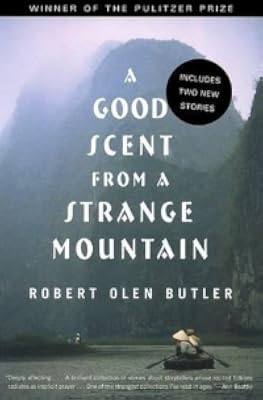
A Good Scent from a Strange Mountain: Stories
by Robert Olen Butler
On This Page
Description
Butler's Pulitzer Prize-winning collection of stories about the aftermath of the Vietnam War and its impact on the Vietnamese is reissued. Includes two subsequently published stories that complete the collection's narrative journey, returning to the jungles of Vietnam.Tags
Recommendations







Member Reviews
Friends have suffered with me as I've whined about every Pulitzer winner I've read that was a book of stories. Well, struggled through. I don't say "short stories" because, to me, a short story is 10 p. or less. With each of the others, I had to push myself to finish each story, setting minimum page limits to read each day and rarely meeting that minimum. Thank heaven for library policies allowing multiple renewals. But I digress.
Good Scent from a Strange Mountain was the opposite. I enjoyed every story. I loved the wide variety of voices and subject matters. Most of all I loved the story-telling. I came to care quickly about each of the characters, feeling that they may well be my neighbors. Each story felt complete in itself without show more leaving the uncomfortable feeling of "now what?". It is as if you, the reader, are handed an interesting photograph and the author says "let me tell you what led up to this picture". And then with deft skill, he guides you there, through the ups and downs and sideways slips. You always know how the story will end because of the photograph. Still, when he finishes the tale, you now understand the poignancy of pathway that led to the photograph.
Excellent, excellent book. Especially for a book of stories. Butler is a masterful story-teller of the old school -- real life, not New Yorker snobbery. show less
Good Scent from a Strange Mountain was the opposite. I enjoyed every story. I loved the wide variety of voices and subject matters. Most of all I loved the story-telling. I came to care quickly about each of the characters, feeling that they may well be my neighbors. Each story felt complete in itself without show more leaving the uncomfortable feeling of "now what?". It is as if you, the reader, are handed an interesting photograph and the author says "let me tell you what led up to this picture". And then with deft skill, he guides you there, through the ups and downs and sideways slips. You always know how the story will end because of the photograph. Still, when he finishes the tale, you now understand the poignancy of pathway that led to the photograph.
Excellent, excellent book. Especially for a book of stories. Butler is a masterful story-teller of the old school -- real life, not New Yorker snobbery. show less
A Good Scent from a Strange Mountain is one of the most extraordinary collections of short stories that I have ever read.
Each of the 15 short stories is written in the first person, from the standpoint of a different individual. All of the fictional narrators are immigrants to the US from Vietnam who are living in New Orleans. The characters are distinctive and memorable, include males and females, and range from young to very old. The stories are powerful and evocative, very human stories of love, loss, betrayal, and reconciliation.
Each of them deserves to be savored. In fact, I cannot read more than one in a setting, and they stay with me long afterwards.
Summarizing their themes does not do them justice. "Fairy Tail" is told from show more the standpoint of a "Miss Nol", an exotic dancer in a New Orleans nightclub who used to work as a bar girl in Saigon -- and who, remarkably, finds what she needed from an unlikely source. "Open Arms" is related by a Vietnamese man who worked as an interpreter during the war. He recounts an episode in which a fighter from the other side is welcomed by the US forces -- with tragic, unforeseeable consequences. "In the Clearing" is told from the standpoint of an expatriate man who is writing a letter back home to Vietnam, to the son he has never met (the man had to leave his homeland at the end of the war, leaving his pregnant wife behind). In "Mid-Autumn", a young woman who is married to an American man, talks to her unborn child about her first betrothed from back home -- who died in the war. In "Preparation", a woman in a mortuary prepares the hair and makeup of her deceased best friend -- with an epiphany that explains their relationship. In the eponymous tale, a 100 year old man imagines that he is being visited by Ho Chi Minh, whom he knew in his younger years. "The American Couple" is a longer piece than the others (at 79 pages), and is a strange and humorous tale about told by a young woman who has come to embrace American pop culture... and whose her husband and his new American friend play seriously at reliving their military experiences.
The author of these stories, Robert Olen Butler, spent years in Vietnam as an army linguist where he adapted to the local culture. That experience, and his ongoing acquaintance with the expatriate Vietnamese communities around New Orleans helped give him the ability to adopt the personas of the fictional narrators of the stories. Given that he is European- American, I expected that some reviewers at Amazon would object to Butler's writing on the grounds of "cultural appropriation". However, of the several reviews that I read, I didn't see any who did so. Perhaps this is because the voicings seem (to a reader's ears) so real and because the stories are so powerful and so sensitively rendered.
I can see why this author won a Pulitzer for these stories. I recommend them highly. show less
Each of the 15 short stories is written in the first person, from the standpoint of a different individual. All of the fictional narrators are immigrants to the US from Vietnam who are living in New Orleans. The characters are distinctive and memorable, include males and females, and range from young to very old. The stories are powerful and evocative, very human stories of love, loss, betrayal, and reconciliation.
Each of them deserves to be savored. In fact, I cannot read more than one in a setting, and they stay with me long afterwards.
Summarizing their themes does not do them justice. "Fairy Tail" is told from show more the standpoint of a "Miss Nol", an exotic dancer in a New Orleans nightclub who used to work as a bar girl in Saigon -- and who, remarkably, finds what she needed from an unlikely source. "Open Arms" is related by a Vietnamese man who worked as an interpreter during the war. He recounts an episode in which a fighter from the other side is welcomed by the US forces -- with tragic, unforeseeable consequences. "In the Clearing" is told from the standpoint of an expatriate man who is writing a letter back home to Vietnam, to the son he has never met (the man had to leave his homeland at the end of the war, leaving his pregnant wife behind). In "Mid-Autumn", a young woman who is married to an American man, talks to her unborn child about her first betrothed from back home -- who died in the war. In "Preparation", a woman in a mortuary prepares the hair and makeup of her deceased best friend -- with an epiphany that explains their relationship. In the eponymous tale, a 100 year old man imagines that he is being visited by Ho Chi Minh, whom he knew in his younger years. "The American Couple" is a longer piece than the others (at 79 pages), and is a strange and humorous tale about told by a young woman who has come to embrace American pop culture... and whose her husband and his new American friend play seriously at reliving their military experiences.
The author of these stories, Robert Olen Butler, spent years in Vietnam as an army linguist where he adapted to the local culture. That experience, and his ongoing acquaintance with the expatriate Vietnamese communities around New Orleans helped give him the ability to adopt the personas of the fictional narrators of the stories. Given that he is European- American, I expected that some reviewers at Amazon would object to Butler's writing on the grounds of "cultural appropriation". However, of the several reviews that I read, I didn't see any who did so. Perhaps this is because the voicings seem (to a reader's ears) so real and because the stories are so powerful and so sensitively rendered.
I can see why this author won a Pulitzer for these stories. I recommend them highly. show less
"I'd lost a whole country and I didn't give it a thought. Vûng Táu was a beautiful city, and if I put my face into the wind, I could see nothing of it clearly, not its shaded streets or its white-sand beaches, not the South China Sea lying there beside it. I can speak these words and perhaps you can see these things clearly because you are using your imagination. But I cannot imagine these things because I lived them, and to remember them with the vividness I know they should have is impossible. They are lost to me."
This collection of short stories won the Pulitzer Prize in 1993. The stories are connected by setting and culture - all of them feature immigrants from Vietnam who have settled in New Orleans, Louisiana after the Vietnam show more War. It loses rating points from me only because the collection is a bit uneven - a few of the stories are not quite as good as the others. That being said, the stories that shine really SHINE. I loved these voices and the complex memories of a culture that has been displaced. It manages to be heart-breaking and triumphant at the same time.
"I like the way fairy tales start in America. When I learn English for real, I buy books for children and I read, 'Once upon a time.' I recognize this word 'upon' from some GI who buys me Saigon teas and spends some time with me and he is a cowboy from the great state of Texas. He tells me he gets up on the back of a bull and he rides it....After that, a few years later, I come to America and I read this word and I ask a man in the place I work on Bourbon Street in New Orleans if this is the same. Up on and upon. He is a nice man who comes late in the evening to clean up after men who see the show. He says this is a good question and he thinks about it and he says that yes, they are the same. I think this is very nice, how you get up on the back of time and ride and you don't know where it will go or how it will try to throw you off."
There are a total of seventeen stories in this collection, and some of them have appeared in other publications, but this is the first time they are all collected together in one book. My very favorites were Mr. Green, The Trip Back, Fairy Tale, Letters to my Father, Snow, Salem, and Missing, but they are all worthy of reading. show less
This collection of short stories won the Pulitzer Prize in 1993. The stories are connected by setting and culture - all of them feature immigrants from Vietnam who have settled in New Orleans, Louisiana after the Vietnam show more War. It loses rating points from me only because the collection is a bit uneven - a few of the stories are not quite as good as the others. That being said, the stories that shine really SHINE. I loved these voices and the complex memories of a culture that has been displaced. It manages to be heart-breaking and triumphant at the same time.
"I like the way fairy tales start in America. When I learn English for real, I buy books for children and I read, 'Once upon a time.' I recognize this word 'upon' from some GI who buys me Saigon teas and spends some time with me and he is a cowboy from the great state of Texas. He tells me he gets up on the back of a bull and he rides it....After that, a few years later, I come to America and I read this word and I ask a man in the place I work on Bourbon Street in New Orleans if this is the same. Up on and upon. He is a nice man who comes late in the evening to clean up after men who see the show. He says this is a good question and he thinks about it and he says that yes, they are the same. I think this is very nice, how you get up on the back of time and ride and you don't know where it will go or how it will try to throw you off."
There are a total of seventeen stories in this collection, and some of them have appeared in other publications, but this is the first time they are all collected together in one book. My very favorites were Mr. Green, The Trip Back, Fairy Tale, Letters to my Father, Snow, Salem, and Missing, but they are all worthy of reading. show less
This book, A GOOD SCENT FROM A STRANGE MOUNTAIN, won a Pulitzer Prize over 25 years ago, so I'm kinda late getting around to it. But Butler's newest book, PERFUME RIVER, just won high praise in the Washington Post, reviewed by a writer I admire, Benjamin Busch. So I shuffled through my bookcase and found this old, much studied and much honored book from 1992, and - lo and behold - there on its blurb page is praise from Ben's late father, Frederick Busch, whose work I revere. Busch the elder said -
"These stories are a searing adventure into the New World he makes of America."
And they are. A different voice tells each tale in this slim collection of 16 stories. And every one of the narrators is a survivor of Vietnam. Indeed, every show more narrator is Vietnamese, young and old, male and female - all are represented. And the characters seem to me to be believable enough, as they tell their stories of how they became a part of the New Orleans communities where they are concentrated. Former ARVN soldiers, young widows, cuckholded husbands, lonely, still-displaced people trying to find a place in this strange 'new world' Fred Busch found in Butler's stories.
The stories themselves are artful and real enough seeming to me, and yet my enjoyment of them was marred ever so slightly by a constant nagging question in the back of my mind. How could Butler, a Caucasian American, presume to tell these stories of displaced people from Southeast Asia, and from their points-of-view? I kept wondering how actual Vietnamese refugees in America who might have read these stories might have reacted. Have any such people been heard from? While it's true that Butler did serve with the US Army in Vietnam, he is NOT Vietnamese. He has never had to flee his own country and start over again, often without friend or family, in a strange country with a new language.
Another nagging question. Did he win the Pulitzer because of the very unusual nature of his stories? All these first-person stories with Vietnamese telling the stories? A leap of faith on the part of readers is absolutely necessary in order to sink into these stories.
I'm "just askin'," ya know? I'm not trying to detract from Butler's obvious storytelling skills. I guess I'm just having trouble with the ol' "willing suspension of disbelief" concept. Bottom line: I liked the book - except for that nagging problem of authenticity of voice, of a certain presumptuousness on Butler's part. Having said all this, I will still recommend the book highly. Now I kinda want to read that PERFUME RIVER book. (four and a half stars)
- Tim Bazzett, author of the memoir, BOOKLOVER show less
"These stories are a searing adventure into the New World he makes of America."
And they are. A different voice tells each tale in this slim collection of 16 stories. And every one of the narrators is a survivor of Vietnam. Indeed, every show more narrator is Vietnamese, young and old, male and female - all are represented. And the characters seem to me to be believable enough, as they tell their stories of how they became a part of the New Orleans communities where they are concentrated. Former ARVN soldiers, young widows, cuckholded husbands, lonely, still-displaced people trying to find a place in this strange 'new world' Fred Busch found in Butler's stories.
The stories themselves are artful and real enough seeming to me, and yet my enjoyment of them was marred ever so slightly by a constant nagging question in the back of my mind. How could Butler, a Caucasian American, presume to tell these stories of displaced people from Southeast Asia, and from their points-of-view? I kept wondering how actual Vietnamese refugees in America who might have read these stories might have reacted. Have any such people been heard from? While it's true that Butler did serve with the US Army in Vietnam, he is NOT Vietnamese. He has never had to flee his own country and start over again, often without friend or family, in a strange country with a new language.
Another nagging question. Did he win the Pulitzer because of the very unusual nature of his stories? All these first-person stories with Vietnamese telling the stories? A leap of faith on the part of readers is absolutely necessary in order to sink into these stories.
I'm "just askin'," ya know? I'm not trying to detract from Butler's obvious storytelling skills. I guess I'm just having trouble with the ol' "willing suspension of disbelief" concept. Bottom line: I liked the book - except for that nagging problem of authenticity of voice, of a certain presumptuousness on Butler's part. Having said all this, I will still recommend the book highly. Now I kinda want to read that PERFUME RIVER book. (four and a half stars)
- Tim Bazzett, author of the memoir, BOOKLOVER show less
A collection of short stories by an American GI (who has long taught creative writing on the college level) who served as a translator in Vietnam. He clearly is taken with the country and its people but I found it offputting that all of the stories are told by Vietnamese narrators. There’s just something about an American writing from the point of view of Vietnamese narrators that bothered me. This won the Pulitzer Prize in 1993; back then, there weren’t a lot of Vietnamese authors writing or available in English so, from that perspective, I guess it’s all understandable but it mostly left me surprised that this was a Pulitzer winner.
This is one of the best books I have read in the last couple of years. Robert Olen Butler has portrayed the people and culture of the Vietnamese community in the United States so convincingly that I was compelled to research how he had developed such insight. (His only direct connection to Vietnam appears to have been a year as a linguist in that country in 1971.) Butler does a tremendous job of portraying both the thoughts and lives of a variety of Vietnamese people and how they have adapted to life in the United States, as well as describe their perceptions of the people of their adoptive country. Butler gives us bar girls, Vietnamese businessmen, a man with a ghost story that ends up as a commentary on living in the United States, an show more American "MIA" who never left Vietnam, a former GI who never got over Vietnam, a half-Vietnamese daughter of a GI who worked for years to get her into the United States and more. Every one of the stories is insightful, evocative and captivating. show less
David Foster Wallace interviews have been playing on the radio recently. In one he made a nice point about sarcasm/parody/wit/whatever-our-modern-skepticism-is being great to highlight hypocrisy - for tearing down - but not so useful for building up something to replace it that would give people some satisfaction. Wallace notes that it is really hard to build a replacement without sounding overly romantic and cheesy. Anyway, I think this book manages to do it. It takes a lot of courage and skill to write in that risky way - to take itself seriously. It does and that is cool.
Also, in general good short stories stay with you because they have some kind of surprise, left-field insight. These stories did that too in most cases. Reminds me show more of Alice Munro in that sense.
All around recommended for when one is in a receptive, non-witty mood. Nice book. show less
Also, in general good short stories stay with you because they have some kind of surprise, left-field insight. These stories did that too in most cases. Reminds me show more of Alice Munro in that sense.
All around recommended for when one is in a receptive, non-witty mood. Nice book. show less
Members
- Recently Added By
Published Reviews
ThingScore 75
"A Good Scent From a Strange Mountain" goes a long way toward making the Vietnamese real, and its method is bold: each of the 15 stories is told in the first person from the viewpoint of a Vietnamese transplanted from the Mekong Delta to the Louisiana bayou. The Americans have become foils; it's the Vietnamese who are now at the center, haunted by the past, ambivalent about their hosts, show more suffering sexual torments, seeking a truce in their various wars....
To become complete, these dislocated men and women return in memory and imagination to Vietnam, where folk tales narrated within the stories often illuminate their present condition....
The intricacy of these stories, and of most of the collection, lies in their motifs, not in psychological insight. Mr. Butler uses the narrative surprises and symbolic imagery of folklore, and as in folklore his meanings can be both simple and opaque. show less
To become complete, these dislocated men and women return in memory and imagination to Vietnam, where folk tales narrated within the stories often illuminate their present condition....
The intricacy of these stories, and of most of the collection, lies in their motifs, not in psychological insight. Mr. Butler uses the narrative surprises and symbolic imagery of folklore, and as in folklore his meanings can be both simple and opaque. show less
added by zhejw
Lists

Pulitzer Prize Winners for Fiction
102 works; 54 members

Pulitzer Prize-Winning Books
42 works; 9 members

Pen/Faulkner Winners and Finalists
178 works; 9 members

Books Read in 2018
4,360 works; 110 members

THE WAR ROOM
813 works; 24 members
Author Information

44+ Works 5,062 Members
Robert Olen Butler is a novelist, screenwriter, educator, and short-story writer who grew up in Granite City, Illinois. Butler served in Vietnam. Following the Vietnam War, Butler began writing. His stories have appeared in The New Yorker, Esquire, The Paris Review, and The Saturday Review, as well as in four annual editions of the Best American show more Short Stories and six annual editions of New Stories of the South. A collection of his stories, A Good Scent from a Strange Mountain, won the 1993 Pulitzer Prize for Fiction. Butler's novels include The Alleys of Eden, Countrymen of Bones, and Sun Dogs. He has received a Guggenheim Fellowship in fiction and a National Endowment for the Arts grant. Butler also won the Richard and Hinda Rosenthal Foundation Award from the American Academy of Arts and Letters. He teaches creative writing at McNeese State University. (Bowker Author Biography) show less
Awards and Honors
Awards
Distinctions
Notable Lists
Common Knowledge
- Original publication date
- 1992
- Important places
- Vietnam
- Dedication
- For John Wood
- First words
- From the first story, Open Arms: I have no hatred in me.
- Last words
- (Click to show. Warning: May contain spoilers.)From the first story, Open Arms: I can think about Thap and I can fold my hands together and at those times there is no hatred at all within me.
Classifications
Statistics
- Members
- 1,541
- Popularity
- 14,834
- Reviews
- 26
- Rating
- (3.80)
- Languages
- 7 — Danish, Dutch, English, French, German, Italian, Serbian
- Media
- Paper, Audiobook, Ebook
- ISBNs
- 16
- ASINs
- 13