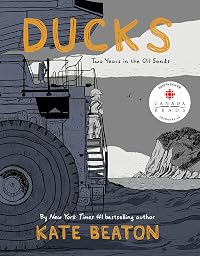
Ducks: Two Years in the Oil Sands
by Kate Beaton
On This Page
Description
Katie heads out west to take advantage of Alberta's oil rush-part of the long tradition of East Coasters who seek gainful employment elsewhere when they can't find it in the homeland they love so much. Katie encounters the harsh reality of life in the oil sands, where trauma is an everyday occurrence yet is never discussed. Beaton's natural cartooning prowess is on full display as she draws colossal machinery and mammoth vehicles set against a sublime Albertan backdrop of wildlife, northern show more lights, and boreal forest. Her first full length graphic narrative, Ducks: Two Years in the Oil Sands is an untold story of Canada: a country that prides itself on its egalitarian ethos and natural beauty while simultaneously exploiting both the riches of its land and the humanity of its people. show lessTags
Recommendations










Member Recommendations

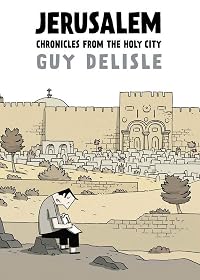
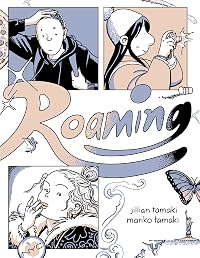
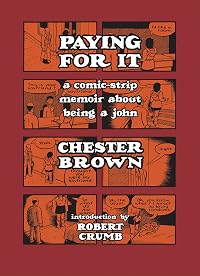
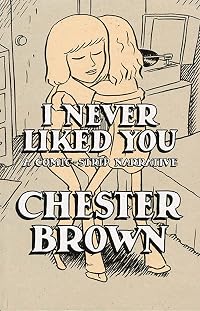
aprille There’s a description of the ugliness of an Australian mining town (Dampier) that chimed with this for me.
Member Reviews
I remember reading Kate Beaton's 'Ducks' back in 2014 when it was just a series of sketch comics on her "Hark a Vagrant" website. A lot of those stories made it into this book verbatim, which is good because I loved those comics.
This is not your typical Kate Beaton book. It's still smart and occasionally funny, but it's also very grounded in the mundane. None of her usual whimsy is to be found here. Even so, Beaton has proven herself to be an excellent storyteller with heavy subject matters.
Beaton does an amazing job humanizing her colleagues from the oil sands of northern Alberta, even the ones she doesn't seem to recall that fondly. She's empathetic enough to understand that even the surliest laborer is a distinct individual with show more their own inner life. It's this same empathy that makes this book a heavy read. Beaton has no shortage of sad or traumatic stories about her time spent working the oil sands. Stories about the long-term effects living an isolated life with little to do has on a person. The oil industry doesn't just remove value from the Earth for profit, it does the same for the humans who work for it.
There's a lot going on in this book, but the one overarching theme that unites everything is the incredible ability humans have to compartmentalize literally anything and keep moving forward. Environmental destruction, exploitative labor practices, harassment, drug addiction, sexual assault, & workplace fatalities are all things that occur within the pages of this book, and the people affected by these events are able to be file them away to be dealt with at some other time. Or not at all. "That's just how things are here!" is a common response for tragedies both large and small. Humanity's superhuman ability to persevere through tragedy can be easily commodified to tolerate abuse.
I don't think this is a book for everyone, it is challenging & sobering, but it is very good. Kate Beaton is a longtime favorite of mine, and I'm glad to finally see those sketch comic PNGs become a full fledged book. show less
This is not your typical Kate Beaton book. It's still smart and occasionally funny, but it's also very grounded in the mundane. None of her usual whimsy is to be found here. Even so, Beaton has proven herself to be an excellent storyteller with heavy subject matters.
Beaton does an amazing job humanizing her colleagues from the oil sands of northern Alberta, even the ones she doesn't seem to recall that fondly. She's empathetic enough to understand that even the surliest laborer is a distinct individual with show more their own inner life. It's this same empathy that makes this book a heavy read. Beaton has no shortage of sad or traumatic stories about her time spent working the oil sands. Stories about the long-term effects living an isolated life with little to do has on a person. The oil industry doesn't just remove value from the Earth for profit, it does the same for the humans who work for it.
There's a lot going on in this book, but the one overarching theme that unites everything is the incredible ability humans have to compartmentalize literally anything and keep moving forward. Environmental destruction, exploitative labor practices, harassment, drug addiction, sexual assault, & workplace fatalities are all things that occur within the pages of this book, and the people affected by these events are able to be file them away to be dealt with at some other time. Or not at all. "That's just how things are here!" is a common response for tragedies both large and small. Humanity's superhuman ability to persevere through tragedy can be easily commodified to tolerate abuse.
I don't think this is a book for everyone, it is challenging & sobering, but it is very good. Kate Beaton is a longtime favorite of mine, and I'm glad to finally see those sketch comic PNGs become a full fledged book. show less
This was really good. I can see why people have loved this. It’s a thoughtful and many-dimensioned look at the ethics of working in the oil sands, of working as a woman in a male-dominated place, of what isolation for work can do to people—any people—who are put in that situation. It was very moving, and Beaton’s ability to create a lot of emotion with her clear, efficient style was truly impressive. I can understand why the wait list for this was so long at the library.
I'm so grateful that people pursue art as a career, that some even went to university for it, even when it so often devalued and overpriced. I'm so glad that Kate Beaton got big enough that she was able to tell this part of her life. This book was a great reminder to me of why I enjoy reading, because I'm fascinated by all the different paths people can take because I can only take one myself.
I think graphic novels have established themselves well enough now as a part of Serious Literature. Even then, this novel still philosophised and delved so much deeper than I expected into the themes of identity and how fragile our sense of self can be.
As already a fan of Beaton's drawings and humour, this was right up alley while also expanding show more what I thought I knew or could assume about her. If you're not a fan yet, then please go through her webcomics first and then once you're an inevitable fan, get onto Ducks. show less
I think graphic novels have established themselves well enough now as a part of Serious Literature. Even then, this novel still philosophised and delved so much deeper than I expected into the themes of identity and how fragile our sense of self can be.
As already a fan of Beaton's drawings and humour, this was right up alley while also expanding show more what I thought I knew or could assume about her. If you're not a fan yet, then please go through her webcomics first and then once you're an inevitable fan, get onto Ducks. show less
After college, Katie Beaton left Mabou to find work in the oil sands of Alberta, in Fort McMurray, in order to pay off her student loans. In the camps, men outnumber women about fifty to one, and harassment is rampant, with no real recourse. Katie learns on the job, and moving from one camp to another, forms bonds with others. After being raped, she leaves for Victoria, British Columbia, to work in a maritime museum, but returns to the camps to earn the rest of the money she needs to pay off her student loans and eventually return home to Cape Breton, Nova Scotia. Katie's time changes her, as she ponders the peculiar environment of the camps - the isolation, depression, and drug abuse, as well as the impact on the environment and the show more Indigenous people whose home is being irreparably damaged.
Often bleak, occasionally funny, always thoughtful.
See also: Hey Kiddo by Jarrett J. Krosoczka, Stitches by David Smalls
Quotes
"All you need here is to be a woman. You stick out, and that's all it takes...and someone thinks they like you. But that doesn't make me feel good! That makes me feel like I'm not even a person!" (Katie, 70)
"Do you know how people treat a place where they don't live?" (Somali cab driver, 142)
"Do you think people are different at home than they are here? ...Then, are they different forever? ...People do things here they wouldn't do at home. But is that who they really are? Or are they who they are at home?" (Katie, 201)
"Do you think this place makes people better or worse?" (Katie, 224)
"Nobody likes it here. Everyone wishes they were somewhere else." (225)
"Well, I'm sure that was fucking weird for everyone! Back to work." (Ryan, 309)
"It felt like I had a second to decide, and an eternity to live with it." (Katie, 381) show less
Often bleak, occasionally funny, always thoughtful.
See also: Hey Kiddo by Jarrett J. Krosoczka, Stitches by David Smalls
Quotes
"All you need here is to be a woman. You stick out, and that's all it takes...and someone thinks they like you. But that doesn't make me feel good! That makes me feel like I'm not even a person!" (Katie, 70)
"Do you know how people treat a place where they don't live?" (Somali cab driver, 142)
"Do you think people are different at home than they are here? ...Then, are they different forever? ...People do things here they wouldn't do at home. But is that who they really are? Or are they who they are at home?" (Katie, 201)
"Do you think this place makes people better or worse?" (Katie, 224)
"Nobody likes it here. Everyone wishes they were somewhere else." (225)
"Well, I'm sure that was fucking weird for everyone! Back to work." (Ryan, 309)
"It felt like I had a second to decide, and an eternity to live with it." (Katie, 381) show less
One of the best graphic novels I've ever read, an incredibly impactful story made all the better by Beaton's incredible command of the comic panel format. Her dialogue is interesting, but so realistic that it makes every page flow like water. Some pictures of banal objects, or beauty against the backdrop of the harsh oil sands camps are staggering.
I feel a personal connection to this one - Beaton went to Mount Allison the same time I did, I remember reading her comics in the student newspaper (The Argosy) all the time. I forget if we met, or spoke but I certainly got a taste of the language and culture of the east coast with my time in New Brunswick. Seeing some very familiar names and slang rushed me back to a very important, show more unforgettable time in my life. To boot, she spent a year in Victoria - my hometown!
The content of the story is heartbreaking and difficult, to say the least. I think what I'm most impressed with is that she doesn't paint any broad strokes about the kind of people that suffer isolation, mental fatigue and physical risks that come with working in the oil sands. She doesn't excuse their bad behavior, nor does she give any easy answers. The reasons as to why people move out there to work, particularly her fellow Maritimers, are both simple and complex. The theme is as old as time, but feels fresh here. She doesn't pull any punches and my heart goes out to her and anybody who had to suffer like her, and many women, did and do on a daily basis.
I write this a week after my high school classmate was murdered by her estranged husband. I feel angry and helpless - I don't know what to do, say or even how to feel. So I might be vulnerable because of this emotional mindset I'm in, but it certainly made Ducks hit harder because of it.
Brilliant book, deserving of all the rewards it received. I hope Beaton keeps writing and drawing for many years. show less
I feel a personal connection to this one - Beaton went to Mount Allison the same time I did, I remember reading her comics in the student newspaper (The Argosy) all the time. I forget if we met, or spoke but I certainly got a taste of the language and culture of the east coast with my time in New Brunswick. Seeing some very familiar names and slang rushed me back to a very important, show more unforgettable time in my life. To boot, she spent a year in Victoria - my hometown!
The content of the story is heartbreaking and difficult, to say the least. I think what I'm most impressed with is that she doesn't paint any broad strokes about the kind of people that suffer isolation, mental fatigue and physical risks that come with working in the oil sands. She doesn't excuse their bad behavior, nor does she give any easy answers. The reasons as to why people move out there to work, particularly her fellow Maritimers, are both simple and complex. The theme is as old as time, but feels fresh here. She doesn't pull any punches and my heart goes out to her and anybody who had to suffer like her, and many women, did and do on a daily basis.
I write this a week after my high school classmate was murdered by her estranged husband. I feel angry and helpless - I don't know what to do, say or even how to feel. So I might be vulnerable because of this emotional mindset I'm in, but it certainly made Ducks hit harder because of it.
Brilliant book, deserving of all the rewards it received. I hope Beaton keeps writing and drawing for many years. show less
Kate Beaton is from Cape Breton, Nova Scotia, which has been suffering from an economic depression since the collapse of the fishing and coal industries a generation ago. Upon graduating from college with large student loans, Kate followed in the footsteps of many of her neighbors and joined the oil industry in Alberta, which promised more cash in a short amount of time than she could ever hope to make at home. For two years she moved around between different mining sites, working in a tool shed here and an office there. The isolation, belittlement, and sexual harassment were near constant, and if she tried to do something about it she was chastised for causing problems. Most of all, she bore witness to what this life does to men like show more her family and neighbors - poor men who leave their family behind for months or years and become hard and mean and get hit by trucks or maimed by machinery, all while destroying the environment.
This book is the definition of a magnum opus. Over 400 pages of hand-drawn grayscale comics detailing how she ended up in the oil sands and the complicated people she met there. The drawings of people are simple, in Beaton’s style, but interspersed are stunning illustrations of oil pumping equipment, landscapes, and wildlife. It’s a story that could never be told in any other format. show less
This book is the definition of a magnum opus. Over 400 pages of hand-drawn grayscale comics detailing how she ended up in the oil sands and the complicated people she met there. The drawings of people are simple, in Beaton’s style, but interspersed are stunning illustrations of oil pumping equipment, landscapes, and wildlife. It’s a story that could never be told in any other format. show less
***SPOILERS HIDDEN***
In 2005 cartoonist Kate Beaton found herself in a dilemma as a recent college graduate with large student loans to pay off. Her double degree in history and anthropology wasn’t opening doors career-wise, so she headed to Alberta, Canada, to work in the oil sands, a job that paid handsomely. Ducks is a sequential-art memoir about her two years working there.
Extremely male-dominated—roughly fifty men to every one woman—oil sands are far from ideal workplaces for women, especially for a young woman making this her first job out of college. This memoir is 450 pages, and stunningly, the majority of it is a chronicling of constant sexual harassment and more:Beaton was raped on two different occasions . It appears show more that not a day went by without some kind of harassment, whether that be quiet leering, objectifying comments to Beaton herself, or objectifying and misogynistic comments about women in general—yet Beaton soldiered her way through what would, understandably, break many people. It was a soul-crushing existence, and her fortitude, and work ethic, stand out as much as the outrageous depictions of harassment.
She wasn’t a robot, though. The panels portrayingher rapes show her in a dissociated state during and hollowed out afterward. Making matters worse was that she had no recourse. Complaining would not only change nothing but could mean consequences for her, and she couldn’t afford to have the job get any worse than it already was, or to lose it altogether. In moments of introspection, Beaton pondered her dilemma and went further to examine how loneliness, isolation, and boredom can bring out another side of a person. She struggled with the reality that most of the men toiling away at this job were husbands, boyfriends, and dads, yet in addition to the sexual harassment and assault, cheating was a way of life at the work camps, expected and even encouraged. She never used the term “toxic masculinity,” but her memoir shows that the oil sands are the very embodiment of the mindset and behavior. In an environment so rough and intimidating, any man who didn’t follow the “male code” would be swiftly mocked and ostracized. She and her sister, who eventually joined her as a co-worker, wondered whether their own loving father could change for the worse if put in such an environment. Is anyone immune?:
"The worst part for me about being harassed here isn’t that people say shitty things. It’s when they say them and they sound like me, in the accent that I dropped when I went to university. That they look like my cousins and uncle, you know, even though they’re from all over the country…that they are familiar. And that this place creates that where it didn’t exist before. This place. It’s not an excuse, it’s just…The worst thing is that your heart breaks."
But Beaton also acknowledged that many men ignored her (not that they weren’t harassing anyone, cheating, or both, however); it’s just that the abusive men so dominated her life that it was easy to forget about the ones who didn’t abuse her.
She also made the best of her situation. She was friendly with many of the (better) men she worked with. All the while, some of these men addressed her as “Doll” and variations on that, but she let it pass. The impression isn’t that she approved of such belittling monikers, just that she recognized the limits of her miserable situation: Complaining wouldn’t be good for her, and her paycheck would. Ducks is Beaton’s reclaiming of some of the power she lost when she was forced to shut up to get what she needed.
People shouldn’t read this book if they can’t tolerate depictions of men behaving at their worst around women. The memoir is basically a series of these incidents. It doesn’t tell a story, and chronology is nonexistent, but that disorganization works somewhat to show that every day was the same—both the soulless, ugly work setting and the atrocious behavior:
" . . . work camps are a uniquely capsuled-off society, a liminal space, and analogue for so many other male-dominated spaces. Gendered violence does happen when men outnumber women by as much as fifty to one, as they can in the camps or [at] work sites. Of course it does. Of course this happens when men are in isolation for long stretches of time, away from their families and relationships and communities, and completely resocialized in a camp and work environment like that of the oil sands."
That’s recognition of a disturbing reality, not an excuse. Beaton’s memoir won’t allow dysfunction to be swept under the rug. show less
In 2005 cartoonist Kate Beaton found herself in a dilemma as a recent college graduate with large student loans to pay off. Her double degree in history and anthropology wasn’t opening doors career-wise, so she headed to Alberta, Canada, to work in the oil sands, a job that paid handsomely. Ducks is a sequential-art memoir about her two years working there.
Extremely male-dominated—roughly fifty men to every one woman—oil sands are far from ideal workplaces for women, especially for a young woman making this her first job out of college. This memoir is 450 pages, and stunningly, the majority of it is a chronicling of constant sexual harassment and more:
She wasn’t a robot, though. The panels portraying
"The worst part for me about being harassed here isn’t that people say shitty things. It’s when they say them and they sound like me, in the accent that I dropped when I went to university. That they look like my cousins and uncle, you know, even though they’re from all over the country…that they are familiar. And that this place creates that where it didn’t exist before. This place. It’s not an excuse, it’s just…The worst thing is that your heart breaks."
But Beaton also acknowledged that many men ignored her (not that they weren’t harassing anyone, cheating, or both, however); it’s just that the abusive men so dominated her life that it was easy to forget about the ones who didn’t abuse her.
She also made the best of her situation. She was friendly with many of the (better) men she worked with. All the while, some of these men addressed her as “Doll” and variations on that, but she let it pass. The impression isn’t that she approved of such belittling monikers, just that she recognized the limits of her miserable situation: Complaining wouldn’t be good for her, and her paycheck would. Ducks is Beaton’s reclaiming of some of the power she lost when she was forced to shut up to get what she needed.
People shouldn’t read this book if they can’t tolerate depictions of men behaving at their worst around women. The memoir is basically a series of these incidents. It doesn’t tell a story, and chronology is nonexistent, but that disorganization works somewhat to show that every day was the same—both the soulless, ugly work setting and the atrocious behavior:
" . . . work camps are a uniquely capsuled-off society, a liminal space, and analogue for so many other male-dominated spaces. Gendered violence does happen when men outnumber women by as much as fifty to one, as they can in the camps or [at] work sites. Of course it does. Of course this happens when men are in isolation for long stretches of time, away from their families and relationships and communities, and completely resocialized in a camp and work environment like that of the oil sands."
That’s recognition of a disturbing reality, not an excuse. Beaton’s memoir won’t allow dysfunction to be swept under the rug. show less
Members
- Recently Added By
Lists

Club Read's Graphic Stories Recommendations
127 works; 2 members

Globe and Mail | Canadian Non-Fiction: September 24, 2022
10 works; 1 member

Globe and Mail | Canadian Non-Fiction: June 10, 2023
10 works; 1 member

Globe and Mail | Canadian Non-Fiction: April 8, 2023
10 works; 1 member
Globe and Mail | Canadian Non-Fiction: April 15, 2023
10 works; 1 member
Globe and Mail | Canadian Non-Fiction: April 22, 2023
10 works; 1 member
Globe and Mail | Canadian Non-Fiction: April 29, 2023
10 works; 1 member
Best Graphic Novel Nonfiction
199 works; 101 members

Globe and Mail | Canadian Non-Fiction: May 5, 2023
10 works; 1 member

Books Read in 2023
5,547 works; 145 members
Globe and Mail | Canadian Non-Fiction: May 13, 2023
10 works; 1 member
Globe and Mail | Canadian Non-Fiction: May 20, 2023
10 works; 1 member
Globe and Mail | Canadian Non-Fiction: May 27, 2023
10 works; 1 member

Globe and Mail | Canadian Non-Fiction: June 17, 2023
10 works; 1 member

Globe and Mail | Canadian Non-Fiction: March 25, 2023
10 works; 1 member
Globe and Mail | Canadian Non-Fiction: July, 29, 2023
10 works; 1 member
Globe and Mail | Canadian Non-Fiction: September 16, 2023
10 works; 1 member

Top Five Books of 2023
767 works; 317 members
Globe and Mail | Canadian Non-Fiction: Year End, 2023
10 works; 1 member

Best Biographies of Notable Women
279 works; 101 members

Best Biographies, Autobiographies and Memoirs
465 works; 160 members

Evergreen Award™ Winners and Nominees 2005–2024
200 works; 3 members

Books Set in Canada
80 works; 16 members

Obama Reads
181 works; 3 members

Top Five Books of 2025
954 works; 303 members
Globe and Mail | Canadian Non-Fiction: April 1, 2023
10 works; 1 member
Globe and Mail | Canadian Non-Fiction: March 11, 2023
10 works; 1 member
Globe and Mail | Canadian Non-Fiction: March 18, 2023
10 works; 1 member

Globe and Mail | Canadian Non-Fiction: December 17, 2022
10 works; 1 member

Globe and Mail | Canadian Non-Fiction: October 8, 2022
10 works; 1 member
Globe and Mail | Canadian Non-Fiction: October 15, 2022
10 works; 1 member
Globe and Mail | Canadian Non-Fiction: October 22, 2022
10 works; 1 member
Globe and Mail | Canadian Non-Fiction: October 29, 2022
10 works; 1 member
Globe and Mail | Canadian Non-Fiction: November 5, 2022
10 works; 1 member
Globe and Mail | Canadian Non-Fiction: November 12, 2022
10 works; 1 member
Globe and Mail | Canadian Non-Fiction: November 19, 2022
10 works; 1 member

Books Read in 2022
5,168 works; 111 members

Top Five Books of 2022
736 works; 272 members

Books recommended by Barack Obama
295 works; 28 members
Globe and Mail | Canadian Non-Fiction: December 24, 2022
10 works; 1 member
Globe and Mail | Canadian Non-Fiction: October 1, 2022
10 works; 1 member
Globe and Mail | Canadian Non-Fiction: January 7, 2023
10 works; 1 member
Globe and Mail | Canadian Non-Fiction: January 14, 2023
10 works; 1 member
Globe and Mail | Canadian Non-Fiction: January 21, 2023
10 works; 1 member

Canada Reads Winners and Nominees
129 works; 9 members
Globe and Mail | Canadian Non-Fiction: January 28, 2023
10 works; 1 member
Globe and Mail | Canadian Non-Fiction: February 4, 2023
10 works; 1 member

Globe and Mail | Canadian Non-Fiction: February 11, 2023
10 works; 1 member

Globe and Mail | Canadian Fiction: February 18, 2023
10 works; 1 member
Globe and Mail | Canadian Non-Fiction: February 25, 2023
10 works; 1 member
Drawn & Quarterly
15 works; 1 member

Globe and Mail | Canadian Non-Fiction: March 4, 2023
10 works; 1 member

naturallogg's 2025 in Books
50 works; 1 member
Author Information

15+ Works 5,533 Members
Awards and Honors
Awards
Distinctions
Notable Lists
Work Relationships
Is an expanded version of
Common Knowledge
- Canonical title
- Ducks: Two Years in the Oil Sands
- Original publication date
- 2022-09-13
- People/Characters
- Kate Beaton; Neil Beaton (father of Katie Beaton); Marion Beaton (mother of Katie Beaton); Becky Beaton (sister of Katie Beaton); Laureen Beaton (sister of Katie Beaton); Maura Beaton (sister of Katie Beaton) (show all 40); Lindsay Bird (travel coordinator); Laura (warehouse supervisor); Darlene (tool crib attendant); Ken (warehouse supervisor); Radar (driver); Archie of Nova Scotia; Lily of Nova Scotia; Carmen (tool crib attendant); Ambrose (mechanic foreman); Brent (mechanic); Tyler (mechanic); Chuck (mechanic); Shane "The Baby" (mechanic); Jodi (tool crib attendant); Rosie (tool crib attendant); Leon (tool crib lead hand); Mike (mechanic); Damian (tool crib attendant); Angus (swamper); Dougie (tool crib attendant); Brian (mechanic); Russell (warehouse foreman); Trish (admin); Joe (equipment coordinator); Ryan (warehouse foreman); Emily Legge (warehouse office); Hatim (QC weld mapping); Pat (tool crib attendant); Davy MacDonald (crane operator); Norman (mechanic); John (field liaison superintendent); Gary (project manager); John Wesley (oil sands worker); Celina Harpe
- Important places
- Fort McMurray, Alberta, Canada; Cape Breton, Nova Scotia, Canada; Mabou, Cape Breton, Nova Scotia, Canada; Athabasca Oil Sands, Alberta, Canada
- First words
- This story starts in 2005. I am twenty-one years old.
- Last words
- (Click to show. Warning: May contain spoilers.)Why did you let him talk to you like that?
- Blurbers
- Machado, Carmen Maria; Thien, Madeleine; Wiener, Anna; Lockwood, Patricia; Bechdel, Alison; Bruder, Jessica (show all 8); Yun, Jung; Turner, Chris
- Original language
- English
Classifications
- Genre
- Graphic Novels & Comics
- DDC/MDS
- 338.2728 — Society, government, & culture Economics Production Mineral Extraction By Product Carbonaceous materials Oil, oil shales, tar sands, natural gas
- LCC
- PN6733 .B33 .D83 — Language and Literature Literature (General) Literature (General) Collections of general literature Comic books, strips, etc.
- BISAC
Statistics
- Members
- 1,289
- Popularity
- 18,902
- Reviews
- 78
- Rating
- (4.35)
- Languages
- 9 — Chinese, English, French, German, Italian, Polish, Portuguese, Spanish, Swedish
- Media
- Paper, Ebook
- ISBNs
- 18
- ASINs
- 1