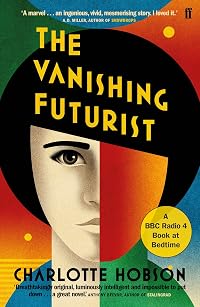
The Vanishing Futurist
by Charlotte Hobson
On This Page
Description
This debut novel by award-winning writer Charlotte Hobson pierces the heart with a story of fleeting, but infinite possibility.Tags
Recommendations






































Member Recommendations
Member Reviews
In the 1970s, an elderly Englishwoman thinks back to her youth, specifically the five years she spent in Moscow. She went there in 1914 as a governess, to the horror of her very conventional parents - they only let her go because a stout and upstanding member of their chapel, Miss Clegg, had worked in Moscow for 10 years and made the introduction to Gerty's new employers. Miss Clegg gives Gerty advice on how to stay out of trouble, but Gerty is rebellious - "I'll do my best to encounter untowardness", she thinks.
She is soon caught up in the romance of the large, disorderly family she works for - and, when it comes, the October revolution. By mid-1918, she is part of the Institute of Revolutionary Transformation, a commune that she has show more established with a group of friends. Their hallmark is to believe in the perfectability of the human being, and their manifesto "declares war" on the Private, the Old and the Ego. But human nature is more stubborn than that, and the commune becomes a microcosm of the trends, good and bad, in the wider Soviet world.
Gerty is conscious of the negative impact the Revolution had on many people, and is ashamed that she and her friends ignored what they knew to be the truth. But at the same time they were caught up in a hopeful idealism, the search for better lives and better relationships. The group's ringleader, a genius and crazed scientist and engineer called Nikita Slavkin (the vanishing futurist of the title) urges them: "Each time we - just we few - allow ourselves to imagine a harmonious world, we bring it closer. We are creating a future here, in our minds." Slavkin's inventions include the Propaganda Machine, which in 5 minutes of sensory overload aimed to create socialists from bourgeouis consciousnesses. His final invention is the Socialisation Machine, which transports the user to an alternate or future world where Communism is already a reality. But when he and his machine disappear, is that his ultimate success or failure?
This was a terrific read. It took me vividly into a world which I couldn't have imagined before, both in the hardships and the idealism - and it is a plea for optimism and belief in the possibility of making things better, however hard things get. show less
She is soon caught up in the romance of the large, disorderly family she works for - and, when it comes, the October revolution. By mid-1918, she is part of the Institute of Revolutionary Transformation, a commune that she has show more established with a group of friends. Their hallmark is to believe in the perfectability of the human being, and their manifesto "declares war" on the Private, the Old and the Ego. But human nature is more stubborn than that, and the commune becomes a microcosm of the trends, good and bad, in the wider Soviet world.
Gerty is conscious of the negative impact the Revolution had on many people, and is ashamed that she and her friends ignored what they knew to be the truth. But at the same time they were caught up in a hopeful idealism, the search for better lives and better relationships. The group's ringleader, a genius and crazed scientist and engineer called Nikita Slavkin (the vanishing futurist of the title) urges them: "Each time we - just we few - allow ourselves to imagine a harmonious world, we bring it closer. We are creating a future here, in our minds." Slavkin's inventions include the Propaganda Machine, which in 5 minutes of sensory overload aimed to create socialists from bourgeouis consciousnesses. His final invention is the Socialisation Machine, which transports the user to an alternate or future world where Communism is already a reality. But when he and his machine disappear, is that his ultimate success or failure?
This was a terrific read. It took me vividly into a world which I couldn't have imagined before, both in the hardships and the idealism - and it is a plea for optimism and belief in the possibility of making things better, however hard things get. show less
Charlotte Hobson has written a book that touches on two subjects that interest me enormously: the Russian Revolution and time travel. Without giving away too much of the plot -- and there is a central mystery which is explained on the very first page -- suffice it to say that the real time travellers here are the author and reader. Hobson has managed to get into the mind of a young English woman who finds herself in the Moscow of 1918. That woman founds an urban commune with her friends, and the stories of their struggles to create a new life together remind me of some stories of the early kibbutzim -- such as the sharing of clothing. Hobson doesn't flinch from describing the reality of Bolshevik Russia -- the cold, the hunger, the show more stifling bureaucracy, the lawlessness of the secret police (the Cheka), all of this happening not in the 1930s under Stalin, but in the first year of Lenin and Trotsky's rule. She understands all that, but she also gets the excitement and the hope, and the possibilities that the overthrow of the tsarist regime opened up. An excellent first novel. show less
Ratings
Members
- Recently Added By
Lists

Books about Russia and the former USSR
67 works; 12 members

Fiction Set During a Revolution
55 works; 23 members

Walter Scott Prize Winners and Shortlist
66 works; 6 members

Books Read in 2018
4,360 works; 110 members
Author Information

2+ Works 159 Members
Charlotte Hobson was born in Wilshire, England in 1970. She spent much of the nineties living in Russia, working for the Saatchi agency in Moscow and as an interpreter in the south of the country and Transcaucasia. Hobson now divides her time between translating and writing her first novel. She lives in Cornwall. (Bowker Author Biography)
Some Editions
Awards and Honors
Common Knowledge
- Original publication date
- 2016
- Important places
- Russia
- Epigraph
- What is a man? He is by no means a finished or harmonious being. No, he is still a highly awkward creature. Man, as an animal, has not evolved by plan but spontaneously, and has accumulated many contradictions...To produced a... (show all) new, 'improved' version of man - that is the future task of Communism. Man must look at himself as a raw material, or at best as a semi-manufactured product, and say: 'At last, my dear homo sapiens, I will work on you.'
Leon Trotsky
There are things which man is afraid to tell even to himself, and every decent man has a number of such things stored away in his mind.
Fyodor Dostoevsky - Dedication
- For Clio and Arthur
- Blurbers
- Beevor, Antony; Theroux, Marcel
- Original language
- English
Classifications
Statistics
- Members
- 45
- Popularity
- 660,905
- Reviews
- 2
- Rating
- (3.88)
- Languages
- English
- Media
- Paper, Ebook
- ISBNs
- 3
- ASINs
- 2