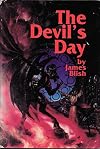
The Devil's Day
by James Blish
After Such Knowledge: Publication order (Collections and Selections — 3-4), After Such Knowledge (Collections and Selections — Omnibus 2.1-2.2)
On This Page
Description
A cloistered monk desperately tries to close the Pandora's box opened by a mischievous weapons dealer who has recruited a powerful black magician to stir up trouble for humanity on the eve of Judgement Day.Tags
Recommendations
















Member Recommendations
paradoxosalpha Naturalistic fantasy fiction that presents absurd features of Christian metaphysics in order to seriously consider their moral and psychological dimensions. Oh, and deicide.
20
Member Reviews
This is an omnibus book of the novella Black Easter and its sequel The Day After Judgement. What Stoker's Dracula and King's Salem's Lot is to vampires, The Devil's Day is to demons. Blish said in his Author's Note to Black Easter that every one of the "novels, poems and plays about magic and witchcraft" he's read treat it as "romantic or playful." He sought to write a treatment that "neither romanticizes magic nor treats it as a game." Black Easter is dedicated to C.S. Lewis and even included an extensive quotation from his Screwtape Letters heading one of the chapters.
So although I'm not sure I'd classify these novellas as out and out Christian fiction, this does come out of that world view and takes the demonic seriously--that's what show more does make it unusual and at times fascinating. It's obvious not just from his note but the vividness of his details and even the quotes heading chapters Blish did extensive research--actually reading grimoires and manuscripts on ceremonial magic. At the same time Blish is best known as a science fiction writer, and approaches magic with almost scientific rigor. The first book reads as Christian allegory of scientific hubris, the second as Cold War parody. I found that dated the second book and made it less interesting, although it did have moments of (very black) comedy. And maybe a believing Christian would have found the ending powerful and moving, as the ending of the first book was intended to be shocking--I found it trite. Mind you, I'm keeping this book on my bookshelf--simply because I find Blish's approach to magic and exploration of the temptations of knowledge so interesting. show less
So although I'm not sure I'd classify these novellas as out and out Christian fiction, this does come out of that world view and takes the demonic seriously--that's what show more does make it unusual and at times fascinating. It's obvious not just from his note but the vividness of his details and even the quotes heading chapters Blish did extensive research--actually reading grimoires and manuscripts on ceremonial magic. At the same time Blish is best known as a science fiction writer, and approaches magic with almost scientific rigor. The first book reads as Christian allegory of scientific hubris, the second as Cold War parody. I found that dated the second book and made it less interesting, although it did have moments of (very black) comedy. And maybe a believing Christian would have found the ending powerful and moving, as the ending of the first book was intended to be shocking--I found it trite. Mind you, I'm keeping this book on my bookshelf--simply because I find Blish's approach to magic and exploration of the temptations of knowledge so interesting. show less
Although the two halves of this book were originally published as separate volumes, they do form one continuous novel between them, and it is good to have them under one cover. With this story, Blish inaugurated a form of naturalistic fantasy that James Morrow (with a more conspicuously satirical bent) was later to make his own: realistic modern characters are subjected to the consequences of supernatural events postulated in biblical religion, or variations thereon.
Among several central characters, the chief protagonist of The Devil's Day is probably black magician Theron Ware. The magic in the book is well researched, and all in the genuine historical tradition, not the fictitious stuff of Harold Shea, Harry Potter, or even Gilbert show more Norrell. All the characters are a little too psychologically self-consistent to be convincing as people, but this ever-so-slight cartoonishness befits their semi-allegorical status, and helps to maintain the adventurous pacing of the story.
The initial scenario has arms tycoon Baines employing Ware to perform some sorcerous assassination. But the project rapidly snowballs in the synergy of the two men's ambitions, until the entire world is in danger. Black Easter (the first half) is in many ways simply a setup for The Day after Judgment (the second). And although there were points in the middle of the latter that I thought it had gone off the rails, it turned out to have very effectively raised what seemed to be the impossibly high stakes of the former. I found the ending quite satisfying. show less
Among several central characters, the chief protagonist of The Devil's Day is probably black magician Theron Ware. The magic in the book is well researched, and all in the genuine historical tradition, not the fictitious stuff of Harold Shea, Harry Potter, or even Gilbert show more Norrell. All the characters are a little too psychologically self-consistent to be convincing as people, but this ever-so-slight cartoonishness befits their semi-allegorical status, and helps to maintain the adventurous pacing of the story.
The initial scenario has arms tycoon Baines employing Ware to perform some sorcerous assassination. But the project rapidly snowballs in the synergy of the two men's ambitions, until the entire world is in danger. Black Easter (the first half) is in many ways simply a setup for The Day after Judgment (the second). And although there were points in the middle of the latter that I thought it had gone off the rails, it turned out to have very effectively raised what seemed to be the impossibly high stakes of the former. I found the ending quite satisfying. show less
Not as good as I remembered, but still pretty entertaining. Unusual premise, strong characters, well written but somehow not compelling. Worth this re-read, but probably shan't do so again.
A collection of 3 stories about devils being set loose in modern society. Not bad, but not extremely memorable either.
This is the book you should give to people who think that the Harry Potter series teaches how to do ritual magic. Let them reflect that it has never been made into a film, and then let them count their blessings.
-John Reilly
http://www.johnreilly.info/30March02.htm
-John Reilly
http://www.johnreilly.info/30March02.htm
Ratings
Members
- Recently Added By
Lists

Best Books Involving Satan
63 works; 26 members
Author Information

267+ Works 24,488 Members
James Benjamin Blish was born on May 23, 1921 in East Orange, N.J. Blish trained as a biologist at Rutgers and Columbia University, and spent 1942 - 1944 as a medical technician in the United States Army. After the war he became the science editor for the Pfizer pharmaceutical company. His first published story appeared in 1940, and his writing show more career progressed until he gave up his job to become a professional writer. From 1962 to 1968, he worked for the Tobacco Institute. Between 1967 and his death from lung cancer in 1975, Blish wrote authorized short story collections based upon the 1960s TV series Star Trek. He wrote 11 volumes adapting episodes of the series. He died midway through writing Star Trek 12. Perhaps Blish's most famous works were the "Okies" stories, known collectively as Cities in Flight, published in the science-fiction digest magazine Astounding Science Fiction. Some of James Blish's other works include The Vanished Jet, And All the Stars a Stage, The Quincunx of Time, and Flight of Eagles. (Bowker Author Biography) show less
Awards and Honors
Notable Lists
Series


Work Relationships
Is contained in
Contains
Common Knowledge
- Original title
- The Devil's Day
- Alternate titles
- Black Easter or Faust Aleph-Null / The Day After Judgement
- Original publication date
- 1980 (collection) (collection); 1968 (Black Easter) (Black Easter); 1971 (Day After Judgment | Day After Judgment) (Day After Judgment | Day After Judgment)
- People/Characters
- Theron Ware; Jack Ginsberg; F.X. Domenico Bruno Garelli; Baines
- Important places
- Death Valley, California, USA; Positano, Italy; Armageddon
- Epigraph
- Black Easter
Why, this is Hell; nor am I out of it. -Christopher Marlowe
The Day After Judgment
After such knowlege, what forgiveness?
--T. S. Eliot - Dedication
- Black Easter
In memoriam C.S. Lewis
The Day After Judgment
To Robert A. W. Lowndes - First words
- Black Easter
The room stank of demons.
The Day After Judgment
The Fall of God put Theron Ware in a peculiarly unenviable position, though he was hardly alone. - Last words
- (Click to show. Warning: May contain spoilers.)Black Easter
God is dead
(Click to show. Warning: May contain spoilers.)The Day After Judgment
Ginsberg: I ... love.
Classifications
Statistics
- Members
- 348
- Popularity
- 90,667
- Reviews
- 5
- Rating
- (3.82)
- Languages
- English
- Media
- Paper
- ISBNs
- 3
- ASINs
- 9