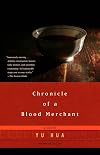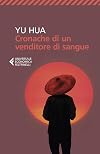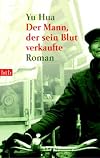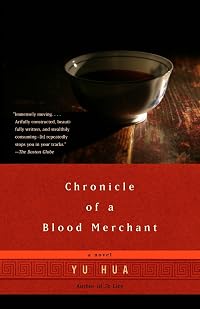
Chronicle of a Blood Merchant
by Yu Hua
On This Page
Description
A soaring literary achievement from internationally acclaimed writer Yu Hua, whose novels are now appearing in English for the first time, Chronicle of a Blood Merchant provides an unflinching portrait of China under Chairman Mao, as a factory worker must sell his blood to overcome every crisis. Xu Sanguan is a Chinese everyman-a cart-pusher in a silk mill struggling under the cruelty and hardships of Mao's leadership. His meager salary is not enough to sustain his family, so he pays regular show more visits to the local blood chief, followed by stops at the Victory Restaurant, where he pounds on the table and demands his ritual meal: "A plate of fried pork livers and two shots of yellow rice wine. And warm the wine up for me." But fried pork livers and yellow rice wine are not enough to restore Xu Sanguan. With the country in the throes of the Cultural Revolution, his visits to the blood chief become lethally frequent and his obligations to his family press against him mercilessly. At the height of famine, the Xu family lies motionless in bed, rising twice a day to consume increasingly watery rations of corn gruel. Xu Sanguan's wife is forced to stand on a stool in the center of town wearing a sandwich board that reads "prostitute". Yile, his wife's bastard son, forever haunts Xu Sanguan's sense of honor. And when Xu Sanguan sells his blood so he can take his family out to a proper meal, he does not invite Yile, who paces the town, famished and in tears, offering himself as a son to any man who will buy him a bowl of noodles. In a series of heartbreaking reversals, Xu Sanguan decides to risk his own life to save Yile and comes to understand that in a society ravaged by suspicion, hostility, and poverty, blood money not only pays debts, but forgives them as well. With rare emotional intensity, grippingly raw descriptions of place and time, and clear-eyed compassion, Yu Hua gives us a stunning tapestry of human life in the grave particulars of one man's days. show lessTags
Recommendations


Member Reviews
Xu Sanguan is an unforgettable character. He is the chronicled blood merchant, who literally and figuratively gives his life's blood for his family. Yu Hua wends this story beautifully, if starkly. It is the tale of a man and his family, while simultaneously providing a window into a culture. I found many facets of this novel to be quite striking. Having read several different Chinese authors, I am struck by the harsh familial culture in China. Horrific verbal slurs can be slung at one another, along with physical harm. However, it seems to be part and parcel of family life and does not necessarily lead to rifts. I am struck by stories of people living through multiple regime changes in one lifetime, and the survival skills spawned by show more those experiences. I have been fortunate to live in a country whose government has its issues, but whose basic values and expectations have remained static for over two hundred years. I am struck, as always, by the deep abiding love of family, of children for parents and vice versa. Love rules above all. Great book! show less
It was 1950s, the time China under the throes of Cultural Revolution and the Great Leap Forward, decades of traumatic history that provides the architectural background to the intimate details of Yu Hua's characters' lives. The novel explores an aspect of poverty that very few Chinese readers would miss the way in which the story engages the social and economics havoc of contemporary Chinese life under the red flag.
Everyone, especially men, who were strong enough went to sell a bowl of blood for 35 yuans (roughly US$5). In the countryside men who had not sold blood could not even get themselves a wife, for blood selling was more than a gesture of showcasing one's masculinity and health. Xu Sanguan was the blood merchant. His meager show more salary as a cart-pusher at a silk mill was not enough to sustain his family, which included his wife Xu Yulan and three sons. The impregnable Xu Sanguan had got himself on the good side of a local Blood Chief and gave blood in a frequent interval that was otherwise forbidden by hospital. In over 40 years, the impregnable Xu Sanguan had overcome every family calamity by selling his blood that he might as well had sold his life along with it. Each and every time he sold blood was for his sons.
For example, he sold blood to pay hospital bills of the blacksmith's son whose skull was cut open by his eldest son Yile, whom he had cuckolded for 9 years. As Mao directed all youths to be exiled to the countryside for reeducation by the farmers, Xu Sanguan again sold blood for money that would ease the austerity of lives of his sons. At the height of the three-year famine that claimed lives of 5 million Chinese, Xu Sanguan sold blood in exchange for food more nutritious than plain corn gruel, as the Xu family would lay in bed all day to conserve energy. In a series of heartrending drama and reversals, Xu Sanguan reconciled with his cuckolded son and decided to risk his life to save Yile, who had contracted hepatitis.
Chronicle of a Blood Merchant follows faithfully Xu's life during the early 1950s when socialism burgeoned in China, then the disastrously ambitious economic collectivization of the Great Leap Forward in 1958 and its aftermath of a 3-year famine (as recalled by my grandfather and father, whose herb house converted into a steel smelting ground by order of local bureau), to the factional violence of Cultural Revolution in 1966 to 1976. Yet the novel is not necessarily, or exclusively, historical in focus. It does not present itself as a rebutting critique of the political upheaval but rather a tapestry of human life and sufferings in the grave particulars of a very ordinary man's days.
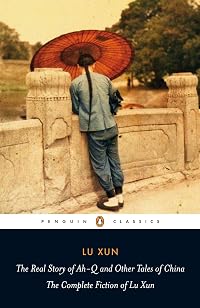
Yu Hua's realistic style bears much resemblance and affinity to that of Lu Xun (Diary of a Madman), another contemporary Chinese literary master whose work had induced the May 4th Movement in 1919. Like Lu Xun, and the more recent Su Tong, Mo Yan, Ha Jin, and Gao Xinjian, Yu Hua returns obsessively to the violent, excruciating spectacles of China's tumultuous modern history without reservation and in a very detached voice. show less
Everyone, especially men, who were strong enough went to sell a bowl of blood for 35 yuans (roughly US$5). In the countryside men who had not sold blood could not even get themselves a wife, for blood selling was more than a gesture of showcasing one's masculinity and health. Xu Sanguan was the blood merchant. His meager show more salary as a cart-pusher at a silk mill was not enough to sustain his family, which included his wife Xu Yulan and three sons. The impregnable Xu Sanguan had got himself on the good side of a local Blood Chief and gave blood in a frequent interval that was otherwise forbidden by hospital. In over 40 years, the impregnable Xu Sanguan had overcome every family calamity by selling his blood that he might as well had sold his life along with it. Each and every time he sold blood was for his sons.
For example, he sold blood to pay hospital bills of the blacksmith's son whose skull was cut open by his eldest son Yile, whom he had cuckolded for 9 years. As Mao directed all youths to be exiled to the countryside for reeducation by the farmers, Xu Sanguan again sold blood for money that would ease the austerity of lives of his sons. At the height of the three-year famine that claimed lives of 5 million Chinese, Xu Sanguan sold blood in exchange for food more nutritious than plain corn gruel, as the Xu family would lay in bed all day to conserve energy. In a series of heartrending drama and reversals, Xu Sanguan reconciled with his cuckolded son and decided to risk his life to save Yile, who had contracted hepatitis.
Chronicle of a Blood Merchant follows faithfully Xu's life during the early 1950s when socialism burgeoned in China, then the disastrously ambitious economic collectivization of the Great Leap Forward in 1958 and its aftermath of a 3-year famine (as recalled by my grandfather and father, whose herb house converted into a steel smelting ground by order of local bureau), to the factional violence of Cultural Revolution in 1966 to 1976. Yet the novel is not necessarily, or exclusively, historical in focus. It does not present itself as a rebutting critique of the political upheaval but rather a tapestry of human life and sufferings in the grave particulars of a very ordinary man's days.
Yu Hua's realistic style bears much resemblance and affinity to that of Lu Xun (Diary of a Madman), another contemporary Chinese literary master whose work had induced the May 4th Movement in 1919. Like Lu Xun, and the more recent Su Tong, Mo Yan, Ha Jin, and Gao Xinjian, Yu Hua returns obsessively to the violent, excruciating spectacles of China's tumultuous modern history without reservation and in a very detached voice. show less
Yu Hua's "Chronicle of a Blood Merchant," translated to English by Andrew F. Jones, is a book that is quick and easy to read, despite spanning 50 years of the protagonist's adult life.
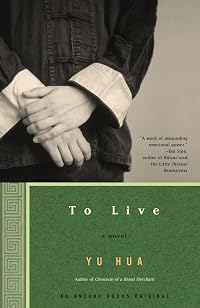
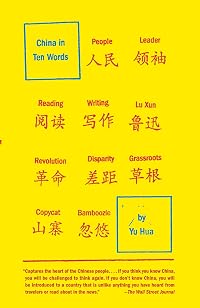
I have previously read Yu Hua's essay collection "China in Ten Words" and "To Live." I did not particularly like the former but I enjoyed the latter. I was most interested in "Chronicle of a Blood Merchant" after reading Yan Lianke's "Dream of Ding Village," which is a fictional account of an AIDS epidemic after a blood selling crisis in a small village.
"Chronicle of a Blood Merchant" tells the story of Xu Sanguan, a small-town factory worker who fights frequently with his wife after she gives birth to three boys, one of whom by another father. Despite show more being a harsh and seemingly unforgiving father, Xu Sanguan works hard for his children. Several times during their lives, he resorts to selling blood for a few dollars in order to help them, even during the famine proceeding the Great Leap Forward.
The book has moments of comedy, such as the back-and-forth squabbling between the husband and wife, and the repetition of phrases in dialogue, as well as some situational humor.
The book's ending is sweet although not as dramatic as "To Live," making "Chronicle of a Blood Merchant" a bit of a lighter read. The last line, "[t]hat's why people say pubic hair doesn't come out till after your eyebrows do, but gets even longer in the end," is confusing. It seems to equate younger people to pubic hair, which is mostly useless. Perhaps eyebrow hair, which is older, is a symbol of the wisdom of older people. show less
I have previously read Yu Hua's essay collection "China in Ten Words" and "To Live." I did not particularly like the former but I enjoyed the latter. I was most interested in "Chronicle of a Blood Merchant" after reading Yan Lianke's "Dream of Ding Village," which is a fictional account of an AIDS epidemic after a blood selling crisis in a small village.
"Chronicle of a Blood Merchant" tells the story of Xu Sanguan, a small-town factory worker who fights frequently with his wife after she gives birth to three boys, one of whom by another father. Despite show more being a harsh and seemingly unforgiving father, Xu Sanguan works hard for his children. Several times during their lives, he resorts to selling blood for a few dollars in order to help them, even during the famine proceeding the Great Leap Forward.
The book has moments of comedy, such as the back-and-forth squabbling between the husband and wife, and the repetition of phrases in dialogue, as well as some situational humor.
The book's ending is sweet although not as dramatic as "To Live," making "Chronicle of a Blood Merchant" a bit of a lighter read. The last line, "[t]hat's why people say pubic hair doesn't come out till after your eyebrows do, but gets even longer in the end," is confusing. It seems to equate younger people to pubic hair, which is mostly useless. Perhaps eyebrow hair, which is older, is a symbol of the wisdom of older people. show less
Yu Wua was very young when Mao worked his special brand of evil on his country. Yu's book and characters suffer from these indecencies, but find strength in the family unit, getting through desperate poverty and illness, betrayal and humiliation with their humanness.
Blood is what gives us fire and strength. By sharing blood, we share our lives and responsibilities with others. By selling blood, our protagonist buys back his own dignity.
I think there's some "lost in translation" happening here. The writer's style is definitely humorous and exaggerated as if writing for Chinese Theater, but still, some of the references and language seem to be lost of me... particularly the very last line: "That's why people say pubic hair doesn't come out till after your eyebrows do, but gets even longer in the end." I think it's something akin to love/familial relationships are stronger than social ones(?), but must be a cultural thing.
"Ce sont nos forces qu'on a vendues, tu comprends? Ce que vous les citadins, vous appelez sang, on l'appelle force à la campagne. IL y a deux genres de force, une qui provient du sang, une qui provient des muscles. La force du sang est plus précieuse que celle des muscles."
Sur 40 ans de vie, c'est sa force que Xu Sanguan vend pour faire face à l'adversité, un mot faible dans un système absurde traversé par la prise de pouvoir de Mao et la révolution culturelle.
Sur 40 ans de vie, c'est sa force que Xu Sanguan vend pour faire face à l'adversité, un mot faible dans un système absurde traversé par la prise de pouvoir de Mao et la révolution culturelle.
Jul 9, 2011French
Members
- Recently Added By
Lists

el
1,139 works; 1 member
Author Information

68+ Works 2,925 Members
Awards and Honors
Common Knowledge
- Canonical title
- Chronicle of a Blood Merchant
- Original title
- Xu Sanguan mai xue ji
- Original publication date
- 1996
- First words
- Xu Sanguan worked in the silk factory in town, distributing silkworm cocoons to the spinners.
Classifications
- Genres
- General Fiction, Fiction and Literature
- DDC/MDS
- 813 — Literature & rhetoric American literature in English American fiction in English
- LCC
- PL2928 .H78 .X813 — Language and Literature Languages and literatures of Eastern Asia, Africa, Oceania Languages of Eastern Asia, Africa, Oceania Chinese language and literature Chinese literature Individual authors and works
- BISAC
Statistics
- Members
- 377
- Popularity
- 83,579
- Reviews
- 9
- Rating
- (3.93)
- Languages
- 11 — Chinese, Dutch, English, Finnish, French, German, Italian, Portuguese, Spanish, Swedish, Turkish
- Media
- Paper, Ebook
- ISBNs
- 21
- ASINs
- 4