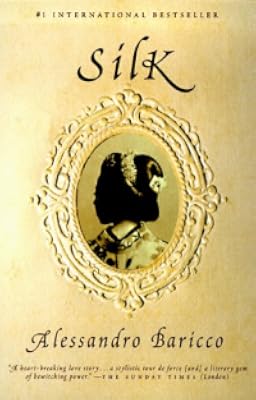
Silk
by Alessandro Baricco
On This Page
Description
A tale of lust and possession in nineteenth-century France and Japan, from the international bestsellerTags
Recommendations













Member Recommendations

Member Reviews
Herve Joncour is a mid 19th century French silkworm merchant, who is asked to travel to Japan to bring back silkworm eggs so that his town can still flourish in producing silk products after many nearer sources of the eggs become infected. There he meets a concubine of the local feudal chief and becomes infatuated with her, and the feeling is very much mutual, even though she can't speak French and is obviously tied to the powerful chief. Over the coming years, his life revolves around these three month trips to Japan, because of this woman, even when Japan slips into civil war and he puts his life in danger for doing so.
In the meantime he has a loving wife back at home, but in Franch he becomes distant and depressed, particularly when show more it seems there is no chance of ever meeting this woman again. But was she really the love of his life, or is there someone else closer to home he should be focusing on.
This very slight novel is nevertheless packed with plot and hidden meaning. It is told in a very sparse style, almost like a fable, with whole passages almost hypnotically, lyrically repeated. Thoughts are almost always hidden, and instead we only have actions to work on, and infer the hidden thoughts for ourselves.
There is an air of perfection to this work, with almost every word obviously carefully chosen, just like a great poem, and you end up feeling that every single word has significance. It appears at first sight to be a standard tragic romance, but the twists at the end demolish this, and then the pragmatic attitude of the protagonist at the very end lends a naturalistic air to it. But at the same time there are surrealistic elements, with the local head of business entirely abandoning all his possessions because of the result of a rather bizarre billiards game.
This is a novel to savour, to read over and over, to be moved by, and ultimately to dwell over for many days after you've put it down. show less
In the meantime he has a loving wife back at home, but in Franch he becomes distant and depressed, particularly when show more it seems there is no chance of ever meeting this woman again. But was she really the love of his life, or is there someone else closer to home he should be focusing on.
This very slight novel is nevertheless packed with plot and hidden meaning. It is told in a very sparse style, almost like a fable, with whole passages almost hypnotically, lyrically repeated. Thoughts are almost always hidden, and instead we only have actions to work on, and infer the hidden thoughts for ourselves.
There is an air of perfection to this work, with almost every word obviously carefully chosen, just like a great poem, and you end up feeling that every single word has significance. It appears at first sight to be a standard tragic romance, but the twists at the end demolish this, and then the pragmatic attitude of the protagonist at the very end lends a naturalistic air to it. But at the same time there are surrealistic elements, with the local head of business entirely abandoning all his possessions because of the result of a rather bizarre billiards game.
This is a novel to savour, to read over and over, to be moved by, and ultimately to dwell over for many days after you've put it down. show less
This story is special. It involves an impossible passion, a faithful wife, international intrigue, an ending with a twist, all told in beautifully spare language that seems not to suffer at all in translation. Written in Italian about a Frenchman traveling to Japan, translated into English---it shouldn't work at all but somehow the result is a magical 19th century romantic fable. With silkworms.
This slim little novella tells the tale of a 19th century silkworm merchant in beautiful, poetic, sometimes repeating prose that is at once lyrical and spare, creating a dreamlike, hypnotic effect. Herve Joncour buys silkworm eggs for the growing silk industry of Lavilledieu in southern France. When the silkworm supply of Europe and the Near East is affected by the spotted disease pebrine, Joncour is determined to travel to Japan, forbidding and mysterious, with a deep distrust of foreigners, and a ban on the sale of silkworm eggs to them.
"This place Japan, where precisely is it?" "That way, and keep going." He said. "Right to the end of the world."
In Japan, he meets Hara Kei, a powerful baron who has control over Joncour's silkworm show more prospects, as well as his safety and life. "The whole village existed for that man; there was scarcely a single action, up in those hills, that was not to protect him or do him pleasure. Life was a subdued hum, it proceeded with a slackness of pace, like a beast threatened in its lair. The world seemed centuries away." At a meeting with Hara Kei, Joncour encounters his concubine, in a profoundly sensual and erotically charged scene, and they are passionately drawn to each other. Like a mermaid's siren, she draws him back to Japan again and again, though they never speak or touch.
Each time Joncour travels to and from Japan the prose repeats, giving the story the feel of a fairy tale, and making Japan as fantastical as the underground land of the 12 Dancing Princesses, or Avalon. The book is both enchanting and wistful. show less
"This place Japan, where precisely is it?" "That way, and keep going." He said. "Right to the end of the world."
In Japan, he meets Hara Kei, a powerful baron who has control over Joncour's silkworm show more prospects, as well as his safety and life. "The whole village existed for that man; there was scarcely a single action, up in those hills, that was not to protect him or do him pleasure. Life was a subdued hum, it proceeded with a slackness of pace, like a beast threatened in its lair. The world seemed centuries away." At a meeting with Hara Kei, Joncour encounters his concubine, in a profoundly sensual and erotically charged scene, and they are passionately drawn to each other. Like a mermaid's siren, she draws him back to Japan again and again, though they never speak or touch.
Each time Joncour travels to and from Japan the prose repeats, giving the story the feel of a fairy tale, and making Japan as fantastical as the underground land of the 12 Dancing Princesses, or Avalon. The book is both enchanting and wistful. show less
What a gorgeous little book this is! It is only 91 pages and most of those pages are not completely filled because each new chapter starts on a new page. I read most of it while sitting in the Assiniboine Park conservatory surrounded by lush vegetation and beautiful flowers. Truly a perfect setting for a lush and beautiful book.
At the core this is a love story but there is also a mystery and a travelogue and history worked into it. Herve Joncour lives in a small town known for weaving silk. He provides the silk worms that produce the silk thread for the mills. When he first started he was able to travel to around the Mediterranean for the silk worms. Then those places started having epidemics that killed the worms so he had to travel show more to Syria and Egypt. The time came when those worms were also infected. In order to get untouched eggs Joncour took the long road to Japan which was just starting to open its doors to westerners. In Japan he met a silk worm merchant who had a non-Oriental woman as a companion. Joncour could not speak Japanese and the woman spoke only Japanese but they managed to convey their feelings of love to each other. Four times Joncour went to Japan and saw the lady but they never touched each other.
Who was this woman? We never find out. And that's just one of the mysteries. show less
At the core this is a love story but there is also a mystery and a travelogue and history worked into it. Herve Joncour lives in a small town known for weaving silk. He provides the silk worms that produce the silk thread for the mills. When he first started he was able to travel to around the Mediterranean for the silk worms. Then those places started having epidemics that killed the worms so he had to travel show more to Syria and Egypt. The time came when those worms were also infected. In order to get untouched eggs Joncour took the long road to Japan which was just starting to open its doors to westerners. In Japan he met a silk worm merchant who had a non-Oriental woman as a companion. Joncour could not speak Japanese and the woman spoke only Japanese but they managed to convey their feelings of love to each other. Four times Joncour went to Japan and saw the lady but they never touched each other.
Who was this woman? We never find out. And that's just one of the mysteries. show less
This is a tiny jewel of a novel and, like a jewel, I felt that it deserves to be looked at for longer than it’s size perhaps might initially indicate. I certainly spent longer looking at it than I might otherwise have done, my ex-wife having gone off with my copy prior to our split.
Eventually, I got it back from her and managed to finish it off. This meant I read it in two sittings, one either side of my divorce which, considering the subject matter, was somewhat ironic. Silk, you see, tells the story of unrequited love within a marriage, something that is sadly all too common an occurrence.
The writing is beautiful and brilliantly paced. It is simple and yet deep, and through it all Baricco lends everyday life a melancholic pathos show more that belies the depths of desire that each of us have. The tragedy of the novel, and unrequited love, is that a partner can remain blind to them while pursuing the fulfilment on their own desires beyond the relationship.
Baricco uses geography as the medium for this metaphor, with the protagonist Hervé Joncour travelling thousands of miles to Japan in search of silkworms from his native France. But Joncour discovers more than silkworms in the orient and returns many times in pursuit of something more, something which continually eludes him.
This is a sad and poignant novel which, if read carefully, serves as a warning not to spend so long gazing for fantasies beyond the horizons of our lives that we overlook those within arms’ reach. You’ll probably think nothing much of this beyond the beautiful writing style until you get to the end.
If it doesn’t hit you then, you’re not ready for this novel. Shelve it and come back to it when life’s dealt you a few blows. show less
Eventually, I got it back from her and managed to finish it off. This meant I read it in two sittings, one either side of my divorce which, considering the subject matter, was somewhat ironic. Silk, you see, tells the story of unrequited love within a marriage, something that is sadly all too common an occurrence.
The writing is beautiful and brilliantly paced. It is simple and yet deep, and through it all Baricco lends everyday life a melancholic pathos show more that belies the depths of desire that each of us have. The tragedy of the novel, and unrequited love, is that a partner can remain blind to them while pursuing the fulfilment on their own desires beyond the relationship.
Baricco uses geography as the medium for this metaphor, with the protagonist Hervé Joncour travelling thousands of miles to Japan in search of silkworms from his native France. But Joncour discovers more than silkworms in the orient and returns many times in pursuit of something more, something which continually eludes him.
This is a sad and poignant novel which, if read carefully, serves as a warning not to spend so long gazing for fantasies beyond the horizons of our lives that we overlook those within arms’ reach. You’ll probably think nothing much of this beyond the beautiful writing style until you get to the end.
If it doesn’t hit you then, you’re not ready for this novel. Shelve it and come back to it when life’s dealt you a few blows. show less
Herve Joncour is a French silk breeder who lives in the small town of Lavilledieu. It is 1861 and epidemics have decimated the silkworm eggs in Europe, so Joncour travels once a year to Egypt and Syria to obtain healthy eggs. Joncour's friend, Baldabiou, tells of the extraordinary silk of Japan and encourages Joncour to travel "to the end of the world" to obtain Japanese silkworm eggs. Joncour travels to Japan four times, each time leaving behind his faithful and loving wife Helene. He always takes the same route, travelling by train, horseback and ship. Japan is closed to the world at this time and Joncour must deal secretly with a local Japanese baron named Hara Kei. While negotiating with Hara Kei, Joncour is enamored by Kei's show more concubine with "eyes [that] did not have an Oriental slant." We learn nothing more about the concubine than this smallest of physical details. She neither speaks to nor touches Joncour, yet he falls instantly in love with this beautiful woman. He believes his love to be reciprocated and looks for her during his three subsequent visits. Civil war tears Hara Kei's village apart and forever separates Joncour from the enigmatic woman he believes he loves. Joncour no longer travels and settles down to a quiet village life with his wife until, one day, a letter arrives covered with Japanese ideograms that look like "a catalog of little bird tracks, compiled with meticulous folly. It was surprising to think that in fact they were signs, that is, the ashes of an incinerated voice." The peacefulness of Joncour's life from that moment on is tinged with the sadness of unfulfillment.
Silk is a simple story, told simply, using language that makes you want to weep. Silk is a novella, but the language and pacing make this little book seem more like poetry. What is left unsaid is just as important as what is said. The often sparse narration adds to the beauty and creates images that speak more intensely than a flurry of words. Take for instance the moment that Hara Kei's concubine looks at Joncour for the first time. She has been laying, perfectly still, with her head on Hara Kei's lap, her hair spread around her. Joncour and Hara Kei are negotiating when:
Suddenly,
without moving at all,
that girl
opened her eyes.
Herve Joncour did not pause, but instinctively lowered his gaze to her, and what he saw, without pausing, was that those eyes did not have an Oriental shape, and that they were fixed, with a disconcerting intensity, on him: as if from the start, from under the eyelids, they had done nothing else.
I am in awe of Baricco's ability to tell a story with such depth and emotion using such sparse language. His storytelling is like pulling the lightest of silks across your skin. It will make you shiver with delight. Read it. show less
Silk is a simple story, told simply, using language that makes you want to weep. Silk is a novella, but the language and pacing make this little book seem more like poetry. What is left unsaid is just as important as what is said. The often sparse narration adds to the beauty and creates images that speak more intensely than a flurry of words. Take for instance the moment that Hara Kei's concubine looks at Joncour for the first time. She has been laying, perfectly still, with her head on Hara Kei's lap, her hair spread around her. Joncour and Hara Kei are negotiating when:
Suddenly,
without moving at all,
that girl
opened her eyes.
Herve Joncour did not pause, but instinctively lowered his gaze to her, and what he saw, without pausing, was that those eyes did not have an Oriental shape, and that they were fixed, with a disconcerting intensity, on him: as if from the start, from under the eyelids, they had done nothing else.
I am in awe of Baricco's ability to tell a story with such depth and emotion using such sparse language. His storytelling is like pulling the lightest of silks across your skin. It will make you shiver with delight. Read it. show less
“Perhaps sometimes life shows you a side of itself which leaves you with nothing more to say”
Let me just start by stating that this was a book that I did not expected to enjoy and only read it because it was on the 1001 list. However, I was very surprised by it. Firstly I read it in sitting which is most unusual, yes it is only a light read only 140 0r so pages long but I found myself totally engrossed with it.
The story is based around a young Frenchman in the 1860s who is involved in the silk trade, travelling around buying silkworms for the mills in his home town. When disease starts to kill off the usual supplies of worms, Herve Jancour is sent to Japan just as the country is being forcibly opened up to outside trade. On arrival show more Jancour becomes obsessed with the concupine of his new supplier's concupine despite being unable to communicate with her looking forward to his return trip each year despite having a wife back at home and having a fairly relaxed way of life. When war breaks out in Japan Jancour's dreams seem to be falling apart. In the end Jancour settles into a contented routine with his wife in France but there was always a wistful part of him that wanted more. Perhaps it was meant as a metaphor for no matter how happy we may feel to be we are all dreaming of something more of perfection. At first I found it hard to imagine how a man could fall for a woman that he could not even talk to let alone touch but later realised that obsession is not so easy to appreciate.
I loved the author's sparse yet rich use on language which had a deeply poetic feel about it with barely a word wasted. On each trip back to Japan there was a fair bit of repetition but this with subtle differences seemed to only enhance to coming action and I certainly got the impression that Baricco rather had fun playing around with it.
As I stated I had not initially expected to enjoy this book but in the end felt it was a little gem and certainly made me think about what exactly is the definition of true love show less
Let me just start by stating that this was a book that I did not expected to enjoy and only read it because it was on the 1001 list. However, I was very surprised by it. Firstly I read it in sitting which is most unusual, yes it is only a light read only 140 0r so pages long but I found myself totally engrossed with it.
The story is based around a young Frenchman in the 1860s who is involved in the silk trade, travelling around buying silkworms for the mills in his home town. When disease starts to kill off the usual supplies of worms, Herve Jancour is sent to Japan just as the country is being forcibly opened up to outside trade. On arrival show more Jancour becomes obsessed with the concupine of his new supplier's concupine despite being unable to communicate with her looking forward to his return trip each year despite having a wife back at home and having a fairly relaxed way of life. When war breaks out in Japan Jancour's dreams seem to be falling apart. In the end Jancour settles into a contented routine with his wife in France but there was always a wistful part of him that wanted more. Perhaps it was meant as a metaphor for no matter how happy we may feel to be we are all dreaming of something more of perfection. At first I found it hard to imagine how a man could fall for a woman that he could not even talk to let alone touch but later realised that obsession is not so easy to appreciate.
I loved the author's sparse yet rich use on language which had a deeply poetic feel about it with barely a word wasted. On each trip back to Japan there was a fair bit of repetition but this with subtle differences seemed to only enhance to coming action and I certainly got the impression that Baricco rather had fun playing around with it.
As I stated I had not initially expected to enjoy this book but in the end felt it was a little gem and certainly made me think about what exactly is the definition of true love show less
Members
- Recently Added By
Lists

1001 Books You Must Read Before You Die
1,448 works; 1,134 members

Italian Literature
556 works; 41 members

Favorite Literary Love Stories
182 works; 101 members

20th Century Literature
1,161 works; 54 members

Books Set in Italy
167 works; 19 members

Top Five Books of 2017
757 works; 230 members

Short and Sweet
246 works; 24 members

1,001 BYMRBYD Concensus
723 works; 27 members

Beautiful Book Covers
16 works; 9 members

A Novel Cure
742 works; 23 members

Books Read in 2023
5,547 works; 145 members

Asia
178 works; 7 members
Five star books
1,756 works; 107 members

Books Read in 2013
1,630 works; 51 members

My TBR
371 works; 3 members

Favorite Books in Translation
320 works; 133 members
Author Information

354 Works 14,623 Members
Some Editions
Awards and Honors
Awards
Series
Belongs to Publisher Series
Meridiana (20)
Helikon Zsebkönyvek (26)
Piper (2822)
dtv grossdruck (25269)
Иллюминатор (23)
Llibres Anagrama (85)
Les ales esteses (309)
Serie Piper (2822)
Gallimard, Folio (3570)
Work Relationships
Is contained in
Has the adaptation
Common Knowledge
- Canonical title
- Silk
- Original title
- Seta
- Original publication date
- 1996 (original Italian) (original Italian)
- People/Characters
- Herve Joncour; Hélène Joncour; Madame Blanche; Baldabiou; Hara Kei; Louis Pasteur
- Important places
- Japan; Lavilledieu, Auvergne-Rhône-Alpes, France; Nîmes, Occitanie, France; Nice, Alpes-Maritimes, Provence-Alpes-Côte d'Azur, France; Shirakawa, Fukushima, Japan
- Important events
- Pébrine silkworm plague
- Related movies
- Silk (2007/I | IMDb)
- First words
- Although his father had pictured for him a brilliant future in the army, Hervé Joncour ended up earning his crust in an unusual career which, by a singular piece of irony, was not unconnected with a charming side that bestow... (show all)ed on it a vaguely feminine intonation.
- Quotations*
- Els productors de seda de Lavilledieu eren, qui més qui menys, gentilhomes, i mai no haurien pensat d'infringir cap de les lleis del seu país. La hipòtesi de fer-ho a l'altra part de món, però, els resultà raonablement ... (show all)sensata. (10)
- Last words
- (Click to show. Warning: May contain spoilers.)Occasionally, on windy days, he would go down to the lake and spend hours in contemplation of it because he seemed to descry, sketched out on the water, the inexplicable sight of his life as it had been, in all its lightness.
- Blurbers*
- Zijde is in diverse opzichten een mooi boek. - NRC Handelsblad
- Original language
- Italian
*Some information comes from Common Knowledge in other languages. Click "Edit" for more information.
Classifications
- Genres
- General Fiction, Fiction and Literature, Historical Fiction
- DDC/MDS
- 853.914 — Literature & rhetoric Italian, Romanian & related literatures Italian fiction 1900- 20th Century 1945-1999
- LCC
- PQ4862 .A6745 .S4713 — Language and Literature French, Italian, Spanish and Portuguese literatures Italian literature Individual authors, 1961-2000
- BISAC
Statistics
- Members
- 4,460
- Popularity
- 3,315
- Reviews
- 165
- Rating
- (3.81)
- Languages
- 26 — Bosnian, Catalan, Chinese, Danish, Dutch, English, Estonian, Finnish, French, German, Galician, Greek, Hungarian, Italian, Lithuanian, Multiple languages, Norwegian (Bokmål), Polish, Portuguese, Russian, Serbian, Croatian, Slovenian, Spanish, Swedish, Thai
- Media
- Paper, Audiobook, Ebook
- ISBNs
- 144
- ASINs
- 29