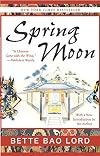
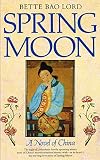
Spring Moon
by Bette Bao Lord
On This Page
Description
A novel which follows Spring Moon, a member of an old Chinese family, from the late 19th century to the present, through the many changes in Chinese society and their effect on her life.Tags
Recommendations



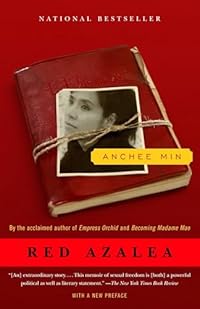
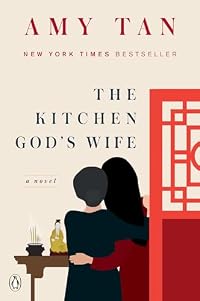
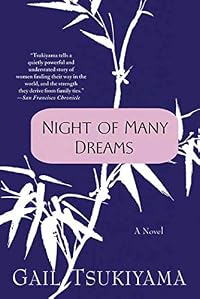
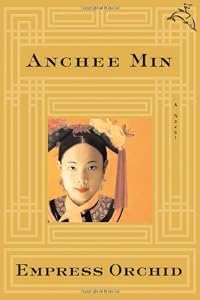









Member Reviews
When I heard this book being described as "a Chinese Gone with the Wind," I simply couldn't resist.
Spring Moon is a strong, intelligent girl growing up in a time and place where girls weren't encouraged to be either. Due to her uncle's (the patriarch of the family) insistence, she is taught how to read and becomes educated, while the rest of her relatives would prefer to see her simply married off into a good family. When he learns that Spring Moon is to be married to a boy he finds unacceptable, her uncle intervenes on her behalf and makes it his mission to find her a better match. With Eldest Uncle acting as her advocate, her life becomes much more enriched than it would have been without his help. She grows into a woman steeped in show more her culture's tradition of honour and respect, but unafraid to speak up and express her thoughts.
Spring Moon does have a lot in common with Scarlett O'Hara. Their families are both torn apart by war, in Spring Moon's case forced to separate in order to survive. She also has to live with a forbidden love, although for very different reasons than Scarlett's. She's forced to face great loss and many hardships, which serve to strengthen her character... and make her story truly enthralling. Although much of her life is filled with sadness, you never doubt for a moment that she will endure, and live to see five generations under one roof, as predicted. show less
Spring Moon is a strong, intelligent girl growing up in a time and place where girls weren't encouraged to be either. Due to her uncle's (the patriarch of the family) insistence, she is taught how to read and becomes educated, while the rest of her relatives would prefer to see her simply married off into a good family. When he learns that Spring Moon is to be married to a boy he finds unacceptable, her uncle intervenes on her behalf and makes it his mission to find her a better match. With Eldest Uncle acting as her advocate, her life becomes much more enriched than it would have been without his help. She grows into a woman steeped in show more her culture's tradition of honour and respect, but unafraid to speak up and express her thoughts.
Spring Moon does have a lot in common with Scarlett O'Hara. Their families are both torn apart by war, in Spring Moon's case forced to separate in order to survive. She also has to live with a forbidden love, although for very different reasons than Scarlett's. She's forced to face great loss and many hardships, which serve to strengthen her character... and make her story truly enthralling. Although much of her life is filled with sadness, you never doubt for a moment that she will endure, and live to see five generations under one roof, as predicted. show less
When Spring Moon was little, it was foretold that she would live to see five generations, and her life unfolds in this story. The family is typical Han Chinese - footbinding and all. The story ends in the late 19th century when the Qing Dynasty still ruled China (but barely) and moves on through the years as the dynasty is abolished and China goes through its revolutionary upheaval. Spring Moon was so sheltered at first, pampered and cared for, and then she goes through all these changes in her life. i read this book back when I was in high school, and really enjoyed it. It's not the best, but it's still a fun read about a person who lives through many of China's dramatic changes and sees how it changes herself and the people around show more her. Highly recommended for a fun read set in old China. show less
I didn't want this book to end!
Spring Moon is a family saga, continuing through several generations, through many wars and revolutions. China has had a very turbulent history, and this is reflected in the fictional families of Chang and Woo. We follow the young girl, Spring Moon (born in 1877) into adolescence and womanhood, marriage, motherhood, heartbreak and tragedy. Her mother-in-law, on her deathbed, predicts that Spring Moon will live to see five generations.
Mrs. Lord is an excellent writer, conveying the history of China through the eyes of one woman and her family. At the same time we are brought into the sequestered world of 19th century privileged women, confined and bound by tradition, but still feeling hope, love, and show more despair behind closed doors. Each chapter begins with ancient tale, legend, or note of history, which adds understanding. The inside front and back covers contain a diagram, a drawing of the courtyards of the House of Chang, Spring Moon's family home. Also, there is a timeline of the events of Chinese history from the ancient legendary era to 1981, the date of the book's publication.
Sent to an old friend from school days (not that she's old; how could she be? She's my age!) She saw my review on Facebook and indicated her intent to get the book. I offered her this one. show less
Spring Moon is a family saga, continuing through several generations, through many wars and revolutions. China has had a very turbulent history, and this is reflected in the fictional families of Chang and Woo. We follow the young girl, Spring Moon (born in 1877) into adolescence and womanhood, marriage, motherhood, heartbreak and tragedy. Her mother-in-law, on her deathbed, predicts that Spring Moon will live to see five generations.
Mrs. Lord is an excellent writer, conveying the history of China through the eyes of one woman and her family. At the same time we are brought into the sequestered world of 19th century privileged women, confined and bound by tradition, but still feeling hope, love, and show more despair behind closed doors. Each chapter begins with ancient tale, legend, or note of history, which adds understanding. The inside front and back covers contain a diagram, a drawing of the courtyards of the House of Chang, Spring Moon's family home. Also, there is a timeline of the events of Chinese history from the ancient legendary era to 1981, the date of the book's publication.
Sent to an old friend from school days (not that she's old; how could she be? She's my age!) She saw my review on Facebook and indicated her intent to get the book. I offered her this one. show less
Spring Moon was a powerful book. It has been almost a decade since I read it and some passages I have never forgotten. The book follows the life of a young girl who is born into a wealthy family in Imperialist China and has her feet bound and ends with her life under the communists when she is an old lady. There is drama and heartache and rare moments of happiness. There are difficult decisions that must be lived with. I learned quite a bit about China reading this book and have never forgotten this novel.
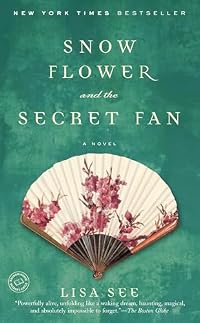
I've recently read three novels set in China from a list of recommended historical fiction: Min's Empress Orchid, See's Snowflower and the Secret Fan, and Bao's Spring Moon. All three are written by Chinese-American women about female Chinese protagonists born in the late Ch'ing Manchu Dynasty--the times of the Opium Wars, the Taiping Rebellion and in the case of this novel, Spring Moon, taking us to the ending of that dynasty to the Communist Revolution. The three books paint a rather consistent portrait of Chinese culture and society in late Imperial China. One in which women lead very circumscribed lives, where ancestors and parents are revered and the status of a woman depends entirely on bearing sons. All three books deal with the show more disruption to a 4,000 year culture by Western forces and the changes that brings.
However, although this book like the others is centered on a female perspective, it also has strong, sympathetic male characters such as Bold Talent--something I found lacking in the other two books, which is one reason I found this my favorite among the three. Another reason I think I liked this one more was that it was less predictable since Min's novel followed famous historical figures and See's novel was framed as the story of an old woman looking back. Bao's tale is the story of a woman her family and clan spanning five generations, told fairly conventionally, but less intimate somehow than the others, with a more ambitious historical sweep. I liked how each chapter was headed with an appropriate tale of Chinese lore, myth, saying, or bit of history. The epilogue, which dealt with the Cultural Revolution, was heart-breaking.
Not quite a book I'd consider a standout, that I'd keep on my shelf or highly recommend to friends or gift them with, but I certainly liked the heroine Spring Moon and found myself engrossed by her story and the picture of Chinese history and culture. show less
However, although this book like the others is centered on a female perspective, it also has strong, sympathetic male characters such as Bold Talent--something I found lacking in the other two books, which is one reason I found this my favorite among the three. Another reason I think I liked this one more was that it was less predictable since Min's novel followed famous historical figures and See's novel was framed as the story of an old woman looking back. Bao's tale is the story of a woman her family and clan spanning five generations, told fairly conventionally, but less intimate somehow than the others, with a more ambitious historical sweep. I liked how each chapter was headed with an appropriate tale of Chinese lore, myth, saying, or bit of history. The epilogue, which dealt with the Cultural Revolution, was heart-breaking.
Not quite a book I'd consider a standout, that I'd keep on my shelf or highly recommend to friends or gift them with, but I certainly liked the heroine Spring Moon and found myself engrossed by her story and the picture of Chinese history and culture. show less
I think someone versed in Chinese history would have enjoyed this more than I did. The novel takes place in the late 1800s to the 1970s in China, although most of it is in the earlier part of that time frame. Thankfully, there was a character list in the front, or I would have been really confused. The names are translated Chinese names and are not easy to get used to since they are so similar. I was frequently puzzled over some of the historical aspects and did look some things up as I read, but it became burdensome after a while, so I raced to get the book read in time for the book club meeting. I've seen this billed as a "Chinese Gone With the Wind". It isn't.
While this book is not completely horrid, the slow progression and lack of focus made me slowly dislike it. The summary says that it tells the story of a Chinese girl named Spring Moon, born in a rich family living in Soochow province, amidst the traditional Chinese culture of showing respect for their elders, bonding their feet (practice they called "golden lilies"), not choosing whom they married. And yes, Spring Moon's life spams form the traditional Chinese life until the Chinese Revolution of Mao Tse-Tung and the foreign countries meddling. The political background is well-researched. What's annoying about it all is that the story simply does not seem to move forward and just keeps introducing random characters that may not have show more the slightest importance to the story.
Overall, the story seems too... automatic. There are no feelings in this romance. Only facts. Facts and descriptions that don't necessarily add something to the story. show less
Overall, the story seems too... automatic. There are no feelings in this romance. Only facts. Facts and descriptions that don't necessarily add something to the story. show less
Members
- Recently Added By
Lists

500 Great Books by Women
507 works; 60 members
Author Information

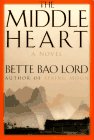
Bette Bao Lord, Bette Bao Lord was born in Shanghai and came to the United States when she was eight years old. Her father, a British trained engineer, was sent to the U.S. in 1946 by the Chinese government to purchase equipment. The family was stranded, in 1947, when Mao Zedong and the communist rebels won the civil war in China. Lord received an show more M.A. from Fletcher School of Law and Diplomacy and graduated with her B.A. from Tufts University. She married Winston Lord, former Ambassador to China and high Ranking State Department official. Lord's first novel, "Spring Moon" (1981), which is set in pre-revolutionary China, was an international bestseller and an American Book Award nominee for best first novel. She has also written about her painful childhood experiences, as a Chinese immigrant in the United States post World War II, in the autobiographical children's book "In the Year of the Boar and Jackie Robinson." The book tells how she struggled to learn English and be accepted by her classmates. "The Middle Heart" spans 70 years of modern Chinese history, ending with the demonstrations in Tiananmen Square in 1989. She has also written articles for such publications as the Los Angeles Times, Newsweek, The New York Times, and USA Today. She has also co-produced The People's Art Theatre's Beijing production of The Caine Mutiny, directed by Charlton Heston. Ms. Lord has received the honor of an appointment by President Clinton to the International Broadcasting Board of Governors to oversee all U.S. non-military international broadcasting. She is also the chairperson the Freedom House, which promotes democratic institutions around the world. President Clinton said of Ms. Lord at one of the organizations conferences, "I'm honored to be introduced by someone who writes so powerfully about the past and is working so effectively to shape the future." She has sat on the Board of Trustees of The Freedom Forum, The Kennedy Center Community and Friends, and The National Portrait Gallery. She serves on the Advisory Council on Foreign Relations, Author's Guild, PEN, and the Organization of Chinese Americans. Some of the awards Ms. Lord has received include honorary doctorates from seven universities, the U.S. International Agency Award for Outstanding Contributions, The Women of Honor Award from the National Council of Women, the New York Public Library's Literary Lion, the American Women for International Understanding Award, the Qingyun Award from the China Institute, the Distinguished American Award, and the Woman of the Year Award from Chinatown Planning Council. (Bowker Author Biography) show less
Some Editions
Awards and Honors
Awards
Distinctions
Common Knowledge
- Canonical title
- Spring Moon
- Original title
- Spring Moon
- Original publication date
- 1982
- People/Characters
- Spring Moon
- Important places
- Soochow, China; Peking, China
- Dedication
- To My Chinese and American parents, My husband, Winston Lord, AND My editor, Corona Machemer Debts I can never repay
- First words
- Before the beginning there was chaos.
- Last words
- (Click to show. Warning: May contain spoilers.)Opening her eyes, Spring Moon reached out and took the child's hand.
Classifications
Statistics
- Members
- 810
- Popularity
- 33,867
- Reviews
- 17
- Rating
- (3.73)
- Languages
- 12 — Danish, Dutch, English, Finnish, French, German, Italian, Latin, Norwegian (Bokmål), Norwegian, Spanish, Swedish
- Media
- Paper
- ISBNs
- 36
- ASINs
- 23