On This Page
Description
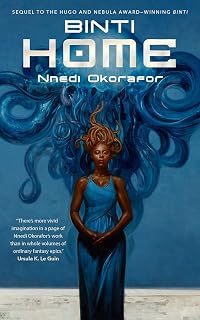
It's been a year since Binti and Okwu enrolled at Oomza University. A year since Binti was declared a hero for uniting two warring planets. A year since she found friendship in the unlikeliest of places. And now she must return home to her people, with her friend Okwu by her side, to face her family and face her elders. But Okwu will be the first of his race to set foot on Earth in over a hundred years, and the first ever to come in peace. After generations of conflict can human and Meduse show more ever learn to truly live in harmony? show lessTags
Recommendations









Member Reviews
To no one's surprise, and certainly not mine, Binti: Home is just as good as the first installment of this series. I flew through this book, immersed in this fascinating, biological, imaginative future. I love the continued exploration of Binti's culture at home, and the minority culture of the desert people that she and her family look down on. I also found the mindset of the Meduse interesting; we get a look at it first-hand as Binti experiences the new, Meduse part of herself partially through occasional flashes of distracting and irrational anger. I hope that in a future installment of this story we get a better sense of the Meduse's culture and society, because I think it would be educational to see how a culture that is so angry show more so often managed to function so well that they're traveling the stars. Do they only get that kind of mad at other species?
Binti's reunion with her family is predictably fraught, since she has gone against all tradition and left the planet to study at Oomza University, and in the process hurt her own marriage prospects, but all of that still reads as real and moving despite the predictability. I'm interested to see how the desert people differ from the Himba - at first meeting they certainly seem to have more equal views of men and women, so that's all to the good.
I would definitely recommend this book to anyone who liked the first book, and I'm really looking forward to book 3! show less
Binti's reunion with her family is predictably fraught, since she has gone against all tradition and left the planet to study at Oomza University, and in the process hurt her own marriage prospects, but all of that still reads as real and moving despite the predictability. I'm interested to see how the desert people differ from the Himba - at first meeting they certainly seem to have more equal views of men and women, so that's all to the good.
I would definitely recommend this book to anyone who liked the first book, and I'm really looking forward to book 3! show less
A reread for my book club :)
I was apprehensive to start this one, having just deducted a star from the first novella. Isn’t it satisfying when books hold up on a reread?
Importantly, the book stops pretending to be sci-fi and reveals its colourful science fantasy outfit. Thank you! Binti’s trauma and PTSD are addressed and explored in ways that lessened my gripes with the first novella.
Trying to reconcile who you are and your home and culture can be hard. It’s a culture that you love, yet it imprisons you, in more ways than you know. Your family loves you and hurts you – because of fear, because or prejudice, because of “this is how things should be”. Oh, Binti. This is indeed “the pain and glory of growth”.
I loved the show more scene when “Desert People” appeared:
“You people are so brilliant, but your world is too small,” the old woman who was my father’s mother, my grandmother said. “One of you finally somehow grows beyond your cultural cage and you want to chop her stem. Fascinating.”
The story ends with one of those horrible cliffhangers that shouldn’t be allowed. I do have the final novella within reach, so I am fine ;) show less
I was apprehensive to start this one, having just deducted a star from the first novella. Isn’t it satisfying when books hold up on a reread?
Importantly, the book stops pretending to be sci-fi and reveals its colourful science fantasy outfit. Thank you! Binti’s trauma and PTSD are addressed and explored in ways that lessened my gripes with the first novella.
Trying to reconcile who you are and your home and culture can be hard. It’s a culture that you love, yet it imprisons you, in more ways than you know. Your family loves you and hurts you – because of fear, because or prejudice, because of “this is how things should be”. Oh, Binti. This is indeed “the pain and glory of growth”.
I loved the show more scene when “Desert People” appeared:
“You people are so brilliant, but your world is too small,” the old woman who was my father’s mother, my grandmother said. “One of you finally somehow grows beyond your cultural cage and you want to chop her stem. Fascinating.”
The story ends with one of those horrible cliffhangers that shouldn’t be allowed. I do have the final novella within reach, so I am fine ;) show less
A reread, because I now have the third installment. Oddly, I remembered a lot about Binti, but almost nothing about Home. And yet, Home is so much more impactful. Change. Growth. The cage of culture. The cage and comfort of family. A girl becomes a woman, becomes an alien, becomes uniquely herself. A world unfolds. It's all here. Except the ending--that's what costs a star. There is no closure, only more questions.
Let me start with a complaint so I can get it out of my system. I hate this emerging practice in Science Fiction to slice novels up into novellas and drip feed them to us.
I hated it with Murderbot and I hate it with Binti.
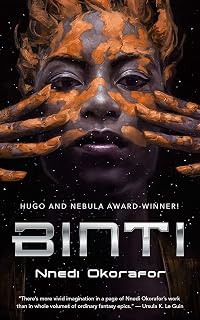
I was blown away by the first novella, "Binti" It deserved the Nebula and Hugo awards it won. It was a startlingly innovative novella about identity, about us and other, about fear and harmony, about how defining what it means to be alien also defines what it means to be human. "Binti" worked as a standalone, self-contained story.
It took two more years for "Binti Home" to reach us and, very disappointingly, it does not work as a self-contained novella. It's a sequel, so it can't be standalone but I did expect it to be show more self-contained. What I got is the second act in a three-act play.
It turns out it's a very good second act in what I'm sure will be an excellent novel but I wish the publishers had had the integrity to wait until the whole book was ready before publishing it.
Ok, complaint over.
There are lots of good things in this middle act of Binti's story.
It retains the freshness of the original novella. It doesn't reprise any of the previous action but carries straight on from where "Binti" finished.
It keeps the humour as well as the drama of the previous events and uses both to explore being alien. Here's what happens when Binti persuades Okuwu, an alien shaped like a massive jellyfish that moves through air rather than water an is always referred to as "it" to put cover its tentacles with otjize, a mix of mud and oil that Himba women cover themselves with:
Covering them with so much otjize, Okwu told me, made it feel a little intoxicated.
“Everything is . . . happy,” it had said, sounding perplexed about this state.
“Good,” I said, grinning. “That way, you won’t be so grumpy when you meet everyone. Khoush like politeness and the Himba expect a sunny disposition.”
“ I will wash this off soon,” it said. “It’s not good to feel this pleased with life.”
"Binti Home" explores the issue of self and other from a new angle by following Binti's own physical and spiritual evolution from the Himba tribal girl she thought herself to be into something other and more than that.
When Binti returns home to restore her sense of identity as a Himba woman she is instead forced to confront the prejudices that shape her view of her homeworld and prevent her from seeing herself clearly. Binti's skill as a "harmonizer" is tested when she finds that it's her rapidly changing self that she needs to harmonize.
The tension builds. Revelations are made. Threats are introduced. Then the novella ends. Well, actually, it just stops.
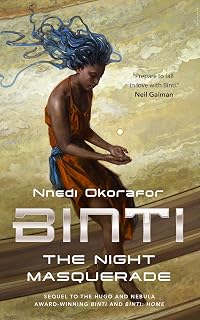
So I'm going to stop as well. I have to go and read the third act, "The Night Masquerade", which I've just downloaded from the Kindle Store for the princely sum of £2.63. show less
I hated it with Murderbot and I hate it with Binti.
I was blown away by the first novella, "Binti" It deserved the Nebula and Hugo awards it won. It was a startlingly innovative novella about identity, about us and other, about fear and harmony, about how defining what it means to be alien also defines what it means to be human. "Binti" worked as a standalone, self-contained story.
It took two more years for "Binti Home" to reach us and, very disappointingly, it does not work as a self-contained novella. It's a sequel, so it can't be standalone but I did expect it to be show more self-contained. What I got is the second act in a three-act play.
It turns out it's a very good second act in what I'm sure will be an excellent novel but I wish the publishers had had the integrity to wait until the whole book was ready before publishing it.
Ok, complaint over.
There are lots of good things in this middle act of Binti's story.
It retains the freshness of the original novella. It doesn't reprise any of the previous action but carries straight on from where "Binti" finished.
It keeps the humour as well as the drama of the previous events and uses both to explore being alien. Here's what happens when Binti persuades Okuwu, an alien shaped like a massive jellyfish that moves through air rather than water an is always referred to as "it" to put cover its tentacles with otjize, a mix of mud and oil that Himba women cover themselves with:
Covering them with so much otjize, Okwu told me, made it feel a little intoxicated.
“Everything is . . . happy,” it had said, sounding perplexed about this state.
“Good,” I said, grinning. “That way, you won’t be so grumpy when you meet everyone. Khoush like politeness and the Himba expect a sunny disposition.”
“ I will wash this off soon,” it said. “It’s not good to feel this pleased with life.”
"Binti Home" explores the issue of self and other from a new angle by following Binti's own physical and spiritual evolution from the Himba tribal girl she thought herself to be into something other and more than that.
When Binti returns home to restore her sense of identity as a Himba woman she is instead forced to confront the prejudices that shape her view of her homeworld and prevent her from seeing herself clearly. Binti's skill as a "harmonizer" is tested when she finds that it's her rapidly changing self that she needs to harmonize.
The tension builds. Revelations are made. Threats are introduced. Then the novella ends. Well, actually, it just stops.
So I'm going to stop as well. I have to go and read the third act, "The Night Masquerade", which I've just downloaded from the Kindle Store for the princely sum of £2.63. show less
In the second installation of the trilogy, Binti and Okwu travel back to Binti's home planet; she wants to go on the traditional pilgrimage. However, her family thinks she has come back to stay; they guilt her for leaving in the first place. Then she sees the Night Masquerade, which is only supposed to be seen by men and is a harbinger of great change. The Desert People - Enyi Zinariya - come to take Binti, and on the journey she learns that she has had many misconceptions about them; far from being primitive, they are much more advanced than the Himba or the Khoush - and they want Binti to be initiated into their group.
"Having curiosity is the only way to learn." (Grandmother to Binti, 127)
I had not taken my place within the show more collective. This had left me feeling exposed and foundationless, even as I pursued my dreams. Now here I was about to make another choice that would further ensure I could never go back. (149)
"What will you be? Maybe it's not up to you." (Ariya to Binti, 150) show less
"Having curiosity is the only way to learn." (Grandmother to Binti, 127)
I had not taken my place within the show more collective. This had left me feeling exposed and foundationless, even as I pursued my dreams. Now here I was about to make another choice that would further ensure I could never go back. (149)
"What will you be? Maybe it's not up to you." (Ariya to Binti, 150) show less
I loved Nnedi Okorafor's novella Binti and had only the small and very minor niggle that the story was a bit plain and resolved rather too easily. Minor niggle to me at least, other readers thought different about that, and apparently so did the author herself - if there is one thing that it is impossible to say about Binti's sequel Home, then that it presents its reader with pat and easy solution. In fact, it leaves us with so many narrative threads dangling (not to mention ending on a cliffhanger) that one cannot help but suspect some kind of Hegelian dialectics at work here: If Binti presented a bold and simply stated thesis, then Home is the antithesis to that, negating and dismantling every apparent certainty established in the show more first novella.
This makes Home an unsettling and occasionally outright uncomfortable reading experience which is far removed from the exuberance of Binti. It is no less fascinating however, the world building continues to be jaw-droppingly bizarre, and the character of Binti only becomes enriched when we learn that the events of the first novella did not pass her by without leaving a trace, something she has to struggle with during her time at Oomza Uni and which leads her to return home where she plans to make a pilgrimage in order to cleanse herself. The pilgrimage however, turns out to be not the one was she was expecting and in the course of it she - and the readers - discover a third culture besides the Khoush and the Himba, along with some reveals about Binti's and her world's past.
There really should be a third novella which harmonizes everything into a synthesis, and I find myself hoping that it will be released very soon. Great stuff, and I really need to read more by Nnedi Okorafor. show less
This makes Home an unsettling and occasionally outright uncomfortable reading experience which is far removed from the exuberance of Binti. It is no less fascinating however, the world building continues to be jaw-droppingly bizarre, and the character of Binti only becomes enriched when we learn that the events of the first novella did not pass her by without leaving a trace, something she has to struggle with during her time at Oomza Uni and which leads her to return home where she plans to make a pilgrimage in order to cleanse herself. The pilgrimage however, turns out to be not the one was she was expecting and in the course of it she - and the readers - discover a third culture besides the Khoush and the Himba, along with some reveals about Binti's and her world's past.
There really should be a third novella which harmonizes everything into a synthesis, and I find myself hoping that it will be released very soon. Great stuff, and I really need to read more by Nnedi Okorafor. show less
My wish that this was longer will be a running theme, I think. There was so much to cover, and not a lot of words to do it with! But I could not stop reading it, and it improves on the first in the best ways.
Content warnings:
- PTSD flashbacks
- panic attacks
Representation:
- the MC and her family are Himba, indigenous people from parts of Namibia & Angola
- a few secondary characters are nomadic people described as “old old Africans”
Binti has been at Oomza Uni for a year now, after having been the lone survivor of a mass murder committed by the Meduse on her way to the university. She’s decided it’s time to visit home and go on the pilgrimage that would traditionally make her a woman, even if her people might not accept her anyway. show more As a symbol of the truce Binti created on her flight to Oomza Uni, the Meduse Okwu will be coming with her to visit home. He will be the first Meduse ever to see Earth. Will it create further harmony, or will the Meduse and the Khoush of Earth never be able to coexist?
You don’t even know how happy I am that this second installment deals with trauma. There was no way Binti would be able to live through all she did in the first book and not be greatly affected by it. I have PTSD, too, and the panic attacks, the flashbacks … it all feels very real and genuine.
Binti: Home is written in the same style as the first, with somewhat simple language and a few typos here and there, but it feels much more mature. Not only does Binti have to face what happened on the ship with the Meduse, she has to confront her own decision to run away from home and the pain it caused her family. As well as the judgement from her very own people -- and some prejudices within herself.
I couldn’t put it down. show less
Content warnings:
- PTSD flashbacks
- panic attacks
Representation:
- the MC and her family are Himba, indigenous people from parts of Namibia & Angola
- a few secondary characters are nomadic people described as “old old Africans”
Binti has been at Oomza Uni for a year now, after having been the lone survivor of a mass murder committed by the Meduse on her way to the university. She’s decided it’s time to visit home and go on the pilgrimage that would traditionally make her a woman, even if her people might not accept her anyway. show more As a symbol of the truce Binti created on her flight to Oomza Uni, the Meduse Okwu will be coming with her to visit home. He will be the first Meduse ever to see Earth. Will it create further harmony, or will the Meduse and the Khoush of Earth never be able to coexist?
You don’t even know how happy I am that this second installment deals with trauma. There was no way Binti would be able to live through all she did in the first book and not be greatly affected by it. I have PTSD, too, and the panic attacks, the flashbacks … it all feels very real and genuine.
Binti: Home is written in the same style as the first, with somewhat simple language and a few typos here and there, but it feels much more mature. Not only does Binti have to face what happened on the ship with the Meduse, she has to confront her own decision to run away from home and the pain it caused her family. As well as the judgement from her very own people -- and some prejudices within herself.
I couldn’t put it down. show less
Members
- Recently Added By
Published Reviews
ThingScore 75
Within a small space, Okorafor efficiently depicts several distinct cultures and portrays a strong and unusual heroine.
added by rretzler
Lists

Best Science Fiction Novels
816 works; 430 members

Favorite Science Fiction by Women Authors
737 works; 202 members

2017 Science Fiction and Fantasy I'm Looking Forward To
46 works; 6 members

quigui wishlish
11 works; 1 member

2018 Hugo Eligible Novellas
33 works; 9 members

Top Five Books of 2017
757 works; 231 members
Books Read in 2018
4,360 works; 110 members

Africa
109 works; 8 members

Books Read in 2020
4,379 works; 124 members

BookTok Adult
115 works; 2 members

Summer Reading
30 works; 1 member

2018 Hugo Eligible Novels
170 works; 16 members
Author Information

108+ Works 21,961 Members
Nnedi Okorafor was born on April 8, 1974 in Cincinnati, Ohio. She is a graduate of Clarion Writers Workshop in Lansing, Michigan and earned her PhD in English from the University of Illinois. Currently she is an associate professor of creative writing and literature at the University at Buffalo (SUNY). Her awards include a 2001 Hurston-Wright show more literary award for her story Amphibious Green, The Wole Soyinka Prize for Literature in Africa for Zahrah the Windseeker, the Carl Brandon Parallax Award for The Shadow Speaker, the 2007-08 winner of the Macmillan Writer's Prize for Africa for Long Juju Man, the 2011 World Fantasy Award for Best Novel for Who Fears Death, and her science fiction novella Binti won the 2016 Nebula Award (Best Novella) and the 2016 Hugo Awards for Best Novella. (Bowker Author Biography) show less

Nnedi Okorafor is a LibraryThing Author, an author who lists their personal library on LibraryThing.
Some Editions
Awards and Honors
Awards
Series

Work Relationships
Is contained in
Common Knowledge
- Canonical title*
- Binti : Retour
- Original title
- Binti: Home
- Original publication date
- 2017-01-31
- People/Characters
- Binti Ekeopara Zuzu Dambu Kaipka; Okwu; Heru; Okpala; Wan; Dema (show all 27); Jalal; Meduse (alien race); Haifa; Saidia Nwanyi; Truck Omaze; Gideon (uncle of Binti Ekeopara Zuzu Dambu Kaipka); Akpe (uncle of Binti Ekeopara Zuzu Dambu Kaipka); Moaoogo Dambu Kaipka Okechukwu Enyi Zinariya (father of Binti Ekeopara Zuzu Dambu Kaipka); Mother (mother of Binti Ekeopara Zuzu Dambu Kaipka); Vera (sister of Binti Ekeopara Zuzu Dambu Kaipka); Omaihi (sister of Binti Ekeopara Zuzu Dambu Kaipka); Peraa (sister of Binti Ekeopara Zuzu Dambu Kaipka); Bana (brother of Binti Ekeopara Zuzu Dambu Kaipka); Omeva (brother of Binti Ekeopara Zuzu Dambu Kaipka); Night Masquerade; Mwinyi; Titi (grandmother of Binti Ekeopara Zuzu Dambu Kaipka); Enyi Zinariya (Namibian desert tribe); Himba (Namibian community); Ariya (priestess of Enyi Zinariya); Third Fish
- Important places
- Oomza University; Weapons City, Oomza University; Math City, Oomza University; Kokure, Africa; Osemba, Namibia; Third Fish
- First words
- "Five, five, five, five, five, five," I whispered.
- Last words
- (Click to show. Warning: May contain spoilers.)We will see.
- Publisher's editor
- Harris, Lee
- Blurbers
- Hines, Jim C.; Le Guin, Ursula K.; Kahiu, Wanuri; Wolfe, Gary K.
- Original language
- English
*Some information comes from Common Knowledge in other languages. Click "Edit" for more information.
Classifications
Statistics
- Members
- 1,457
- Popularity
- 16,097
- Reviews
- 104
- Rating
- (3.97)
- Languages
- 5 — English, French, German, Spanish, Swedish
- Media
- Paper, Audiobook, Ebook
- ISBNs
- 13
- ASINs
- 2