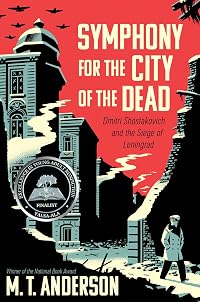
Symphony for the City of the Dead: Dmitri Shostakovich and the Siege of Leningrad
by M. T. Anderson
On This Page
Description
In September 1941, Adolf Hitler's Wehrmacht surrounded Leningrad in what was to become one of the longest and most destructive sieges in Western history -- almost three years of bombardment and starvation that culminated in the harsh winter of 1943-1944. More than a million citizens perished. Survivors recall corpses littering the frozen streets, their relatives having neither the means nor the strength to bury them. Residents burned books, furniture, and floorboards to keep warm. They ate show more family pets and -- eventually -- one another to stay alive. Trapped between the Nazi invading force and the Soviet government itself was composer Dmitri Shostakovich, who would write a symphony that roused, rallied, eulogized, and commemorated his fellow citizens -- the Leningrad Symphony, which came to occupy a surprising place of prominence in the eventual Allied victory. This is the true story of a city under siege: the triumph of bravery and defiance in the face of terrifying odds. It is also a look at the power and layered meaning of music in beleaguered lives. show lessTags
Recommendations







Member Reviews
To be honest, there's very little chance I would normally pick up a biography of Dmitri Shostakovich, even though such a topic does sound interesting in a hypothetical sense; I simply just don't read a ton of nonfiction. But tell me about a biography of Dmitri Shostakovich written by the best YA author currently working, M. T. Anderson, and of course I'm all over it.
This takes in Shostakovich's whole life, but mostly focuses on the siege of Leningrad, when the Nazi army cut the city off from any supply lines; it chronicles Shostakovich's life up until that point but also provides a lot of historical information about the history of the Soviet Union for context. Even though it's for a YA audience, I found it totally successful for an show more adult audience, and even ended up recommending it to my father, a WWII buff but definitely not a YA reader, who enjoyed it so much that a couple months later he was citing facts he learned from it back to me, having forgotten I was the one who recommended it to him to begin with. Anderson even does some original research here; poking around on Google Scholar, it seems that academics are citing his work in peer-reviewed journals already.
The book is pretty horrifying. WWII-era Soviet Russia was a pretty awful place to live even before the Nazis showed up. Anderson does a great job exploring the intersection of politics and art, how art is shaped by politics and works to defy it. Anderson writes about music beautifully (no easy feat!) and really gets us into the head of Shostakovich in particular and the world of Russia in general; I learned a lot about Stalin from this, actually. Overall, excellent work, and a good example of why M. T. Anderson is one of my favorite authors full stop, not just one of my favorite YA authors. show less
This takes in Shostakovich's whole life, but mostly focuses on the siege of Leningrad, when the Nazi army cut the city off from any supply lines; it chronicles Shostakovich's life up until that point but also provides a lot of historical information about the history of the Soviet Union for context. Even though it's for a YA audience, I found it totally successful for an show more adult audience, and even ended up recommending it to my father, a WWII buff but definitely not a YA reader, who enjoyed it so much that a couple months later he was citing facts he learned from it back to me, having forgotten I was the one who recommended it to him to begin with. Anderson even does some original research here; poking around on Google Scholar, it seems that academics are citing his work in peer-reviewed journals already.
The book is pretty horrifying. WWII-era Soviet Russia was a pretty awful place to live even before the Nazis showed up. Anderson does a great job exploring the intersection of politics and art, how art is shaped by politics and works to defy it. Anderson writes about music beautifully (no easy feat!) and really gets us into the head of Shostakovich in particular and the world of Russia in general; I learned a lot about Stalin from this, actually. Overall, excellent work, and a good example of why M. T. Anderson is one of my favorite authors full stop, not just one of my favorite YA authors. show less
I remember having lunch with M.T. Anderson while he was researching this book. As we ate at a wonderful Asian restaurant in Cambridge, he spoke with such excitement and passion about the subject of composer Dmitri Shostakovich and how clandestine it was to smuggle the 7th symphony.Real spy type stuff. You could really see the spark of creation in Anderson.
This is the story of all artists. It is a look into the horrors of Stalin coming to power, as well as the Nazis, and how difficult it was to be an artist in Russia during that time. It is also a novel about survival and determination under such oppression.Here is a brilliant man, who had to live a life of duplicity; on one hand writing scores for Stalin's propaganda films, on the other show more hand writing great works expressing the suffering under Stalin's hand. An artist who had to dance between comrade and bourgeoisie as his friends disappeared in the night, were jailed, tortured and killed. As all of this is happening in his country, Herr Wolf is also taking his turn at the stage of fascism.
The world is lucky that Shostakovich survived and Anderson expresses this eloquently. He paints a vivid and well researched picture of not only the microcosm of Shostakovich's life, but also the world at the time as effected by Russia. A power book about the difficulty of life for an artist, and a lesson to ANY artist oppressed by either fascism or banned books or any situation where art is being suppressed.
M.T. Anderson is one of the most prolific authors I have the pleasure of knowing. His books range from the silly to the sci-fi to the historic. Symphony is one of his best. show less
This is the story of all artists. It is a look into the horrors of Stalin coming to power, as well as the Nazis, and how difficult it was to be an artist in Russia during that time. It is also a novel about survival and determination under such oppression.Here is a brilliant man, who had to live a life of duplicity; on one hand writing scores for Stalin's propaganda films, on the other show more hand writing great works expressing the suffering under Stalin's hand. An artist who had to dance between comrade and bourgeoisie as his friends disappeared in the night, were jailed, tortured and killed. As all of this is happening in his country, Herr Wolf is also taking his turn at the stage of fascism.
The world is lucky that Shostakovich survived and Anderson expresses this eloquently. He paints a vivid and well researched picture of not only the microcosm of Shostakovich's life, but also the world at the time as effected by Russia. A power book about the difficulty of life for an artist, and a lesson to ANY artist oppressed by either fascism or banned books or any situation where art is being suppressed.
M.T. Anderson is one of the most prolific authors I have the pleasure of knowing. His books range from the silly to the sci-fi to the historic. Symphony is one of his best. show less
 This review was written for LibraryThing Early Reviewers.
A powerful and poignant YA non-fiction narrative about the composition of Shostakovich's Seventh Symphony during, and partly inside, the siege of Leningrad. Tracing Shostakovich's early life during the Bolshevik revolution, then the slow tightening of totalitarianism and the rise to power of Stalin and the terror of the purges, taking its toll on artists and the intelligentsia, Shostakovitch himself only surviving partly by cruel luck and partly through his international fame, not a long-term survival strategy with the jealous Stalin.
The sudden brutal onslaught of Operation Barbarossa convulses Russia as German armies drive across the countryside, slaughtering the population of hated Slavs as they go. The siege of Leningrad is a long, show more ugly torment of military might and official incompetence and the grinding down of humanity as starvation reduces the population to near savagery.
Shostakovich composes the most of his symphony in the heart of the siege until he is evacuated with his immediate family. Once completed, it becomes an important cultural object of Russian spirit and defiance, a way of humanising the new Russian allies to the US, and even if it doesn't prompt them to open the second front, it contributes to reducing opposition to vital aid and increasing support.
It's an amazing, heartrending story of art surviving war, and helping people survive war. Theories of art and music and political philosophy and the strategies of war and the broad stretches of history are explained with simplicity and clarity, and the character of Shostakovich is explored through the murkiness of a society where people had to hide their true selves to survive and the secret police scrutinised everything.
A brilliant, riveting, passionate, big-hearted and heart-breaking book. show less
The sudden brutal onslaught of Operation Barbarossa convulses Russia as German armies drive across the countryside, slaughtering the population of hated Slavs as they go. The siege of Leningrad is a long, show more ugly torment of military might and official incompetence and the grinding down of humanity as starvation reduces the population to near savagery.
Shostakovich composes the most of his symphony in the heart of the siege until he is evacuated with his immediate family. Once completed, it becomes an important cultural object of Russian spirit and defiance, a way of humanising the new Russian allies to the US, and even if it doesn't prompt them to open the second front, it contributes to reducing opposition to vital aid and increasing support.
It's an amazing, heartrending story of art surviving war, and helping people survive war. Theories of art and music and political philosophy and the strategies of war and the broad stretches of history are explained with simplicity and clarity, and the character of Shostakovich is explored through the murkiness of a society where people had to hide their true selves to survive and the secret police scrutinised everything.
A brilliant, riveting, passionate, big-hearted and heart-breaking book. show less
M.T. Anderson's experience as a YA writer shows in this biography of Shostakovich: the writing is clear and engaging to make for an uncomplicated read, and he takes pains to point out where facts end and conjecture begins, which is especially useful for younger readers who may not have the sophistication or experience to figure it out by reading between the lines.
Symphony for the City of the Dead sets out to tell the story of Dmitri Shostakovich's 7th symphony - why it was created and what happened during that creation to make it so special. To fully explain the context of Leningrad in 1941 and 1942, Anderson goes back to the Russian Revolution of 1905 and lays out basic facts of what life was like and a general idea of why the show more revolution occurred, only a year before Shostakovich's birth. He then recounts what is known or supposed of Shostakovich's childhood, and what life would have been like under Bolshevik and then Soviet rule. Shostakovich's music is complicated and not easily accessible for new listeners, so Anderson also details Shostakovich's musical background and influences - this includes explanations of Soviet Constructivism in all the fine arts, painting and theatre as well as music.
The second third of the book traces Shostakovich's work in the 1930s and during Stalin's Great Purge, injecting a frisson of suspense as Shostakovich comes so close to being purged himself several times during his life. We know that he survived to create his symphony during the war, but was he tortured or banished to Siberia during the Purge? One place that the book falls short here, and which I only happened to discover by happenstance of watching a Hollywood movie from 1938 while I was reading, is that Anderson doesn't really make it clear how famous Shostakovich was internationally during the period, and that his international fame was quite likely what saved him. On the other hand, this section goes further in contextual history and gives more background to Stalin's Purge and political actions, laying the groundwork to understand why everything went so poorly at the start of the war, and in Leningrad especially.
The final third looks at the Siege of Leningrad itself - this is why the symphony was so important, and the conditions Shostakovich endured while writing it. These chapters are dramatized, with anecdotes and facts chosen to have the reader empathize with the residents of the city. It is not an impartial recounting that can be found on Wikipedia or dryer history books, which unfortunately means that even while it draws the reader in and creates a very rich environment, it probably doesn't create a very balanced view of the Siege, but overemphasizes the darkest days. Still, it was extremely readable, and gave me a fuller understanding of that part of history, which I was only incidentally familiar with before (thanks in part to books like Rose Under Fire (Wein) or Between Shades of Grey (Sepetys)).
Overall, I have two responses to Symphony for the City of the Dead. 1) I am super grateful for Anderson's explanations of Constructivism and the Soviet-approved artforms of the 1910s-1930s - I work in a contemporary art museum, but have found it somewhat difficult to fully understand the context of some of the artwork we have, including recent exhibitions of Malevich's work, but Anderson provided me with several Aha! moments so that I I feel like huge chunks of understanding of modern/contemporary art are filled in. 2) The book trails off after the Leningrad premier of Shostakovich's Symphony No. 7 and gives only a cursory outline of what happened to Shostakovich afterwards. I am incredibly curious now about how Soviet life, as Anderson describes it here, transitioned post-Stalin and into the Cold War era, and I feel a need to seek out more books on the topic. I've friends who lived in Soviet Russia and Ukraine in the 1980s and 1990s, so I have some understanding of what it was like then, but 1945-1980 is something of a blank for me, which this book has made more obvious simply by filling in the 1905-1945 parts.
I highly recommend Symphony for the City of the Dead to any reader who would like to read more of any of the topic it covers, or as an introduction to reading about history and biographies for young people. Not only does Anderson write an engaging book about history, but he shows readers what goes into figuring out history from source documents, so that they can become more discerning readers in the future. show less
Symphony for the City of the Dead sets out to tell the story of Dmitri Shostakovich's 7th symphony - why it was created and what happened during that creation to make it so special. To fully explain the context of Leningrad in 1941 and 1942, Anderson goes back to the Russian Revolution of 1905 and lays out basic facts of what life was like and a general idea of why the show more revolution occurred, only a year before Shostakovich's birth. He then recounts what is known or supposed of Shostakovich's childhood, and what life would have been like under Bolshevik and then Soviet rule. Shostakovich's music is complicated and not easily accessible for new listeners, so Anderson also details Shostakovich's musical background and influences - this includes explanations of Soviet Constructivism in all the fine arts, painting and theatre as well as music.
The second third of the book traces Shostakovich's work in the 1930s and during Stalin's Great Purge, injecting a frisson of suspense as Shostakovich comes so close to being purged himself several times during his life. We know that he survived to create his symphony during the war, but was he tortured or banished to Siberia during the Purge? One place that the book falls short here, and which I only happened to discover by happenstance of watching a Hollywood movie from 1938 while I was reading, is that Anderson doesn't really make it clear how famous Shostakovich was internationally during the period, and that his international fame was quite likely what saved him. On the other hand, this section goes further in contextual history and gives more background to Stalin's Purge and political actions, laying the groundwork to understand why everything went so poorly at the start of the war, and in Leningrad especially.
The final third looks at the Siege of Leningrad itself - this is why the symphony was so important, and the conditions Shostakovich endured while writing it. These chapters are dramatized, with anecdotes and facts chosen to have the reader empathize with the residents of the city. It is not an impartial recounting that can be found on Wikipedia or dryer history books, which unfortunately means that even while it draws the reader in and creates a very rich environment, it probably doesn't create a very balanced view of the Siege, but overemphasizes the darkest days. Still, it was extremely readable, and gave me a fuller understanding of that part of history, which I was only incidentally familiar with before (thanks in part to books like Rose Under Fire (Wein) or Between Shades of Grey (Sepetys)).
Overall, I have two responses to Symphony for the City of the Dead. 1) I am super grateful for Anderson's explanations of Constructivism and the Soviet-approved artforms of the 1910s-1930s - I work in a contemporary art museum, but have found it somewhat difficult to fully understand the context of some of the artwork we have, including recent exhibitions of Malevich's work, but Anderson provided me with several Aha! moments so that I I feel like huge chunks of understanding of modern/contemporary art are filled in. 2) The book trails off after the Leningrad premier of Shostakovich's Symphony No. 7 and gives only a cursory outline of what happened to Shostakovich afterwards. I am incredibly curious now about how Soviet life, as Anderson describes it here, transitioned post-Stalin and into the Cold War era, and I feel a need to seek out more books on the topic. I've friends who lived in Soviet Russia and Ukraine in the 1980s and 1990s, so I have some understanding of what it was like then, but 1945-1980 is something of a blank for me, which this book has made more obvious simply by filling in the 1905-1945 parts.
I highly recommend Symphony for the City of the Dead to any reader who would like to read more of any of the topic it covers, or as an introduction to reading about history and biographies for young people. Not only does Anderson write an engaging book about history, but he shows readers what goes into figuring out history from source documents, so that they can become more discerning readers in the future. show less
This review was written for LibraryThing Early Reviewers.Symphony for the City of the Dead by M.T. Anderson is the kind of book that makes people never want to stop reading. The book tells the larger story of the Russian Revolution and the Soviet experience in World War II through the lens of the life of composer Dmitri Shostakovich. It follows him through the chaotic but hopeful years of the revolution, the darkening years of Stalinization, and finally the horors of the siege of Leningrad, from which Shostakovich escapes to write his much heralded 7th Symphony, a symphony which was in and of itself a hero of the war throughout the Allied countries.
The storytelling is detailed, crisp, and brisk. Anderson knows just when to insert some question to the reader while recounting some horror of show more Soviet life, a feature that makes this book especially suitable for teaching students how to read. Speaking of men who committed suicide rather than give in to Stalin one more day, or men who capitulated and followed party lines, the author points out “When we read tales of atrocity, we all want to be the one who stood firm, who would not bend… it is easy for us all to imagine we are heroes when we are sitting in our kitchens, dreaming of distant stuff.” Confrontational ideas that force the reader to really put themselves in other peoples places are one of the most valuable features of this book, and they come often.
As does the occasional bit of lighthearted or dark humor. The subject matter can be very overwhelming at times, so much so that one has to stop reading at points, and the reprieve provided by the humor is welcome but also entertaining and shows a certain trust by the author to his readers, who in this case are intended to be young adults, and so this trust has great value.
Another great feature was Anderson’s constant questioning of sources. Any writer tackling Soviet era history has a harder time than most tending to accuracy. Sources cannot be trusted; a piece may be authored by a political operative rather than the credited author, or written by the author but with the intention of appeasing the authorities. Was Shostakovich’s journal really written by him, and if so, why so many contradictions and apparent mistakes? Anderson is constantly begging the reader to question the truth of any of this history, as so much of the information comes from such troubled times. This book would pair well with the movie “Waltzing with Bashir”, which also contemplates memory, history, and their relationship.
Be warned, reading this book is difficult. It is full of injustice, cruelty, and despair. In one harrowing scene an actress cannot go on with her lines in a production of “The Three Musketeers” because she has looked over off stage to see that one of her fellow cast members has succumbed to starvation. The audience patiently, knowingly waits for her to regain composure, and the play is finished with only two musketeers. But the hope and inspiration of artists and there willingness to persevere in order to inspire their countrymen provide a good counterbalance to the grimness, and overall it is a very engaging, absorbing read. show less
The storytelling is detailed, crisp, and brisk. Anderson knows just when to insert some question to the reader while recounting some horror of show more Soviet life, a feature that makes this book especially suitable for teaching students how to read. Speaking of men who committed suicide rather than give in to Stalin one more day, or men who capitulated and followed party lines, the author points out “When we read tales of atrocity, we all want to be the one who stood firm, who would not bend… it is easy for us all to imagine we are heroes when we are sitting in our kitchens, dreaming of distant stuff.” Confrontational ideas that force the reader to really put themselves in other peoples places are one of the most valuable features of this book, and they come often.
As does the occasional bit of lighthearted or dark humor. The subject matter can be very overwhelming at times, so much so that one has to stop reading at points, and the reprieve provided by the humor is welcome but also entertaining and shows a certain trust by the author to his readers, who in this case are intended to be young adults, and so this trust has great value.
Another great feature was Anderson’s constant questioning of sources. Any writer tackling Soviet era history has a harder time than most tending to accuracy. Sources cannot be trusted; a piece may be authored by a political operative rather than the credited author, or written by the author but with the intention of appeasing the authorities. Was Shostakovich’s journal really written by him, and if so, why so many contradictions and apparent mistakes? Anderson is constantly begging the reader to question the truth of any of this history, as so much of the information comes from such troubled times. This book would pair well with the movie “Waltzing with Bashir”, which also contemplates memory, history, and their relationship.
Be warned, reading this book is difficult. It is full of injustice, cruelty, and despair. In one harrowing scene an actress cannot go on with her lines in a production of “The Three Musketeers” because she has looked over off stage to see that one of her fellow cast members has succumbed to starvation. The audience patiently, knowingly waits for her to regain composure, and the play is finished with only two musketeers. But the hope and inspiration of artists and there willingness to persevere in order to inspire their countrymen provide a good counterbalance to the grimness, and overall it is a very engaging, absorbing read. show less
Stunning, whether you think you're interested in the topic or not. (Though not for the weak of stomach. My four hour bus ride home from Thanksgiving included an hour of pet-eating and cannibalism.) The descriptions of music are some of the clearest I've ever read. I don't understand classical music or the stories it tells; this book starts from the assumption that most readers don't and explains beautifully from there. I bought the audiobook to hear the music as he's describing it -- unfortunately there are fewer music clips than I wanted.
The YA audience will be very particular, but they're out there, and there's no reason this wouldn't work as an adult book as well.
The YA audience will be very particular, but they're out there, and there's no reason this wouldn't work as an adult book as well.
While I love listening to classical music, it’s rare that I am willing to read a book about composers or their music. I’d rather let their music speak for them. I’m also not a big fan of Russian composers, especially modern ones, having little experience with their music. But for some reason, M. T. Anderson’s “Symphony for the City of the Dead: Dmitri Shostakovich and the Siege of Leningrad” seemed like it might be interesting to read, even though I don’t own any of Shostakovich’s music and can’t even recall hearing it. I suppose I need to put that in the past-tense now, because reading Mr. Anderson’s book spurred me to buy Shostakovich’s Seventh Symphony (his Leningrad Symphony that is the subject of this book) show more and listen to it. I have to say that it’s not what I expected, either itself or its history, which I mean as a very big compliment.
Mr. Anderson’s book starts out reading like a gripping spy-thriller, complete with American and Russian agents and secret microfilms smuggled across enemy lines and across the world during WWII at great personal risk. From there the book returns to Russia at the dawn of the 20th Century, proceeding through the Russian Revolution and life in Russia, especially in Leningrad, through to the end of the Second World War. The German siege of Leningrad plays a starring role, with all its heroism and suffering and death. Throughout it all play the strains of Shostakovich’s Leningrad Symphony, a symphony that may have done as much as anything else to help Russia defeat the Germans despite the long odds against them.
Mr. Anderson does a marvelous job ferreting out the facts from conflicting sources, including the words of Shostakovich himself, sources whose veracity is often subject to question. Telling the truth in Russia, throughout the period at issue, could all too easily lead to exile, torture, and/or execution. The “truth” was all too often a lie intended to support an ideological end or intended to ensure self-preservation for oneself or one’s family. Winnowing what appears to be the truth from all the lies could not have been easy.
I don’t want to give too much away about this marvelous book. Suffice it to say that if you are a fan of history, WWII, classical music, Soviet Russia, or books about human nature, I think this book will appeal to you. I suspect there is something for most readers in this book and I’ve found myself raving about it to friends with very disparate reading interests. If you buy this book, I recommend that you at the same time buy a copy of Shostakovich’s Seventh Symphony. You will invariably decide you need to hear it, probably more than once, while reading this book, and buying both at the same time will simply help you avoid frustration later when you want to hear the piece but don’t have it on hand. I bought Leonard Bernstein’s and the Chicago Symphony Orchestra’s Shostakovich: Symphonies Nos.1 & 7 “Leningrad". Their recording has received rave reviews as the one to beat. While I haven’t heard other recordings of this symphony, having heard this one, I find it hard to believe that anyone can have topped it. I’d highly recommend both the book and this CD. The biggest risk is that you will decide, as I have, that you now need to acquire Shostakovich’s other symphonies mentioned in the book (especially his 4th Symphony, which you may also want to have on hand while reading the book). But that’s a risk that seems worthwhile. show less
Mr. Anderson’s book starts out reading like a gripping spy-thriller, complete with American and Russian agents and secret microfilms smuggled across enemy lines and across the world during WWII at great personal risk. From there the book returns to Russia at the dawn of the 20th Century, proceeding through the Russian Revolution and life in Russia, especially in Leningrad, through to the end of the Second World War. The German siege of Leningrad plays a starring role, with all its heroism and suffering and death. Throughout it all play the strains of Shostakovich’s Leningrad Symphony, a symphony that may have done as much as anything else to help Russia defeat the Germans despite the long odds against them.
Mr. Anderson does a marvelous job ferreting out the facts from conflicting sources, including the words of Shostakovich himself, sources whose veracity is often subject to question. Telling the truth in Russia, throughout the period at issue, could all too easily lead to exile, torture, and/or execution. The “truth” was all too often a lie intended to support an ideological end or intended to ensure self-preservation for oneself or one’s family. Winnowing what appears to be the truth from all the lies could not have been easy.
I don’t want to give too much away about this marvelous book. Suffice it to say that if you are a fan of history, WWII, classical music, Soviet Russia, or books about human nature, I think this book will appeal to you. I suspect there is something for most readers in this book and I’ve found myself raving about it to friends with very disparate reading interests. If you buy this book, I recommend that you at the same time buy a copy of Shostakovich’s Seventh Symphony. You will invariably decide you need to hear it, probably more than once, while reading this book, and buying both at the same time will simply help you avoid frustration later when you want to hear the piece but don’t have it on hand. I bought Leonard Bernstein’s and the Chicago Symphony Orchestra’s Shostakovich: Symphonies Nos.1 & 7 “Leningrad". Their recording has received rave reviews as the one to beat. While I haven’t heard other recordings of this symphony, having heard this one, I find it hard to believe that anyone can have topped it. I’d highly recommend both the book and this CD. The biggest risk is that you will decide, as I have, that you now need to acquire Shostakovich’s other symphonies mentioned in the book (especially his 4th Symphony, which you may also want to have on hand while reading the book). But that’s a risk that seems worthwhile. show less
This review was written for LibraryThing Early Reviewers.Members
- Recently Added By
Lists

Best Biographies, Autobiographies and Memoirs
464 works; 158 members

Top Five Books of 2015
811 works; 241 members

Recommend the 20 best books you've read in the last five years
2,168 works; 606 members

Top Five Books of 2023
767 works; 317 members

Books recommended by Calgary Public Library staff
1,588 works; 4 members
Author Information

37+ Works 16,945 Members
Some Editions
Awards and Honors
Awards
Distinctions
Notable Lists
Common Knowledge
- Original publication date
- 2015
- People/Characters
- Dmitri Shostakovich; Anna Akhmatova; Mikhail Tukhachevsky; Vladimir Lenin; Joseph Stalin; Vladimir Mayakovsky (show all 13); Vsevolod Meyerhold; Nadezhda Mandelstam; Osip Mandelstam; Sergei Prokofiev; Lavrenty Beria; Vyacheslav Molotov; Nina Varzar
- Important places
- Leningrad, Russia; Moscow, Russia; Vyritsa, Russia
- Important events
- World War II; Seige of Leningrad; Bolshevik Revolution
- Canonical DDC/MDS
- 780.92
- Canonical LCC
- ML385
Classifications
Statistics
- Members
- 754
- Popularity
- 37,139
- Reviews
- 53
- Rating
- (4.34)
- Languages
- English, Spanish
- Media
- Paper, Audiobook, Ebook
- ISBNs
- 16
- UPCs
- 1
- ASINs
- 3