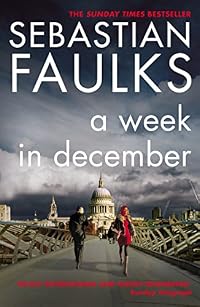
A Week in December
by Sebastian Faulks
On This Page
Description
A powerful contemporary novel set in London from a master of literary fiction. London, the week before Christmas, 2007. Over seven days we follow the lives of seven major characters: a hedge fund manager trying to bring off the biggest trade of his career; a professional footballer recently arrived from Poland; a young lawyer with little work and too much time to speculate; a student who has been led astray by Islamist theory; a hack book-reviewer; a schoolboy hooked on skunk and reality TV; show more and a Tube train driver whose Circle Line train joins these and countless other lives together in a daily loop. With daring skill, the novel pieces together the complex patterns and crossings of modern urban life. Greed, the dehumanising effects of the electronic age and the fragmentation of society are some of the themes dealt with in this savagely humorous book. The writing on the wall appears in letters ten feet high, but the characters refuse to see it -- and party on as though tomorrow is a dream. Sebastian Faulks probes not only the self-deceptions of this intensely realised group of people, but their hopes and loves as well. As the novel moves to its gripping climax, they are forced, one by one, to confront the true nature of the world they inhabit. show lessTags
Recommendations





















Member Recommendations

browner56 Interesting social satire that takes shots at the hubris of the financial services industry
30

Member Reviews
I have a particular fascination with books that move among multiple points of view, interweaving the characters' mini-plots into one well-crafted whole. Overall, Sebastian Faulks's latest novel, A Week in December, successfully does just that. With tongue firmly in cheek, but also with a good amount of affection for all of his characters, Faulks gives us a well-rounded but satirical view of contemporary London society: the good, the bad, the ugly, the charming, and the misguided.
As others have mentioned, two potentially disaster-creating characters--hedge fund owner John Veals and would-be terrorist Hassan al-Rashid--take center stage, and while their stories are indeed fascinating, they push the others' (some of which I found much more show more interesting) into the background. If the novel has one fault, it may be that there are a few too many threads in the plot, and, as a result, some characters get shorted. I wanted to know more about Jenni Fortune, the book-loving tube conductor who is addicted to an online role-playing game, and her blooming romance with barrister Gabriel Northwood; I wanted to learn more about Gabriel's schizophrenic brother Adam; about the senior al-Rashids; about Spike, the Polish soccer player, and his girlfriend, Olya, who poses for online porn.
The novel also runs the reader through the full emotional gamut. Perhaps the most satisfying moments for me were those that reflect on books, reading, academia, and the world of competitive literary prizes. Faulks is at his satirical best here. As an educator, I was particularly amused by a small incident, the book reviewer R. Tantor being hired (undercover, of course) by a school to write comments on students' papers, a way of appeasing the parents who complained that the teachers themselves couldn't even spell. And I was highly amused by Trantor's observation that technology has managed to make ignorance not only acceptable but an asset. He's a cranky old bird who gets his comeuppance in the end, but his perceptions are often right on target.
A Week in December is sharp, entertaining, and complex. It's one of those rare books that I will likely read again one day because I have the feeling that I might have missed something. show less
As others have mentioned, two potentially disaster-creating characters--hedge fund owner John Veals and would-be terrorist Hassan al-Rashid--take center stage, and while their stories are indeed fascinating, they push the others' (some of which I found much more show more interesting) into the background. If the novel has one fault, it may be that there are a few too many threads in the plot, and, as a result, some characters get shorted. I wanted to know more about Jenni Fortune, the book-loving tube conductor who is addicted to an online role-playing game, and her blooming romance with barrister Gabriel Northwood; I wanted to learn more about Gabriel's schizophrenic brother Adam; about the senior al-Rashids; about Spike, the Polish soccer player, and his girlfriend, Olya, who poses for online porn.
The novel also runs the reader through the full emotional gamut. Perhaps the most satisfying moments for me were those that reflect on books, reading, academia, and the world of competitive literary prizes. Faulks is at his satirical best here. As an educator, I was particularly amused by a small incident, the book reviewer R. Tantor being hired (undercover, of course) by a school to write comments on students' papers, a way of appeasing the parents who complained that the teachers themselves couldn't even spell. And I was highly amused by Trantor's observation that technology has managed to make ignorance not only acceptable but an asset. He's a cranky old bird who gets his comeuppance in the end, but his perceptions are often right on target.
A Week in December is sharp, entertaining, and complex. It's one of those rare books that I will likely read again one day because I have the feeling that I might have missed something. show less
I really enjoyed this one. It's smart, terribly funny, and incredibly cinematic (no doubt studios are battling over the film rights already).
This book starts out quick and keeps you reading – panning across a large cast of characters that sometimes only fleetingly, though always cleverly, overlaps. Each of the interwoven story lines offers suspense of its own, so the pace stays lively throughout. And the satire is so sharp and dead-on I started to wonder if the show “It’s Madness” was actually on the air in Britain.
Faulks nails everything that’s crazy in the 21st century. And though he’s writing about an era in which "you can't make this stuff up", he still manages turn the times into fiction that impresses with its show more inventiveness and insight. I found this a very satisfying work. show less
This book starts out quick and keeps you reading – panning across a large cast of characters that sometimes only fleetingly, though always cleverly, overlaps. Each of the interwoven story lines offers suspense of its own, so the pace stays lively throughout. And the satire is so sharp and dead-on I started to wonder if the show “It’s Madness” was actually on the air in Britain.
Faulks nails everything that’s crazy in the 21st century. And though he’s writing about an era in which "you can't make this stuff up", he still manages turn the times into fiction that impresses with its show more inventiveness and insight. I found this a very satisfying work. show less
Seven days, seven people, slice of life at the end of the world we all hope perished with the coming of our most recent financial crisis. Do that right, and you could be the modern Dickens or Trollope. Do it wrong, and you’ll remain plain old Sebastian Faulks of many TV appearances and no lasting fame.
It’s interesting, in light of the fact that surely this is Faulks’s bid for repute down the ages, that this book so clearly attributes the distortions and grotesqueries of the early 20th century to the death of the middlebrow, which Faulks, touchingly overreaching perhaps but with an undeniable core of truth, sees as signifying the death of the human. All the major characters here except one are more or less sympathetic, and all of show more them are struggling to hold onto either a rounded, magnificent Western humanism (I’m on the Tube into London for the first time in a year as I write this; hoping to spend some time dreaming among spires this trip, or at least blue plaques—and it’s worth noting in passing that if Faulks, or some other writer, had tried to set this book in New York, it would have been a retread of The Bonfire of the Vanities at best and a laughable pseud’s mess at worst; London has basically no competition as the symbol of our present decline and fall. Though that does lead to the further interesting question of when the great novel of real estate in Dubai, or the Chinese opera of hedge funds in Shanghai, is gonna happen). Northwood, with his deep thoughts; Tranter, the representative of old class dynamics and all their attendant resentment and self-loathing and righteous “there’s just one thing we’ve got more of / that’s our minds” warmaking, weirdly alien these days, when there’s no consciousness of who’s winning—as they like it—because we’re allllll supposed to be “ballers” or whatever, within our own limited horizons. And then the second group are the more wounded ones, the ones just trying to hang onto their humanity—Hassan, just trying to get clean, gravitating inevitably toward the form of resistance he’s given, the one that—how? why?—offers just as little of the full life, or of love, or fuck, hermeneutics—just didacticism, violence, and wealth and slaves in the hereafter. Is the human really so outmoded? Is all we can respond to the one-word answer? Or Jenni Fortune, who learns with trepidation to leave that answer behind, to come to life with Gabriel—and with simple kindness gives him an answer to his complex of needs as well. You’re rolling your eyes, but can anyone really say we don’t need to value kindness more? And exhort each other to do it until we do?
And then there is Veals. Terrifying not because he’s a memorable villain—just a regular, sociopathic, blinkered piece of shit. Terrifying perhaps because he’s not memorable—just a person reduced to a money machine, just the way capitalism reduces us all down our lines of least resistance—but Veals doesn’t try in even the most feeble or misguided way to fight it. I’m too close to this, historically speaking, to judge it, but in the The Way We Live Now awards for 2000–2010, it’s in with a fighting chance. show less
It’s interesting, in light of the fact that surely this is Faulks’s bid for repute down the ages, that this book so clearly attributes the distortions and grotesqueries of the early 20th century to the death of the middlebrow, which Faulks, touchingly overreaching perhaps but with an undeniable core of truth, sees as signifying the death of the human. All the major characters here except one are more or less sympathetic, and all of show more them are struggling to hold onto either a rounded, magnificent Western humanism (I’m on the Tube into London for the first time in a year as I write this; hoping to spend some time dreaming among spires this trip, or at least blue plaques—and it’s worth noting in passing that if Faulks, or some other writer, had tried to set this book in New York, it would have been a retread of The Bonfire of the Vanities at best and a laughable pseud’s mess at worst; London has basically no competition as the symbol of our present decline and fall. Though that does lead to the further interesting question of when the great novel of real estate in Dubai, or the Chinese opera of hedge funds in Shanghai, is gonna happen). Northwood, with his deep thoughts; Tranter, the representative of old class dynamics and all their attendant resentment and self-loathing and righteous “there’s just one thing we’ve got more of / that’s our minds” warmaking, weirdly alien these days, when there’s no consciousness of who’s winning—as they like it—because we’re allllll supposed to be “ballers” or whatever, within our own limited horizons. And then the second group are the more wounded ones, the ones just trying to hang onto their humanity—Hassan, just trying to get clean, gravitating inevitably toward the form of resistance he’s given, the one that—how? why?—offers just as little of the full life, or of love, or fuck, hermeneutics—just didacticism, violence, and wealth and slaves in the hereafter. Is the human really so outmoded? Is all we can respond to the one-word answer? Or Jenni Fortune, who learns with trepidation to leave that answer behind, to come to life with Gabriel—and with simple kindness gives him an answer to his complex of needs as well. You’re rolling your eyes, but can anyone really say we don’t need to value kindness more? And exhort each other to do it until we do?
And then there is Veals. Terrifying not because he’s a memorable villain—just a regular, sociopathic, blinkered piece of shit. Terrifying perhaps because he’s not memorable—just a person reduced to a money machine, just the way capitalism reduces us all down our lines of least resistance—but Veals doesn’t try in even the most feeble or misguided way to fight it. I’m too close to this, historically speaking, to judge it, but in the The Way We Live Now awards for 2000–2010, it’s in with a fighting chance. show less
This is a powerful contemporary novel set in London from a master of literary fiction.
Structured like a thriller, A Week in December takes place over the course of a single week at the end of 2008. Set in London, it brings together an intriguing cast of characters whose lives seem to run on parallel lines but, as gradually becomes clear, are intricately related. The central anti-hero, John Veals, is a shadily successful and boundlessly ambitious Dickensian character who is trading billions. The tentacles of Veals’ influence encompass newspaper columnists, MPs, businessmen, footballers, a female tube driver, a Scottish convert to Islam, a disaffected teenager, and a care worker, whose different perspectives build up a tale of love, show more family and money as the story builds to its powerful climax. All of the characters are utterly believable, and finely drawn, and Faulks displays complete mastery in the manner in which he interleaves their stories.
At times hilarious, yet also strewn with undercurrents of melancholic resignation, this novel also offers some poignant insights. The most striking of these was Gabriel Northwood's passionate lament over the failure of the education system, and the sad descent from a halcyon age when children were taught from a belief that it was simply good to have a wide base of knowledge rather than to equip them to take on jobs that might no longer be there by the time they leave school. show less
Structured like a thriller, A Week in December takes place over the course of a single week at the end of 2008. Set in London, it brings together an intriguing cast of characters whose lives seem to run on parallel lines but, as gradually becomes clear, are intricately related. The central anti-hero, John Veals, is a shadily successful and boundlessly ambitious Dickensian character who is trading billions. The tentacles of Veals’ influence encompass newspaper columnists, MPs, businessmen, footballers, a female tube driver, a Scottish convert to Islam, a disaffected teenager, and a care worker, whose different perspectives build up a tale of love, show more family and money as the story builds to its powerful climax. All of the characters are utterly believable, and finely drawn, and Faulks displays complete mastery in the manner in which he interleaves their stories.
At times hilarious, yet also strewn with undercurrents of melancholic resignation, this novel also offers some poignant insights. The most striking of these was Gabriel Northwood's passionate lament over the failure of the education system, and the sad descent from a halcyon age when children were taught from a belief that it was simply good to have a wide base of knowledge rather than to equip them to take on jobs that might no longer be there by the time they leave school. show less
As a long-time admirer of Tom Wolfe, it seems to me that producing the sort of panoramic social satire he specializes in can be very tricky business. At its best (The Bonfire of the Vanities), the work can be both wildly entertaining and help shape the way we view the world in which we live. When it fails (I Am Charlotte Simmons), however, the effect is quite the opposite as the reader is confronted with false notes on almost every page. This novel, whose economic and social themes make it a Bonfire for the new millennium, ends up falling somewhere between those two extremes.
Set in London during the week before Christmas in 2007, Faulks populates the book with a dizzying array of characters that cross virtually all possible lines in show more terms of race, gender, education, and economic and social status. Their stories intersect in ways that are occasionally meaningful but more often superficial and contrived. The two characters around whom the most significant events take place are a billionaire hedge fund manager seemingly intent on destroying England’s biggest bank for his own profit and a confused young Islamic jihadist involved in a plot to bomb a hospital. Thus, terrorism—both economic and physical—is the major concept around which much of the novel’s central action revolves.
My chief complaint about the world the author has created is the cursory way in which he has developed his main characters, most of whom come off as one-dimensional and cartoonish. In particular, the hedge fund manager is drawn to be totally loathsome and utterly devoid of human emotion or compassion; he shows no concern, for instance, as his son descends into drug-induced psychosis while he is trying to complete a big deal. In contrast, the jihadist is portrayed as being earnest and sincere, but ultimately confused. As other reviewers have noted, a revealing aspect of the novel’s political bent is that the former is seen as a far greater villain than the latter. Beyond those two, though, the other principal actors—the caring but impoverished attorney, the mixed-race transit worker traumatized by a bad past relationship, the Polish soccer star with a porn-industry girlfriend, the failed novelist turned cynical book reviewer—are never developed in sufficient depth for us to care about or even understand their motivations.
Despite this clumsiness in characterization, what ultimately made this a somewhat satisfying reading experience for me is the richness of the book’s ideas. Faulks is fearless in the way he tackles so many of the catalyzing issues of the day, including the inherent conflicts between Christian, Judaic, and Islamic beliefs, the devolution of the financial services industry, the widening economic gap between the “haves” and “have nots,” the politics of the book publishing business, and the obsession with reality-based media. (Incidentally, as a professor of Finance who teaches the topic for a living, I am really impressed by anyone who would even try to build a major work of fiction around credit default swaps. That almost seems like the punch line to a bar bet the author lost one night.) These are rich, thoughtful, and provocative discussions that, while I disagree completely with the author’s position on the economic merits of hedge funds, do justify the shallowness of the characters that had to be created to move them forward.
On balance, then, I found A Week in December to be a fully imagined, but half-finished world. Although hardly compact at almost 400 pages, it really needed to be either longer in order to develop the myriad story lines sufficiently or less ambitious in its scope. It is a book that I can recommend, but not without reservation. show less
Set in London during the week before Christmas in 2007, Faulks populates the book with a dizzying array of characters that cross virtually all possible lines in show more terms of race, gender, education, and economic and social status. Their stories intersect in ways that are occasionally meaningful but more often superficial and contrived. The two characters around whom the most significant events take place are a billionaire hedge fund manager seemingly intent on destroying England’s biggest bank for his own profit and a confused young Islamic jihadist involved in a plot to bomb a hospital. Thus, terrorism—both economic and physical—is the major concept around which much of the novel’s central action revolves.
My chief complaint about the world the author has created is the cursory way in which he has developed his main characters, most of whom come off as one-dimensional and cartoonish. In particular, the hedge fund manager is drawn to be totally loathsome and utterly devoid of human emotion or compassion; he shows no concern, for instance, as his son descends into drug-induced psychosis while he is trying to complete a big deal. In contrast, the jihadist is portrayed as being earnest and sincere, but ultimately confused. As other reviewers have noted, a revealing aspect of the novel’s political bent is that the former is seen as a far greater villain than the latter. Beyond those two, though, the other principal actors—the caring but impoverished attorney, the mixed-race transit worker traumatized by a bad past relationship, the Polish soccer star with a porn-industry girlfriend, the failed novelist turned cynical book reviewer—are never developed in sufficient depth for us to care about or even understand their motivations.
Despite this clumsiness in characterization, what ultimately made this a somewhat satisfying reading experience for me is the richness of the book’s ideas. Faulks is fearless in the way he tackles so many of the catalyzing issues of the day, including the inherent conflicts between Christian, Judaic, and Islamic beliefs, the devolution of the financial services industry, the widening economic gap between the “haves” and “have nots,” the politics of the book publishing business, and the obsession with reality-based media. (Incidentally, as a professor of Finance who teaches the topic for a living, I am really impressed by anyone who would even try to build a major work of fiction around credit default swaps. That almost seems like the punch line to a bar bet the author lost one night.) These are rich, thoughtful, and provocative discussions that, while I disagree completely with the author’s position on the economic merits of hedge funds, do justify the shallowness of the characters that had to be created to move them forward.
On balance, then, I found A Week in December to be a fully imagined, but half-finished world. Although hardly compact at almost 400 pages, it really needed to be either longer in order to develop the myriad story lines sufficiently or less ambitious in its scope. It is a book that I can recommend, but not without reservation. show less
 This review was written for LibraryThing Early Reviewers.
Powerful contemporary novel set in London from a master of literary fiction.
Structured like a thriller, A Week in December takes place over the course of a single week at the end of 2008. Set in London, it brings together an intriguing cast of characters whose lives apparently run on parallel lines but — as it gradually becomes clear — are intricately related. The central anti-hero, John Veals, is a shadily successful and boundlessly ambitious Dickensian character who is trading billions. The tentacles of Veals’ influence encompass newspaper columnists, MPs, businessmen, footballers, a female tube driver, a Scottish convert to Islam, a disaffected teenager, and a care worker, whose different perspectives build up a tale of love, show more family and money as the story builds to its powerful climax. All of the characters are utterly believable, and finely drawn, and Faulks displays complete mastery in the manner in which he interleaves their stories.
At times hilarious, yet also steeped at times in melancholic resignation, this novel also offers some poignant insights. The most striking of these was Gabriel Northwood's passionate lament over the failure of the education system, and the sad descent from a halcyon age when children were taught for the sheer sake of learning rather than to equip them to take on jobs that might no longer be there. show less
Structured like a thriller, A Week in December takes place over the course of a single week at the end of 2008. Set in London, it brings together an intriguing cast of characters whose lives apparently run on parallel lines but — as it gradually becomes clear — are intricately related. The central anti-hero, John Veals, is a shadily successful and boundlessly ambitious Dickensian character who is trading billions. The tentacles of Veals’ influence encompass newspaper columnists, MPs, businessmen, footballers, a female tube driver, a Scottish convert to Islam, a disaffected teenager, and a care worker, whose different perspectives build up a tale of love, show more family and money as the story builds to its powerful climax. All of the characters are utterly believable, and finely drawn, and Faulks displays complete mastery in the manner in which he interleaves their stories.
At times hilarious, yet also steeped at times in melancholic resignation, this novel also offers some poignant insights. The most striking of these was Gabriel Northwood's passionate lament over the failure of the education system, and the sad descent from a halcyon age when children were taught for the sheer sake of learning rather than to equip them to take on jobs that might no longer be there. show less
"A Week in December" offers a view of life in London over the course of one week in December 2007. There are numerous characters and the reader gets to know them all, some more than others. And chapter after chapter, the links between them come to light, some superficial and obscure, others much deeper than you first thought.
There is a financial tycoon who only lives for the next big deal, a teenage boy addicted to drugs and reality TV, a Polish footballer just starting his career in a London team, a young female tube driver who plays an online game in her free time, a poor lawyer trying to find his way, a young muslim ensnared by a radical group, a literary critic who hates contemporary literature, and so on...
In the beginning it was show more hard for me to keep the characters straight and to get used to the story which was much more about these characters than about a specific plot. But after some time, I just went along with the ride and the characters grew on me. Each of them, in their own way, is looking for a life worth living, dealing with feelings of loneliness and isolation, trying to find something to hold on to. It is so true to life on the small scale. On the big scale, however, Faulks hits on basically every contemporary topic that was big in the late 2000s: The world of finance, terrorism, TV & online media, the publishing world, the health system, integration. His satire is sharp, yet the strength of the book for me is in the characters and the ties between them. I would happily have read a whole novel about each of these characters, with the exception of the hedge fund manager, because well, there was already more about the finance world than I ever wanted to know in this novel. show less
There is a financial tycoon who only lives for the next big deal, a teenage boy addicted to drugs and reality TV, a Polish footballer just starting his career in a London team, a young female tube driver who plays an online game in her free time, a poor lawyer trying to find his way, a young muslim ensnared by a radical group, a literary critic who hates contemporary literature, and so on...
In the beginning it was show more hard for me to keep the characters straight and to get used to the story which was much more about these characters than about a specific plot. But after some time, I just went along with the ride and the characters grew on me. Each of them, in their own way, is looking for a life worth living, dealing with feelings of loneliness and isolation, trying to find something to hold on to. It is so true to life on the small scale. On the big scale, however, Faulks hits on basically every contemporary topic that was big in the late 2000s: The world of finance, terrorism, TV & online media, the publishing world, the health system, integration. His satire is sharp, yet the strength of the book for me is in the characters and the ties between them. I would happily have read a whole novel about each of these characters, with the exception of the hedge fund manager, because well, there was already more about the finance world than I ever wanted to know in this novel. show less
Members
- Recently Added By
Published Reviews
ThingScore 75
Lists

Top Five Books of 2013
1,564 works; 722 members

Best Books Set in London
157 works; 42 members
Author Information

38+ Works 21,445 Members
Sebastian Faulks is the author of Where My Heart Used to Beat, which made the New Zealand Best Seller List 2015. (Bowker Author Biography)
Some Editions
Awards and Honors
Awards
Series
Belongs to Publisher Series
Common Knowledge
- Canonical title*
- Een week in december
- Original publication date
- 2010
- People/Characters
- Gabriel Northwood; Sophie Topping; R. Tranter; John Veals; Jenni Fortune; Hasaan al-Rashid
- Important places
- London, England, UK; The Tube, London, England, UK
- Important events
- Credit crunch
- Epigraph
- 'As long as the music is playing, you've got to get up and dance... We're still dancing.'
Chuck Prince, Chief Executive, Citigroup, interview, Financial Times, July 9, 2007
'If you talk to God, you are praying. If God talks to you, you have schizophrenia.'
Dr. Thomas Szasz, psychiatrist, The Second Sin, 1973 - Dedication
- For David Jones-Parry
- First words
- Five o'clock and freezing.
- Last words
- (Click to show. Warning: May contain spoilers.)As he stood with his hands in his pockets, staring out over the sleeping city, over its darkened wheels and spires and domes, Veals laughed.
- Original language*
- English
- Disambiguation notice*
- original title: A Week in December
*Some information comes from Common Knowledge in other languages. Click "Edit" for more information.
Classifications
Statistics
- Members
- 1,437
- Popularity
- 16,259
- Reviews
- 74
- Rating
- (3.38)
- Languages
- 5 — Dutch, English, Finnish, French, Russian
- Media
- Paper, Audiobook, Ebook
- ISBNs
- 31
- ASINs
- 14
