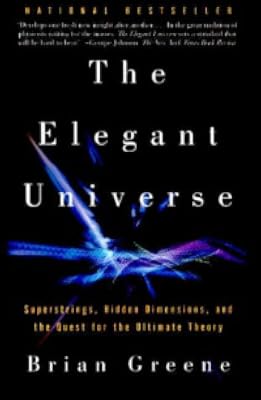
The Elegant Universe: Superstrings, Hidden Dimensions, and the Quest for the Ultimate Theory
by Brian Greene
On This Page
Description
Science. Physics. Nonfiction. HTML:"[Greene] develops one fresh new insight after another...In the great tradition of physicists writing for the masses, The Elegant Universe sets a standard that will be hard to beat." —George Johnson, The New York Times Book ReviewIn a rare blend of scientific insight and writing as elegant as the theories it explains, Brian Greene, one of the world's leading string theorists, peels away the layers of mystery surrounding string theory to reveal a universe show more that consists of 11 dimensions where the fabric of space tears and repairs itself, and all matter-from the smallest quarks to the most gargantuan supernovas-is generated by the vibrations of microscopically tiny loops of energy.
Green uses everything from an amusement park ride to ants on a garden hose to illustrate the beautiful yet bizarre realities that modern physics is unveiling. Dazzling in its brilliance, unprecedented in its ability to both illuminate and entertain, The Elegant Universe is a tour de force of science writing-a delightful, lucid voyage through modern physics that brings us closer than ever to understanding how the universe works. show less
Tags
Recommendations



Member Reviews
An excellent explanation of a theory we've all heard of but which few non-physicists, I fear, have much grasp of. Building up from the basics, through general relativity and quantum mechanics, Greene paints a phenomenally rich and compelling picture of superstring theory (and its derivatives) with analogies perfectly suited to make this ephemeral set of ideas intuitive. I'm convinced! A must-read.
This was my breakthrough book with General Relativity.
I remember reading it on a plane as a teenager and when the author's analogies (which are great) of Einstein's General Theory of Relativity finally broke through to me, something switched on in my brain. My jaw literally dropped, and I looked out over the clouds, into the stars, with absolute disbelief. At that moment, my entire understand of the world around me, and in me, was profoundly and forever changed. I almost cried when I understood the implications of relativity.
As the book continues on, however, the author seems to leave the layman behind. Perhaps I am sub-layman, and others who consider themselves laymen found the latter quantum mechanics chapters easy to grapple with. show more But I lost my ability to comprehend his writing as the theories and jargon piled on heavier and heavier.
And don't get me started on the string theory chapters. What the hell is string theory. Like seriously.
In conclusion, I must rate this book highly because it was my first taste of the world of relativity, but I can't say I got much out of the quantum mechanics or string theory because they were just too tough to handle.
Maybe I'm just dumb. show less
I remember reading it on a plane as a teenager and when the author's analogies (which are great) of Einstein's General Theory of Relativity finally broke through to me, something switched on in my brain. My jaw literally dropped, and I looked out over the clouds, into the stars, with absolute disbelief. At that moment, my entire understand of the world around me, and in me, was profoundly and forever changed. I almost cried when I understood the implications of relativity.
As the book continues on, however, the author seems to leave the layman behind. Perhaps I am sub-layman, and others who consider themselves laymen found the latter quantum mechanics chapters easy to grapple with. show more But I lost my ability to comprehend his writing as the theories and jargon piled on heavier and heavier.
And don't get me started on the string theory chapters. What the hell is string theory. Like seriously.
In conclusion, I must rate this book highly because it was my first taste of the world of relativity, but I can't say I got much out of the quantum mechanics or string theory because they were just too tough to handle.
Maybe I'm just dumb. show less
“A Mind-Bending Exploration of the Universe’s Hidden Dimensions” 4-Stars by Rebecca Raffle
⭐️⭐️⭐️⭐️
The Elegant Universe is an ambitious, thought-provoking dive into the world of string theory, relativity, and quantum mechanics. It was a book that left me both awestruck and, at times, mentally exhausted (in the best way possible).
Brian Greene has a rare gift: he makes incredibly complex physics feel almost intuitive, weaving together mathematical theory with engaging storytelling and vivid analogies. His explanations of extra dimensions, vibrating strings, and the quest for a unified theory are fascinating, even when they challenge everything you think you know about reality.
What stood out most to me was his show more breakdown of Einstein’s relativity versus quantum mechanics. They are two pillars of modern physics that seem irreconcilable until string theory offers a potential solution.
Greene describes it as a “theory of everything”, and while that idea is both exciting and controversial, he presents it with both enthusiasm and scientific rigor.
“Physicists have been struggling to unify gravity and quantum mechanics for nearly a century. String theory offers a compelling solution—if it proves to be true.”
That’s where the book gets tricky. While I loved the sense of discovery and intellectual adventure, some of the later chapters become dense, speculative, and theoretical, making me wish for a bit more grounding in experimental science. Greene acknowledges that much of string theory remains unproven, but at times, the sheer complexity of the subject makes it feel like we’re grasping at shadows of an unseen reality.
Who Should Read This?
✔️ Anyone Curious About the Universe – If you’ve ever looked at the stars and wondered what reality is made of, this book will blow your mind.
✔️ Fans of A Brief History of Time – Greene’s approach is a bit more detailed, but equally enthusiastic and fascinating.
✔️ Readers Who Enjoy a Challenge – This isn’t light reading, but it rewards patience with mind-expanding ideas.
Final Thoughts 🔥
I’m giving The Elegant Universe 4 stars because while it’s brilliantly written and endlessly fascinating, it can become overwhelming in its complexity. That said, if you’re willing to push through the tough parts, it offers a thrilling glimpse into the fundamental structure of the cosmos.
🚀 If you’ve ever wondered whether reality has more dimensions than we can see, this book will keep you up at night.
📚 Enjoy my reviews? Let’s connect!
📖 Read more in-depth reviews & essays on Medium: medium.com/@RebeccaRaffle
📷 Follow my Instagram @RebeccaRaffle for book updates & foodie adventures: https://www.instagram.com/rebeccaraffle
🌍 Explore more on my website: https://www.rebeccaraffle.com show less
⭐️⭐️⭐️⭐️
The Elegant Universe is an ambitious, thought-provoking dive into the world of string theory, relativity, and quantum mechanics. It was a book that left me both awestruck and, at times, mentally exhausted (in the best way possible).
Brian Greene has a rare gift: he makes incredibly complex physics feel almost intuitive, weaving together mathematical theory with engaging storytelling and vivid analogies. His explanations of extra dimensions, vibrating strings, and the quest for a unified theory are fascinating, even when they challenge everything you think you know about reality.
What stood out most to me was his show more breakdown of Einstein’s relativity versus quantum mechanics. They are two pillars of modern physics that seem irreconcilable until string theory offers a potential solution.
Greene describes it as a “theory of everything”, and while that idea is both exciting and controversial, he presents it with both enthusiasm and scientific rigor.
“Physicists have been struggling to unify gravity and quantum mechanics for nearly a century. String theory offers a compelling solution—if it proves to be true.”
That’s where the book gets tricky. While I loved the sense of discovery and intellectual adventure, some of the later chapters become dense, speculative, and theoretical, making me wish for a bit more grounding in experimental science. Greene acknowledges that much of string theory remains unproven, but at times, the sheer complexity of the subject makes it feel like we’re grasping at shadows of an unseen reality.
Who Should Read This?
✔️ Anyone Curious About the Universe – If you’ve ever looked at the stars and wondered what reality is made of, this book will blow your mind.
✔️ Fans of A Brief History of Time – Greene’s approach is a bit more detailed, but equally enthusiastic and fascinating.
✔️ Readers Who Enjoy a Challenge – This isn’t light reading, but it rewards patience with mind-expanding ideas.
Final Thoughts 🔥
I’m giving The Elegant Universe 4 stars because while it’s brilliantly written and endlessly fascinating, it can become overwhelming in its complexity. That said, if you’re willing to push through the tough parts, it offers a thrilling glimpse into the fundamental structure of the cosmos.
🚀 If you’ve ever wondered whether reality has more dimensions than we can see, this book will keep you up at night.
📚 Enjoy my reviews? Let’s connect!
📖 Read more in-depth reviews & essays on Medium: medium.com/@RebeccaRaffle
📷 Follow my Instagram @RebeccaRaffle for book updates & foodie adventures: https://www.instagram.com/rebeccaraffle
🌍 Explore more on my website: https://www.rebeccaraffle.com show less
Relativity and quantum mechanics both help us understand the universe, but in some cases the equations involved don't play nice and come up with nonsensical answers. Superstring theory (or string theory for short) is a "theory of everything" that attempts to better explain the universe. The gist of the theory is that instead of particles (electrons, quarks, etc.), the smallest units are, in fact, vibrating one-dimensional strings. In The Elegant Universe, Greene expands on the basics to explain in fairly non-mathematical language what the possible ramifications would be.
I never took physics in school, though I'm fascinated by the subject and have read a handful of popular science books on the topic. That being said, I probably would not show more have managed to finish this book if it hadn't been for a tutored read with help from fellow LTer Jim (drneutron). In the first few chapters, Greene details what has gone on in physics before, from our changing understanding of gravity, to special and general relativity. In chapter 5, he switches gears and lays out the basics of string theory. Chapter 7 on gets more and more speculative as Greene explores how 10 dimensions could exist, supersymmetry, black holes, and more. He is a definite proponent of the theory, and is not always clear about what is a core part of string theory or what is a fun mathematical possibility within the theory. Still, it was entertaining to read and a mind-stretching experience. I will be very interested in seeing what the next decade brings to the search for a theory of everything. show less
I never took physics in school, though I'm fascinated by the subject and have read a handful of popular science books on the topic. That being said, I probably would not show more have managed to finish this book if it hadn't been for a tutored read with help from fellow LTer Jim (drneutron). In the first few chapters, Greene details what has gone on in physics before, from our changing understanding of gravity, to special and general relativity. In chapter 5, he switches gears and lays out the basics of string theory. Chapter 7 on gets more and more speculative as Greene explores how 10 dimensions could exist, supersymmetry, black holes, and more. He is a definite proponent of the theory, and is not always clear about what is a core part of string theory or what is a fun mathematical possibility within the theory. Still, it was entertaining to read and a mind-stretching experience. I will be very interested in seeing what the next decade brings to the search for a theory of everything. show less
At long last I have finished this book. It took me a long time to read it, not because I didn't find it interesting, but because I needed to have periods of uninterrupted time to read and absorb the information. Uninterrupted time seemed to be at a premium this spring.
However, having read it, I believe I can say I understand string theory a little bit whereas, before I read it, I had barely even heard of string theory. Dr. Greene's illustrations and examples helped a lot to make a rather arcane subject comprehensible. One example, though, really jarred me. On page 264 he is talking about wormholes and uses the idea of a bridge between the World Trade Centre Towers to illustrate the concept. Of course, this was written before 9/11 but show more it occurred to me that the terrorists really chose their target well when it is used even in a scientific text to illustrate something of massive size.
Dr. Greene is obviously that rarest of scientists i.e. someone who can explain their specialty in terms a novice can easily understand.
Having said all this, a part of me still wonders if string theory isn't some giant hoax foisted on us by physicists who sit around and laugh uproariously at how gullible we are. I work in biochemistry research and I'm used to not seeing the particles I work with (enzymes) but at least we can perform experiments which show reactions in the presence of and in the absence of the particles and thereby demonstrate that there is a difference. String theorists seem mostly to manipulate equations and then say they prove what they set out to prove. It's a little too esoteric for my liking. I'll stick to biochemistry. show less
However, having read it, I believe I can say I understand string theory a little bit whereas, before I read it, I had barely even heard of string theory. Dr. Greene's illustrations and examples helped a lot to make a rather arcane subject comprehensible. One example, though, really jarred me. On page 264 he is talking about wormholes and uses the idea of a bridge between the World Trade Centre Towers to illustrate the concept. Of course, this was written before 9/11 but show more it occurred to me that the terrorists really chose their target well when it is used even in a scientific text to illustrate something of massive size.
Dr. Greene is obviously that rarest of scientists i.e. someone who can explain their specialty in terms a novice can easily understand.
Having said all this, a part of me still wonders if string theory isn't some giant hoax foisted on us by physicists who sit around and laugh uproariously at how gullible we are. I work in biochemistry research and I'm used to not seeing the particles I work with (enzymes) but at least we can perform experiments which show reactions in the presence of and in the absence of the particles and thereby demonstrate that there is a difference. String theorists seem mostly to manipulate equations and then say they prove what they set out to prove. It's a little too esoteric for my liking. I'll stick to biochemistry. show less
First, despite being 20 years old, this book isn't particularly dated. Lots of questions about string theory still remain.
Greene writes very clearly as he describes first the theories of Einstein and of Quantum Mechanics, then why they don't reconcile with each other and how string theory brings them together--at least in theory. As a non-scientist, I am still not 100 percent certain how physicists can derive so many facts from an unproven theory, but Greene explains things about as well as it is possible to do so. I found it a compelling and not particularly difficult read. Before I read the book, I had watched Greene's PBS series based on it (and Greene's second PBS series based on his later book, The Fabric of the Cosmos.) This show more predisposed me to like the book and its author, since Greene's star power and ability to communicate complex ideas quite clearly is pretty amazing. If you're buying this book used, try to get a copy with the updated preface and epilogue. show less
Greene writes very clearly as he describes first the theories of Einstein and of Quantum Mechanics, then why they don't reconcile with each other and how string theory brings them together--at least in theory. As a non-scientist, I am still not 100 percent certain how physicists can derive so many facts from an unproven theory, but Greene explains things about as well as it is possible to do so. I found it a compelling and not particularly difficult read. Before I read the book, I had watched Greene's PBS series based on it (and Greene's second PBS series based on his later book, The Fabric of the Cosmos.) This show more predisposed me to like the book and its author, since Greene's star power and ability to communicate complex ideas quite clearly is pretty amazing. If you're buying this book used, try to get a copy with the updated preface and epilogue. show less
Well-written, fascinating look at the development of special and general relativity—and the omissions that are driving theoretical research ever since. HOWEVER, and this is a huge caveat, most of the book may be chronicling a misfire. (Lee Smolin's book THE TROUBLE WITH PHYSICS makes a good case for String Theory's failures; I'm about to re-read it to refresh my memory, so I can't go into too much detail yet.)
Greene's storytelling is certainly seductive, but a lot of String Theory's appeal is getting the same results as other theories, but in a more elegant fashion. This is a good thing because it means the theory avoids being outright wrong, but makes it difficult to find results that'll uniquely support strings, and not just the show more mass of other popular theories.
More troublingly, the experimental evidence that might support strings or these other theories simply isn't showing up. The Large Hadron Collider found the Higgs Boson, but has yet to uncover ANY signs of supersymmetry—the linchpin of string theory and other popular proposals. Oops. Of course, there are always other variants that hold out the hope that supersymmetric partners are just higher mass and harder to reach, but constant tweaking and adjustment kinda undermines the original claims to elegance!
When the book is standing on firmer ground, it's marvelous; Greene is a fantastic writer and explainer. But as an argument for String Theory? Reader beware. show less
Greene's storytelling is certainly seductive, but a lot of String Theory's appeal is getting the same results as other theories, but in a more elegant fashion. This is a good thing because it means the theory avoids being outright wrong, but makes it difficult to find results that'll uniquely support strings, and not just the show more mass of other popular theories.
More troublingly, the experimental evidence that might support strings or these other theories simply isn't showing up. The Large Hadron Collider found the Higgs Boson, but has yet to uncover ANY signs of supersymmetry—the linchpin of string theory and other popular proposals. Oops. Of course, there are always other variants that hold out the hope that supersymmetric partners are just higher mass and harder to reach, but constant tweaking and adjustment kinda undermines the original claims to elegance!
When the book is standing on firmer ground, it's marvelous; Greene is a fantastic writer and explainer. But as an argument for String Theory? Reader beware. show less
Members
- Recently Added By
Published Reviews
ThingScore 100
In the great tradition of physicists writing for the masses, ''The Elegant Universe'' sets a standard that will be hard to beat.
added by jlelliott
Lists

Non-Fiction Worth Reading
1,016 works; 258 members

Unread books
1,063 works; 87 members

For Science!
39 works; 5 members

25 Greatest Science Books of All Time
33 works; 6 members

Phi Beta Kappa reading list
260 works; 8 members

Read These Too
458 works; 9 members

Physics
29 works; 3 members

Books Read in 2018
4,360 works; 110 members

The r/AskScience Reading List
159 works; 3 members
Favourite Books
1,820 works; 316 members
Talk Discussions
Past Discussions
The Elegant Universe by Brian Greene - drneutron tutoring bell7 in 75 Books Challenge for 2012 (July 2016)
Author Information

24+ Works 19,100 Members
Brian Greene was born on February 9, 1963 in New York City. After attending Stuyvesant High School, where he was a classmate of fellow physicist Lisa Randall. Brian Greene entered Harvard in 1980 to major in physics. He graduated with a bachelor's degree, and went on to earn his doctorate from Oxford University as a Rhodes Scholar, graduating in show more 1987. Greene joined the physics faculty of Cornell University in 1990, and was appointed to a full professorship in 1995. The following year, he joined the staff of Columbia University as a full professor; this remains his current position. At Columbia, Greene is co-director of the University's Institute for Strings, Cosmology, and Astroparticle Physics (ISCAP), and is leading a research program applying superstring theory to cosmological questions. He has become known to a wider audience through his books for the general public, The Elegant Universe, Icarus at the Edge of Time, The Fabric of the Cosmos, The Hidden Reality, and a related PBS television special. (Bowker Author Biography) show less
Some Editions
Awards and Honors
Awards
Distinctions
Series
Belongs to Publisher Series
Work Relationships
Is contained in
Contains
Has the adaptation
Is abridged in
Common Knowledge
- Canonical title
- The Elegant Universe: Superstrings, Hidden Dimensions, and the Quest for the Ultimate Theory
- Original title
- The Elegant Universe: Superstrings, Hidden Dimensions, and the Quest for the Ultimate Theory
- Original publication date
- 1999 (1st edition, New York, W.W. Norton) (1st edition, New York, W.W. Norton)
- People/Characters
- Albert Einstein
- Dedication
- To my mother and the memory of my father, with love and gratitude
- First words
- Preface
During the last thirty years of his life, Albert Einstein sought relentlessly for a so-called unified field theory—a theory capable of describing nature's forces within a single, all-encompassing, coherent framew... (show all)ork.
Calling it a cover-up would be far too dramatic. - Last words
- (Click to show. Warning: May contain spoilers.)And as our generation marvels at our new view of the universe—our new way of asserting the world's coherence—we are fulfilling our part, contributing our rung to the human ladder reaching for the stars.
- Blurbers
- Lightman, Alan; Johnson, George
- Original language*
- Inglese
- Disambiguation notice
- Full title (1999): The elegant universe : superstrings, hidden dimensions, and the quest for the ultimate theory / Brian Greene
*Some information comes from Common Knowledge in other languages. Click "Edit" for more information.
Classifications
Statistics
- Members
- 10,034
- Popularity
- 999
- Reviews
- 91
- Rating
- (3.98)
- Languages
- 18 — Czech, Dutch, English, Finnish, French, German, Greek, Hungarian, Italian, Japanese, Polish, Portuguese, Romanian, Russian, Slovenian, Spanish, Swedish, Turkish
- Media
- Paper, Audiobook, Ebook
- ISBNs
- 61
- UPCs
- 1
- ASINs
- 40