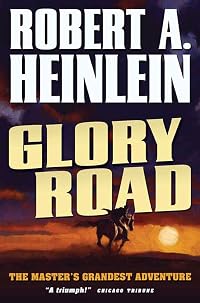
Glory Road
by Robert A. Heinlein
On This Page
Description
E. C. "Scar" Gordon was on the French Riviera recovering from a tour of combat in Southeast Asia, but he hadn't given up his habit of scanning the personals in the newspaper. One ad in particular leapt out at him:Are you a coward? This is not for you. We badly need a brave man. He must be 23 to 25 years old, in perfect health, at least six feet tall, weigh about 190 pounds, fluent English with some French, proficient with all weapons, some knowledge of engineering and mathematics essential, show more willing to travel, no family or emotional ties, indomitably courageous and handsome of face and figure. Permanent employment, very high pay, glorious adventure, great danger. You must apply in person, 17 rue Dante, Nice, 2me étage, apt. D.
How could you not answer an ad like that, especially when it seemed to describe you perfectly? Well, except maybe for the "handsome" part, but that was in the eye of the beholder anyway. So he went to that apartment and was greeted by the most beautiful woman he'd ever met. She seemed to have many names but agreed he could call her Star. A pretty appropriate name, as it turned out, for the empress of twenty universes. And she sends him on the adventure of a lifetime.Robert A. Heinlein's one true fantasy novel, Glory Road is as much fun today as when he wrote it after Stranger in a Strange Land. Heinlein proves himself as adept with sword and sorcery as with rockets and slide rules, and the result is exciting, satirical, fast-paced, funny, and tremendously readable—a favorite of all who have read it. Glory Road is a masterpiece of escapist entertainment with a typically Heinleinian sting in its tail.
. show less
Tags
Recommendations
















Member Recommendations
Member Reviews
Re-reading my least favorite of Heinlein's works, because who knows? Maybe an older eye can shed some light upon this most shameful of tales rife with sexism, unabashed fantastical thinking (that works because this is a fantasy), or the fact that there *might* be a good reason why Heinlein only wrote one fantasy novel.
Results of my analysis are pretty much the same as when I was a kid. Odd, that. I mean, sure, there's the fighting of dragons and lots of really cool swordplay, geometrical magical symbols and magic flying everywhere, and adventure, adventure, adventure, and while none of that is particularly noteworthy in a world literally overwhelmed with such things, there is a certain odd quirk to this novel that at once feels way out show more of place for a fantasy novel and later how it becomes almost the entire focus.
It's a book about relationships.
Not heroism, guts, luck, or doing one's manly duty.
It's about getting in the girl's pants, discovering that she's playing him for the same reason, marrying her because of a sense of "that's what men do", learning she's a galactic empress in a high-tech interstellar kingdom, learning he's filthy rich, and then, even though he's "wildly in love" with her, gets bored within months and drops her to go back to earth and act like a screwed-up war vet, all the while obsessing over her, the fact that he'd just given up high-tech immortality and endless wealth, and he dropped her all because she's freaking old, too, and it doesn't even matter if she looks like she's in her early 20's and she's an empress that has been ruling for a long time. He's upset because she went out to sow her wild oats, and he was the result.
Wild sexism is rampant throughout this novel. Absolutely. All on his part. He's pretty much the perfect example of "do as I say not as I do" idiocy that men tell each other about the women in their lives, and because this is a poor fantasy because it is just as fantastical to see this dipshit as a lady's man that all the chicks flock to, it IS a condemnation of such thinking, too.
I mean, I think I'd have preferred to have read the book from Star's PoV, not Scar's. After all, she's out there playing the game and even offering this dipshit not just the world but her wonderful self, endless wealth, immortality, and the respect of a whole empire for the heroic deeds that he (and she) accomplished. She played the game as only a smart and sexy woman of 1964 could play it, hamming it up for the benefit of the idiot male and giving him what he expected at every turn. All she really wanted was fun and companionship and a bit of love. She'd already had three children and 50 born ex-vitro. She has experience, she's smart, and she's bored.
It's just a shame that we had to follow along with this asshole, instead. If the novel had been written the way that Heinlein had written Maureen from Sail Beyond the Sunset, this novel would probably be a long-enduring classic. But it wasn't.
I did like the full synthesis of other-universal conditions that changed the laws where certain tech isn't feasible but magic is. This makes the novel Science-Fantasy rather than standard SF, but I have no problems with it. It was nominated for the Hugo in '64 and [b:Way Station|190999|Way Station|Clifford D. Simak|https://d.gr-assets.com/books/1326490682s/190999.jpg|348798] won instead. That was a smart move. [b:Way Station|190999|Way Station|Clifford D. Simak|https://d.gr-assets.com/books/1326490682s/190999.jpg|348798] was awesome. :)
I knocked off a star from my original review for all the reasons listed. It may be unfair to judge a work that is of its times this way, kind of like judging the men in Mad Men in the early 60's for their behavior by our standards, but it is what it is. *shrug*
Let's see how some of my better-beloved Heinleins will hold up! :) show less
Results of my analysis are pretty much the same as when I was a kid. Odd, that. I mean, sure, there's the fighting of dragons and lots of really cool swordplay, geometrical magical symbols and magic flying everywhere, and adventure, adventure, adventure, and while none of that is particularly noteworthy in a world literally overwhelmed with such things, there is a certain odd quirk to this novel that at once feels way out show more of place for a fantasy novel and later how it becomes almost the entire focus.
It's a book about relationships.
Not heroism, guts, luck, or doing one's manly duty.
It's about getting in the girl's pants, discovering that she's playing him for the same reason, marrying her because of a sense of "that's what men do", learning she's a galactic empress in a high-tech interstellar kingdom, learning he's filthy rich, and then, even though he's "wildly in love" with her, gets bored within months and drops her to go back to earth and act like a screwed-up war vet, all the while obsessing over her, the fact that he'd just given up high-tech immortality and endless wealth, and he dropped her all because she's freaking old, too, and it doesn't even matter if she looks like she's in her early 20's and she's an empress that has been ruling for a long time. He's upset because she went out to sow her wild oats, and he was the result.
Wild sexism is rampant throughout this novel. Absolutely. All on his part. He's pretty much the perfect example of "do as I say not as I do" idiocy that men tell each other about the women in their lives, and because this is a poor fantasy because it is just as fantastical to see this dipshit as a lady's man that all the chicks flock to, it IS a condemnation of such thinking, too.
I mean, I think I'd have preferred to have read the book from Star's PoV, not Scar's. After all, she's out there playing the game and even offering this dipshit not just the world but her wonderful self, endless wealth, immortality, and the respect of a whole empire for the heroic deeds that he (and she) accomplished. She played the game as only a smart and sexy woman of 1964 could play it, hamming it up for the benefit of the idiot male and giving him what he expected at every turn. All she really wanted was fun and companionship and a bit of love. She'd already had three children and 50 born ex-vitro. She has experience, she's smart, and she's bored.
It's just a shame that we had to follow along with this asshole, instead. If the novel had been written the way that Heinlein had written Maureen from Sail Beyond the Sunset, this novel would probably be a long-enduring classic. But it wasn't.
I did like the full synthesis of other-universal conditions that changed the laws where certain tech isn't feasible but magic is. This makes the novel Science-Fantasy rather than standard SF, but I have no problems with it. It was nominated for the Hugo in '64 and [b:Way Station|190999|Way Station|Clifford D. Simak|https://d.gr-assets.com/books/1326490682s/190999.jpg|348798] won instead. That was a smart move. [b:Way Station|190999|Way Station|Clifford D. Simak|https://d.gr-assets.com/books/1326490682s/190999.jpg|348798] was awesome. :)
I knocked off a star from my original review for all the reasons listed. It may be unfair to judge a work that is of its times this way, kind of like judging the men in Mad Men in the early 60's for their behavior by our standards, but it is what it is. *shrug*
Let's see how some of my better-beloved Heinleins will hold up! :) show less
Heinlein's Stranger in a Strange Land (1961) was certainly his most read and most influential novel. The one that followed next, Glory Road (1963), was perhaps his least. In terms of basic literary substance and quality, it represented no slackening on his part, but it fell afoul of a genre-oriented readership that expected Science Fiction from a writer who had done as much as anyone to define the form in the mid-20th century. Instead, Glory Road most nearly approximates heroic fantasy, albeit in a subversive manner consistent with the Cabellesque, satirical inclinations already on display in Stranger in a Strange Land.
If it were to be given a Cabell-style subtitle, Glory Road might well have been called "A Comedy of Vocation." show more Heinlein's not-thoroughly-sympathetic protagonist "Easy" Gordon is a young US army veteran of the "police action" in Southeast Asia. As he is trying to sort out his future, it seems as if he might have a winning sweepstakes ticket that will put him through college. It turns out that he himself is a winning ticket (a.k.a. "hero") for a sorceress from another dimension who needs his help to reclaim an invaluable artifact from a hostile world. So roughly the first two thirds of the book is the gradual disclosure and accomplishment of this quest for the "Egg of the Phoenix."
But the final third of the book is far too much for a "happily ever after," and even exceeds what might be classed as a denouement. In this structural respect, as in several others, the book reminded me of Fleming's Casino Royale from about a decade earlier. (Substitute fencing for baccarat in this case.) Gordon discovers that being a "retired hero" does not suit him, and that having achieved greater rewards and higher luxury than he could have possibly imagined, he is dissatisfied without work to suit his character. The resolution of this dilemma, complicated through personal relationships and extradimensional migration, is the concern of the final arc of the story.
Like Stranger, Glory Road is sure to offend some 21st-century shallow readers who want to collapse the sexual prejudices of its protagonist onto its author--despite the protagonist overcoming some of those prejudices, and despite the story upending a variety of gender preconceptions within both the 'fairy tale' and 'fantasy adventure' paradigms. A few of Heinlein's personal fetishes (sexual or otherwise) are likely on display, but these are gestures I wouldn't begrudge any author. An epigram from George Bernard Shaw's Caesar and Cleopatra is the first instance of a leitmotif regarding cultural difference and moral relativism that is sounded throughout the book, not just in the later sections that portray the social commerce of a multiverse.
But "cultural pluralism" (as it is called in the Samuel Delany essay about the book appended to my 2004 Tor edition) is not the central conundrum of the book. As noted before, it is about the necessity of finding and cleaving to a calling, despite convention, cowardice, and any sort of distracting appetite. Gordon discovers what is needful in order to do that one thing which is the true purpose of his sojourn, and that makes him a hero. show less
If it were to be given a Cabell-style subtitle, Glory Road might well have been called "A Comedy of Vocation." show more Heinlein's not-thoroughly-sympathetic protagonist "Easy" Gordon is a young US army veteran of the "police action" in Southeast Asia. As he is trying to sort out his future, it seems as if he might have a winning sweepstakes ticket that will put him through college. It turns out that he himself is a winning ticket (a.k.a. "hero") for a sorceress from another dimension who needs his help to reclaim an invaluable artifact from a hostile world. So roughly the first two thirds of the book is the gradual disclosure and accomplishment of this quest for the "Egg of the Phoenix."
But the final third of the book is far too much for a "happily ever after," and even exceeds what might be classed as a denouement. In this structural respect, as in several others, the book reminded me of Fleming's Casino Royale from about a decade earlier. (Substitute fencing for baccarat in this case.) Gordon discovers that being a "retired hero" does not suit him, and that having achieved greater rewards and higher luxury than he could have possibly imagined, he is dissatisfied without work to suit his character. The resolution of this dilemma, complicated through personal relationships and extradimensional migration, is the concern of the final arc of the story.
Like Stranger, Glory Road is sure to offend some 21st-century shallow readers who want to collapse the sexual prejudices of its protagonist onto its author--despite the protagonist overcoming some of those prejudices, and despite the story upending a variety of gender preconceptions within both the 'fairy tale' and 'fantasy adventure' paradigms. A few of Heinlein's personal fetishes (sexual or otherwise) are likely on display, but these are gestures I wouldn't begrudge any author. An epigram from George Bernard Shaw's Caesar and Cleopatra is the first instance of a leitmotif regarding cultural difference and moral relativism that is sounded throughout the book, not just in the later sections that portray the social commerce of a multiverse.
But "cultural pluralism" (as it is called in the Samuel Delany essay about the book appended to my 2004 Tor edition) is not the central conundrum of the book. As noted before, it is about the necessity of finding and cleaving to a calling, despite convention, cowardice, and any sort of distracting appetite. Gordon discovers what is needful in order to do that one thing which is the true purpose of his sojourn, and that makes him a hero. show less
I continue the self-flagellating task of rereading the less notable works of Robert Heinlein, an author who was important to me in my teens, as he was to every serious fan of science fiction in the mid-20th century. This one's a sword-and-sorcery fantasy, dressed up at the end with sufficient revelations to qualify it as SF, however dubiously.
In an amusing review at Tor.com, Alan Brown points out that getting to the adventure part of the book seems interminable: In a book of less than 300 pages, it starts with "33 pages of Oscar [the hero] complaining about his life" and "31 pages of Oscar preparing for his quest" before wrapping up at the end with over 60 pages of what you might call post-adventurum depression. To that I might add that show more probably a quarter of the book, if you were to total it, consists of various characters, but mostly our under-25 hero, spouting off about taxes, liberty (narrowly defined), patriotism, sexual mores, and manners in the there-can-be-no-disagreement voice of the 56-year-old author.
Now, the adventure parts are very entertaining. And the characters are vivid, even though they conform, from start to end, to the very limited palette of stock characters that Heinlein kept in his toolbox. (And as with most of Heinlein's books, including his most famous, your ability to stomach his ideas about the differing natures of the two human species, homo vir and homo femina, probably depends on your age.) But like Alan Brown, as an older reader I find I lack the patience I had when I was younger. I'm less willing to put up with narrative slack, less willing to be lectured, and less willing to put myself uncomplainingly in the hands of an author whose great powers of imagination did not extend to include points of view greatly different from his own.
If you are a less easily irritated reader, there is a lot in this book you'll find fun. (For me, the best part was the surprise final guardian of the treasure: he goes unnamed in the book, but it's pretty clear who he is, and although his presence is never explained, it's so wild and unexpected that I was laughing aloud in delight.) But for the issues that I found annoying, I wouldn't recommend it. In fact, I increasingly wonder whether Heinlein's limitations are simply so great from a modern perspective that he can no longer effectively speak to today's readers. There is simply so much else out there. show less
In an amusing review at Tor.com, Alan Brown points out that getting to the adventure part of the book seems interminable: In a book of less than 300 pages, it starts with "33 pages of Oscar [the hero] complaining about his life" and "31 pages of Oscar preparing for his quest" before wrapping up at the end with over 60 pages of what you might call post-adventurum depression. To that I might add that show more probably a quarter of the book, if you were to total it, consists of various characters, but mostly our under-25 hero, spouting off about taxes, liberty (narrowly defined), patriotism, sexual mores, and manners in the there-can-be-no-disagreement voice of the 56-year-old author.
Now, the adventure parts are very entertaining. And the characters are vivid, even though they conform, from start to end, to the very limited palette of stock characters that Heinlein kept in his toolbox. (And as with most of Heinlein's books, including his most famous, your ability to stomach his ideas about the differing natures of the two human species, homo vir and homo femina, probably depends on your age.) But like Alan Brown, as an older reader I find I lack the patience I had when I was younger. I'm less willing to put up with narrative slack, less willing to be lectured, and less willing to put myself uncomplainingly in the hands of an author whose great powers of imagination did not extend to include points of view greatly different from his own.
If you are a less easily irritated reader, there is a lot in this book you'll find fun. (For me, the best part was the surprise final guardian of the treasure: he goes unnamed in the book, but it's pretty clear who he is, and although his presence is never explained, it's so wild and unexpected that I was laughing aloud in delight.) But for the issues that I found annoying, I wouldn't recommend it. In fact, I increasingly wonder whether Heinlein's limitations are simply so great from a modern perspective that he can no longer effectively speak to today's readers. There is simply so much else out there. show less
Ah, Heinlein, nobody spins an adventure tale like Heinlein. Glory Road is a departure from Heinlein's hard-SF roots, into a distinctly twisted take on the monomyth, as a young, down-at-the-heals veteran is recruited by an dimension-hopping princess for a dangerous Quest. Dragons are slain, perils braved, and our hero goes toe-to-toe with the Eater of Souls. But this book is really about a lot more than heroism, with long meditations on sex, marriage, government, and all the rest. As a novel, it's neither one thing or the other, not quite swashbuckling enough for a pure adventure, and not quite thoughtful enough for a philosophical exploration. But it does happen to be surprisingly psychological realistic, and quite a lot of fun. As show more little excursion for an author at the height of his powers (Glory Road was published after Stranger in a Strange Land and before The Moon is a Harsh Mistress), it makes for a welcome bridge between early Heinlein and later "brain worm" Heinlein. The afterward by Samuel Delany is worth the price of admission alone. Only really necessary for the Heinlein completionist, it's still a good read for the general SF fan. show less
E.C. Oscar, Gordon, a military veteran struggling to find purpose on Earth, spots a bizarre classified ad seeking a brave, highly skilled man for a dangerous, glorious quest. He travels to a fantasy universe alongside his employers: Star and an eccentric, ancient storyteller named Rufo.
They embark on a perilous trek to retrieve the Egg of the Phoenix, an object containing millennia of accumulated knowledge and wisdom. After surviving swordfights, magical traps, and various absurd monsters, Oscar successfully claims the Egg and marries Star.
Oscar realizes that Star is not just a fantasy queen, but the immortal, galactic Empress. Despite the wealth, technology, and his intense love for her, he soon grows completely bored with his idle, show more aristocratic life. show less
They embark on a perilous trek to retrieve the Egg of the Phoenix, an object containing millennia of accumulated knowledge and wisdom. After surviving swordfights, magical traps, and various absurd monsters, Oscar successfully claims the Egg and marries Star.
Oscar realizes that Star is not just a fantasy queen, but the immortal, galactic Empress. Despite the wealth, technology, and his intense love for her, he soon grows completely bored with his idle, show more aristocratic life. show less
(reading dates are for copy 2; reread for the first time in many years)
The inside cover blurb says "A tougher Tolkien or an urbane Burroughs might have written Glory Road, but only Heinlein could have carried it off as perfectly as he has!" -- which is accurate in the first part, not so much in the second.
The book is fundamentally sword-and-sorcery, with a "scientific" veneer to avoid labeling it as fantasy; it is one of the hybrid models that have pretty much disappeared now, with some "alternate history" exceptions.
The story is a good romp (literally; male adolescent fantasy to the max), and okay for what it is, but doesn't have the depth and breadth of Tolkien, and the novelty of Burroughs has worn thin.
Still, it is vintage Heinlein, show more so the set-up is fun, the characters are engaging, and the repartee entertaining.
Caveat to the RadFemLib section: Heinlein is not a misogynist; probably the exact opposite - his female characters are generally stronger than his males in intellect, empathy, and skills-sets (everything but brute muscle power), but he is a product of his time.
One can appreciate Scar's appreciation of Star's talents while still cringing at the casual machismo of the age he comes from, and her meek acceptance of it despite her higher status in all possible dimensions.
Kind of a "His Girl Friday" thing, which is a film of the same general era. They represent a peculiar but not unusual mix of liberated woman & patriarchal privilege, but none of it is with any malicious or venal intent.
Deal with it.
NOTES:
p. 188 explains why Heinlein prefers swords over projectile weapons.
p. 214 shows an uneasy alliance of libertarianism with absolute tyranny.
p. 218 describes the difference between "magic" and "technology" (to avoid being a "fantasy" rather than "science fiction").
p. 228 is a convoluted essay on religious tolerance "rules" even though most humans actually hate freedom.
(applicable to today's conflicts).
There are more instances of his usual political and social theorizing, not any different from other books. show less
The inside cover blurb says "A tougher Tolkien or an urbane Burroughs might have written Glory Road, but only Heinlein could have carried it off as perfectly as he has!" -- which is accurate in the first part, not so much in the second.
The book is fundamentally sword-and-sorcery, with a "scientific" veneer to avoid labeling it as fantasy; it is one of the hybrid models that have pretty much disappeared now, with some "alternate history" exceptions.
The story is a good romp (literally; male adolescent fantasy to the max), and okay for what it is, but doesn't have the depth and breadth of Tolkien, and the novelty of Burroughs has worn thin.
Still, it is vintage Heinlein, show more so the set-up is fun, the characters are engaging, and the repartee entertaining.
Caveat to the RadFemLib section: Heinlein is not a misogynist; probably the exact opposite - his female characters are generally stronger than his males in intellect, empathy, and skills-sets (everything but brute muscle power), but he is a product of his time.
One can appreciate Scar's appreciation of Star's talents while still cringing at the casual machismo of the age he comes from, and her meek acceptance of it despite her higher status in all possible dimensions.
Kind of a "His Girl Friday" thing, which is a film of the same general era. They represent a peculiar but not unusual mix of liberated woman & patriarchal privilege, but none of it is with any malicious or venal intent.
Deal with it.
NOTES:
p. 188 explains why Heinlein prefers swords over projectile weapons.
p. 214 shows an uneasy alliance of libertarianism with absolute tyranny.
p. 218 describes the difference between "magic" and "technology" (to avoid being a "fantasy" rather than "science fiction").
p. 228 is a convoluted essay on religious tolerance "rules" even though most humans actually hate freedom.
(applicable to today's conflicts).
There are more instances of his usual political and social theorizing, not any different from other books. show less
When this book was published I was in high school. I remember doing an oral book report on it, which was weird. I reported the book as a fun read, but "vulgar." I'm pretty sure I read an excerpt to the class, which must have been carefully selected.
That opinion still holds, more or less, though the word I'd use now would be sexualized--despite there's no actual sex in the book. More important, though, is that I now find the book's philosophizing both shallow and annoying. It's a lot like RAH was trying to sell us something we really didn't/don't want to buy.
That opinion still holds, more or less, though the word I'd use now would be sexualized--despite there's no actual sex in the book. More important, though, is that I now find the book's philosophizing both shallow and annoying. It's a lot like RAH was trying to sell us something we really didn't/don't want to buy.
Members
- Recently Added By
Published Reviews
Recensie(s)
Als een moderne Odysseus zwerft Omar Gordon door de "Twintig Universa" over het "Pad van roem". Hij doet dit naar aanleiding van een advertentie die hoog loon, roemrijk avontuur en groot gevaar biedt. Aan zijn zijde de mooiste vrouw die de aarde ooit gezien heeft, mysterieus als een middeleeuwse heks. Hij moet deze vrouw via vele gevaren naar haar bestemming brengen en ontvangt als show more loon een fabelachtige schat. Een zeer welkome herdruk van een goed geschreven s.f.-roman met kostelijke soms wat simpele humor. show less
Als een moderne Odysseus zwerft Omar Gordon door de "Twintig Universa" over het "Pad van roem". Hij doet dit naar aanleiding van een advertentie die hoog loon, roemrijk avontuur en groot gevaar biedt. Aan zijn zijde de mooiste vrouw die de aarde ooit gezien heeft, mysterieus als een middeleeuwse heks. Hij moet deze vrouw via vele gevaren naar haar bestemming brengen en ontvangt als show more loon een fabelachtige schat. Een zeer welkome herdruk van een goed geschreven s.f.-roman met kostelijke soms wat simpele humor. show less
added by karnoefel
Lists

Best Books About Journeys and Quests
117 works; 30 members
Bibliography for Among Others
159 works; 15 members

Speculative Fiction to Read
706 works; 32 members

Swashbucklers
29 works; 6 members

David Pringle's Modern Fantasy: The 100 Best Novels
100 works; 5 members

Books Read in 2018
4,360 works; 110 members

Top Five Books of 2023
767 works; 317 members

Slipstream or Interstitial Fiction
160 works; 19 members
Author Information

459+ Works 174,677 Members
Robert Anson Heinlein was born on July 7, 1907 in Butler, Mo. The son of Rex Ivar and Bam Lyle Heinlein, Robert Heinlein had two older brothers, one younger brother, and three younger sisters. Moving to Kansas City, Mo., at a young age, Heinlein graduated from Central High School in 1924 and attended one year of college at Kansas City Community show more College. Following in his older brother's footsteps, Heinlein entered the Navel Academy in 1925. After contracting pulmonary tuberculosis, of which he was later cured, Heinlein retired from the Navy and married Leslyn MacDonald. Heinlein was said to have held jobs in real estate and photography, before he began working as a staff writer for Upton Sinclair's EPIC News in 1938. Still needing money desperately, Heinlein entered a writing contest sponsored by the science fiction magazine Thrilling Wonder Stories. Heinlein wrote and submitted the story "Life-Line," which went on to win the contest. This guaranteed Heinlein a future in writing. Using his real name and the pen names Caleb Saunders, Anson MacDonald, Lyle Monroe, John Riverside, and Simon York, Heinlein wrote numerous novels including For Us the Living, Methuselah's Children, and Starship Troopers, which was adapted into a big-budget film for Tri-Star Pictures in 1997. The Science Fiction Writers of America named Heinlein its first Grand Master in 1974, presented 1975. Officers and past presidents of the Association select a living writer for lifetime achievement. Also, the Science Fiction and Fantasy Hall of Fame inducted Heinlein in 1998. Heinlein died in 1988 from emphysema and other related health problems. Heinlein's remains were scattered from the stern of a Navy warship off the coast of California. (Bowker Author Biography) show less
Some Editions
Awards and Honors
Awards
Distinctions
Notable Lists
Series
Belongs to Publisher Series
Delta Pocket (11)
Work Relationships
Common Knowledge
- Canonical title*
- Straße des Ruhms
- Original title
- Glory Road
- Original publication date
- 1963
- People/Characters
- Oscar Gordon (Flash, EC, Easy, Evelyn Cyril); Her Wisdom, Star Gordon; Never-Born; Rufo
- Important places
- Paris, France; Centre-Val de Loire, France; Nevia; Barsoom (Mars)
- Epigraph
- BRITANNUS (shocked): Caesar, this is not proper.
THEODOTUS (outraged): HOW?
CAESAR (recovering his self-possession):
Pardon him. Theodotus: he is a barbarian, and thinks that the customs of his tribe and isl... (show all)and are the laws of nature.
Caesar and Cleopatra, Act II
GEORGE BERNARD SHAW - Dedication
- For George H. Scithers and the regular patrons of the Terminus, Owlswick, and Ft. Mudge Electric Street Railway
- First words
- I know a place where there is no smog and no parking problem and no population explosion ... no Cold War and no H-bombs and no television commercials ... no Summit Conferences, no Foreign Aid, no hidden taxes - no income tax.
- Last words
- (Click to show. Warning: May contain spoilers.)Got any dragons you need killed?
- Original language
- English
*Some information comes from Common Knowledge in other languages. Click "Edit" for more information.
Classifications
Statistics
- Members
- 3,911
- Popularity
- 4,055
- Reviews
- 56
- Rating
- (3.64)
- Languages
- 11 — Czech, Dutch, English, French, German, Greek, Italian, Portuguese, Russian, Spanish, Swedish
- Media
- Paper, Audiobook, Ebook
- ISBNs
- 48
- ASINs
- 52