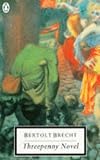
Threepenny Novel
by Bertolt Brecht
On This Page
Description
Based on a German translation of John Gay's "Beggar's opera", this work (originally presented in dramatic form as "The threepenny opera") is a satire on the decayed capitalism of the 1930s but set in the London of the 1900s.Tags
Recommendations




















Member Reviews
This was a strange one. I had no idea about any of the background to the novel at all, not even the play it’s based on, John Gay’s Beggar’s Opera. While the novel can be taken at face value as a tale of the business rivalries amid the slums of Victorian London, Brecht would not have us remain on the surface. It was important to him that the play he originally wrote, Threepenny Opera, and this subsequent novel should serve as a vehicle for his ideas about capitalism and its impact on the masses. In this regard, it has not lost its relevance to our lives.
The plot twists and turns around various characters and chiefly centres on the business rivals Peachum, Coax and Macheath. Each of these is pursuing his own method of developing show more capital: pimping beggars, trading commercial shipping and discount shops respectively. Each of these lives intertwines, not least due to the secret marriage of Macheath to Polly, the daughter of Peachum.
Now, I don’t for a minute claim to understand economics and how trade achieves capital. I found quite a bit of the business discussions hard to follow. But never once did I feel that made me want to stop reading. Brecht has built on Gay’s characters to create vivid portrayals of archetypal capitalists.
And that’s why the novel is so relevant today. It has a lot to teach us about how a focus on capital can mean people are reduced to the simple status of drones who generate profit. Had this been written only recently, it would not be hard to imagine individuals today who these characters would be based upon. Foxconn and Amazon came to mind.
Some might argue, correctly, that this is Marxist ideology. That, of course, doesn’t make it irrelevant per se. If anyone wants to attempt to convince me that this element of Marx is somehow irrelevant to issues we face in 21st century society, please do. Threepenny Novel is a brilliant illustration of how “the love of money is the root of all kinds of evil. And some people, craving money, have… pierced themselves with many sorrows.” (1 Timothy 6:10)
It’s a desperate narrative which ends with an imagined trial of humanity by the dead which results in all round condemnation for the exploitation we depend on to further our lifestyles. Again, the relevance is resounding and I can’t understand why a novel like this, with very real historical significance, was removed from the 1001 Books list in favour of banality like The Marriage Plot. show less
The plot twists and turns around various characters and chiefly centres on the business rivals Peachum, Coax and Macheath. Each of these is pursuing his own method of developing show more capital: pimping beggars, trading commercial shipping and discount shops respectively. Each of these lives intertwines, not least due to the secret marriage of Macheath to Polly, the daughter of Peachum.
Now, I don’t for a minute claim to understand economics and how trade achieves capital. I found quite a bit of the business discussions hard to follow. But never once did I feel that made me want to stop reading. Brecht has built on Gay’s characters to create vivid portrayals of archetypal capitalists.
And that’s why the novel is so relevant today. It has a lot to teach us about how a focus on capital can mean people are reduced to the simple status of drones who generate profit. Had this been written only recently, it would not be hard to imagine individuals today who these characters would be based upon. Foxconn and Amazon came to mind.
Some might argue, correctly, that this is Marxist ideology. That, of course, doesn’t make it irrelevant per se. If anyone wants to attempt to convince me that this element of Marx is somehow irrelevant to issues we face in 21st century society, please do. Threepenny Novel is a brilliant illustration of how “the love of money is the root of all kinds of evil. And some people, craving money, have… pierced themselves with many sorrows.” (1 Timothy 6:10)
It’s a desperate narrative which ends with an imagined trial of humanity by the dead which results in all round condemnation for the exploitation we depend on to further our lifestyles. Again, the relevance is resounding and I can’t understand why a novel like this, with very real historical significance, was removed from the 1001 Books list in favour of banality like The Marriage Plot. show less
A disturbing novel based on the business dealings of Peachum and Macheath, unscrupulous businessmen from Victorian London. Peachum runs a business outfitting individuals who rent clothing, props, and locations for begging. Macheath rents out bargain basement stores to would be entrepreneurs who he then supplies with stolen goods from other cities. Peachum is satisfied with his lot but Macneath yearns for bigger things and eventually branches into buying dilapidated ships to sell to the British government to move troops to South Africa for the Boer War. Peachum is brought into the business but both run into financial trouble when a competitor arrives. Macneath, through nefarious means, gains control of the competitor’s bank and manages show more to wiggle both himself and Peachum, his father-in-law, free of disaster, but cannot help the small entrepreneurs out of the financial disaster that befalls. The cutthroat world of big business at the expense of the small shop owner is laid bare for all to see. The use of the Biblical parable of the three servants left to look after their master’s investment is used to chilling effect by a religious figure to rationalize the lack of sympathy to failed shop keepers. Jesus would cry at this perverse use of His parable. show less
Reason Read: Reading 1001, March botm
This is an odd book and it seems I’ve heard of this idea of putting the poor to work as beggars and I also know of Mac the Knife and enjoyed the music back in the day. A funny book to find on the 1001 list as this is a play/opera and not a novel. It is the story of Mac the Knife and the King of the Beggars coming together around a girl named Polly, Daughter of Peachem (the king of the beggars). A person can watch this on u tube. It is considered to also be Marxist and political. It has all of that but it is also a crime novel with an Dicksonian atmosphere.
This is an odd book and it seems I’ve heard of this idea of putting the poor to work as beggars and I also know of Mac the Knife and enjoyed the music back in the day. A funny book to find on the 1001 list as this is a play/opera and not a novel. It is the story of Mac the Knife and the King of the Beggars coming together around a girl named Polly, Daughter of Peachem (the king of the beggars). A person can watch this on u tube. It is considered to also be Marxist and political. It has all of that but it is also a crime novel with an Dicksonian atmosphere.
Plus another half star because actually I really loved it - but I put it down and I just can't pick it up again. There's just too much of it and I just don't have the impetus at the moment. It's a bit Dickensian - or perhaps a bit like I imagine Dickens ought to be (as I don't enjoy Dickens much) and it deals with economics and capitalism and stuff but not in a way I can engage. The characters are great but I don't need to know how the drama plays out. Maybe at another time in my life.
Plus another half star because actually I really loved it - but I put it down and I just can't pick it up again. There's just too much of it and I just don't have the impetus at the moment. It's a bit Dickensian - or perhaps a bit like I imagine Dickens ought to be (as I don't enjoy Dickens much) and it deals with economics and capitalism and stuff but not in a way I can engage. The characters are great but I don't need to know how the drama plays out. Maybe at another time in my life.
Románová adaptace hry anglického autora Johna Gaye Beggar’s Opera z r. 1728, jež byla satirou na vládnoucí vrstvy. Německý autor, jenž hru postupně zpracoval pro divadlo, film a posléze v román, položil děj do Anglie roku 1902 a vykreslil drsně realistický obraz světa londýnské spodiny a obchodních kořistníků. Všechny ovládá hltavá touha po penězích a vědomí, že za peníze lze koupit i prodat cokoli, je hnací silou jejich celého života.
Apr 15, 2024Czech
Brecht's eerste en enige roman waarvoor hij opniew elementen en personages ontleende aan 'The beggar's opera' van John Gay. het is een ironische weergave van de moraal van het zakendoen. Brecht spaart de burgelijke moraal in de persoonlijke verhoudingen niet, in deze bijtende zedenzchets van liefde en huwelijk, van abortus en prostitutie.
Feb 18, 2008Dutch
Members
- Recently Added By
Lists

German Literature
518 works; 55 members

20th Century Literature
1,161 works; 54 members

Tammen Keltainen kirjasto
81 works; 1 member

Biggest Disappointments
606 works; 168 members
Author Information

1,435+ Works 23,725 Members
Bertolt Brecht was born on February 10, 1898 in Augsburg, Bavaria, and died on August 14, 1956. He was a German playwright, theatre director and Marxist. The modest house where he was born is today preserved as a Brecht Museum. Brecht formed a writing collective which became prolific and very influential. He wrote many lyrics for musicals and show more collaborated with Kurt Weill to create Die Dregroschenoper -- the biggest hit in 1920s Berlin. Brecht experimented with his own theater and company -- the Berliner Ensemble -- which put on his plays under his direction and which continued after his death with the assistance of his wife. Brecht aspired to create political theater, and it is difficult to evaluate his work in purely aesthetic terms. Brecht died in 1956. (Bowker Author Biography) show less
Some Editions
Awards and Honors
Series
Belongs to Publisher Series
Κλασικά Παπύρου (40)
Keltainen kirjasto (21)
SUNschrift (141)
Rainbow pocketboeken (51)
Nuovi Coralli [Einaudi] (242)
Penguin Books (1515)
suhrkamp taschenbuch (1846)
rororo (263-264)
Common Knowledge
- Canonical title
- Threepenny Novel
- Original title
- Drei Groschen Roman
- Alternate titles
- A Penny for the Poor
- Original publication date
- 1934
- People/Characters
- Polly Peachum; Macheath ('Mac the knife'); Jenny
- Important places
- London, England, UK
- Related movies*
- The 3 Penny Opera (1931 | IMDb); Driestuiversopera (1969 | IMDb); Die Dreigroschenoper (1972 | IMDb); Die Dreigroschenoper (1995 | IMDb); Die Dreigroschenoper (2004 | IMDb)
- First words
- A soldier by the name of George Fewkoombey was shot in the leg in the Boer War, so that the lower half of his leg had to be amputated in a hospital in Cape Town.
- Last words*
- (Click to show. Warning: May contain spoilers.)Er wurde zum Tode verurteilt und aufgehängt, in Anwesenheit und unter dem Beifall einer großen Menge von Kleingewerbetreibenden, Nähmädchen, Invaliden Soldaten [sic!] und Bettlern.
- Blurbers
- Rees, Garonwy; Haffner, Sebastian
- Original language
- German
- Disambiguation notice
- Do not combine with Threepenny Opera.
*Some information comes from Common Knowledge in other languages. Click "Edit" for more information.
Classifications
Statistics
- Members
- 760
- Popularity
- 36,888
- Reviews
- 12
- Rating
- (3.64)
- Languages
- 14 — Catalan, Czech, Danish, Dutch, English, Esperanto, Finnish, French, German, Greek, Hungarian, Italian, Portuguese, Russian
- Media
- Paper
- ISBNs
- 24
- ASINs
- 31