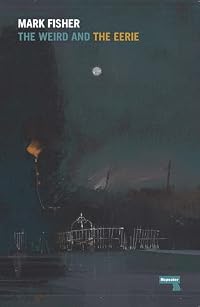
The Weird and the Eerie
by Mark Fisher
On This Page
Description
"What exactly are the 'weird' and the 'eerie'? In this new essay, Mark Fisher argues that some of the most haunting and anomalous fiction of the 20th century belongs to these two modes. The 'weird' and the 'eerie' are closely related but distinct modes, each possessing its own distinct properties. Both have often been associated with Horror, yet this emphasis overlooks the aching fascination that such texts can exercise. The 'weird' and the 'eerie' both fundamentally concern the outside and show more the unknown, which are not intrinsically horrifying, even if they are always unsettling. Perhaps a proper understanding of the human condition requires examination of liminal concepts such as the 'weird' and the 'eerie'. These two modes will be analysed with reference to the work of authors such as H.P. Lovecraft, H.G. Wells, M.R. James, Christopher Priest, Joan Lindsay, Nigel Kneale, Daphne Du Maurier, Alan Garner and Margaret Atwood, and films by Stanley Kubrick, Jonathan Glazer and Christoper Nolan." -- Publisher's description show lessTags
Recommendations























Member Reviews
Mark Fisher's fairly slim 2016 exploration of the weird and eerie (as two separate if related concepts in culture) reads as a series of very long blog articles on representative figures rather than a sustained argument but, at that level, it contains insights and is a relaxed read.
The problem is that he could probably have defined both his terms in a single article or perhaps pamphlet so the explorations become like a lot of cherries on a rather basic cake. There is also some Lacanian theory added on as unnecessary cream.
Nevertheless, I would not discourage anyone from reading it. It may introduce the reader (especially the young reader) to new sources and films or books that might otherwise have gone unnoticed. Fisher's judgements are show more generally sensible and informative and he clearly cared about his subjects.
As to the core definitions, he gets these about right without actually needing the examples. The weird involves the irruption into this world of something from outside. The eerie is when there is something where there should be nothing or nothing where there should be something.
Taken as set of interlinked essays that create a mood or understanding of a psychological reality that culture represents, something to be read alongside Burke's 'Philosophical Enquiry' of 1757 on the Sublime and Beautiful, the book has merit as a footnote to aesthetics.
Tragically Fisher, who suffered severe depression, killed himself just after publication and it is hard not to read a diffident slightly melancholy perspective into the book. There is a constant skirting of theory as if already he was giving up on it and going through the motions.
There is a desultory anti-capitalism and an unfashionable engagement with Freud (albeit via Lacan) but the book reads as if the concrete, the work, is what is to be investigated as a facet of something of which the weird and eerie are just symptoms. He writes of the 'death drive' in touching terms.
Perhaps there is a danger of reading too much into this book in this sad context. It is certainly not an emotional work but rather a quite clinical exploration of authors and auteurs that perhaps he had hoped might have offered some salvation through 'art'.
This leads one to the thought that perhaps we have here an intellectual who was going through the same crisis about aesthetics, the salvatory role of the artist, as Nietzsche had done but whose own disposition did not enable him to overcome or explore his situation in the same way.
The critique of capitalism for which he had been best known is present but only barely. His artists are now observing a 'reality' (it would seem) that may no longer be challengable except negatively through an escape into an unreality that perhaps casts light on that reality.
This is all speculation, of course. The book is cool more than it is melancholy, the very lack of emotion in itself disturbing in the light of his irrevocable decision. And an opportunity was lost perhaps to take the plunge and look more existentially at the weird and eerie.
If the weird and eerie are just artistic responses to the existential question of why there is something rather than nothing through either 'irruption' of something or something or nothing being present when things should be otherwise, then this is certainly worth exploring.
The book describes the symptoms of the disease of imagining a fantastic reality through the artists the author admires and who perhaps gave him solace and meaning or perhaps adventure and distraction as they do many of us. Why many of us need them is not explored however.
The underlying situation that gives rise to the weird and eerie also seems to be skirted whereas a Burke or a Nietzsche at either ends of the philosophical spectrum might have dug deeper whether analytically or to pass through a dark night of the soul into something new.
As a result the book is a stepping stone that is full of interesting data towards solving a problem rather than a resolution of a problem. The weird and eerie are 'professionally' defined but what all this means is rather skimmed over even if we see the lineaments of where an argument may go.
Knowing what happened yet with my prejudice never to see a man and his work as identical - as much in the case of rogues like 'Gary Glitter' as in apparent intellectual saints - it is still impossible not to mourn this man who one feels might have overcome his situation with more help. show less
The problem is that he could probably have defined both his terms in a single article or perhaps pamphlet so the explorations become like a lot of cherries on a rather basic cake. There is also some Lacanian theory added on as unnecessary cream.
Nevertheless, I would not discourage anyone from reading it. It may introduce the reader (especially the young reader) to new sources and films or books that might otherwise have gone unnoticed. Fisher's judgements are show more generally sensible and informative and he clearly cared about his subjects.
As to the core definitions, he gets these about right without actually needing the examples. The weird involves the irruption into this world of something from outside. The eerie is when there is something where there should be nothing or nothing where there should be something.
Taken as set of interlinked essays that create a mood or understanding of a psychological reality that culture represents, something to be read alongside Burke's 'Philosophical Enquiry' of 1757 on the Sublime and Beautiful, the book has merit as a footnote to aesthetics.
Tragically Fisher, who suffered severe depression, killed himself just after publication and it is hard not to read a diffident slightly melancholy perspective into the book. There is a constant skirting of theory as if already he was giving up on it and going through the motions.
There is a desultory anti-capitalism and an unfashionable engagement with Freud (albeit via Lacan) but the book reads as if the concrete, the work, is what is to be investigated as a facet of something of which the weird and eerie are just symptoms. He writes of the 'death drive' in touching terms.
Perhaps there is a danger of reading too much into this book in this sad context. It is certainly not an emotional work but rather a quite clinical exploration of authors and auteurs that perhaps he had hoped might have offered some salvation through 'art'.
This leads one to the thought that perhaps we have here an intellectual who was going through the same crisis about aesthetics, the salvatory role of the artist, as Nietzsche had done but whose own disposition did not enable him to overcome or explore his situation in the same way.
The critique of capitalism for which he had been best known is present but only barely. His artists are now observing a 'reality' (it would seem) that may no longer be challengable except negatively through an escape into an unreality that perhaps casts light on that reality.
This is all speculation, of course. The book is cool more than it is melancholy, the very lack of emotion in itself disturbing in the light of his irrevocable decision. And an opportunity was lost perhaps to take the plunge and look more existentially at the weird and eerie.
If the weird and eerie are just artistic responses to the existential question of why there is something rather than nothing through either 'irruption' of something or something or nothing being present when things should be otherwise, then this is certainly worth exploring.
The book describes the symptoms of the disease of imagining a fantastic reality through the artists the author admires and who perhaps gave him solace and meaning or perhaps adventure and distraction as they do many of us. Why many of us need them is not explored however.
The underlying situation that gives rise to the weird and eerie also seems to be skirted whereas a Burke or a Nietzsche at either ends of the philosophical spectrum might have dug deeper whether analytically or to pass through a dark night of the soul into something new.
As a result the book is a stepping stone that is full of interesting data towards solving a problem rather than a resolution of a problem. The weird and eerie are 'professionally' defined but what all this means is rather skimmed over even if we see the lineaments of where an argument may go.
Knowing what happened yet with my prejudice never to see a man and his work as identical - as much in the case of rogues like 'Gary Glitter' as in apparent intellectual saints - it is still impossible not to mourn this man who one feels might have overcome his situation with more help. show less
Honestly, I'm giving The Weird and the Eerie four stars for Fisher's lucid prose and the overall quality of his insight. As a whole, the book is uneven and the individual essays, while often quite good, could use a larger context than that Fisher provides with his explications of "the weird" and "the eerie." Still, quite a lot to think about, and no doubt subsequent writers will use Fisher's interpretations to generate a more comprehensive hermeneutics of the weird.
An interesting discussion of "weird" and "eerie," what Fisher calls "modes" rather than genre. He starts with literature but also discusses other media like music and film. A bit jargon-y at times (I had to look up a couple words), I feel that this book is more for additional studies rather than an introduction. At least some familiarity with the material helps with following the discussions.
Analisi di due concetti apparentemente intraducibili (weird e eerie) che Fisher definisce e correda di esempi tratti da letteratura e cinema. Un libro che immagino divertente da scrivere (lo è sempre “inventare” categorie e definirle) e piacevole da leggere, aggiungendo un livello all’universo pop di Fisher, anche se forse non è proprio così in quanto questo è purtroppo l'ultimo testo prima del suicidio.
Mark Fisher, known for writing about post-punk and popular culture under the K-Punk moniker, tries to distinguish between the outright weird and the not-so-easily defined eerie. Weirdness is described as the feeling of being
Skip around and only read the essays that are interesting to you.
Ratings
Members
- Recently Added By
Lists


Author Information

12+ Works 3,623 Members
Some Editions
Common Knowledge
- Alternate titles
- Das Seltsame und Gespenstische
- Original language
- English
Classifications
- Genres
- Literature Studies and Criticism, Nonfiction, Philosophy
- DDC/MDS
- 809.304 — Literature & rhetoric Literature, rhetoric & criticism History, description, critical appraisal of more than two literatures Fiction
- LCC
- PN3503 .F57 — Language and Literature Literature (General) Literature (General) Prose. Prose fiction History
- BISAC
Statistics
- Members
- 588
- Popularity
- 49,531
- Reviews
- 6
- Rating
- (3.84)
- Languages
- 5 — English, German, Italian, Spanish, Turkish
- Media
- Paper, Audiobook, Ebook
- ISBNs
- 7
- ASINs
- 3