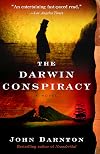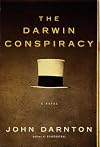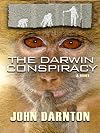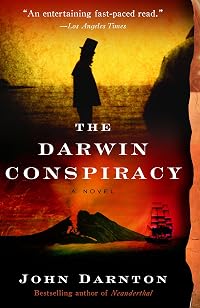
The Darwin Conspiracy
by John Darnton
On This Page
Description
In this riveting new novel, bestselling author John Darnton transports us to Victorian England and around the world to reveal the secrets of a legendary nineteenth-century figure. Darnton elegantly blends the power of fact and the insights of fiction to explore the many mysteries attached to the life and work of Charles Darwin. What led Darwin to the theory of evolution? Why did he wait twenty-two years to write On the Origin of Species? Why was he incapacitated by mysterious illnesses and show more frightened of travel? Who was his secret rival? These are some of the questions driving Darnton's richly dramatic narrative, which unfolds through three vivid points of view: Darwin's own as he sails around the world aboard the Beagle; his daughter Lizzie's as she strives to understand the guilt and fear that struck her father at the height of his fame; and that of present-day anthropologist Hugh Kellem and Darwin scholar Beth Dulcimer, whose obsession with Darwin (and with each other) drives them beyond the accepted boundaries of scholarly research. What Hugh and Beth discover--Lizzie's diaries and letters lead them to a hidden chapter of Darwin's autobiography--is a maze of bitter rivalries, petty deceptions, and jealously guarded secrets, at the heart of which lies the birth of the theory of evolution. show lessTags
Recommendations


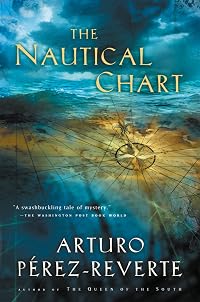
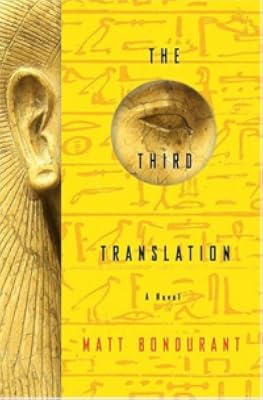
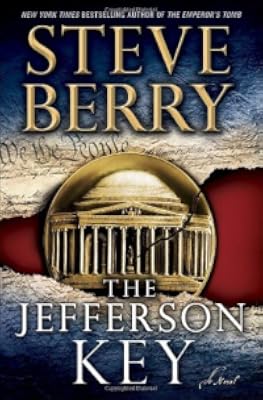
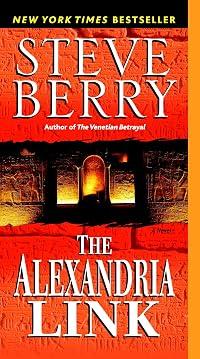
Member Recommendations
Evolution's Captain: The Tragic Fate of Robert Fitzroy, the Man Who Sailed Charles Darwin Around the World by Peter Nichols
fyrefly98 A very readable biography and background of Captain Fitzroy, the Fuegian natives, and the reason for the Beagle's second (and famous) journey.
edwinbcn In both novels competing academics uncover autographs and written sources (diaries, letters, etc). Similar approach, widely different topics, each beautifully written.
Member Reviews
Summary: While Darwin's theory of evolution of natural selection revolutionized the way we think about science, much of its origin remains shrouded in mystery. Darwin journeyed to South America and the Galápagos aboard the Beagle in his early 20s, but didn't publish On the Origin of Species until almost 20 years afterwards. The question of when - and how - he came up with his famous idea has always been a matter of speculation. Until Hugh Kellem, a graduate student, unearths the hidden diary of Lizzie, one of Darwin's daughters. It points to a horrible, dark secret in Darwin's past, and a conspiracy to keep that secret from coming to light. The story alternates between Hugh's story, Lizzie's diaries, and sections of prose describing show more Darwin's experiences on the Beagle.
Review: I normally read fiction for escapism - hence the prevalence of fantasy and historical fiction in my reading diet. So, imagine my surprise when the first eight pages turn out to be about mist-netting for birds - exactly what I've been spending my time doing recently. And, I'm pleased to say, Darnton got it pretty much right, except I don't think most researchers use calipers to measure wing length, and holding a bird in bander's grip, the heartbeat is much stronger against your fingers than your palm. This same level of detail and accuracy characterizes the rest of the novel as well. Darnton draws heavily on his source material, including (naturally) Darwin's own Beagle Diaries as well as Peter Nichols's Evolution's Captain. The places where he invents details and conspiracies are legit, filling in the gaps without deviating from known historical fact. (Although, for the record, no graduate advisor in the world is going to take a graduate student who is tired of studying evolutionary biology and wants instead to go to England and "study something about Darwin" and tell them to go ahead and have a good time.)
As historical mysteries go, it's a pretty good mystery. While I'd pieced together most of the major clues before the characters got there, there were bits and pieces that got added in during the revelation to the characters that helped to create a fairly tight and well-thought-out conspiracy mystery. However, there were two main problems I had with this book. The first, and more minor, was that the historical sections from Darwin's POV seemed kind of remote, as though Darnton was afraid that he'd used up all his "fictionalization cred" on the fiction parts of the book, and didn't want to add too much dialogue or details to the parts that are a matter of historical record. The second is that Hugh's contemporary story, of trying to deal with/find out about his older brother's death, seemed extraneous. If I stretched, I could probably draw some parallels between the contemporary and historical storylines, but it mostly seemed like Darnton needed something for his characters to do other than research - it either needed to be further fleshed out, or cut. Overall, though, it was a fast-paced and ingenious mystery, sufficiently entertaining without going too far out on a historical limb. Also, it didn't even get in to the science/religious debate, instead going for the view that even if Darwin was flawed as a man, the theory stands on its own - which was much appreciated. 4 out of 5 stars.
Recommendation: Fun reading for biology geeks like me, and I bet it would be interesting for anyone who likes "true-fact" historical mystery, like Josephine Tey's The Daughter of Time or The DaVinci Code (although with better writing!). show less
Review: I normally read fiction for escapism - hence the prevalence of fantasy and historical fiction in my reading diet. So, imagine my surprise when the first eight pages turn out to be about mist-netting for birds - exactly what I've been spending my time doing recently. And, I'm pleased to say, Darnton got it pretty much right, except I don't think most researchers use calipers to measure wing length, and holding a bird in bander's grip, the heartbeat is much stronger against your fingers than your palm. This same level of detail and accuracy characterizes the rest of the novel as well. Darnton draws heavily on his source material, including (naturally) Darwin's own Beagle Diaries as well as Peter Nichols's Evolution's Captain. The places where he invents details and conspiracies are legit, filling in the gaps without deviating from known historical fact. (Although, for the record, no graduate advisor in the world is going to take a graduate student who is tired of studying evolutionary biology and wants instead to go to England and "study something about Darwin" and tell them to go ahead and have a good time.)
As historical mysteries go, it's a pretty good mystery. While I'd pieced together most of the major clues before the characters got there, there were bits and pieces that got added in during the revelation to the characters that helped to create a fairly tight and well-thought-out conspiracy mystery. However, there were two main problems I had with this book. The first, and more minor, was that the historical sections from Darwin's POV seemed kind of remote, as though Darnton was afraid that he'd used up all his "fictionalization cred" on the fiction parts of the book, and didn't want to add too much dialogue or details to the parts that are a matter of historical record. The second is that Hugh's contemporary story, of trying to deal with/find out about his older brother's death, seemed extraneous. If I stretched, I could probably draw some parallels between the contemporary and historical storylines, but it mostly seemed like Darnton needed something for his characters to do other than research - it either needed to be further fleshed out, or cut. Overall, though, it was a fast-paced and ingenious mystery, sufficiently entertaining without going too far out on a historical limb. Also, it didn't even get in to the science/religious debate, instead going for the view that even if Darwin was flawed as a man, the theory stands on its own - which was much appreciated. 4 out of 5 stars.
Recommendation: Fun reading for biology geeks like me, and I bet it would be interesting for anyone who likes "true-fact" historical mystery, like Josephine Tey's The Daughter of Time or The DaVinci Code (although with better writing!). show less
The Darwin Conspiracy is a bloated, overwritten novel that was at times painful to read. The novel constantly flashes back from modern times, following Hugh and Beth, two grad students who follow the works of Darwin and come across the conspiracy described in the title, and to Darwin in his voyage on the Beagle, and then to the diary entries of one of Darwin’s daughters. I wasn’t a big fan of the constant flipping back and forth from modern time to the past and the constant shifts in points of view that accompanied it, but that was the least of this novel’s problems.
There were many things I didn’t like about this novel, but chief among them was that it was overly long for the story it was trying to tell. There was so much fluff show more in this novel that it could easily have been cut in half and not missed a beat. It seems to me as if the publisher wanted a certain word count, and the author didn’t have a long enough story to tell so he filled it with needless back story, side plots that were inconsequential, and as much fluff as he could muster. Beyond that, the characters were not terribly interesting. Finally, the novel tried to hype this massive, awe inspiring conspiracy for hundreds of pages, and when it finally did the reveal at the end, it had the amazing accomplishment of both being underwhelming and completely unbelievable. This is not a novel that is worth your time and money.
Carl Alves – author of Two For Eternity show less
There were many things I didn’t like about this novel, but chief among them was that it was overly long for the story it was trying to tell. There was so much fluff show more in this novel that it could easily have been cut in half and not missed a beat. It seems to me as if the publisher wanted a certain word count, and the author didn’t have a long enough story to tell so he filled it with needless back story, side plots that were inconsequential, and as much fluff as he could muster. Beyond that, the characters were not terribly interesting. Finally, the novel tried to hype this massive, awe inspiring conspiracy for hundreds of pages, and when it finally did the reveal at the end, it had the amazing accomplishment of both being underwhelming and completely unbelievable. This is not a novel that is worth your time and money.
Carl Alves – author of Two For Eternity show less
John Darnton has done a near-impossible thing: craft a thriller, using Darwin as a foil, yet sidestep the current religious brouhaha about evolution. Well, not entirely. By the end of the book it's clear that science and common sense are still safe, even as Darwin himself is peeled open as a near-plagiarist, possible murderer, and all-around nervous wreck.
It's hard to tell, though, if the scholarship and historical theorizing that saturate this story constitute some meaningful ideas on the author's part, or if it's just there to serve the story. The book is flat-out engrossing, and deftly weaves present-day amateur detectives, young Darwin's voyage of discovery, and his last, troubled days. I was lured in by the prospect of exposing show more Darwin the brilliant thinker, the heroic disruptor of sacred cows (turns out they're just cows!), as -- a VILLAIN. I admit I was worried (is this thickly-disguised anti-scientism?), but ultimately it's just a tease. The mystery's the thing, and it's jim-dandy.
Of course, few fundamentalists will be taken in. Anything short of out-right refutation and denunciation of evolution is seen as coddling poor Charlie, but a few might be fooled by the title, and will squirm with delight as the clues pile up and Darwin's own daughter begins to revile him. Have at thee, rationality! Even so, materialistic science is not undone.
The description of the original voyage of the Beagle, with shipboard details, revelatory jungle excursions, bug discoveries, and professional jealousies, is memorable, even thrilling. The sleuthing sub-plot has his "lesser" daughter emerging from dim history and struggle to reconcile the father she idolizes with his accomplishments, and possible crimes. It's highly effective, but relies on a literary device that's problematic.
Evoking this young girl (and then woman), tracing the arc of her tragic life, her filial devotion and unappreciated brilliance, is an original and plausible way to enter Darwin's life and times. All the right things are said, even when she is merely advancing the plot. Darnton wisely shows feminist subtext sparingly, and without demagoguery. But the author (male, middle-aged) attempts a Herculean task: writing as a 19th century girl, one from a literary, well-heeled family. It was a time when well-formed sentences were expected, even from females. Juggling all this requires exquisite balance and excruciating word choices. While she is credible overall, and effective as an ensemble character, she doesn't quite come through as an adolescent girl. I wanted to see a few just-so stumbles in that formidable syntax, some juvenile choices in her diary prose, something to reveal the stifled inner life and emotional depth of such a unique character. There is none of the occasional panic that accompanies the transit to womanhood in any age. At no time is Darnton wrong with her voice, but she carries too much of the story to remain at arm's length.
We need this book. Darwin changed everything, deflating our conceit about human importance and elevating our knowledge. His careful observations turned pieties about "God's creation" into a rich, ever-evolving, as it were, engagement with the natural world. He was not, even so, a "god", or even dem-iurge, and "The Darwin Conspiracy" elevates his accomplishment while examining, with Darwinian attention to detail, his feet of clay.
show less
It's hard to tell, though, if the scholarship and historical theorizing that saturate this story constitute some meaningful ideas on the author's part, or if it's just there to serve the story. The book is flat-out engrossing, and deftly weaves present-day amateur detectives, young Darwin's voyage of discovery, and his last, troubled days. I was lured in by the prospect of exposing show more Darwin the brilliant thinker, the heroic disruptor of sacred cows (turns out they're just cows!), as -- a VILLAIN. I admit I was worried (is this thickly-disguised anti-scientism?), but ultimately it's just a tease. The mystery's the thing, and it's jim-dandy.
Of course, few fundamentalists will be taken in. Anything short of out-right refutation and denunciation of evolution is seen as coddling poor Charlie, but a few might be fooled by the title, and will squirm with delight as the clues pile up and Darwin's own daughter begins to revile him. Have at thee, rationality! Even so, materialistic science is not undone.
The description of the original voyage of the Beagle, with shipboard details, revelatory jungle excursions, bug discoveries, and professional jealousies, is memorable, even thrilling. The sleuthing sub-plot has his "lesser" daughter emerging from dim history and struggle to reconcile the father she idolizes with his accomplishments, and possible crimes. It's highly effective, but relies on a literary device that's problematic.
Evoking this young girl (and then woman), tracing the arc of her tragic life, her filial devotion and unappreciated brilliance, is an original and plausible way to enter Darwin's life and times. All the right things are said, even when she is merely advancing the plot. Darnton wisely shows feminist subtext sparingly, and without demagoguery. But the author (male, middle-aged) attempts a Herculean task: writing as a 19th century girl, one from a literary, well-heeled family. It was a time when well-formed sentences were expected, even from females. Juggling all this requires exquisite balance and excruciating word choices. While she is credible overall, and effective as an ensemble character, she doesn't quite come through as an adolescent girl. I wanted to see a few just-so stumbles in that formidable syntax, some juvenile choices in her diary prose, something to reveal the stifled inner life and emotional depth of such a unique character. There is none of the occasional panic that accompanies the transit to womanhood in any age. At no time is Darnton wrong with her voice, but she carries too much of the story to remain at arm's length.
We need this book. Darwin changed everything, deflating our conceit about human importance and elevating our knowledge. His careful observations turned pieties about "God's creation" into a rich, ever-evolving, as it were, engagement with the natural world. He was not, even so, a "god", or even dem-iurge, and "The Darwin Conspiracy" elevates his accomplishment while examining, with Darwinian attention to detail, his feet of clay.
show less
In The Darwin Conspiracy, Darnton has exploited holes and inconsistencies in Darwin’s life story/mythos to craft a historical pastiche that more or less delivers the goods.
By and large, I enjoyed the non-fiction elements of the book: Darnton’s account of Darwin’s early life, how he came to sail aboard the Beagle, and how he spent the later years of his life. However, I now feel like I need to read an authorized Darwin biography so I can sort out which of Darnton’s bits were authentic and which “embellished.”
Alas, the fictional elements of the book are decidedly less intriguing. I found his main character, Hugh, to be unsympathetic (a little whiny, to be frank) and his relationship with Beth, who may or may not be a show more descendent of Darwin, implausible. The subplot devoted to Hugh and the mystery behind his brother’s death distracts, rather than adds, to the tale, and another subplot involving a colleague of Darwin’s resolves with a disappointing thud rather than a narrative pop.
If you’re paying attention you’ll spot the “surprise ending” coming from a mile away, but that doesn’t necessarily detract from what may be the only part of the fictional tale that I enjoyed. While highly improbable, the denoument did make me crack a wry smile and spend some moments reflecting on the hypocracies that inevitably arise every time we insist on mythologizing our fellow men. I can’t help but think that George Washington, Abraham Lincoln, and Albert Einstein would empathize with our Heroic Scientist’s hypothetic predicament.
If you’re a fan of scientific fiction or Darwin, you may find this worthwhile. But if you’re looking for a riveting mystery – or, even better, a Da Vinci Code-like expose that reveals Darwin as a fraud or imposter – there are probably better ways to spend your time. show less
By and large, I enjoyed the non-fiction elements of the book: Darnton’s account of Darwin’s early life, how he came to sail aboard the Beagle, and how he spent the later years of his life. However, I now feel like I need to read an authorized Darwin biography so I can sort out which of Darnton’s bits were authentic and which “embellished.”
Alas, the fictional elements of the book are decidedly less intriguing. I found his main character, Hugh, to be unsympathetic (a little whiny, to be frank) and his relationship with Beth, who may or may not be a show more descendent of Darwin, implausible. The subplot devoted to Hugh and the mystery behind his brother’s death distracts, rather than adds, to the tale, and another subplot involving a colleague of Darwin’s resolves with a disappointing thud rather than a narrative pop.
If you’re paying attention you’ll spot the “surprise ending” coming from a mile away, but that doesn’t necessarily detract from what may be the only part of the fictional tale that I enjoyed. While highly improbable, the denoument did make me crack a wry smile and spend some moments reflecting on the hypocracies that inevitably arise every time we insist on mythologizing our fellow men. I can’t help but think that George Washington, Abraham Lincoln, and Albert Einstein would empathize with our Heroic Scientist’s hypothetic predicament.
If you’re a fan of scientific fiction or Darwin, you may find this worthwhile. But if you’re looking for a riveting mystery – or, even better, a Da Vinci Code-like expose that reveals Darwin as a fraud or imposter – there are probably better ways to spend your time. show less
I took this book on a trip from Canada all the way down to Florida. I tried to read it a few times during the trip. Took it to the beach. Wasn't interested. The first few chapters are just not that very good. Upon returning to Canada, I picked it up again. Slowly but surely, the book gets better. More intriguing. It's not a book for the intellectual person. It's a book for the average Joe who loves a good story and knows something is rotten and somebody is getting away with murder. The shifting back and forth of the parallel narratives gets tiring somewhat. I enjoyed very much the last few chapters. I found them amazing. They are a beautifully written crescendo. The story about the shaman is just pure poetry. I read it 3 times. For a show more few minutes, I almost became a believer of what Mr. Darwin claims to be the truth of our origins as a species. show less
My definition of historical fiction is a work that takes key pieces of a very real history while expanding and filling in the gaps of the unknown to create a more fully fleshed version of reality. John Darnton's "The Darwin Conspiracy" targets something a little different. Darnton takes the bones of history, specifically Charles Darwin's trip to South America on board 'The Beagle', and wraps around it a skin of his own creation, to display an alternate version of of how he came to develop his notions of evolution.
At the core, Darnton builds a mystery around why Darwin took so many years to actually announce his suggestion and evidence for evolution and 'survival of the fittest'. Why was he so sickly? And what was the nature of his show more relationship with the English intelligentsia of the 19th century? On Darwin's trail in the modern world is Hugh, a meandering and unfocused student of evolution and history with a very sad soul, and beth, his girlfriend who has a unique connection of her own to the Darwin family. Hugh discovers a journal written by one of Darwin's daughters, hidden in the back of an accounting ledger. It doesn't take long for Hugh to realize that there's a rather nasty secret that her father Charles has been keeping for a very long time.
Darnton structures his book around three distinct narratives: Hugh and Beth's search for the hidden truth of Darwin's trip; Darwin's daughter Lizzie's journal; and Darwin's own monologue during his trip on the Beagle. Each thread is laced with multiple micro-plots and mysteries that compound and build upon each other providing the drive of the primary mysteries.
The book is well written and the distinct plot points that ultimately wind together are interesting enough to make this a solid, but light-weight, read. The characters are a little all over the place and either not sympathetic nor particularly well developed to drive the story itself. There's no elegance to the unraveling of the mystery giving a sense of a rather heavy handed editor.
I enjoyed the book and its look back across 150+ years to the world of 19th century exploration, and the very conservative Victorian world through the eyes of Lizzie. This is a good, but not great, novel. show less
At the core, Darnton builds a mystery around why Darwin took so many years to actually announce his suggestion and evidence for evolution and 'survival of the fittest'. Why was he so sickly? And what was the nature of his show more relationship with the English intelligentsia of the 19th century? On Darwin's trail in the modern world is Hugh, a meandering and unfocused student of evolution and history with a very sad soul, and beth, his girlfriend who has a unique connection of her own to the Darwin family. Hugh discovers a journal written by one of Darwin's daughters, hidden in the back of an accounting ledger. It doesn't take long for Hugh to realize that there's a rather nasty secret that her father Charles has been keeping for a very long time.
Darnton structures his book around three distinct narratives: Hugh and Beth's search for the hidden truth of Darwin's trip; Darwin's daughter Lizzie's journal; and Darwin's own monologue during his trip on the Beagle. Each thread is laced with multiple micro-plots and mysteries that compound and build upon each other providing the drive of the primary mysteries.
The book is well written and the distinct plot points that ultimately wind together are interesting enough to make this a solid, but light-weight, read. The characters are a little all over the place and either not sympathetic nor particularly well developed to drive the story itself. There's no elegance to the unraveling of the mystery giving a sense of a rather heavy handed editor.
I enjoyed the book and its look back across 150+ years to the world of 19th century exploration, and the very conservative Victorian world through the eyes of Lizzie. This is a good, but not great, novel. show less
In 2009, the 200th anniversary of the publication of The origin of species was commemorated, which prompted "The Bookworm", a bookstore in Beijing, to organize a literary festival around Charles Darwin and evolution theory. During the festival period, I bought this novel, The Darwin conspiracy by the American author John Darnton.
The title is a bit of a misnomer, and might put some people off. The author has published other novels in the genre of thrillers / suspense, but unlike his previous books, The Darwin conspiracy is a historical novel, belonging to the more serious genre of literary fiction.
The opening chapter is a bit messy, and this messiness keeps coming back. The book is structured in chapters alternating between the past of show more Darwin's age, and the present. Unfortunately the present-day chapters are weak, including far too many side-lines and sub-plots, which distract from the main story. Also, the main plot relies too heavily on unlikely story elements, played out in the present-day chapters. The characters in these chapters are also not very interesting, and their actions too subservient to plot development.
The past-time chapters, however, are very well-written, and the ideas constituting this part of the book are original and interesting. The unfolds as two academic researchers discover unpublished diaries and letters, which throw a new light on the development of Darwin's theory, suggesting how and why it took Darwin so long to publish. The uncovering of the historical material, which gradually reveals the story is reminiscent of A.S. Byatt's great novel Possession.
Apart from some weaknesses, I felt very much drawn into the story, which I truly enjoyed reading. show less
The title is a bit of a misnomer, and might put some people off. The author has published other novels in the genre of thrillers / suspense, but unlike his previous books, The Darwin conspiracy is a historical novel, belonging to the more serious genre of literary fiction.
The opening chapter is a bit messy, and this messiness keeps coming back. The book is structured in chapters alternating between the past of show more Darwin's age, and the present. Unfortunately the present-day chapters are weak, including far too many side-lines and sub-plots, which distract from the main story. Also, the main plot relies too heavily on unlikely story elements, played out in the present-day chapters. The characters in these chapters are also not very interesting, and their actions too subservient to plot development.
The past-time chapters, however, are very well-written, and the ideas constituting this part of the book are original and interesting. The unfolds as two academic researchers discover unpublished diaries and letters, which throw a new light on the development of Darwin's theory, suggesting how and why it took Darwin so long to publish. The uncovering of the historical material, which gradually reveals the story is reminiscent of A.S. Byatt's great novel Possession.
Apart from some weaknesses, I felt very much drawn into the story, which I truly enjoyed reading. show less
Members
- Recently Added By
Author Information

11+ Works 2,722 Members
John Darnton is culture editor for The New York Times. He lives in New York.
Some Editions
Work Relationships
Was inspired by
Common Knowledge
- Canonical title
- The Darwin Conspiracy
- Original title
- The Darwin Conspiracy
- Original publication date
- 2005
- People/Characters
- Charles Darwin [Charles Robert: 1809-1882]; Robert Fitzroy; Hugh Kellem; Lizzie Darwin
- Important places
- Galápagos Islands, Ecuador; England, UK; Tierra del Fuego, Argentina
- Dedication*
- Voor Bob
- First words
- Hugh spotted the boat while it was still a dot on the horizon and watched it approach the island, making a wide, white arc.
- Quotations*
- De geschiedenis is rijk aan slinkse wegen,
Aan sluw gewrochte doorgangen en verbanden,
Bedriegt met gefluisterde ambities,
En verlokt ons door ijdelheid.
T.S. Eliot - Last words*
- (Click to show. Warning: May contain spoilers.)Morgen was vroeg genoeg om met schrijven te beginnen.
- Blurbers
- Kopit, Arthur; Delbanco, Nicholas; Furst, Alan; Wiesel, Elie
- Original language*
- Engels
*Some information comes from Common Knowledge in other languages. Click "Edit" for more information.
Classifications
- Genres
- Fiction and Literature, General Fiction, Historical Fiction, Mystery
- DDC/MDS
- 813.54 — Literature & rhetoric American literature in English American fiction in English 1900-1999 1945-1999
- LCC
- PS3554 .A727 .D368 — Language and Literature American literature American literature Individual authors 1961-
- BISAC
Statistics
- Members
- 553
- Popularity
- 53,618
- Reviews
- 22
- Rating
- (2.89)
- Languages
- 7 — Chinese, Dutch, English, French, Portuguese, Spanish, Turkish
- Media
- Paper, Audiobook, Ebook
- ISBNs
- 22
- ASINs
- 2