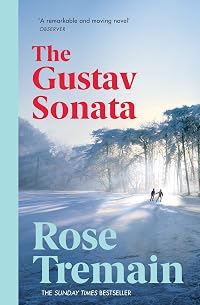
The Gustav Sonata
by Rose Tremain
On This Page
Description
Growing up sheltered from the echoes of World War II, Gustav forges an intense relationship with a mercurial Jewish boy, Anton, a talented pianist who introduces him to the harsh realities of racism, tolerance, and cruelty during a friendship spanning half a century.Tags
Recommendations


























Member Reviews
Gustav and Anton meet on the first day of kindergarten. It's 1948 in a small town in Switzerland and Gustav responds to Anton's fearful crying by playing with him and distracting him. Gustav's mother, a depressed widow who works in a cheese factory, is not thrilled about her young son's friendship with a boy from a wealthy Jewish family, but Anton and Gustav become best friends nonetheless. Not only are their stations in life vastly different but their apparent prospects are, too. Anton is a gifted pianist, a prodigy. All expectations are that he will become a famous concert pianist, a dream that Gustav struggles to support although it evokes a bewildering sense of betrayal and abandonment in him.
We follow the boys' relationship, but show more the narration also takes us back in time, to 1939 when Gustav's parents met, fell in love, and married, and had their happy life brutally disrupted by the specter of WWII and the fear of a German invasion. Gustav is told by his mother that his father was a hero in those early days of the war and that he sacrificed his life to save the Jews. Ah, but there is so much more to that story.
I thoroughly enjoyed this novel. Tremain develops her flawed characters with compassion and a bit of cynicism. At times I felt the story veered too far into implausibility but it was compelling and satisfying nonetheless. Tremain continues to be an author worth the allocation of my precious reading time. show less
We follow the boys' relationship, but show more the narration also takes us back in time, to 1939 when Gustav's parents met, fell in love, and married, and had their happy life brutally disrupted by the specter of WWII and the fear of a German invasion. Gustav is told by his mother that his father was a hero in those early days of the war and that he sacrificed his life to save the Jews. Ah, but there is so much more to that story.
I thoroughly enjoyed this novel. Tremain develops her flawed characters with compassion and a bit of cynicism. At times I felt the story veered too far into implausibility but it was compelling and satisfying nonetheless. Tremain continues to be an author worth the allocation of my precious reading time. show less
This book takes the form of a sonata in a 3-parts. I found Part 1 touching and fluidly written. In it, the author introduces the main character, Gustav, and his friend Anton. They come from very different family backgrounds, but become good friends. Gustav copes with his mother’s bitterness, trying his best to please her. Anton is a child prodigy from a secure home, but cannot seem to tame his nerves for his piano recitals. Part 2 goes back in time to cover the meeting of Gustav’s parents, and attempts to describe why Gustav’s mother developed such an angry attitude. I found this part less satisfying, partially due to the author switching to present tense to cover a past time and partly due to what I felt were inconsistent show more actions. In Part 3, we fast-forward to Gustav and Anton from age forty to sixty. For me, this was the least satisfying part due to the huge number of missing years. Also, much of the rationale for the characters’ actions was laid between the lines. If you like stories about relationships, you may enjoy this book. From my perspective, it lacked action, and the primary character was a bit dull. I added a star for the author's fluid writing style, which I enjoyed. show less
As a musical sonata is defined by being typically in two or three parts, usually as a solo but can be up to three parts, so The Gustav Sonata is a story of three parts with two main characters plus other players in the background that all have their moment in the spotlight.
Gustav is the soloist, a steady, sturdy boy who meets Anton at nursery where Anton is crying. Gustav picks him up and Anton never really leaves him although he does go away. The first part of the book focuses on their childhood, growing up, the difficulties of being Swiss and neutral during the second world war and Anton coming from a Jewish, banking family and having much more money than Gustav. In fact the boys and their families are opposites in many ways, show more temperament, wealth, character and the amount of love and attention from their parents. Gustav is often left alone with a cold mother who is unable to love him and Anton is surrounded/smothered by loving parents who want him to be a concert pianist.
The middle section of the book flashes back to pre-war and during the war to describe how Gustav's mother came to be widowed and living in poverty. Her husband, the deputy Chief of Police, signed papers to allow Jews to enter the country after a dictate had come out that no more were allowed in for fear that Germany might invade because they were sheltering so many. There were betrayals but the outcome was that Gustav was left with a mother who worshipped her husband's picture and had no love for Gustav.
The final section jumps forward in time to Anton and Gustav in their fifties and how what is seemingly an insignificant event changes everything (I can't help feeling that this is the same in war) and Anton leaves Matzlingen to forge a life he has always felt he should have. I have to say, though, that the ending is very satisfactory.
The writing is sublime: it's smooth and flows around you, pulling you up into the world of Anton and Gustav.
Soon after arriving in Paris, Gustav saw clearly that the best time to visit an unknown city was in the autumn. He understood that everything which gives to a foreign metropolis its outward expression of hostility - the grey contours of buildings from which you feel you might be forever excluded, the pavements with their freight of hurrying strangers - was softened and made human by leaves falling and dancing in the wind.
p208
When I get to the end of books like this, I often wonder what they were about, and so it is with this one. As I was reading, the themes didn't announce themselves until I had finished. They are woven into the narrative, gently and so have to be teased out. There is loyalty, ambition, a love story (more than one) and the need to tell stories to protect and survive. They are beautifully orchestrated. show less
Gustav is the soloist, a steady, sturdy boy who meets Anton at nursery where Anton is crying. Gustav picks him up and Anton never really leaves him although he does go away. The first part of the book focuses on their childhood, growing up, the difficulties of being Swiss and neutral during the second world war and Anton coming from a Jewish, banking family and having much more money than Gustav. In fact the boys and their families are opposites in many ways, show more temperament, wealth, character and the amount of love and attention from their parents. Gustav is often left alone with a cold mother who is unable to love him and Anton is surrounded/smothered by loving parents who want him to be a concert pianist.
The middle section of the book flashes back to pre-war and during the war to describe how Gustav's mother came to be widowed and living in poverty. Her husband, the deputy Chief of Police, signed papers to allow Jews to enter the country after a dictate had come out that no more were allowed in for fear that Germany might invade because they were sheltering so many. There were betrayals but the outcome was that Gustav was left with a mother who worshipped her husband's picture and had no love for Gustav.
The final section jumps forward in time to Anton and Gustav in their fifties and how what is seemingly an insignificant event changes everything (I can't help feeling that this is the same in war) and Anton leaves Matzlingen to forge a life he has always felt he should have. I have to say, though, that the ending is very satisfactory.
The writing is sublime: it's smooth and flows around you, pulling you up into the world of Anton and Gustav.
Soon after arriving in Paris, Gustav saw clearly that the best time to visit an unknown city was in the autumn. He understood that everything which gives to a foreign metropolis its outward expression of hostility - the grey contours of buildings from which you feel you might be forever excluded, the pavements with their freight of hurrying strangers - was softened and made human by leaves falling and dancing in the wind.
p208
When I get to the end of books like this, I often wonder what they were about, and so it is with this one. As I was reading, the themes didn't announce themselves until I had finished. They are woven into the narrative, gently and so have to be teased out. There is loyalty, ambition, a love story (more than one) and the need to tell stories to protect and survive. They are beautifully orchestrated. show less
This book has been on my to-read pile for quite a while. It came to my attention because it kept appearing on the lists of well-known literary prizes and it also appealed because of its setting. Other than Heidi, one of my favourite childhood books, I’ve read few books set in Switzerland. I’m pleased that I finally got around to reading it.
Like a sonata, the story is told in three movements. The first part, set in the late 1940s, focuses on the childhood of Gustav Perle. He lives an impoverished life with his emotionally distant mother Emilie but his world opens up when he befriends Anton Zweibel, a Jewish boy who is a precocious pianist. Part II flashes back to World War II. We learn about Emilie’s meeting with Erich and their show more marriage until Erich’s untimely death after he makes a decision that has devastating consequences for himself, Emilie, and Gustav. The third part, set in the late 1990s, focuses on Gustav and Anton’s faltering relationship as Anton moves to Geneva obsessed with acquiring fame as a pianist, despite his debilitating stage fright.
The novel examines the implications and human costs of self-restraint. When he is a child, Gustav is repeatedly told that he must master self-control. Emilie tells him he has to be like Switzerland: “’You have to hold yourself together and be courageous, stay separate and strong.’” A tutor repeats this advice by describing a coconut: “the shell is hard and fibrous, difficult to penetrate. It protects the nourishing coconut flesh and milk inside. And that is how Switzerland is . . . We protect ourselves . . . with hard and determined yet rational behaviour – our neutrality.’” Gustav does achieve emotional self-mastery but he becomes an anxious individual; he describes himself as being “obsessive in his quest for superficial order and control” and with “an intolerable pain in his heart.”
The novel also shows what life was like in neutral Switzerland during the war. Switzerland was committed to remaining neutral but was terrified of antagonizing Hitler lest he turn his attention to the country: “Fear of a German invasion is a daily agony for the country, seldom talked about, yet always felt.” As one person points out, “’fear of that extreme kind affects how people behave.’” Because of fear of an over-concentration of Jews, what was known as Überjudung, the Swiss government passed a law stopping the flow of Jewish refugees. The police were expected to enforce the law, but Erich, a policeman, says “’But people forget that policemen have human feelings and sympathies’” and “’We strive for indifference. As members of the police we are taught to feel it. But is not indifference a moral crime?’” It becomes obvious that many Swiss chose to turn a blind eye to the war; certainly, Emilie is guilty of willful ignorance because “she has no wish to think about things that are happening outside Switzerland.” Even her husband calls her ignorant and blind, and there’s an apt description of her as a “terrified creature – a bat clinging to the wall of its cave.” Switzerland remained neutral but there was a human cost and not just for the Jews who were turned away.
Characterization is certainly a strong element. Emilie emerges as the least sympathetic character. Though her life with her mother and events in her marriage explain her behaviour, it is still difficult to forgive her treatment of her son; she is cold, severe, and neglectful. She is self-centred and self-pitying and not deserving of her son’s love which seems boundless: “He knew that, in spite of everything, he still loved her. In some part of himself, he’d always believed that his mother couldn’t die before she’d learned to love him.”
Gustav, of course, is the most sympathetic. He is a gentle soul, always compassionate and kind-hearted. He seems driven to look after other people. His most outstanding trait is his ability to love others who do not always love him in return. Besides Emilie, there is Anton who is sometimes so self-absorbed and disloyal. It is difficult to see Gustav so unhappy especially when he describes himself as a “loser sent away to hunger and solitude.” The reader wishes that Gustav were less staid and decorous. His steadfastness may be rewarded but that reward is a lifetime in coming.
The style of the book can be described as understated. The diction is clean and precise with no excessive emotion, like the neutrality of Switzerland and the self-restraint of Gustav, yet somehow it highlights the underlying strong emotions felt by the characters.
I am so impressed with this author that I’m amazed at my ignorance of her work. I will definitely be checking out her other novels.
Note: Please check out my reader's blog (https://schatjesshelves.blogspot.com/) and follow me on Twitter (@DCYakabuski). show less
Like a sonata, the story is told in three movements. The first part, set in the late 1940s, focuses on the childhood of Gustav Perle. He lives an impoverished life with his emotionally distant mother Emilie but his world opens up when he befriends Anton Zweibel, a Jewish boy who is a precocious pianist. Part II flashes back to World War II. We learn about Emilie’s meeting with Erich and their show more marriage until Erich’s untimely death after he makes a decision that has devastating consequences for himself, Emilie, and Gustav. The third part, set in the late 1990s, focuses on Gustav and Anton’s faltering relationship as Anton moves to Geneva obsessed with acquiring fame as a pianist, despite his debilitating stage fright.
The novel examines the implications and human costs of self-restraint. When he is a child, Gustav is repeatedly told that he must master self-control. Emilie tells him he has to be like Switzerland: “’You have to hold yourself together and be courageous, stay separate and strong.’” A tutor repeats this advice by describing a coconut: “the shell is hard and fibrous, difficult to penetrate. It protects the nourishing coconut flesh and milk inside. And that is how Switzerland is . . . We protect ourselves . . . with hard and determined yet rational behaviour – our neutrality.’” Gustav does achieve emotional self-mastery but he becomes an anxious individual; he describes himself as being “obsessive in his quest for superficial order and control” and with “an intolerable pain in his heart.”
The novel also shows what life was like in neutral Switzerland during the war. Switzerland was committed to remaining neutral but was terrified of antagonizing Hitler lest he turn his attention to the country: “Fear of a German invasion is a daily agony for the country, seldom talked about, yet always felt.” As one person points out, “’fear of that extreme kind affects how people behave.’” Because of fear of an over-concentration of Jews, what was known as Überjudung, the Swiss government passed a law stopping the flow of Jewish refugees. The police were expected to enforce the law, but Erich, a policeman, says “’But people forget that policemen have human feelings and sympathies’” and “’We strive for indifference. As members of the police we are taught to feel it. But is not indifference a moral crime?’” It becomes obvious that many Swiss chose to turn a blind eye to the war; certainly, Emilie is guilty of willful ignorance because “she has no wish to think about things that are happening outside Switzerland.” Even her husband calls her ignorant and blind, and there’s an apt description of her as a “terrified creature – a bat clinging to the wall of its cave.” Switzerland remained neutral but there was a human cost and not just for the Jews who were turned away.
Characterization is certainly a strong element. Emilie emerges as the least sympathetic character. Though her life with her mother and events in her marriage explain her behaviour, it is still difficult to forgive her treatment of her son; she is cold, severe, and neglectful. She is self-centred and self-pitying and not deserving of her son’s love which seems boundless: “He knew that, in spite of everything, he still loved her. In some part of himself, he’d always believed that his mother couldn’t die before she’d learned to love him.”
Gustav, of course, is the most sympathetic. He is a gentle soul, always compassionate and kind-hearted. He seems driven to look after other people. His most outstanding trait is his ability to love others who do not always love him in return. Besides Emilie, there is Anton who is sometimes so self-absorbed and disloyal. It is difficult to see Gustav so unhappy especially when he describes himself as a “loser sent away to hunger and solitude.” The reader wishes that Gustav were less staid and decorous. His steadfastness may be rewarded but that reward is a lifetime in coming.
The style of the book can be described as understated. The diction is clean and precise with no excessive emotion, like the neutrality of Switzerland and the self-restraint of Gustav, yet somehow it highlights the underlying strong emotions felt by the characters.
I am so impressed with this author that I’m amazed at my ignorance of her work. I will definitely be checking out her other novels.
Note: Please check out my reader's blog (https://schatjesshelves.blogspot.com/) and follow me on Twitter (@DCYakabuski). show less
Distinguished British author Rose Tremain serves up further proof of her mastery in The Gustav Sonata. This touching piece reinforces our long-held love and admiration: she handles the personal journey, the evolving internal consciousness, like no other.
She’s proven over and over the depth and breadth of her abilities. In The Colour she constructs the soaring symbolic conceit of Harriet’s transformation during her visit to the mountaintop. In The Road Home she very effectively portrays a Russian immigrant in London, whose class outshines that of every other character. In Trespass she brings to bear a magisterial justice in rural France, tipping the balance to triumph for a downtrodden protagonist. One can catch echoes from these show more lovely and memorable earlier works in Gustav, if one wants to. But Gustav excels in a quiet new way, bringing to light the long self-sacrifice of its eponymous character, and its fitting coda. Marvelous. Touching, understated, honest - with its real characters and its scope.
We meet Gustav in kindergarten in a Swiss backwater town, where he shows the ropes to the fearful new kid, Anton. They go side by side through the primary grades at school and Gustav becomes a member of Anton’s family, which is considerably better off than his own. Gustav’s mother has issues with Anton’s family’s Jewishness; we learn more about this as the story proceeds.
One episode during the two boys’ youth brings Thomas Mann squarely into the frame. The chapter’s even called “The Magic Mountain,” in which during a mountain holiday the boys play at curing sanitarium patients, eventually engaging in an experimental kiss, insisted upon by the over-dramatic Anton. “Death in Venice” makes an appearance later in the book, at a time when Gustav pines over his errant Anton, who has moved away to record Beethoven and Schubert concertos for an Austrian impresario. Gustav compares himself to Aschenbach, Mann's lovestruck tourist in Venice, and he decides he doesn’t want to end up like that character, who (spoiler alert) dies rather unexpectedly.
But a very important echo from Mann gets no direct mention here: Dr. Faustus. Anton breaks down like Adrian Leverkühn, beset with disappointing CD sales and a degrading love life in Geneva. Gustav goes to see him at the psychiatric hospital, and from there Anton insists Gustav must move him out and care for him. It’s a development that turns both Faustus and Magic Mountain on their heads: it appears that Anton has a chance to recover, and the mountain retreat is the locale for a conclusion rather than a beginning.
Additionally, events occur during Gustav’s parents’ lives, in the late 1930s as Europe gets ready to immolate itself again in another war. This is the subsequent war to the cataclysm that ends Mann’s Magic Mountain. Where World War I ended Europe’s lingering 19th-Century cultural edifices, World War II demonstrated the unconscionable power of propaganda and focused hatred. Against this backdrop, Ms. Tremain’s characters struggle to find the consoling habits, or better yet, the one person, who will redeem them and make life livable.
This novel hides intricate and balanced principles beneath its plain telling. Its rich vein of allusion illuminates the author’s weighty themes, and I feel the need for a lot more work to fully explore them. Suffice it to say today, that like all other Rose Tremain novels, simply based on its plot and characters this is a rewarding read. Those willing to plumb its depths will find extra and wondrous layers for delectation. Outstanding work.
http://bassoprofundo1.blogspot.com/2016/11/the-gustav-sonata-by-rose-tremain.htm... show less
She’s proven over and over the depth and breadth of her abilities. In The Colour she constructs the soaring symbolic conceit of Harriet’s transformation during her visit to the mountaintop. In The Road Home she very effectively portrays a Russian immigrant in London, whose class outshines that of every other character. In Trespass she brings to bear a magisterial justice in rural France, tipping the balance to triumph for a downtrodden protagonist. One can catch echoes from these show more lovely and memorable earlier works in Gustav, if one wants to. But Gustav excels in a quiet new way, bringing to light the long self-sacrifice of its eponymous character, and its fitting coda. Marvelous. Touching, understated, honest - with its real characters and its scope.
We meet Gustav in kindergarten in a Swiss backwater town, where he shows the ropes to the fearful new kid, Anton. They go side by side through the primary grades at school and Gustav becomes a member of Anton’s family, which is considerably better off than his own. Gustav’s mother has issues with Anton’s family’s Jewishness; we learn more about this as the story proceeds.
One episode during the two boys’ youth brings Thomas Mann squarely into the frame. The chapter’s even called “The Magic Mountain,” in which during a mountain holiday the boys play at curing sanitarium patients, eventually engaging in an experimental kiss, insisted upon by the over-dramatic Anton. “Death in Venice” makes an appearance later in the book, at a time when Gustav pines over his errant Anton, who has moved away to record Beethoven and Schubert concertos for an Austrian impresario. Gustav compares himself to Aschenbach, Mann's lovestruck tourist in Venice, and he decides he doesn’t want to end up like that character, who (spoiler alert) dies rather unexpectedly.
But a very important echo from Mann gets no direct mention here: Dr. Faustus. Anton breaks down like Adrian Leverkühn, beset with disappointing CD sales and a degrading love life in Geneva. Gustav goes to see him at the psychiatric hospital, and from there Anton insists Gustav must move him out and care for him. It’s a development that turns both Faustus and Magic Mountain on their heads: it appears that Anton has a chance to recover, and the mountain retreat is the locale for a conclusion rather than a beginning.
Additionally, events occur during Gustav’s parents’ lives, in the late 1930s as Europe gets ready to immolate itself again in another war. This is the subsequent war to the cataclysm that ends Mann’s Magic Mountain. Where World War I ended Europe’s lingering 19th-Century cultural edifices, World War II demonstrated the unconscionable power of propaganda and focused hatred. Against this backdrop, Ms. Tremain’s characters struggle to find the consoling habits, or better yet, the one person, who will redeem them and make life livable.
This novel hides intricate and balanced principles beneath its plain telling. Its rich vein of allusion illuminates the author’s weighty themes, and I feel the need for a lot more work to fully explore them. Suffice it to say today, that like all other Rose Tremain novels, simply based on its plot and characters this is a rewarding read. Those willing to plumb its depths will find extra and wondrous layers for delectation. Outstanding work.
http://bassoprofundo1.blogspot.com/2016/11/the-gustav-sonata-by-rose-tremain.htm... show less
This novel is a remedy. If you have been reading too many fast-moving, cliff-hanging, emotionally-wringing new novels which don’t give you time to breathe, now sink into this. ‘The Gustav Sonata’ by Rose Tremain is a sensitive portrayal of the friendship of two boys who meet at kindergarten and form a lifelong on-off friendship. Gustav and Anton are the products of their parents and upbringing, and the baggage they inherit. All of this is complicated by post-war Switzerland. The war seems, to them, irrelevant, but in fact it frames their whole lives.
Gustav lives with his widowed mother Emilie in a small town in Switzerland. Money is tight and Emilie juggles jobs to manage. As a lonely toddler who misses a father he barely show more remembers, Gustav longs for more warmth from an emotionally-distant mother. She encourages him to ‘master himself’, his behaviour, his emotions, his ambitions. He accompanies her to her cleaning job at the local church, he helps by cleaning rubbish from beneath the grating; instead of throwing it away, he keeps it carefully in a tin. The only person with whom he shares these treasures is Anton, his first real friend. Visiting Anton’s home and meeting his parents, Gustav comes to realize that his own lifestyle is not the norm and that other people live and love in different ways. He starts to question his mother, her distance, her lack of love, and why she will not talk about Gustav’s father, Erich. Anton, Gustav soon understands, is emotionally vulnerable and unable to master himself. This makes him feel protective of his friend, especially when it becomes clear to Gustav that his mother dislikes Anton. The reasons why are hinted at but not understood until the story of Erich is told.
This is a slow-paced novel about friendship, love, and how and where these connect and disconnect. It is about the expectations of relationships and how these can run afoul when any hopes and ambitions are hidden. And it is about conscience: when to do the right thing; what is the right thing; when to remain silent and when to speak out. Decisions taken based on conscience can haunt an individual all their life and affect everyone around them forever. The conflicts faced by the two boys and their parents reflect the moral dilemmas faced by Switzerland during World War Two and afterwards, long after the two boys have become men.
The story is told in three parts. Gustav’s childhood to the age of five. The story of Emilie and Erich’s romance and early married life. And finally Gustav and Anton as men in their fifties. Facts are slowly revealed which explain Emile’s coldness, and Erich’s failure as a police officer. But some things remain a secret until Gustav himself is nearing retirement and his mother is no longer there to question. Anton’s hoped-for high-flown career as a concert pianist morphs into the underwhelming one of music teacher in his hometown. Gustav opens a hotel and concentrates on creating comfort for his guests. A comfort he never felt in his own home: warmth, soft beds, roaring fires, exquisite food. Both men are products of their childhood but lack the self-awareness to change things mid-life. At the heart of it all is Mitteland, their ordinary hometown.
Mitteland in itself is an indication of how Tremain spins a compelling story out of everyday ingredients. There is nothing glamorous about ‘The Gustav Sonata’. There is depression, privation and jealousy. But there is also love and hope. The scenes in Davos when the two boys play make-believe, running a sanatorium for imaginary sufferers of TB, are delicate and touching. Rose Tremain is an author whose books vary considerably from each other. The breadth of her understanding of human nature, and the diversity of history and settings she writes about, is humbling. She is never a boring author.
Read more of my book reviews at http://www.sandradanby.com/book-reviews-a-z/ show less
Gustav lives with his widowed mother Emilie in a small town in Switzerland. Money is tight and Emilie juggles jobs to manage. As a lonely toddler who misses a father he barely show more remembers, Gustav longs for more warmth from an emotionally-distant mother. She encourages him to ‘master himself’, his behaviour, his emotions, his ambitions. He accompanies her to her cleaning job at the local church, he helps by cleaning rubbish from beneath the grating; instead of throwing it away, he keeps it carefully in a tin. The only person with whom he shares these treasures is Anton, his first real friend. Visiting Anton’s home and meeting his parents, Gustav comes to realize that his own lifestyle is not the norm and that other people live and love in different ways. He starts to question his mother, her distance, her lack of love, and why she will not talk about Gustav’s father, Erich. Anton, Gustav soon understands, is emotionally vulnerable and unable to master himself. This makes him feel protective of his friend, especially when it becomes clear to Gustav that his mother dislikes Anton. The reasons why are hinted at but not understood until the story of Erich is told.
This is a slow-paced novel about friendship, love, and how and where these connect and disconnect. It is about the expectations of relationships and how these can run afoul when any hopes and ambitions are hidden. And it is about conscience: when to do the right thing; what is the right thing; when to remain silent and when to speak out. Decisions taken based on conscience can haunt an individual all their life and affect everyone around them forever. The conflicts faced by the two boys and their parents reflect the moral dilemmas faced by Switzerland during World War Two and afterwards, long after the two boys have become men.
The story is told in three parts. Gustav’s childhood to the age of five. The story of Emilie and Erich’s romance and early married life. And finally Gustav and Anton as men in their fifties. Facts are slowly revealed which explain Emile’s coldness, and Erich’s failure as a police officer. But some things remain a secret until Gustav himself is nearing retirement and his mother is no longer there to question. Anton’s hoped-for high-flown career as a concert pianist morphs into the underwhelming one of music teacher in his hometown. Gustav opens a hotel and concentrates on creating comfort for his guests. A comfort he never felt in his own home: warmth, soft beds, roaring fires, exquisite food. Both men are products of their childhood but lack the self-awareness to change things mid-life. At the heart of it all is Mitteland, their ordinary hometown.
Mitteland in itself is an indication of how Tremain spins a compelling story out of everyday ingredients. There is nothing glamorous about ‘The Gustav Sonata’. There is depression, privation and jealousy. But there is also love and hope. The scenes in Davos when the two boys play make-believe, running a sanatorium for imaginary sufferers of TB, are delicate and touching. Rose Tremain is an author whose books vary considerably from each other. The breadth of her understanding of human nature, and the diversity of history and settings she writes about, is humbling. She is never a boring author.
Read more of my book reviews at http://www.sandradanby.com/book-reviews-a-z/ show less
Masterfully written story of two men who meet as boys in neutral post-war Switzerland, both misfits in their small town - one a musical prodigy in a well-heeled family and the other the only child of a psychologically damaging mother. They save each other but eventually grow apart, in part due to Gustav's mother's dislike of Jews. During the war Gustav's father helped Jewish refugees enter Switzerland and paid a heavy price, which in her damaged logic leads her to blame the victims. I don't want to give away the plot, but I can say the reading this plot thread on the day that Trump banned 'certain' refugees from entering the U.S. was very chilling.
Members
- Recently Added By
Published Reviews
ThingScore 100
Rose Tremain is natuurlijk een schrijfster die haar sporen al lang heeft verdiend – haar literaire werk is in 29 landen uitgebracht en wordt met grote regelmaat bekroond met prijzen en prachtige recensies. Het boek Gustav & Anton past helemaal in deze traditie. Tremain weet te boeien vanaf de allereerste tot aan de allerlaatste zin, met haar prachtige schrijfstijl die zowel vlot is en show more prachtige, heldere beelden bij de lezer oproept is, als diepgang heeft: Rose Tremain begrijpt mensen en hun gevoelens op een diep niveau. Ze schuwt het niet om ook de lelijkheid van het leven, van ziektes, van mensen en hun onderlinge relaties te laten zien...lees verder > show less
added by Jordaan
For Gustav Perle, the protagonist of this novel, life is a matter of restraint, self-control and, above all, neutrality. “You have to be like Switzerland,” urges his mother in the opening pages...This is also a book about friendship and longing, unsentimentally told and bleakly precise...t from this tangled mess of human relations, Tremain draws a conclusion that is simultaneously show more straightforward and sweetly transformative. Like so much else in this compassionate and musical novel, it hits a perfect note. show less
added by vancouverdeb
This is a perfect novel about life’s imperfection. Gustav is a mother’s boy growing up during the second world war in Switzerland. He has had to learn to have a stiff upper lip... The narrative skill and subtlety are exemplary. Tremain does not judge – so we, inevitably, do...Tremain is anything but an indulgent writer and is, here, writing at the height of her inimitable powers. Without show more giving away the ending, she has the most merciful, believable and uplifting surprise in store show less
added by vancouverdeb
Lists

2017 Baileys Women's Prize for Fiction
16 works; 7 members

Top Five Books of 2016
795 works; 229 members

Books Read in 2017
4,249 works; 130 members

Morphy Pick!
24 works; 1 member

Fiction with Men's Given Names in the Title
302 works; 11 members

Walter Scott Prize Winners and Shortlist
66 works; 6 members

Books Read in 2018
4,360 works; 110 members

History: Holocaust
106 works; 1 member
Author Information

38+ Works 10,025 Members
Rose Tremain was born in London, England on August 2, 1943. She has written several novels including The Way I Found Her, Merivel: A Man of His Time, and The American Lover. Restoration was adapted into a movie in 1995 and a stage production in 2009. She has won numerous awards including the James Tait Memorial Prize and the Prix Femina Etranger show more for Sacred Country, the Whitbread Novel of the Year Award for Music and Silence, and the Orange Prize for Fiction in 2008 for The Road Home. She was made a CBE in 2007. (Bowker Author Biography) show less
Awards and Honors
Awards
Distinctions
Notable Lists
Common Knowledge
- Canonical title
- The Gustav Sonata
- Original title
- The Gustav Sonata
- Original publication date
- 2016
- People/Characters*
- Emilie Perle; Erich Perle; Gustav Perle; Anton Zwiebel; Adriana Zwiebel; Armin Zwiebel (show all 8); Roger Erdman; Lottie Erdman
- Important places
- Matzingen, Thurgau, Switzerland; Davos, Graubünden, Switzerland; Geneva, Geneva, Switzerland; Bern, Bern, Switzerland; Paris, France
- Important events
- Holocaust; World War II
- Epigraph
- 'If anyone should importune me to give a reason
why I loved him, I feel it could not otherwise be expressed than by making the answer, "Because it was he, because it was I".
- Michel de Montaigne, On Friendship... (show all)i> - Dedication
- To the memory of Richard Simon
1932-2013 - First words
- At the age of five, Gustav Perle was certain of only one thing: he loved his mother.
- Last words*
- (Click to show. Warning: May contain spoilers.)"Ich habe es die Gustav-Sonate genannt."
- Original language
- English, UK
*Some information comes from Common Knowledge in other languages. Click "Edit" for more information.
Classifications
Statistics
- Members
- 689
- Popularity
- 41,528
- Reviews
- 40
- Rating
- (3.76)
- Languages
- 6 — Dutch, English, French, German, Polish, Portuguese
- Media
- Paper, Audiobook, Ebook
- ISBNs
- 28
- UPCs
- 1
- ASINs
- 7