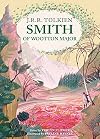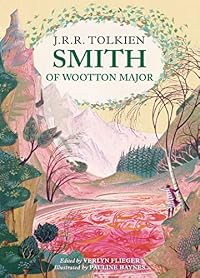
Smith of Wootton Major: Extended Edition
by J. R. R. Tolkien
On This Page
Description
A charming new pocket edition of one of Tolkien's major pieces of short fiction, and his only finished work dating from after publication of The Lord of the Rings. What began as a preface to The Golden Key by George MacDonald eventually grew into this charming short story, so named by Tolkien to suggest an early work by P.G. Wodehouse. Composed almost a decade after The Lord of the Rings, and when his lifelong occupation with the 'Silmarillion' was winding down, Smith of Wootton Major was show more the product of ripened experience and reflection. It was published in 1967 as a small hardback, complete with charming black and white illustrations by Pauline Baynes, and would be the last work of fiction to be published in Tolkien's own lifetime. Now, almost 50 years on, this enchanting tale of a wanderer who finds his way into the perilous realm of Faery is being published once again as a pocket hardback. Contained here are many intriguing links to the world of Middle-earth, as well as to Tolkien's other tales, and this new edition is enhanced with a facsimile of the illustrated first edition, a manuscript of Tolkien's early draft of the story, notes and an alternate ending, and a lengthy essay on the nature of Faery. show lessTags
Recommendations

Member Recommendations

Member Reviews
I’m going to admit right off the bat that maaaaybe this shouldn’t have been my very first book to read by Tolkien. Being sort-of a cynic about fantasy, I probably had no business picking this up. But it’s such a charming, tiny little book I couldn’t resist! Written a decade or so after Lord of the Rings, this book seems to be an allegorical-ish fable about fairies. I’m not actually sure, but this edition has a helpful forward, afterward and essay to help explain what Tolkien might have meant when he wrote about a boy who accidentally eats a fairy-star which ends up granting him access to the fairy-woods. It feels disjointed and impersonal, lacking magic or mystery that I would expect from a tale about fairies. The most show more fascinating part about Smith of Wootton Major isn’t even the story. It’s the inclusion of Tolkien’s unfinished draft introduction for a friend’s book. In it, he explains how he doesn’t even like introductions:
"The author meant to speak direct to his reader, and did not want any one else to interfere, telling the author to notice this or that, or to understand that or this, before the tale has even begun. You should be free to notice and like (or dislike) this and that for yourselves at first, without help or (very probably) hindrance. So do not pay any attention to me."
K. ¯_(ツ)_/¯ show less
"The author meant to speak direct to his reader, and did not want any one else to interfere, telling the author to notice this or that, or to understand that or this, before the tale has even begun. You should be free to notice and like (or dislike) this and that for yourselves at first, without help or (very probably) hindrance. So do not pay any attention to me."
K. ¯_(ツ)_/¯ show less
In the village of Wootton Major, The Feast of Good Children is held every twenty-four years. Twenty-four children are invited and the feast ends with an extraordinary Great Cake. During one of these celebrations, a very special ingredient is hidden in the cake. A young boy swallows it, only finding it months later when it makes itself known. It's a star, but not just any star, it's a star that grants him entry to the Land of Faery.
It's a short but lovely story written quite beautifully. It's definitely an adventure even if it shares traits with The Lord of the Rings; there isn't really much happening other than his exploring of the Land of Faery. That's the adventure. Perhaps not exciting but both heart-warming and gut-wrenching as show more it's more or less a metaphor about growing old and losing more and more of that creativity and the colourful imagination. By the end of the story, the man has to give back the star. He can still enter Land of Faery but is unable to discover anything new; he can only visit the parts he's already seen. But even without that metaphor, it's a nice little fantasy story. Not that I was expecting anything less from Tolkien himself. He sure knows how to write a good story. show less
It's a short but lovely story written quite beautifully. It's definitely an adventure even if it shares traits with The Lord of the Rings; there isn't really much happening other than his exploring of the Land of Faery. That's the adventure. Perhaps not exciting but both heart-warming and gut-wrenching as show more it's more or less a metaphor about growing old and losing more and more of that creativity and the colourful imagination. By the end of the story, the man has to give back the star. He can still enter Land of Faery but is unable to discover anything new; he can only visit the parts he's already seen. But even without that metaphor, it's a nice little fantasy story. Not that I was expecting anything less from Tolkien himself. He sure knows how to write a good story. show less
Ratings
Members
- Recently Added By
Lists

Fêtes worse than death? — Village festivals in fiction
37 works; 7 members

Books Read in 2022
5,164 works; 113 members
Author Information

584+ Works 510,485 Members
A writer of fantasies, Tolkien, a professor of language and literature at Oxford University, was always intrigued by early English and the imaginative use of language. In his greatest story, the trilogy The Lord of the Rings (1954--56), Tolkien invented a language with vocabulary, grammar, syntax, even poetry of its own. Though readers have show more created various possible allegorical interpretations, Tolkien has said: "It is not about anything but itself. (Certainly it has no allegorical intentions, general, particular or topical, moral, religious or political.)" In The Adventures of Tom Bombadil (1962), Tolkien tells the story of the "master of wood, water, and hill," a jolly teller of tales and singer of songs, one of the multitude of characters in his romance, saga, epic, or fairy tales about his country of the Hobbits. Tolkien was also a formidable medieval scholar, as evidenced by his work, Beowulf: The Monster and the Critics (1936) and his edition of Anciene Wisse: English Text of the Anciene Riwle. Among his works published posthumously, are The Legend of Sigurd and Gudrún and The Fall of Arthur, which was edited by his son, Christopher. In 2013, his title, TheHobbit (Movie Tie-In) made The New York Times Best Seller List. (Bowker Author Biography) show less
All Editions
Awards and Honors
Awards
Work Relationships
Is contained in
Is an expanded version of
Common Knowledge
- Canonical title
- Smith of Wootton Major: Extended Edition
- Original title
- Smith of Wootton Major: Extended Edition
- Original publication date
- 1967 (Tolkien's publication of "Smith") (Tolkien's publication of "Smith"); 2005 (extended edition with annotations by Verlyn Flieger) (extended edition with annotations by Verlyn Flieger)
- People/Characters
- Smith Smithson (Starbrow); Alf Prentice; Nokes; King of Faery; Queen of Faery; Master Cook (show all 15); Nell; Nan; Ned Smithson; Nokes of Townsend; Nokes of Townsend's Tim; J. R. R. Tolkien; Rob Rider; Rose Sangster; Ella Rider
- Important places
- Wootton Major; Faerie (Faery); Wootton Minor; Far Easton; Westwood; Sea of Windless Storm, Faery (show all 12); Unlight, Faery; Dark Marches, Faery; Outer Mountains, Faery; Inner Mountains, Faery; Vale of Evermorn, Faery; Walton
- First words
- There was a village once, not very long ago for those with long memories, nor very far away for those with long legs.
- Original language
- English
- Disambiguation notice*
- This is the edition with the first drafts of the story, the draft of the origin of the story, and commentary by Verlyn Flieger. Do not combine with editions with just the story.
*Some information comes from Common Knowledge in other languages. Click "Edit" for more information.
Classifications
Statistics
- Members
- 215
- Popularity
- 151,186
- Reviews
- 2
- Rating
- (3.94)
- Languages
- English, Finnish
- Media
- Paper, Audiobook, Ebook
- ISBNs
- 3