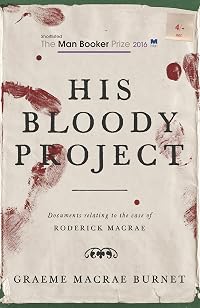
His Bloody Project: Documents Relating to the Case of Roderick Macrae
by Graeme Macrae Burnet
On This Page
Description
A brutal triple murder in a remote Scottish farming community in 1869 leads to the arrest of seventeen-year-old Roderick Macrae. There is no question that Macrae committed this terrible act. What would lead such a shy and intelligent boy down this bloody path? And will he hang for his crime? Presented as a collection of documents discovered by the author, His Bloody Project opens with a series of police statements taken from the villagers of Culdie, Ross-shire. They offer conflicting show more impressions of the accused; one interviewee recalls Macrae as a gentle and quiet child, while another details him as evil and wicked. Chief among the papers is Roderick Macrae's own memoirs where he outlines the series of events leading up to the murder in eloquent and affectless prose. There follow medical reports, psychological evaluations, a courtroom transcript from the trial, and other documents that throw both Macrae's motive and his sanity into question. Graeme Macrae Burnet's multilayered narrative-centered around an unreliable narrator-will keep the reader guessing to the very end. His Bloody Project is a deeply imagined crime novel that is both thrilling and luridly entertaining from an exceptional new voice. show lessTags
Recommendations












Member Recommendations
cbl_tn Both are Booker shortlisted novels that tell the story of a 19th century crime. Atwood's is based on a real crime.
30
Member Reviews
One of my favourites so far this year, and a great book to discuss at book group. The basic facts of the murder are established very early on, but take the rest of the book to gradually unravel, becoming if anything less clear the more different accounts we hear. It is bleak, with grinding poverty and the crofters sometimes seen as barely human by others. But it's also funny, with a dark sense of humour and some properly hilarious moments especially at the trial.
The “bloody project” of the title is the triple murder of members of the Mackenzie family committed by fellow Culduie resident Roderick Macrae. There seems to be little doubt that it was he who committed the murders; however, what was his motive? And can he be considered sane? The book consists of Macrae’s own account of the events, the opinion of a psychologist, and notes on the trial, all of which shed different light on the story.
This was a fascinating book, especially as the other points of view were brought in and added new facts and insights that we may not have been privy to with only Macrae’s account. It contains flashes of disturbing moments, and in the end you may not be entirely sure how you feel about the outcome. show more (Personally, I think Lachlan Broad deserved what was coming to him, and the psychologist was a condescending fool…) I liked the journalists’ accounts of the trial, particularly the snarky commentary by one of the columnists — the best was the line where the journalist commented that when the psychologist thought prisoners speaking gibberish were insane, perhaps he was not taking into account the fact that they were speaking Gaelic?? A very good point and one that serves to highlight the Highland vs. Lowland divide.
I’d recommend this book to anyone who likes stories of crime set in the Victorian era and/or books set in Scotland. show less
This was a fascinating book, especially as the other points of view were brought in and added new facts and insights that we may not have been privy to with only Macrae’s account. It contains flashes of disturbing moments, and in the end you may not be entirely sure how you feel about the outcome. show more (Personally, I think Lachlan Broad deserved what was coming to him, and the psychologist was a condescending fool…) I liked the journalists’ accounts of the trial, particularly the snarky commentary by one of the columnists — the best was the line where the journalist commented that when the psychologist thought prisoners speaking gibberish were insane, perhaps he was not taking into account the fact that they were speaking Gaelic?? A very good point and one that serves to highlight the Highland vs. Lowland divide.
I’d recommend this book to anyone who likes stories of crime set in the Victorian era and/or books set in Scotland. show less
I try to read my library books in order of 'due back' date...but the rest had to be put on hold for 24 hours so I could immerse myself in this. It's brilliant!
Having read the introduction, where the author explained this was the memoir left by one of his ancestors - hanged in the 19th century for a horrific crime - I read some twenty pages (feeling somewhat irked that Mr Macrae Burnet made it to Booker Prize shortlist on the back of another's work) before I twigged it was all a work of fiction!
Our narrator, 17 year old Roddy Macrae, is an intelligent but slightly strange youth living in the grimmest of circumstances. His mother recently died in childbirth; he now lives with his dour Presbyterian father, his lovely sister (in whom one show more senses a non-fraternal interest developing) and the infant twins in an impoverished hamlet in the Highlands.
"Our own house comprises two chambers. The greater part consists of the byre, and to the right of the door, our living quarters. The floor slopes downwards a little towards the sea, which prevents the dung from the animals running into our quarters."
Prevented from pursuing more than a basic schooling, Roddy's life comes to revolve around the bullying and unpleasant Lachlan Mackenzie, a man who gains increasing power over his neighbours and seems to have it 'in for' the Macraes. But Mackenzie also has a pretty daughter, who comes to figure in Roddy's dreams...
A gripping read, but also one that highlights the complexity of the human psyche. Unlike lesser crime fiction, where baddies tend to be all bad, Roddy is a much deeper, contradictory personality. Even his own words give us a confusing set of facts to work with...the comparative ease with which he kills an injured sheep ("I felt no pity for the beast, only a kind of loathing for its stupidity") set against the time he deliberately ruins a stag hunt (to his own detriment) because he can't bear the loss of life. The fact that his mass killing spares the senile grandmother. And while we fully comprehend the reasons for Mackenzie's murder, we baulk at the other two, and the other facts that come to light...
Is Roddy a gifted, unhappy boy in trying circumstances? A lust crazed madman? There are no easy answers.
Recommended. show less
Having read the introduction, where the author explained this was the memoir left by one of his ancestors - hanged in the 19th century for a horrific crime - I read some twenty pages (feeling somewhat irked that Mr Macrae Burnet made it to Booker Prize shortlist on the back of another's work) before I twigged it was all a work of fiction!
Our narrator, 17 year old Roddy Macrae, is an intelligent but slightly strange youth living in the grimmest of circumstances. His mother recently died in childbirth; he now lives with his dour Presbyterian father, his lovely sister (in whom one show more senses a non-fraternal interest developing) and the infant twins in an impoverished hamlet in the Highlands.
"Our own house comprises two chambers. The greater part consists of the byre, and to the right of the door, our living quarters. The floor slopes downwards a little towards the sea, which prevents the dung from the animals running into our quarters."
Prevented from pursuing more than a basic schooling, Roddy's life comes to revolve around the bullying and unpleasant Lachlan Mackenzie, a man who gains increasing power over his neighbours and seems to have it 'in for' the Macraes. But Mackenzie also has a pretty daughter, who comes to figure in Roddy's dreams...
A gripping read, but also one that highlights the complexity of the human psyche. Unlike lesser crime fiction, where baddies tend to be all bad, Roddy is a much deeper, contradictory personality. Even his own words give us a confusing set of facts to work with...the comparative ease with which he kills an injured sheep ("I felt no pity for the beast, only a kind of loathing for its stupidity") set against the time he deliberately ruins a stag hunt (to his own detriment) because he can't bear the loss of life. The fact that his mass killing spares the senile grandmother. And while we fully comprehend the reasons for Mackenzie's murder, we baulk at the other two, and the other facts that come to light...
Is Roddy a gifted, unhappy boy in trying circumstances? A lust crazed madman? There are no easy answers.
Recommended. show less
Literarischer Thriller, psychologischer Thriller, raffinierter Thriller - wow, das muss ja ein Superthriller sein, wenn die Umschlagseiten dieses Buch mit solchen Begriffen gepflastert sind. Mein Fazit hierzu schon mal vorweg: Ja, es ist spannend, aber ganz sicher kein Thriller. Laut Wiki ist dieses Genre gekennzeichnet durch ein beständiges Spiel zwischen Anspannung und Erleichterung, wovon in diesem Buch nicht viel zu merken ist.
Der Fall ist von Beginn an klar: Der 17jährige Roderick Macrae bringt drei Menschen um, was er auch ohne Zögern gesteht. Schriftlich hält er in der Haft fest, wie es dazu kam, ergänzt durch ärztliche Gutachten und der Prozessbeschreibung.
Neben den Geschehnissen, die zu den Morden führten, beschreibt der show more Täter detailliert das Leben in einem kleinen schottischen Dorf im 19. Jahrhundert. Es ist ein armseliges Dasein, die Menschen sind als Pächter mehr oder weniger Leibeigene des Gutsherrn und erwirtschaften eher schlecht als recht ihren eigenen Unterhalt. Sie sind der Wilkür der Herrschenden ausgeliefert und missbraucht einer seine Macht, gibt es keinen Widerstand - das Schicksal ist gottgegeben und nicht zu ändern. Gleichmütig schildert Roderick, wie seine Familie den Launen des Constable (einer Art Aufseher) ausgeliefert war und in stummer Resignation alles hinnahm, da selbst das kleinste Aufbegehren umgehend drakonische Strafmaßnahmen nach sich zog und schon im voraus klar war, dass es keinen Erfolg hatte.
Auch die ärztlichen Berichte sind erschütternd, denn sie zeigen überdeutlich die Arroganz der bürgerlichen Klasse gegenüber der armen Landbevölkerung. Zudem erhält man einen Einblick in die Anfänge der Kriminalpsychologie, wonach die meisten Kriminellen schon als Verbrecher geboren werden ('Verbrecherrasse'), was sich auch in vielerlei Anomalien und Missbildungen zeigt wie beispielsweise Taubheit, Blindheit, Klumpfüße usw.. Kaum vorstellbar, dass das Alles erst 150 Jahre her ist.
Dieses Buch ist nicht nur die Schilderung eines Kriminalfalles und der Anfänge der Kriminalpsychologie, sondern auch ein detailliertes, düsteres Sittengemälde einer Zeit, die wohl kaum jemand kennt. Spannend, ein Thriller jedoch ist es nicht. show less
Der Fall ist von Beginn an klar: Der 17jährige Roderick Macrae bringt drei Menschen um, was er auch ohne Zögern gesteht. Schriftlich hält er in der Haft fest, wie es dazu kam, ergänzt durch ärztliche Gutachten und der Prozessbeschreibung.
Neben den Geschehnissen, die zu den Morden führten, beschreibt der show more Täter detailliert das Leben in einem kleinen schottischen Dorf im 19. Jahrhundert. Es ist ein armseliges Dasein, die Menschen sind als Pächter mehr oder weniger Leibeigene des Gutsherrn und erwirtschaften eher schlecht als recht ihren eigenen Unterhalt. Sie sind der Wilkür der Herrschenden ausgeliefert und missbraucht einer seine Macht, gibt es keinen Widerstand - das Schicksal ist gottgegeben und nicht zu ändern. Gleichmütig schildert Roderick, wie seine Familie den Launen des Constable (einer Art Aufseher) ausgeliefert war und in stummer Resignation alles hinnahm, da selbst das kleinste Aufbegehren umgehend drakonische Strafmaßnahmen nach sich zog und schon im voraus klar war, dass es keinen Erfolg hatte.
Auch die ärztlichen Berichte sind erschütternd, denn sie zeigen überdeutlich die Arroganz der bürgerlichen Klasse gegenüber der armen Landbevölkerung. Zudem erhält man einen Einblick in die Anfänge der Kriminalpsychologie, wonach die meisten Kriminellen schon als Verbrecher geboren werden ('Verbrecherrasse'), was sich auch in vielerlei Anomalien und Missbildungen zeigt wie beispielsweise Taubheit, Blindheit, Klumpfüße usw.. Kaum vorstellbar, dass das Alles erst 150 Jahre her ist.
Dieses Buch ist nicht nur die Schilderung eines Kriminalfalles und der Anfänge der Kriminalpsychologie, sondern auch ein detailliertes, düsteres Sittengemälde einer Zeit, die wohl kaum jemand kennt. Spannend, ein Thriller jedoch ist es nicht. show less
His Bloody Project is historical fiction that appears, at first glance, to be a work of non-fiction. Set in 1869 in Culduie, a remote Scottish Highland village in a crofting community, the novel presents as a collection of historical documents relating to a triple murder committed by seventeen-year-old Roderick "Roddy" Macrae. Roddy does not dispute the killings. The storyline is conveyed via police statements, medical reports, psychological evaluations, a court transcript, and the memoir of the accused. These records provide the reader with the background that led to the murders and other facts of the case.
The storyline reveals how the appointment of Lachlan Broad (Mackenzie) as constable creates escalating tensions with the Macrae show more family, ultimately leading to tragedy. Yet as additional perspectives emerge through other documents, we begin to question Roddy's reliability as a narrator, creating a fascinating psychological complexity. The language feels authentically period-appropriate, with just enough Scottish dialect.
Themes include truth, power, justice, class, and sanity. The novel explores the arbitrariness of power in remote communities, where one person's authority can (and did) devastate lives. It also examines how different professional lenses can interpret the same events in vastly different ways. The book functions as a gripping crime narrative, as historical fiction that vividly depicts the harsh realities of 19th-century Scottish crofting life, and as a philosophical meditation on the elusive nature of truth.
Burnet keeps readers intellectually engaged throughout, constantly re-evaluating what they think they know. During the trial, I felt like a member of the jury, with the added benefit of having access to Roddy’s memoir, which is not allowed as evidence. It's the kind of book that questions whose version of events, if any, represents the complete truth. This book would be a very good one to discuss with a book group, as there are sure to be multiple opinions of what really happened and why. show less
The storyline reveals how the appointment of Lachlan Broad (Mackenzie) as constable creates escalating tensions with the Macrae show more family, ultimately leading to tragedy. Yet as additional perspectives emerge through other documents, we begin to question Roddy's reliability as a narrator, creating a fascinating psychological complexity. The language feels authentically period-appropriate, with just enough Scottish dialect.
Themes include truth, power, justice, class, and sanity. The novel explores the arbitrariness of power in remote communities, where one person's authority can (and did) devastate lives. It also examines how different professional lenses can interpret the same events in vastly different ways. The book functions as a gripping crime narrative, as historical fiction that vividly depicts the harsh realities of 19th-century Scottish crofting life, and as a philosophical meditation on the elusive nature of truth.
Burnet keeps readers intellectually engaged throughout, constantly re-evaluating what they think they know. During the trial, I felt like a member of the jury, with the added benefit of having access to Roddy’s memoir, which is not allowed as evidence. It's the kind of book that questions whose version of events, if any, represents the complete truth. This book would be a very good one to discuss with a book group, as there are sure to be multiple opinions of what really happened and why. show less
"Roddy, despite your best efforts to conceal them, God has granted you some uncommon gifts. It would be sinful not to make use of them." (pg. 25)
His Bloody Project is a difficult book to assess for two reasons. The first is that this is a novel, despite the structure and the tone of the content (the subtitle is Documents Relating to the Case of Roderick Macrae and it's written almost like non-fiction, with a narrative only inferred by the sequence). Its approach looks daunting at first glance, with initial witness statements being followed by the criminal's lengthy testimony, then medical reports and other media. The effect is an uncanny one: a piece of true crime, but one created by a novelist for purposes that are not always clear.
It show more reminded me, in a way, of the sort of frame of mind you put yourself in to enjoy something like the Netflix documentary Making a Murderer. It's an odd sensation to read, and the sort of gears a reader turns in his mind to assess a piece of literature have to be slightly altered here. The author provides the 'evidence', the 'documents', and the reader is the one who has to reason out the sequence of events, the character arcs and, most importantly, the motivations. Nevertheless, author Graeme Macrae Burnet does well to shape his story into a basic three-act structure: firstly, the account of the criminal; secondly, the responses of the doctors and the criminal advocate, set against the backdrop of the community coming to terms with the crime; and thirdly, the trial of the criminal and its verdict.
The second, and more critical, reason why the book is difficult to assess is that it is more than crime, but arguably less than literature. (I don't mean that to be too disparaging to the crime genre; it's only an observation that His Bloody Project doesn't rely on formula or convention or story resolution.) And this makes it difficult to wrangle with because, while there is obvious literary merit in the book, it's sometimes underdeveloped, or buried so deep that the reader is doing work bringing themes to the fore, when this really ought to be done by the writer of any particular novel. (In this sense, the book contains 'Documents' – primary sources, raw material – and the reader must make of them what they will.)
This is less a criticism and more an observation, because it is clear that the reader's engagement with the 'evidence' that the author creates is the raison d'être of the book: "This case… is distinguished not by the nature of the crime itself, but by the dissembling nature of the perpetrator's statements after the fact" (pp259-60). That Roderick Macrae commits the murders in the book is beyond doubt (though because such doubt is a staple of crime fiction, you do wonder at first, and you have to ignore that impulse – one more of those gears in the mind that the reader has to alter). What His Bloody Project concerns itself with is why Roderick Macrae committed those acts, and which (if any) of the arguments made in his defence or in the prosecution have merit.
Burnet succeeds in creating this murk in what appears to be an open-and-shut case, which goes some way in showing the reader how even an unremarkable murder (so to speak) can be complex. We know 'whodunnit', and so Burnet pursues a 'whydunnit'. It's an interesting novelty. But it's here that tension is to be found between the crime novel and the literary aspirations. The former requires closure: just as a whodunnit needs to tell us who done it, a whydunnit needs to tell us why it was done. It's here that His Bloody Project begins to dissatisfy.
It's not the fault of the author, who has conceived something original, written it very well and set a slow roast on some compelling literary ideas bubbling under. The problem is that the premise, which allows for each of these benefits to manifest, has inbuilt limitations. The seed can only grow into certain dimensions. By presenting the case, through fictionalized documents, from the perspective of the criminal, witnesses, doctors, lawyers, journalists, and so on, Burnet compels the reader towards the conclusion that "what is at issue are not the facts of the case, but the contents of the perpetrator's mind and… this is something few, if any, could truthfully presume to know" (pg. 250). It would almost be a post-modern take, in which the story takes fundamentally different forms depending on the perspective it is viewed from and the power and influence of the character with that perspective. I say almost, because Burnet and his characters (and the reader) all acknowledge the basic facts of the murder; the objective truth of them. But because of this, we don't get an answer to the 'why' of the whydunnit.
Where Burnet is inarguably successful in his literary efforts is in conveying "the injustice of the feudal conditions under which the Highland crofter continued to toil" (pg. 2). The horrors of the book are not really those of murder – the gruesomeness of which is covered in just a few pages – but of serfdom and the exercise of petty and vindictive power. Set in 1869 in the bleak Scottish Highlands, the common crofters (of whom Roderick Macrae is one) eke out a miserable existence "in a state barely higher than livestock" (pg. 187). Even the paltry, gainless patch of land they live on "belongs to the laird [lord] and it is at his discretion that you have the privilege of working it" (pg. 60). Opportunities of redress are scarce to say the least, but there's always someone who can make it worse: the oppressive difficulties that result in Roderick Macrae taking a tool to someone's skull are exacerbated by a new constable (a sort of overseer) pursuing a cruel, grasping and malicious vendetta. More than that, they do so under a shameless veneer of moral vindication, making it even harder to counteract. The Macrae family squirms under the yoke.
The evidence of this bleak existence is even more damning than that which eventually condemns Roderick Macrae for his crime. This might well be Burnet's intent: there are a number of allusions in the book, particularly in the trial at the end, that the crime is titillating for the community, particularly those who watch from the public gallery and press sections of the court. Even with the doctors and the lawyers, Macrae is more an intellectual curiosity and professional challenge than a man. The lowly crofter himself comments on the "absurdity of the situation in which, by virtue of making a murderer of myself, gentlemen now sought out my company" (pg. 86). Perhaps, Burnet is saying to us, I had to write a crime novel in order to get your attention – you wouldn't have read a bleak literary novel about an ordinary Highland crofter. (Then again, perhaps this isn't what Burnet is saying: he is a crime writer and wouldn't have written a bleak literary novel about an ordinary Highland crofter.)
It begins to get more than a little confusing. Though the literary material is there and the links can be made, there is little to no judiciousness on the part of the author (an inbuilt limitation of that 'documents' premise) and the reader struggles to separate the inevitable tangle. There's something to be said about the sheep that Macrae mercy-kills, though whether it applies to Macrae, his father, or to someone else is an idea which can spark in your brain but is quickly lost in the tangle. It's the same with the irony of the insanity plea in Macrae's trial; the prosecution agrees with Macrae that he was of sound mind, and it is his own defence which says he is insane. Think about that: the defence takes away Macrae's dignity – i.e. that he must be insane, his mind as menial as his labour – but the prosecution, if correct, takes away his life. This, perhaps, is the poverty trap: you're damned if you do and damned if you don't. Even if the insanity plea works, the result is not acquittal and freedom, but a commutation of the death penalty and the "dubious reward" of life imprisonment in an asylum (pg. 272). Macrae squirms under the yoke or he kicks air under the rope; there is no other choice.
This can be taken even further. "Do you think it is possible," Macrae's lawyer asks him on page 85, "for a madman to think that he is of sound mind?" As a comment on the poverty trap, it is apposite. Macrae accepts his lot, defers unquestioningly to his betters; he sees this life as normal, when only a madman could accept it. When he commits the murders, there's something almost automatic about it, a subconscious rebellion; the act of murder in part an outbreak of sanity. The gentlemen, too, believing the crofters to be almost a separate, lesser species wallowing in their proper place, don't understand why Macrae performed an act which suggests he isn't content with his lot.
All of this is there in Burnet's book, suggesting it's of great literary merit, but it's hard to say how much was intentional. This is in part because of the documentary nature: Burnet provides the materials and we work up our 'whydunnit' hypotheses. When the reader does the work – and I've had to hold a number of tangled things in my mind when writing the above review – it's hard to know whether to complement the writer for provoking the thoughts that emerge, or gently chastise them for not doing more to facilitate such literary happenings. Surely, from the latter perspective, the worth of an artist is in drawing the water from the well and bringing it to the village, not only in finding the well. Certainly, many readers will finish His Bloody Project feeling rather cold, and not knowing what the fuss was about.
Ultimately, I'm inclined to be favourable to Burnet's book. There are times when the literary aspects falter, and other times when the very nature of the premise prevents them from being exploited. Creating and then organising documents before the reader is an interesting strategy, but it means that the literary stuff is not brought out enough to strike the reader fully. I have a feeling that, in time, I will forget many of the tangled thoughts I have written above, whereas if the book had grasped them and honed them rather than merely provoked them, I might remember them more vividly. Certainly, I would remember them more intuitively; as it is, I feel almost like one of Burnet's gentlemen, seeing Macrae's case as an intellectual exercise. What I will remember is the pitilessness, the sense of hopelessness in the story. There's no light at the end of the tunnel here, unless you would argue for the distant light of understanding. The reader wants to parse the story even if it is forbiddingly tangled. Burnet muddies the waters for indeterminate gain, but we still want to drink. show less
His Bloody Project is a difficult book to assess for two reasons. The first is that this is a novel, despite the structure and the tone of the content (the subtitle is Documents Relating to the Case of Roderick Macrae and it's written almost like non-fiction, with a narrative only inferred by the sequence). Its approach looks daunting at first glance, with initial witness statements being followed by the criminal's lengthy testimony, then medical reports and other media. The effect is an uncanny one: a piece of true crime, but one created by a novelist for purposes that are not always clear.
It show more reminded me, in a way, of the sort of frame of mind you put yourself in to enjoy something like the Netflix documentary Making a Murderer. It's an odd sensation to read, and the sort of gears a reader turns in his mind to assess a piece of literature have to be slightly altered here. The author provides the 'evidence', the 'documents', and the reader is the one who has to reason out the sequence of events, the character arcs and, most importantly, the motivations. Nevertheless, author Graeme Macrae Burnet does well to shape his story into a basic three-act structure: firstly, the account of the criminal; secondly, the responses of the doctors and the criminal advocate, set against the backdrop of the community coming to terms with the crime; and thirdly, the trial of the criminal and its verdict.
The second, and more critical, reason why the book is difficult to assess is that it is more than crime, but arguably less than literature. (I don't mean that to be too disparaging to the crime genre; it's only an observation that His Bloody Project doesn't rely on formula or convention or story resolution.) And this makes it difficult to wrangle with because, while there is obvious literary merit in the book, it's sometimes underdeveloped, or buried so deep that the reader is doing work bringing themes to the fore, when this really ought to be done by the writer of any particular novel. (In this sense, the book contains 'Documents' – primary sources, raw material – and the reader must make of them what they will.)
This is less a criticism and more an observation, because it is clear that the reader's engagement with the 'evidence' that the author creates is the raison d'être of the book: "This case… is distinguished not by the nature of the crime itself, but by the dissembling nature of the perpetrator's statements after the fact" (pp259-60). That Roderick Macrae commits the murders in the book is beyond doubt (though because such doubt is a staple of crime fiction, you do wonder at first, and you have to ignore that impulse – one more of those gears in the mind that the reader has to alter). What His Bloody Project concerns itself with is why Roderick Macrae committed those acts, and which (if any) of the arguments made in his defence or in the prosecution have merit.
Burnet succeeds in creating this murk in what appears to be an open-and-shut case, which goes some way in showing the reader how even an unremarkable murder (so to speak) can be complex. We know 'whodunnit', and so Burnet pursues a 'whydunnit'. It's an interesting novelty. But it's here that tension is to be found between the crime novel and the literary aspirations. The former requires closure: just as a whodunnit needs to tell us who done it, a whydunnit needs to tell us why it was done. It's here that His Bloody Project begins to dissatisfy.
It's not the fault of the author, who has conceived something original, written it very well and set a slow roast on some compelling literary ideas bubbling under. The problem is that the premise, which allows for each of these benefits to manifest, has inbuilt limitations. The seed can only grow into certain dimensions. By presenting the case, through fictionalized documents, from the perspective of the criminal, witnesses, doctors, lawyers, journalists, and so on, Burnet compels the reader towards the conclusion that "what is at issue are not the facts of the case, but the contents of the perpetrator's mind and… this is something few, if any, could truthfully presume to know" (pg. 250). It would almost be a post-modern take, in which the story takes fundamentally different forms depending on the perspective it is viewed from and the power and influence of the character with that perspective. I say almost, because Burnet and his characters (and the reader) all acknowledge the basic facts of the murder; the objective truth of them. But because of this, we don't get an answer to the 'why' of the whydunnit.
Where Burnet is inarguably successful in his literary efforts is in conveying "the injustice of the feudal conditions under which the Highland crofter continued to toil" (pg. 2). The horrors of the book are not really those of murder – the gruesomeness of which is covered in just a few pages – but of serfdom and the exercise of petty and vindictive power. Set in 1869 in the bleak Scottish Highlands, the common crofters (of whom Roderick Macrae is one) eke out a miserable existence "in a state barely higher than livestock" (pg. 187). Even the paltry, gainless patch of land they live on "belongs to the laird [lord] and it is at his discretion that you have the privilege of working it" (pg. 60). Opportunities of redress are scarce to say the least, but there's always someone who can make it worse: the oppressive difficulties that result in Roderick Macrae taking a tool to someone's skull are exacerbated by a new constable (a sort of overseer) pursuing a cruel, grasping and malicious vendetta. More than that, they do so under a shameless veneer of moral vindication, making it even harder to counteract. The Macrae family squirms under the yoke.
The evidence of this bleak existence is even more damning than that which eventually condemns Roderick Macrae for his crime. This might well be Burnet's intent: there are a number of allusions in the book, particularly in the trial at the end, that the crime is titillating for the community, particularly those who watch from the public gallery and press sections of the court. Even with the doctors and the lawyers, Macrae is more an intellectual curiosity and professional challenge than a man. The lowly crofter himself comments on the "absurdity of the situation in which, by virtue of making a murderer of myself, gentlemen now sought out my company" (pg. 86). Perhaps, Burnet is saying to us, I had to write a crime novel in order to get your attention – you wouldn't have read a bleak literary novel about an ordinary Highland crofter. (Then again, perhaps this isn't what Burnet is saying: he is a crime writer and wouldn't have written a bleak literary novel about an ordinary Highland crofter.)
It begins to get more than a little confusing. Though the literary material is there and the links can be made, there is little to no judiciousness on the part of the author (an inbuilt limitation of that 'documents' premise) and the reader struggles to separate the inevitable tangle. There's something to be said about the sheep that Macrae mercy-kills, though whether it applies to Macrae, his father, or to someone else is an idea which can spark in your brain but is quickly lost in the tangle. It's the same with the irony of the insanity plea in Macrae's trial; the prosecution agrees with Macrae that he was of sound mind, and it is his own defence which says he is insane. Think about that: the defence takes away Macrae's dignity – i.e. that he must be insane, his mind as menial as his labour – but the prosecution, if correct, takes away his life. This, perhaps, is the poverty trap: you're damned if you do and damned if you don't. Even if the insanity plea works, the result is not acquittal and freedom, but a commutation of the death penalty and the "dubious reward" of life imprisonment in an asylum (pg. 272). Macrae squirms under the yoke or he kicks air under the rope; there is no other choice.
This can be taken even further. "Do you think it is possible," Macrae's lawyer asks him on page 85, "for a madman to think that he is of sound mind?" As a comment on the poverty trap, it is apposite. Macrae accepts his lot, defers unquestioningly to his betters; he sees this life as normal, when only a madman could accept it. When he commits the murders, there's something almost automatic about it, a subconscious rebellion; the act of murder in part an outbreak of sanity. The gentlemen, too, believing the crofters to be almost a separate, lesser species wallowing in their proper place, don't understand why Macrae performed an act which suggests he isn't content with his lot.
All of this is there in Burnet's book, suggesting it's of great literary merit, but it's hard to say how much was intentional. This is in part because of the documentary nature: Burnet provides the materials and we work up our 'whydunnit' hypotheses. When the reader does the work – and I've had to hold a number of tangled things in my mind when writing the above review – it's hard to know whether to complement the writer for provoking the thoughts that emerge, or gently chastise them for not doing more to facilitate such literary happenings. Surely, from the latter perspective, the worth of an artist is in drawing the water from the well and bringing it to the village, not only in finding the well. Certainly, many readers will finish His Bloody Project feeling rather cold, and not knowing what the fuss was about.
Ultimately, I'm inclined to be favourable to Burnet's book. There are times when the literary aspects falter, and other times when the very nature of the premise prevents them from being exploited. Creating and then organising documents before the reader is an interesting strategy, but it means that the literary stuff is not brought out enough to strike the reader fully. I have a feeling that, in time, I will forget many of the tangled thoughts I have written above, whereas if the book had grasped them and honed them rather than merely provoked them, I might remember them more vividly. Certainly, I would remember them more intuitively; as it is, I feel almost like one of Burnet's gentlemen, seeing Macrae's case as an intellectual exercise. What I will remember is the pitilessness, the sense of hopelessness in the story. There's no light at the end of the tunnel here, unless you would argue for the distant light of understanding. The reader wants to parse the story even if it is forbiddingly tangled. Burnet muddies the waters for indeterminate gain, but we still want to drink. show less
Graeme Macrae Burnet’s Booker Prize-nominated novel, His Bloody Project, purports to reconstruct, using contemporaneous documents, the story of a brutal triple slaying that took place in the Scottish village of Culduie. On an otherwise unexceptional day in August 1869, seventeen-year-old Roderick Macrae strolled up the lane from his house to the house of a neighbour, Lachlan Mackenzie. On the way there he was seen by another neighbour and spoke with her. She later testified that Roddy’s manner was normal: he was calm, gave her no cause for fear and did not raise her suspicions. Once at the Mackenzie house he used farming implements he had brought with him to bludgeon to death Lachlan’s daughter Flora and son Donnie, then waited show more for Lachlan. When Lachlan arrived home, Roddy beat him to death as well. Burnet’s novel consists of an account of the incident written by Roddy after his arrest, several witness statements, medical reports, an excerpt from a study of criminal psychology, and the trial transcript. Posing as an historical document, Burnet’s novel is thoroughly convincing, not to mention suspenseful and addictively readable. His detailed but never heavy handed prose brilliantly reconstructs the period in which the story is set, capturing the doleful spirit of the times, the superstitions that people held, the laws under which they laboured, the technologies they used, their pastimes and the beliefs that swayed attitudes and behaviours. The book, and Roddy himself, are infused with a mood of tragic inevitability. At the trial, Roddy’s motives come under close scrutiny. Experts and witnesses weight in on possible reasons for his actions. But questions persist. How can anyone know the content of another man’s mind? Graeme Macrae Burnet has written an astonishing and gripping novel that gives the reader plenty to think about. show less
Members
- Recently Added By
Published Reviews
ThingScore 92
Een jaar voor de dramatische gebeurtenissen verliest Roderick Macrea zijn moeder. Omdat iedereen haar persoonlijkheid vergeleek met ‘het zonlicht dat de gewassen koesterde’ was het hele dorp in diepe rouw gedompeld. Zijn vader leek er niet veel last van te hebben, hij was altijd in mineurstemming. Dorpsgenoten leggen de situatie allemaal anders uit. Maar er komt wel degelijk een beeld uit show more naar voren dat Roderick Macrae en zijn vader telkens weer vernederd werd door dorpsgenoot Lachlan Mackenzie...lees verder > show less
added by Jordaan
Graeme Macrae Burnet’s “His Bloody Project” was shortlisted for The Man Booker Prize 2016, and it is easy to see why. It is consummately conceived and competently written. Its most interesting aspect is the clever blending of reality and fiction. For example, woven into the story are some figures – notably prison doctor and psychology specialist J. Bruce Thomson and journalist John show more Murdoch who actually existed at the time. Their roles, their thoughts, as portrayed in the novel are those that they held at the historical time of the events of the story unfolds. There are other “real” elements that have been blended in as well. show less
added by steevohenderson
Burnet has been quick to point out that it's not a typical crime novel ("I prefer to call it 'a novel about a crime'"), and though this is indisputable, it is also true that it's just not a typical novel. The book is presented as a true-crime dossier per its subtitle, "Documents Relating to the Case of Roderick Macrae" — a group of found documents excavated by a fictional version of Burnet show more in the course of researching his grandfather (Donald "Tramp" Macrae), coupled with Burnet's reconstruction of his ancestor's trial. There are witness statements and medical reports, but the centerpiece of these documents is the fictional memoir of 17-year-old Roderick Macrae, written in prison after his arrest for a gory triple murder in his home village of Culduie in 1869. show less
added by steevohenderson
Lists

Booker Prize
491 works; 62 members

Top Five Books of 2016
795 works; 228 members

Top Five Books of 2017
757 works; 231 members

Top Five Books of 2015
811 works; 240 members

Man Booker Prize Longlist 2016
13 works; 2 members

Contemporary Fiction
109 works; 7 members

Books Read in 2017
4,249 works; 129 members

BBC Radio 4 Bookclub
340 works; 13 members

Books Set in Scotland
19 works; 5 members

Books Read in 2016
4,666 works; 197 members

Books Read in 2018
4,360 works; 110 members

Historical Fiction Books
99 works; 5 members

United Kingdom and Ireland
37 works; 1 member

Fakes, Forgeries, and Fictitious Authors
112 works; 4 members

Favorite Epistolary Fiction
143 works; 144 members

Books Read in 2024
4,623 works; 126 members

BBC World Book Club
265 works; 5 members

Death and Mystery (with some Adventure)
69 works; 1 member
Author Information

7+ Works 2,936 Members
Some Editions
Awards and Honors
Awards
Distinctions
Series
Belongs to Publisher Series
Impedimenta (201)
Common Knowledge
- Canonical title
- His Bloody Project: Documents Relating to the Case of Roderick Macrae
- Original title
- His Bloody Project: Documents Relating to the Case of Roderick Macrae
- Original publication date
- 2015
- People/Characters
- Roderick McCrae; Lachlan MacKenzie (Lachlan Broad); Flora MacKenzie; John Macrae (The Black Macrae); Jetta Macrae; James Craufurd, Lord Ardmillan (The Lord Justice-Clerk) (show all 39); Malcolm Chisholm; Murdo Cock; Allan Cruikshank; Ishbel Farquhar; Calum Finlayson; James Galbraith; Miss Galbraith; The gaoler; The ghillie; Mr Gifford; J. D. Gilchrist; William Gillies; Duncan Gregor; Dunkie Gregor; Charles Baillie, Lord Jerviswoode; Aeneas Mackenzie; Donald Mackenzie; Mimi Mackenzie (Mimi Broad); Peter Mackenzie; Charles MacLennon; Mrs MacLeod (The Onion); William MacLeod [in His Bloody Project]; Una Macrae; Lord Middleton; Alexander Moncrieff; Hector Munro; Carmina Murchison (Carmina Smoke); Kenneth Murchison (Kenny Smoke); James Philby; Archibald Ross; Andrew Sinclair; Edward Smith [in His Bloody Project]; James Bruce Thomson
- Important places
- Culduie, Ross-shire, Scotland, UK; Inverness, Scotland, UK
- Epigraph
- The quern performs best when the grindstone has been pitted.
Highland proverb - First words
- Preface
I am writing this at the behest of my advocate, Mr Andrew Sinclair, who since my incarceration here in Inverness has treated me with a degree of civility I in no way deserve. - Last words
- (Click to show. Warning: May contain spoilers.)'The hanging,' stated the doctor's report, 'was conducted in an exemplary fashion, and no undue suffering was caused to the prisoner.'
- Original language
- English
- Canonical DDC/MDS
- 823.92
- Canonical LCC
- PR6102.U7553
Classifications
Statistics
- Members
- 1,866
- Popularity
- 11,544
- Reviews
- 96
- Rating
- (3.87)
- Languages
- 11 — Danish, Dutch, English, Estonian, French, German, Italian, Polish, Portuguese, Spanish, Swedish
- Media
- Paper, Audiobook, Ebook
- ISBNs
- 46
- ASINs
- 15