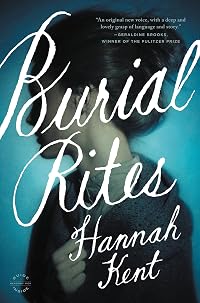
Burial Rites
by Hannah Kent
On This Page
Description
Set against Iceland's stark landscape, Hannah Kent brings to vivid life the story of Agnes, who, charged with the brutal murder of her former master, is sent to an isolated farm to await execution. Horrified at the prospect of housing a convicted murderer, the family at first avoids Agnes. Only Tóti, a priest Agnes has mysteriously chosen to be her spiritual guardian, seeks to understand her. But as Agnes's death looms, the farmer's wife and their daughters learn there is another side to show more the sensational story they've heard. . . . BURIAL RITES evokes a dramatic existence in a distant time and place -- show lessTags
Recommendations







Member Recommendations
BookshelfMonstrosity The Polished Hoe portrays conditions in 20th-century Jamaica, while Burial Rites focuses on 19th-century Iceland, but these exquisitely detailed literary historical novels explore the lives of unusually intelligent women whose treatment by their masters has resulted in terrible crimes.
50
BookshelfMonstrosity Although Slammerkin is more suspenseful and richly detailed than the spare, reflective Burial Rites, both character-driven historical novels draw upon true stories of young women accused of murder. Emphasis on the protagonists' impoverished backgrounds allows for exploration of social issues.
20

The Blue Fox by Sjón
by tandah
Bookmarque Another woman named Agnes, murder and the vulnerabilities created by love.
bluepiano Another novel about murder in 19th-century Iceland that's based on a real case.

vwinsloe 19th Century murderess in a cold, bleak location.

Member Reviews
This book made me thankful I was born in the US in the latter half of the twentieth century. Yeah, it’s one of those. Full of grinding poverty, disease, filth, vermin, hard physical labor, wicked weather and death. Not that we have learned to give death the slip or manage the weather, but they don’t control our everyday lives like it was for the people of Iceland in the 1820s. For those folks, wooden panels for your dirt walls were luxury. Having teeth was a luxury. More than one dress. Food. I read this book electronically, but if I’d read it as a physical copy, it was so atmospheric I would have expected dirt to fall out of it.
Agnes is to be pitied, but isn’t full of self-pity. She knows she’s been railroaded to some degree show more (and just how much is hidden from the reader until almost the end, and who can trust the source anyway?), but she doesn’t rail and cry and only once does she try to change her destiny. Her destiny, along with one of her co-conspirators, is with the axe. Because that’s an established fact (Agnes will and did die, the character is based on the real Agnes Magnusdottir), you’d expect this book to be a total downer, but it isn’t.
It starts off that way, with everyone hating, condemning and repudiating every minute of her existence because of her part in the deaths of two men. Not only their deaths, but an attempt to cover those deaths by fire. She is treated brutally, far more brutally than you’d ever see today and probably worse than her two accomplices. She is bruised, beaten and starved. Malnutrition has caused her to stop menstruating, a fact she considers to mean she is no longer a woman. She is literally crusted over with dirt, blood, piss and shit when she’s delivered to the farm at Kornsa. She turns the bathwater to sludge and the stench of her burning clothes drives everyone from the croft. Instead of bathing in the water, at first, Agnes tries to drink it, plunging her whole head into the bucket. This moves the heart of the most steely Margret, in whose home she is billeted until her execution.
From there, it’s basically a story of Agnes’s life; flashbacks to her past and vignettes from her present. It was rewarding to see her become a person to those she is forced upon; Margret, Jon, Steina & Lauga. Steina is first to recognize Agnes and tries to draw her out about her past. She’s not too successful and draws the ire of both her mother and sister. Especially Lauga, who being the youngest still sees the world largely in black and white, and while her mother, sister and local priest and even her father start to see Agnes’s humanity, Lauga steadfastly refuses and continues to be horrified that they actually have to feed her and let her stay indoors.
Interspersed with the fictional parts of the story are what appear to be transcriptions of actual court documents, official letters and other records of the murder, the trial and the subsequent housing and execution of the prisoners. Some of the attitudes are so harsh that it seems our own criminal justice system is laughably soft. Even Sigga’s reduced sentence at first seems like a mercy, but is anything but.
The characters seemed realistic and balanced to me. No one is an over-the-top villain, hero or victim and while some attitudes and behaviors made me angry, they were of the place and time. Like blaming women for their rapes. Expecting men to understand and deal with women better than women because they are men. The general deference to men as knowing and being better than women. The whacky religious fervor. Ugh. Back to being glad for being born when and where I was.
The language is starkly beautiful in spots and I highlighted a few passages that struck me -
(Early in Agnes & Margret’s relationship, Margret muses on Agnes’s nature)
“This woman is not a saga woman. She’s a landless workmaid raised on a porridge of moss and poverty.”
“Winter comes like a punch in the dark.”
“Illugastadir. Of all the names, one is a mistake. One is a nightmare. The stair you miss in the darkness.”
“As they say...Blind is a man without a book.”
Agnes is remembering how her relationship with Natan changed -
“It was only later that our tongues produced landslides, that we became caught in the cracks between what we said and what we meant, until we could not find each other, did not trust the words in our own mouths.”
I’m not surprised this has been shortlisted for the Bailey’s Orange Prize this year. It’s a well-crafted novel that will stick with me and one I’ll probably read again someday. show less
Agnes is to be pitied, but isn’t full of self-pity. She knows she’s been railroaded to some degree show more (and just how much is hidden from the reader until almost the end, and who can trust the source anyway?), but she doesn’t rail and cry and only once does she try to change her destiny. Her destiny, along with one of her co-conspirators, is with the axe. Because that’s an established fact (Agnes will and did die, the character is based on the real Agnes Magnusdottir), you’d expect this book to be a total downer, but it isn’t.
It starts off that way, with everyone hating, condemning and repudiating every minute of her existence because of her part in the deaths of two men. Not only their deaths, but an attempt to cover those deaths by fire. She is treated brutally, far more brutally than you’d ever see today and probably worse than her two accomplices. She is bruised, beaten and starved. Malnutrition has caused her to stop menstruating, a fact she considers to mean she is no longer a woman. She is literally crusted over with dirt, blood, piss and shit when she’s delivered to the farm at Kornsa. She turns the bathwater to sludge and the stench of her burning clothes drives everyone from the croft. Instead of bathing in the water, at first, Agnes tries to drink it, plunging her whole head into the bucket. This moves the heart of the most steely Margret, in whose home she is billeted until her execution.
From there, it’s basically a story of Agnes’s life; flashbacks to her past and vignettes from her present. It was rewarding to see her become a person to those she is forced upon; Margret, Jon, Steina & Lauga. Steina is first to recognize Agnes and tries to draw her out about her past. She’s not too successful and draws the ire of both her mother and sister. Especially Lauga, who being the youngest still sees the world largely in black and white, and while her mother, sister and local priest and even her father start to see Agnes’s humanity, Lauga steadfastly refuses and continues to be horrified that they actually have to feed her and let her stay indoors.
Interspersed with the fictional parts of the story are what appear to be transcriptions of actual court documents, official letters and other records of the murder, the trial and the subsequent housing and execution of the prisoners. Some of the attitudes are so harsh that it seems our own criminal justice system is laughably soft. Even Sigga’s reduced sentence at first seems like a mercy, but is anything but.
The characters seemed realistic and balanced to me. No one is an over-the-top villain, hero or victim and while some attitudes and behaviors made me angry, they were of the place and time. Like blaming women for their rapes. Expecting men to understand and deal with women better than women because they are men. The general deference to men as knowing and being better than women. The whacky religious fervor. Ugh. Back to being glad for being born when and where I was.
The language is starkly beautiful in spots and I highlighted a few passages that struck me -
(Early in Agnes & Margret’s relationship, Margret muses on Agnes’s nature)
“This woman is not a saga woman. She’s a landless workmaid raised on a porridge of moss and poverty.”
“Winter comes like a punch in the dark.”
“Illugastadir. Of all the names, one is a mistake. One is a nightmare. The stair you miss in the darkness.”
“As they say...Blind is a man without a book.”
Agnes is remembering how her relationship with Natan changed -
“It was only later that our tongues produced landslides, that we became caught in the cracks between what we said and what we meant, until we could not find each other, did not trust the words in our own mouths.”
I’m not surprised this has been shortlisted for the Bailey’s Orange Prize this year. It’s a well-crafted novel that will stick with me and one I’ll probably read again someday. show less
Burial Rites surprised me. I went in expecting a grim historical novel, but what Kent delivers is something far heavier — a cold, controlled excavation of a woman’s last months, written with an emotional precision that never allows you an easy out. The book’s power doesn’t come from melodrama. It comes from restraint, from the quiet horror of a community where gossip is moral law, and from the claustrophobic daily life of a household forced to live with someone they’ve already been told to fear.
Kent’s writing is beautiful, sometimes too beautiful. She loves to describe things — landscapes, gestures, emotional beats — and there are moments when it feels like she is describing for the sake of describing. As a reader, you show more occasionally want to say, “Yes, I get it, you’ve already shown me this.” There’s a stretch around pages 240–263 where the story slows to almost a crawl. You feel the wheel spinning, the mood tightening. For me, it was a slog to get through — but it pays off, because the emotional weight of the ending relies on that tightening coil.
The characters are what make the novel unforgettable.
Burial Rites is beautifully written, emotionally punishing, occasionally overwritten, and absolutely worth reading. It’s the story of a woman the world decided to erase — told in a tone so stark and unsentimental that you feel the erasure happening even as you read. It hurt, and I loved it. show less
Kent’s writing is beautiful, sometimes too beautiful. She loves to describe things — landscapes, gestures, emotional beats — and there are moments when it feels like she is describing for the sake of describing. As a reader, you show more occasionally want to say, “Yes, I get it, you’ve already shown me this.” There’s a stretch around pages 240–263 where the story slows to almost a crawl. You feel the wheel spinning, the mood tightening. For me, it was a slog to get through — but it pays off, because the emotional weight of the ending relies on that tightening coil.
The characters are what make the novel unforgettable.
Burial Rites is beautifully written, emotionally punishing, occasionally overwritten, and absolutely worth reading. It’s the story of a woman the world decided to erase — told in a tone so stark and unsentimental that you feel the erasure happening even as you read. It hurt, and I loved it. show less
This was Kent's debut novel and it was superb! It is the story of Agnes Magnusdottir, a 30 year old woman in Iceland that was put to death for a gruesome murder. The first lines of the book set the tone, and they are chilling: "They said I must die. They said that I stole the breath from men, and now they must steal mine. I imagine, then, that we are all candle flames, greasy-bright, fluttering in the darkness and the howl of the wind, and in the stillness of the room I hear footsteps, awful coming footsteps, coming to blow me out and send my life up away from me in a gray wreath of smoke." The book, although a novel, was based on a true story. Definitely a winner!
I love reading about Iceland, which sounds like a fascinating if rather bleak place to live, but even a glimpse into the history of the country wasn't enough to lift this novel out of the three star doldrums. All praise to the author for her research and skill in writing a novel about the fate of a real woman in an alien place and time, however - her notes on crafting her first book were almost as overwrought as the main character's life story!
Based on the infamous case of the last woman to executed - by axe! - in Iceland, Agnes Magnúsdóttir in 1827, Hannah Kent weaves a more sympathetic version of the condemned woman's final months in the custody of a farming family living in the bleak north of the island. Agnes and two others were show more convicted of bludgeoning and stabbing to death Agnes' lover Natan and another man before setting fire to his remote house in a bid to destroy the bodies. Agnes and Fridrik, an acquaintance of Natan's, were sentenced to death, while Natan's young housekeeper had her conviction commuted to hard labour. Kent delivers Agnes' version of the murders in reverse, revealing the 'human truth' of her part in the crime via an extended therapy session to a young priest sent to help the murderess seek forgiveness for her sins.
Finding out if Agnes was actually guilty, and to what extent, is all that kept me reading after a certain point, and even that revelation turned out to be an anticlimax. The bulk of the novel, which could have been shorter, is more of a depressing travel guide for Iceland, with families freezing to death in hovels or butchering animals as a community event. The narrative is divided between repetitive third person accounts of Agnes surviving day to day with the family of a local official while waiting her execution date and Agnes' own life story in first person, as reported to the reverend in training who is little more than a sounding board for her tale of woe (or as one of the official's daughters captures pithily: 'Oh, pity me, I'm a pauper!'). I did actually start to feel sorry for Agnes, who is portrayed as capable and intelligent, until her story boiled down to falling in love with a wrong 'un and being rejected for a younger model. Her life choices were limited, certainly, but a woman throwing her life away for a man is always a depressing read.
I did get into the 'rhythm' of the story after a while, and the setting was very evocative - this is definitely a book to read in winter rather than mid-August! - but the pacing started to drag and I lost interest around the halfway point and started skim reading towards the end. show less
Based on the infamous case of the last woman to executed - by axe! - in Iceland, Agnes Magnúsdóttir in 1827, Hannah Kent weaves a more sympathetic version of the condemned woman's final months in the custody of a farming family living in the bleak north of the island. Agnes and two others were show more convicted of bludgeoning and stabbing to death Agnes' lover Natan and another man before setting fire to his remote house in a bid to destroy the bodies. Agnes and Fridrik, an acquaintance of Natan's, were sentenced to death, while Natan's young housekeeper had her conviction commuted to hard labour. Kent delivers Agnes' version of the murders in reverse, revealing the 'human truth' of her part in the crime via an extended therapy session to a young priest sent to help the murderess seek forgiveness for her sins.
Finding out if Agnes was actually guilty, and to what extent, is all that kept me reading after a certain point, and even that revelation turned out to be an anticlimax. The bulk of the novel, which could have been shorter, is more of a depressing travel guide for Iceland, with families freezing to death in hovels or butchering animals as a community event. The narrative is divided between repetitive third person accounts of Agnes surviving day to day with the family of a local official while waiting her execution date and Agnes' own life story in first person, as reported to the reverend in training who is little more than a sounding board for her tale of woe (or as one of the official's daughters captures pithily: 'Oh, pity me, I'm a pauper!'). I did actually start to feel sorry for Agnes, who is portrayed as capable and intelligent, until her story boiled down to falling in love with a wrong 'un and being rejected for a younger model. Her life choices were limited, certainly, but a woman throwing her life away for a man is always a depressing read.
I did get into the 'rhythm' of the story after a while, and the setting was very evocative - this is definitely a book to read in winter rather than mid-August! - but the pacing started to drag and I lost interest around the halfway point and started skim reading towards the end. show less
This impressive debut novel by Hannah Kent is a fictionalized account of a true life story. In 1829, Agnes Magnusdottir and two other servants are sentenced to death for the gruesome murder of two men on a isolated farm in northern Iceland. While waiting for her execution date she is put under the physical supervision of District Officer Jon Jonsson and the spiritual supervision of Assistant Reverend Thorvardur Jonsson (Toti).
During the cold winter months Agnes begins to unburden herself to Toti, even thought she has never spoken of her story before. As she works alongside the Jonsson's on their farm, the family begin to see another side to Agnes and begin to wonder if she is actually guilty of the crime she has been accused and show more convicted of. The story of Agnes' life is told in a series of flashbacks, describing her early life as well as the actual murder and her relationship with both the men who were killed.
Each chapter begins with a piece of correspondence or a witness testimony, which reflects the legal standards of the time. The title “Burial Rites” refers to whether the dead deserve to be buried on consecrated ground.
The author brings the harsh Icelandic environment sharply to life. We experience how the characters struggle to maintain their meager existence out of the land, continually battling the threat of severe weather. Agnes is a tragic figure and the descriptions of the bleak and miserable lives of the other characters and how they live will fill you with pity. Children and servants are thrown out into the harsh weather to die. I kept thinking as I read....how could I ever live such an existence? How were these people able to live in such poverty and endure such desperation and loneliness?
I felt that the book was beautifully written and the story compelling. I'm haven't been able to stop thinking about Agnes and the rest of the characters. It's a book that will stay with me for a long, long time I think. show less
During the cold winter months Agnes begins to unburden herself to Toti, even thought she has never spoken of her story before. As she works alongside the Jonsson's on their farm, the family begin to see another side to Agnes and begin to wonder if she is actually guilty of the crime she has been accused and show more convicted of. The story of Agnes' life is told in a series of flashbacks, describing her early life as well as the actual murder and her relationship with both the men who were killed.
Each chapter begins with a piece of correspondence or a witness testimony, which reflects the legal standards of the time. The title “Burial Rites” refers to whether the dead deserve to be buried on consecrated ground.
The author brings the harsh Icelandic environment sharply to life. We experience how the characters struggle to maintain their meager existence out of the land, continually battling the threat of severe weather. Agnes is a tragic figure and the descriptions of the bleak and miserable lives of the other characters and how they live will fill you with pity. Children and servants are thrown out into the harsh weather to die. I kept thinking as I read....how could I ever live such an existence? How were these people able to live in such poverty and endure such desperation and loneliness?
I felt that the book was beautifully written and the story compelling. I'm haven't been able to stop thinking about Agnes and the rest of the characters. It's a book that will stay with me for a long, long time I think. show less
I loved this book! Even though it was much less action-packed than other things I've read so far this year, I didn't want to put it down. The prose was so well written I felt like I was sitting in the room with them, not in my apartment. It was really interesting the way the beginning of each chapter presented hard facts of what was happening within the government to prepare for the execution and then the meat of the chapter was so much more emotional. Even though before even opening the book you know how it will end, I just wanted to know more. Kent does a great job of slowly revealing what really happened the night of the crime while you are jumping to your own conclusions. The character development is quite slow, so you almost don't show more realize it's happening until the end - but that makes it all the more beautifully tragic. Right out of the gate, you empathize with Agnes as she is in this horrible jail and you just want the best for her, but it never happens. When she finally gets what she wanted her whole life, it is too late.
I highly recommend this to anyone, it was a beautiful read and I'm so glad I picked it up. show less
I highly recommend this to anyone, it was a beautiful read and I'm so glad I picked it up. show less
No need for spoiler alerts. We know how this one ends before it begins: In Iceland in 1830, a woman is executed for murder.
It takes real skill to build suspense toward a known outcome, and something akin to sorcery to make that outcome almost surprising. Hannah Kent manages this, and so much more.
Her depiction of life in rural Iceland 200 years ago is fascinating. Read the book just for that, and consider the flowing prose and gripping plot a bonus. Then fall on your knees and give thanks for a lice-free bed and central heating.
Burial Rites is a stunning view into a cold, bleak corner of history. Kent lifts it up for us to see and fills it with humanity--both the light of compassion and the darkness of pride and jealousy.
It takes real skill to build suspense toward a known outcome, and something akin to sorcery to make that outcome almost surprising. Hannah Kent manages this, and so much more.
Her depiction of life in rural Iceland 200 years ago is fascinating. Read the book just for that, and consider the flowing prose and gripping plot a bonus. Then fall on your knees and give thanks for a lice-free bed and central heating.
Burial Rites is a stunning view into a cold, bleak corner of history. Kent lifts it up for us to see and fills it with humanity--both the light of compassion and the darkness of pride and jealousy.
Members
- Recently Added By
Published Reviews
ThingScore 77
One of the best “Scandinavian” crime novels I have read, Burial Rites is the work of an Australian who visited Iceland on a cultural exchange.
added by hf22
The novel isn't seamless—Ms. Kent disrupts its rhythms by awkwardly switching between an omniscient narrator and Agnes's first-person point of view. But it convincingly animates Agnes, who feels "knifed to the hilt with fate," showing her headstrong humanity and heart-wrenching thirst for life. At one point she recalls seeing two icebergs grinding together off the northern shore, the show more friction from their exposed boulders causing gathered driftwood to go up in flames. At her best, Ms. Kent achieves a similar eerie force in this story of passion in a frozen place. show less
added by hf22
There are other stylistic problems. Some dialogue that’s meant to seem elevated and of its time simply sounds unidiomatic: “I was worried of as much”; “The only recourse to her absolution would be through prayer.” There’s prefab phrasing — “my heart throbbed,” “she said breathlessly,” “overcome with relief” — and descriptive clichés, including a sky that’s show more “bright, bright blue, so bright you could weep.” show less
added by hf22
Lists

Top Five Books of 2013
1,562 works; 715 members

Best Historical Fiction
620 works; 258 members

Your favorite books from the 2014 Baileys Women's Prize for Fiction
20 works; 23 members

Favourite Women's Prize for Fiction, Orange & Bailey's Prize contenders
132 works; 52 members

Baileys Women's Prize for Fiction Winners and Shortlisted Books
61 works; 11 members

Historical Fiction
889 works; 91 members

Best 21st Century Books (So Far)
679 works; 85 members

Best Contemporary Literary Fiction (Around the Last 30 Years)
400 works; 124 members

Female Author
1,234 works; 65 members

Top Five Books of 2014
1,064 works; 397 members

Sense of place
156 works; 13 members

Women's Stories
88 works; 13 members
Female Protagonist
1,056 works; 57 members
LibraryThingers' 1001 Books You Must Read Before You Die
442 works; 30 members

Top Five Books of 2015
811 works; 240 members

Books Read in 2014
2,344 works; 89 members

Top Five Books of 2021
604 works; 181 members
International IMPAC Dublin Literary Award
179 works; 6 members
Literature About Women and Girls
426 works; 40 members

Summer Reads 2014
207 works; 69 members

Books Set on Islands
190 works; 24 members

Indie Next Picks
196 works; 4 members

2016 Book Club Choices
52 works; 7 members

Netgalley Reads
468 works; 3 members

Books Read in 2023
5,638 works; 147 members
Book Club 2020
4 works; 1 member

Books About Murder
313 works; 7 members

History novels (not too romancey)
37 works; 5 members

Historical Fiction Lovers
88 works; 4 members

Australian Women's Writing 2003 - 2014
49 works; 3 members
First Novels
373 works; 17 members

Reading Group 2014
4 works; 1 member

Traveling the world in books
24 works; 1 member

Book Club 2017
8 works; 2 members

Books Read in 2015
3,299 works; 126 members

Books on my Kindle
162 works; 3 members
SantaThing 2014 Gifts
299 works; 17 members

Historical fiction by women authors
15 works; 5 members

Books Read in 2022
5,226 works; 112 members

Books Read in 2019
4,052 works; 108 members
Rebel Women Reading List
25 works; 2 members

Historical Figures in Fiction
51 works; 5 members
Books read in 2015
213 works; 5 members

Allie's Wishlist
217 works; 2 members

Global Reads: Books Set in Western Europe
186 works; 10 members

Fresh Time and Place Historical Fiction
6 works; 1 member

Red Dot 2014-2015 - Mature Readers - Longlist
36 works; 5 members

Books recommended by Calgary Public Library staff
1,588 works; 4 members
Best Australian Books of the 21st Century
88 works; 2 members
Author Information

7+ Works 5,611 Members
Hannah Kent was born in 1985 in Adelaide, Australia. She is the co-founder and publishing director of Australian literary journal Kill Your Darlings. She won the inaugural Writing Australia Unpublished Manuscript Award (2011). Burial Rites is her first novel. It won numerous awards including the ABIA Literary Fiction Book of the Year, the Indie show more Awards Debut Fiction Book of the Year and the Victorian Premier's People's Choice Award. Her second novel, The Good People, is being adapted into a film. She will be writing the screenplay. (Bowker Author Biography) show less
Some Editions
Awards and Honors
Awards
Distinctions
Series
Belongs to Publisher Series
Contemporánea [Alba] (14)
Common Knowledge
- Canonical title*
- De laatste rituelen
- Original title
- Burial Rites
- Original publication date
- 2013-09-10
- People/Characters
- Agnes Magnúsdóttir; Natan Ketilsson; Björn Blöndal; Pétur Jónsson; Steina Jónsdóttir; Margrét (show all 9); Jón; Lauga Jónsdóttir; Tóti (Assistant Reverend Thorvardur Jónsson)
- Important places
- Iceland; Húnavatnssýsla, Iceland
- Important events
- Last execution of capital punishment in Iceland (1830-12-1)
- Epigraph
- I was worst to the one I loved best.
Laxdæla Saga - Dedication
- For my parents
- First words
- They said I must die.
- Quotations
- His hair is as red as before, as red as the midnight sun. It looks as though his locks have soaked up the light as a skein of wool suffers the dye.
"Do you know the right name for a flock of ravens?"
Tóti shook his head.
"A conspiracy, Reverend. A conspiracy."
A tight fear, like a fishing line, hooked upon something that must, inevitably, be dragged from the depths.
Yes, I am quite alone, and a tremble of exhilaration passes along my skin, like the tremor on the surface of a pot of water about to boil.
At Hvammur, during the trial, they plucked at my words like birds. Dreadful birds, dressing in red with breasts of silver buttons, and cocked heads and sharp mouths, looking for guilt like berries on a bush.
After the trial, the priest from Tjörn told me that I would burn if I did not cast my mind back over the sin of my life and pray for forgiveness. As though prayer could simply pluck sin out. But any woman knows that a thread... (show all), once woven, is fixed in place; the only way to smooth a mistake is to let it all unravel.
I feel drunk with summer and sunlight. I want to seize fistfuls of sky and eat them. As the scythes run sharp fingers through the stalks, the cut grass makes a gasping sound.
"That's what happened to my mother, Reverend," Agnes continued. "Who was she really? Probably not as people say she was, but she made mistakes and others made up their minds about her. People around here don't let you forget ... (show all)your misdeeds. They think them the only things worth writing down."
If he wants to learn of my family he'll have a hard time of it. Two fathers and a mother who seem as blurry to me as strangers departing through a snowstorm.
It's a silent memory, and one, like the others, I can't quite trust. Memories shift like loose snow in a wind, or are a chorale of ghosts all talking over one another. There is only ever a sense that what is real to me is not... (show all) real to others, and to share a memory with someone is to risk sullying my belief in what has truly happened.
Did my mother look down at her baby daughter and think: "One day I will leave you?" Did she look at my scrunched face, hoping I would die, or did she silently urge me to stick to life like a burr? Perhaps she looked out to th... (show all)e valley, into the mist and stillness, and wondered what she could give me. A lie for a father. A head of dark hair. A hayrack to sleep in. A kiss. A stone, so that I might learn to understand the birds and never be lonely.
"In here," she said, "I can turn to that day as though it were a page in a book. It's written so deeply upon my mind I can almost taste the ink."
two women were spreading clothes out to dry in what slender sun the day afforded.
In those early visits it was as though we were building something sacred. We'd place words carefully together, piling them upon one another, leaving no spaces.
Then there was the first touch of skin on skin, and that was the gunshot, the freefall.
I craved his weight, then.
I arched my neck until my face was wet with the drifting damp.
He groaned and the sound lingered in the air like a cloud of ash over a volcano.
I felt too much to see it for what it was.
When everything froze we met in the storeroom, with a constellation of drying meat above our heads.
I remember feeling too full with blood.
For the first time in my life, someone saw me, and I loved him because he made me feel I was enough.
All those weeks, all those nights, I was rotted through with hunger.
All that willpower to contain that which I wanted to cry into the wind, and scratch into the dirt, and burn into the grass.
He would haul me out of the valley, out of the husk of my miserable, loveless life, and everything would be new.
I could even see the west fjords over the gray swell of water. Like a shadow of themselves.
I learnt later that he was as changeable as the ocean, and God help you if you saw his expression shift and darken.
But the hours crept past like the guilty and midnight came and went, and still he did not come inside.
Only the wind speaks and it will not talk sense, it screams like the widow of the world and will not wait for a reply. - Last words
- (Click to show. Warning: May contain spoilers.)The sudden sound of the first axe fall echoed throughout the valley.
(Click to show. Warning: May contain spoilers.)While the deed took place, and there until it was finished, everything was appropriately quiet and well-ordered, and it was concluded by a short address by Reverend Magnus Arnason to those that were there.
Actum ut supra.
B. Bléndal, R. Olsen, A. Arnason
From the Magistrate's Book of Hunavatn District, 1830
(Epilogue) - Blurbers
- Miller, Madeline; Brooks, Geraldine; Berry, Anne; Abbott, Megan; Slaughter, Karin
- Original language
- English
*Some information comes from Common Knowledge in other languages. Click "Edit" for more information.
Classifications
Statistics
- Members
- 4,209
- Popularity
- 3,646
- Reviews
- 306
- Rating
- (4.01)
- Languages
- 15 — Danish, Dutch, English, Estonian, French, German, Greek, Hungarian, Italian, Lithuanian, Norwegian (Bokmål), Portuguese, Spanish, Swedish, Turkish
- Media
- Paper, Audiobook, Ebook
- ISBNs
- 61
- ASINs
- 20