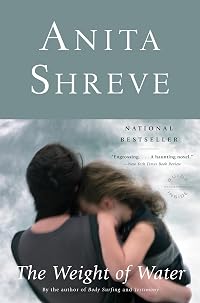
The Weight of Water
by Anita Shreve
On This Page
Description
Journeying to Smuttynose Island, off the coast of New Hampshire, to shoot a photo essay about a century-old double murder, a photographer becomes absorbed by the crime and increasingly obsessed with jealousy over the idea that her husband is having an affair..
Tags
Recommendations






































Member Recommendations



vwinsloe Murderess in a cold, bleak location.
Member Reviews
Anita Shreve (author of the much-touted "The Pilot’s Wife") has done the near-impossible in "The Weight of Water." She has written two tragic tales, separated by more than 100 years, and coiled them seamlessly into one compelling narrative. This is one of the most emotional, provocative and exciting novels I’ve read in a long time. For those who dismissed "The Pilot’s Wife" with a shrug, this is THE Shreve novel to search out at the local bookstore. "The Weight of Water" is a much better crafted work than the more recent Oprah pick.
In the novel, a photojournalist named Jean gets an assignment to do a photo essay on a 100-year-old double-murder that happened on the Isles of Shoals, a tiny group of islands off the coast of New show more Hampshire. Jean brings along her poet husband, her five-year-old daughter, her brother-in-law and his new girlfriend. They all climb aboard an old sailboat and head out for the barren islands. Turmoil brews as quick as afternoon storm clouds. Jean and her husband Thomas have a strained marriage, full of jealousy and stony silences; Rich, Thomas’ brother, has a physically passionate relationship with his girlfriend, but their relationship also shows signs of trouble when she starts to flirt with Thomas; then there’s the volatile relationship between Thomas and Rich. Let's just say, it’s a far cry from the Love Boat.
Shreve skillfully gets the reader involved in the soap opera when, in the first few pages, Jean and Rich take a trip onto the island to photograph the murder scene. The attraction and tension between them is as palpable as the briny sea air.
Interwoven with the modern story is the saga of what happened on the island in 1873 when two women were brutally murdered with an ax. This part of the novel, told in a memoir by another woman who hid in a cave after the murders, is even more intense than Jean’s marital woes. I don’t want to spoil any of the delicious narrative surprises Shreve has in store, so I’ll just say that there’s insanity, jealousy and incest at work on the island in 1873—problems that continue to resonate and haunt characters 100 years later.
As she proved in "The Pilot’s Wife," Shreve has a sure touch when it comes to accurate, detailed descriptions. With an admirable economy of words, she gets us right under the skin of the characters. Here’s Jean’s lament from the opening pages of the novel: "Sometimes I think that if it were possible to tell a story often enough to make the hurt ease up, to make the words slide down my arms and away from me like water, I would tell that story a thousand times."
Fortunately for us, we are given the story and all of its pain and passion.
(As an aside, Shreve’s descriptions of Smuttynose Island and the rest of the Isles of Shoals were so graphic and interesting, that I immediately searched the Internet for photos of the area. I found one site [though there may be more] that had a collection of beautiful images: http://www.perpublisher.com/shoals.html) show less
In the novel, a photojournalist named Jean gets an assignment to do a photo essay on a 100-year-old double-murder that happened on the Isles of Shoals, a tiny group of islands off the coast of New show more Hampshire. Jean brings along her poet husband, her five-year-old daughter, her brother-in-law and his new girlfriend. They all climb aboard an old sailboat and head out for the barren islands. Turmoil brews as quick as afternoon storm clouds. Jean and her husband Thomas have a strained marriage, full of jealousy and stony silences; Rich, Thomas’ brother, has a physically passionate relationship with his girlfriend, but their relationship also shows signs of trouble when she starts to flirt with Thomas; then there’s the volatile relationship between Thomas and Rich. Let's just say, it’s a far cry from the Love Boat.
Shreve skillfully gets the reader involved in the soap opera when, in the first few pages, Jean and Rich take a trip onto the island to photograph the murder scene. The attraction and tension between them is as palpable as the briny sea air.
Interwoven with the modern story is the saga of what happened on the island in 1873 when two women were brutally murdered with an ax. This part of the novel, told in a memoir by another woman who hid in a cave after the murders, is even more intense than Jean’s marital woes. I don’t want to spoil any of the delicious narrative surprises Shreve has in store, so I’ll just say that there’s insanity, jealousy and incest at work on the island in 1873—problems that continue to resonate and haunt characters 100 years later.
As she proved in "The Pilot’s Wife," Shreve has a sure touch when it comes to accurate, detailed descriptions. With an admirable economy of words, she gets us right under the skin of the characters. Here’s Jean’s lament from the opening pages of the novel: "Sometimes I think that if it were possible to tell a story often enough to make the hurt ease up, to make the words slide down my arms and away from me like water, I would tell that story a thousand times."
Fortunately for us, we are given the story and all of its pain and passion.
(As an aside, Shreve’s descriptions of Smuttynose Island and the rest of the Isles of Shoals were so graphic and interesting, that I immediately searched the Internet for photos of the area. I found one site [though there may be more] that had a collection of beautiful images: http://www.perpublisher.com/shoals.html) show less
As a woman who has been pushed to the edge once or twice, the back copy of his book of this book lured me in. “I wonder this: If you take a woman and push her to the edge, how will she behave?”
The feeling of impending tragedy is overwhelming as Jean explores an isolated island in search of a story. The past and present weave together and both are slipping like water towards the revelation.
Anita Shreve, author of THE PILOT’s WIFE, is a master of atmosphere.
Couldn’t put this down and had a few late nights reading it and then trying to sleep. It is a ‘high residue’ story, and it curls up in the back of your mind, making you vaguely uncomfortable. The work of a master writer.
Loved it. Best to read when the sun is shining...
The feeling of impending tragedy is overwhelming as Jean explores an isolated island in search of a story. The past and present weave together and both are slipping like water towards the revelation.
Anita Shreve, author of THE PILOT’s WIFE, is a master of atmosphere.
Couldn’t put this down and had a few late nights reading it and then trying to sleep. It is a ‘high residue’ story, and it curls up in the back of your mind, making you vaguely uncomfortable. The work of a master writer.
Loved it. Best to read when the sun is shining...
A new book about the 1873 murders on Smuttynose mentioned this book as one that sensationalized the case. As if much more of that was really needed. Around here, it’s pretty famous and many, many books have been written on the subject. The thing this new author objected to was that Shreve invented a new killer for her book. In reality, the ax murderer was caught, tried and hanged. Instead of following that line, Shreve gives us a secret deathbed confession discovered in the Portsmouth Athenaeum by a photographer on assignment.
Spoilers await -
Those are the two narratives that make up the book; the document and a present-day tale of photographer, Jean, who is on location with her husband, daughter, brother-in-law and his girlfriend. show more Tensions are running high due to the girlfriend’s presence. Jean is convinced she and her husband, Thomas are having an affair. Certainly she’s alluring and even her daughter, Billie, is under her spell. As a photographer myself, I found her work ethic pretty lax and she remarks on some gorgeous light, but doesn’t break out the ‘Blad. Strange. Overall though, the way Shreve wound the situation up tight to breaking was well done. She leaves us in held-breath suspense while the narrative changes time frame back to the past.
Those sections were less realistic for me because the writing was so polished and full of high language, considering the author. That author, Maren, survivor of the murders, had some education, but hadn’t had time to utilize any of her skills during the years she spent as a fisherman’s wife. It’s possible that after she returned to Norway she undertook a job where she wasn’t just a manual labor drudge, but Shreve didn’t set that up for us and so the writing style just didn’t check up with Maren’s real situation. The scenario though, I could buy. The bleak hours and stress of being on a basically barren island 10 miles from shore in a sea that’s not exactly placid. Being alone so much of the time, unloved and then with a nasty sister arriving on the side, that can make anyone snap. Still, Maren’s cool-headed crime clean up and frame job was a bit fanciful.
The women’s tales coincided well, although the blocking in my ebook copy was non-existent and the paragraphs changed abruptly from one to another with no visual cues. Both women were physically confined (a sailboat for Jean, the rocky island for Maren) with a narrow cast of companions, some positive and some negative. Each felt like their lives were slipping beyond their control. They felt threatened and not just by the awful weather persistent in both timelines. As the pressure mounted each responded differently, but that was the exercise; to see what they would do. Maren’s plight was certainly more worthy of pity than Jean’s, but I still felt empathy for that situation. The endings are not happy and offer little in the way of hope or condolence.
Since I used to work in Kittery and spent a lot of time in Portsmouth, it was fun wandering the streets with Jean and her family. Some parts of the town haven’t changed all that much in the last 150 years, and with Strawbery Banke preserved as a colonial showcase, it was easy to picture Maren’s time as well. Strangely enough, even though I’ve lived in NH all my life, I’ve never visited the islands themselves. They’re rich in history and totally up my alley so I’d like to go someday. show less
Spoilers await -
Those are the two narratives that make up the book; the document and a present-day tale of photographer, Jean, who is on location with her husband, daughter, brother-in-law and his girlfriend. show more Tensions are running high due to the girlfriend’s presence. Jean is convinced she and her husband, Thomas are having an affair. Certainly she’s alluring and even her daughter, Billie, is under her spell. As a photographer myself, I found her work ethic pretty lax and she remarks on some gorgeous light, but doesn’t break out the ‘Blad. Strange. Overall though, the way Shreve wound the situation up tight to breaking was well done. She leaves us in held-breath suspense while the narrative changes time frame back to the past.
Those sections were less realistic for me because the writing was so polished and full of high language, considering the author. That author, Maren, survivor of the murders, had some education, but hadn’t had time to utilize any of her skills during the years she spent as a fisherman’s wife. It’s possible that after she returned to Norway she undertook a job where she wasn’t just a manual labor drudge, but Shreve didn’t set that up for us and so the writing style just didn’t check up with Maren’s real situation. The scenario though, I could buy. The bleak hours and stress of being on a basically barren island 10 miles from shore in a sea that’s not exactly placid. Being alone so much of the time, unloved and then with a nasty sister arriving on the side, that can make anyone snap. Still, Maren’s cool-headed crime clean up and frame job was a bit fanciful.
The women’s tales coincided well, although the blocking in my ebook copy was non-existent and the paragraphs changed abruptly from one to another with no visual cues. Both women were physically confined (a sailboat for Jean, the rocky island for Maren) with a narrow cast of companions, some positive and some negative. Each felt like their lives were slipping beyond their control. They felt threatened and not just by the awful weather persistent in both timelines. As the pressure mounted each responded differently, but that was the exercise; to see what they would do. Maren’s plight was certainly more worthy of pity than Jean’s, but I still felt empathy for that situation. The endings are not happy and offer little in the way of hope or condolence.
Since I used to work in Kittery and spent a lot of time in Portsmouth, it was fun wandering the streets with Jean and her family. Some parts of the town haven’t changed all that much in the last 150 years, and with Strawbery Banke preserved as a colonial showcase, it was easy to picture Maren’s time as well. Strangely enough, even though I’ve lived in NH all my life, I’ve never visited the islands themselves. They’re rich in history and totally up my alley so I’d like to go someday. show less
What to say about a book I didn't actually enjoy, but read like a fiend? It's hard to read about love without humor, without happiness. It's especially difficult to read about a twisted, obsessive love that spirals out of control. And when emotional chaos seems to span generations, the reading gets particularly bleak. At the same time, Anita Shreve's "The Weight of Water" is a fascinating read. Partly the isolated and soulless location which infects even the reader with same depressing hopelessness felt by the characters, partly the brutal violence at the core of this story of tortuous passion and fierce suspicion - I read this at a frantic pace, caught up in this vividly awful story.
The prequel to "The Last Time They Met," this is by show more far the better written book and I recommend it. show less
The prequel to "The Last Time They Met," this is by show more far the better written book and I recommend it. show less
I really liked how Shreve wove then and now together. The hint of resemblance between Magdalene and Adaline was lovely. The denouement was easy to guess but seeing how Shreve accomplished it was a pleasure.
In 1873 two women are brutally murdered on a small island off the coast of New Hampshire. A third woman, Maren, scared, alone and covered in blood hides in a cave on the shoreline. In what becomes referred to as the ‘trial of the century’ by newspapers of the time, Louis Wagner is arrested, charged, tried and hanged for the murders. In the present day, Jean, a photojournalist, is visiting the island where the murders took place on an assignment for the magazine she works for. Her editor thinks there is a link between the 1873 murders and a famous trial in the 1990s involving “a double murder, with a blade, a famous trial, circumstantial evidence that hinges on tiny factual details.”
On the trip with Jean are her husband Thomas, show more her daughter Billie, her brother in law Rich and his girlfriend Adaline. Using Rich’s boat they travel to what is an archipelago of nine islands, eight at low tide. Thomas is a university professor and poet and an alcoholic. He told Jean that he loved her the day after they met but Jean feels at times that she is more of a muse to Thomas than someone he truly loves. Jean also begins to believe that her husband is having an affair with Adaline.
The novel switches between the present day and a document of 1899 written by Maren on her deathbed. The document is found by Jean in the archives of a local island library, which she steals from the library with the intention of returning it at a later date.
The novel is laden with metaphors. The sea of course is the novel’s strongest metaphor with its allusions to emotional undercurrents, its inherent beauty and benign nature when calm but unforgiving and treacherous as life can be when we least expect it. The weight of emotions, expectations, dreams, desires, loved one’s needs, fears and disappointments that pressurize us the deeper we enter our mortal coil.
Anita Shreve’s novel is a light book of only 246 pages but weighs heavily on the mind after reading it with its genuinely emotional writing. In less competent hands this story would have become fatuous, over-wrought and sentimental but the author steers the story away from those over populated islands and sails us toward the more treasured, resplendent islands of intelligent, empathetic, well-crafted and erudite.
My only criticism is the denouement of Maren’s document and the reason why the murderer committed the heinous crimes they did. I felt it neither rang true nor was satisfactory in its reasoning. The events that led to the murders felt contrived and lacked any narrative truth. However, Jean’s story ends truthfully and leaves one feeling battered and bruised by the storm of edifying, emotionally charged prose show less
On the trip with Jean are her husband Thomas, show more her daughter Billie, her brother in law Rich and his girlfriend Adaline. Using Rich’s boat they travel to what is an archipelago of nine islands, eight at low tide. Thomas is a university professor and poet and an alcoholic. He told Jean that he loved her the day after they met but Jean feels at times that she is more of a muse to Thomas than someone he truly loves. Jean also begins to believe that her husband is having an affair with Adaline.
The novel switches between the present day and a document of 1899 written by Maren on her deathbed. The document is found by Jean in the archives of a local island library, which she steals from the library with the intention of returning it at a later date.
The novel is laden with metaphors. The sea of course is the novel’s strongest metaphor with its allusions to emotional undercurrents, its inherent beauty and benign nature when calm but unforgiving and treacherous as life can be when we least expect it. The weight of emotions, expectations, dreams, desires, loved one’s needs, fears and disappointments that pressurize us the deeper we enter our mortal coil.
Anita Shreve’s novel is a light book of only 246 pages but weighs heavily on the mind after reading it with its genuinely emotional writing. In less competent hands this story would have become fatuous, over-wrought and sentimental but the author steers the story away from those over populated islands and sails us toward the more treasured, resplendent islands of intelligent, empathetic, well-crafted and erudite.
My only criticism is the denouement of Maren’s document and the reason why the murderer committed the heinous crimes they did. I felt it neither rang true nor was satisfactory in its reasoning. The events that led to the murders felt contrived and lacked any narrative truth. However, Jean’s story ends truthfully and leaves one feeling battered and bruised by the storm of edifying, emotionally charged prose show less
I remember being surprised at how much I liked a book by Anita Shreve. I think I had her pegged in the "B" class of fiction writers, a writer of "chicklit", "women's fiction". I suppose this could be called women's fiction, much as I hate that term, simply because it features a woman as the protagonist, who is propelled by emotion as much as by necessity. I prefer to consider it simply "fiction" or "literature". A book worth reading, by anyone.
Jean is a photographer sent on assignment to photograph the site of a crime committed over 100 years before. The site is on a rocky, lonely island called Smuttynose Island, off the coast of Maine. There Jean photographs the remains of a small cabin, from many angles. She did not simply arrive at show more the island and take photographs, however. She spent time digging up the history of the event, and even found a letter written many years later by the lone survivor of the murder. The details of the people who lived here well up in her brain and make her hesitate to return to the boat, where her husband, her young child, and the girlfriend of her husband's brother await.
A storm is brewing but she has to get these last shots. She has to work her way through the story of the murders. We read the letter along with her, in parts, as she investigates the site and considers the possibility that all is not well with her own marriage. Do the two relate to each other? I think they do. show less
Jean is a photographer sent on assignment to photograph the site of a crime committed over 100 years before. The site is on a rocky, lonely island called Smuttynose Island, off the coast of Maine. There Jean photographs the remains of a small cabin, from many angles. She did not simply arrive at show more the island and take photographs, however. She spent time digging up the history of the event, and even found a letter written many years later by the lone survivor of the murder. The details of the people who lived here well up in her brain and make her hesitate to return to the boat, where her husband, her young child, and the girlfriend of her husband's brother await.
A storm is brewing but she has to get these last shots. She has to work her way through the story of the murders. We read the letter along with her, in parts, as she investigates the site and considers the possibility that all is not well with her own marriage. Do the two relate to each other? I think they do. show less
Members
- Recently Added By
Lists

Favourite Women's Prize for Fiction, Orange & Bailey's Prize contenders
132 works; 52 members

Female Author
1,234 works; 64 members

Must-Read Maine
146 works; 91 members

New England Books
101 works; 10 members
Oprah's Book Club (original and 2.0)
91 works; 21 members

Books Read in 2014
2,344 works; 89 members

Books I have Recommended
208 works; 1 member

Books Read in 2013
1,630 works; 51 members
Author Information

30+ Works 43,812 Members
Anita Shreve grew up in Dedham, Massachusetts. After receiving a bachelor's degree in English from Tufts University, she taught high school English for five years before becoming a full-time author. She worked for an English-language magazine in Nairobi and wrote for everything from Cosmopolitan magazine to The New York Times. Her nonfiction books show more included Remaking Motherhood and Women Together, Women Alone. Her novels included Eden Close, Strange Fits of Passion, Where or When, Fortune's Rocks, Rescue, Stella Bain, and The Stars are Fire. Several of her books were made into movies including The Pilot's Wife, Resistance, and The Weight of Water. She died from cancer on March 29, 2018 at the age of 71. (Bowker Author Biography) show less
Some Editions
Awards and Honors
Awards
Work Relationships
Is contained in
Was inspired by
Common Knowledge
- Canonical title*
- Het gewicht van water
- Original title
- The Weight of Water
- Original publication date
- 1997
- People/Characters
- Jean Janes; Thomas Janes; Billie Janes; Rich Janes; Adaline Gunne; Maren Hontvedt (show all 11); John Hontvedt; Karen Christensen; Evan Christensen; Anethe Christensen; Louis Wagner
- Important places
- Isles of Shoals, Maine, USA; Norway
- Related movies
- The Weight of Water (2000 | IMDb)
- Dedication
- For my mother and my daughter
- First words
- I have to let this story go.
- Last words
- (Click to show. Warning: May contain spoilers.)I think of the hurt that stories cannot ease, not with a thousand tellings
- Original language*
- Amerikanisch
- Canonical DDC/MDS
- 813.54
- Canonical LCC
- PS3569.H7385
*Some information comes from Common Knowledge in other languages. Click "Edit" for more information.
Classifications
- Genres
- Fiction and Literature, General Fiction, Mystery, Historical Fiction
- DDC/MDS
- 813.54 — Literature & rhetoric American literature in English American fiction in English 1900-1999 1945-1999
- LCC
- PS3569 .H7385 — Language and Literature American literature American literature Individual authors 1961-
- BISAC
Statistics
- Members
- 3,389
- Popularity
- 4,990
- Reviews
- 60
- Rating
- (3.60)
- Languages
- 12 — Catalan, Danish, Dutch, English, Finnish, French, German, Italian, Polish, Portuguese, Spanish, Swedish
- Media
- Paper, Audiobook, Ebook
- ISBNs
- 59
- UPCs
- 2
- ASINs
- 14