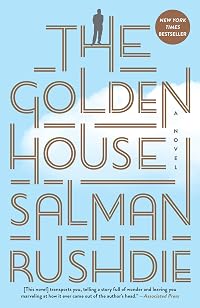
The Golden House
by Salman Rushdie
On This Page
Description
On the day of Barack Obama's inauguration, an enigmatic billionaire from foreign shores takes up residence in the architectural jewel of 'the Gardens,' a cloistered community in New York's Greenwich Village. The neighborhood is a bubble within a bubble, and the residents are immediately intrigued by the eccentric newcomer and his family.Tags
Recommendations


Member Reviews
This novel focuses on the Golden family, a very secretive, very wealthy family living in the most lavish mansion in an exclusive enclave in New York City. Initially little is known about the members of the family. They do not speak about where they came from, and their names are inventions; the patriarch calls himself Nero Golden and his three sons have names from Roman history and mythology. One of their neighbours is René, a young, aspiring film-maker. René decides the mysterious family would be a perfect subject for a film so he befriends them to learn their secrets; he ends up being more involved than he anticipated as he records their rise and fall.
Characterization is definitely a strong element. There are many characters but show more there is no difficulty differentiating them. Each emerges as a unique individual with his/her distinct personality traits, strengths and weaknesses, and interests. Petya, the eldest son, is the intelligent, agoraphobic, alcoholic with Asperger’s Syndrome; Apu, the middle son, is a gifted but attention-seeking artist; and D, the youngest, struggles with his identity. The siren Vasilisa who seduces the much older Nero is one of the most memorable characters; her ruthlessness and amorality match those of her powerful husband and make her one “among the all-time pantheon of designing women.”
René, the narrator, is not a likeable character. He inserts himself within the family and shamelessly uses their confidences for his own purposes. He is a self-centred voyeur waiting for disaster to befall people who treat him kindly. He also proves himself to be such a weak person. Fortunately, he shows some maturity at the end of the novel.
Though the novel is clearly set in the eight years of Obama’s presidency, I at first thought of Nero as a parallel to Donald Trump. He is deeply involved in the construction and development business so the word “GOLDEN, a golden word, colored gold, in brightly illuminated gold neon, and all in capital letters of gold, began to be seen.” This is certainly reminiscent of Trump Tower and Trump’s penchant for gold in his Trump Tower home and the Oval Office. Nero believes that “the only virtue worth caring about was loyalty” and that mirrors the president who dismisses those who are not first and foremost loyal to him. As Nero’s story of his corrupt rise to power emerges, there are obvious parallels with the rise of Trump. Nero’s marriage to a much younger Russian model is similar to Trump’s marriage to the much younger model born in the Socialist Republic of Slovenia. What about Vespa and Barron?
Then Rushdie mentions, “The Joker was on TV, announcing a run for president.” There is no doubt who the Joker is: “In Gotham we knew who the Joker was, and wanted nothing to do with him, or the daughter he lusted after, or the daughter he never mentioned, or the sons who murdered elephants and leopards for sport.” The presidential election “became a contest between the Batwoman and the Joker – Batwoman, who owned her dark side, but used it to fight for good, justice, and the American way.” The descriptions of the Joker are many and scathing so there is no ambiguity about Rushdie’s feelings about the current president. Sometimes, the book seems almost prophetic. As I write this review, the news is full of the investigations into Trump’s ties to Russian businesses and Trump’s unwillingness to denounce white supremacists, so reading references to “Russian oligarchs propping up the Joker’s shady enterprises” and descriptions of the Joker’s skin as “white as a Klansman’s hood” is chilling.
The book asks a number of questions and examines a number of issues. It asks whether it is possible for a person to totally reinvent him/herself? Is it possible to escape one’s past? Can a person be simultaneously good and bad? It discusses how difficult it is to find the truth. Several times it is repeated that truth lies beneath a veneer, that “the truth often lies below the surface,” and that “so much is hidden, now that we live in surfaces, in presentations and falsifications of ourselves, the seeker after truth must pick up his shovel, break the surface and look for the blood beneath.” Rushdie suggests that people lie more often than they tell the truth: “These are the times we live in, in which men hide their truths, perhaps even from themselves, and live in lies.” A character says, “’True is such a twentieth-century concept. The question is, can I get you to believe it, can I get it repeated enough times to make it as good as true.’” When René is not privy to an event, he imagines it and passes on his fiction as a truth, so sometimes it becomes difficult to remember what is reality and what is one of René’s fictions. He often uses the phrase “to tell the truth” to reassure the reader that he isn’t lying so the reader wonders whether at other times the narrator is lying. At one point he admits, “I’m also finishing up my Golden screenplay, my fiction about these men who made fictions of themselves, and the two are blurring into each other until I’m not sure anymore what’s real and what I made up.” Using René, a man whose career is based on the use of fiction, as an unreliable narrator is an ingenious way to emphasize the difficulty to getting to the truth.
Gender identity is also explored, primarily through the struggles of D. The reader, like D, may have to think of gender identity in a new way. Are you gay or straight and cis or trans? D is told, “MTF was male to female, FTM was vice versa. Now she was pouring words over him, gender fluid, bigender, agender, trans with an asterisk: trans*, the difference between woman and female, gender nonconforming, genderqueer, nonbinary, and, from Native American culture, two-spirit.’”
The style of the book would undoubtedly be called “elitist” by some. I agree with the narrator who says, “Americans tell you that knowing things is élitist and they hate élites, and all you have ever had is your mind and you were brought up to believe in the loveliness of knowledge, not the knowledge-is-power nonsense but knowledge is beauty, and then all of that, education, art, music, film, becomes a reason for being loathed.” This sounds like Rushdie’s defense of his intellectual writing style for the book is full of allusions to literature, both ancient and modern, and to cinema. René has an encyclopedic knowledge of films and film-makers and I don’t, so I know I missed a lot; I just didn’t have the time to research all of the references.
Besides feeling somewhat intimidated by the number of cinematic allusions, I sometimes became irritated by the number of rambling tangents. The paucity of dialogue and the lengthy sentences do not make his style accessible. Here’s one sentence that is rather overwhelming: “The person credited with making this profound change in Zamzama’s world view and range of interests was a demagogic preacher named Rahman, founder and secretary of a militant organization based in the city and calling itself the Azhar Academy, dedicated to promoting the thought of a nineteenth-century Indian firebrand, Imam Azhar of Bareilly, the town which gave its name to the Barelvi sect of which the preacher Rahman was the leading light.” Another element of the style that bothered me is the excessive foreshadowing of impending doom with statements like “by the time I’m done, much will be said, much of it horrifying” and “I could have prevented what followed if I had been more vigilant” and “Maybe I could have prevented what happened.”
This novel is very broad in scope. At one point René talks about the type of film he would like to make: “a mighty film, or a Dekalog-style sequence of films, dealing with migration, transformation, fear, danger, rationalism, romanticism, sexual change, the city, cowardice, and courage; nothing less than a panoramic portrait of my times.” All of these subjects are in the novel and there are more besides: gun violence, political corruption in the U.S. and India, mental illness, etc.
The book is well worth reading. It will not be a comfortable fit for everyone, but anyone who likes an erudite book that compels him/her to think and enjoys social, political and cultural commentary will love it. In addition, there is a plot with mystery and strong characterization. Though the book has some stylistic excesses, it has so much to recommend it.
Note: I received an eARC of this book from the publisher via NetGalley.
Please check out my reader's blog (https://schatjesshelves.blogspot.ca/) and follow me on Twitter (@DCYakabuski). show less
Characterization is definitely a strong element. There are many characters but show more there is no difficulty differentiating them. Each emerges as a unique individual with his/her distinct personality traits, strengths and weaknesses, and interests. Petya, the eldest son, is the intelligent, agoraphobic, alcoholic with Asperger’s Syndrome; Apu, the middle son, is a gifted but attention-seeking artist; and D, the youngest, struggles with his identity. The siren Vasilisa who seduces the much older Nero is one of the most memorable characters; her ruthlessness and amorality match those of her powerful husband and make her one “among the all-time pantheon of designing women.”
René, the narrator, is not a likeable character. He inserts himself within the family and shamelessly uses their confidences for his own purposes. He is a self-centred voyeur waiting for disaster to befall people who treat him kindly. He also proves himself to be such a weak person. Fortunately, he shows some maturity at the end of the novel.
Though the novel is clearly set in the eight years of Obama’s presidency, I at first thought of Nero as a parallel to Donald Trump. He is deeply involved in the construction and development business so the word “GOLDEN, a golden word, colored gold, in brightly illuminated gold neon, and all in capital letters of gold, began to be seen.” This is certainly reminiscent of Trump Tower and Trump’s penchant for gold in his Trump Tower home and the Oval Office. Nero believes that “the only virtue worth caring about was loyalty” and that mirrors the president who dismisses those who are not first and foremost loyal to him. As Nero’s story of his corrupt rise to power emerges, there are obvious parallels with the rise of Trump. Nero’s marriage to a much younger Russian model is similar to Trump’s marriage to the much younger model born in the Socialist Republic of Slovenia. What about Vespa and Barron?
Then Rushdie mentions, “The Joker was on TV, announcing a run for president.” There is no doubt who the Joker is: “In Gotham we knew who the Joker was, and wanted nothing to do with him, or the daughter he lusted after, or the daughter he never mentioned, or the sons who murdered elephants and leopards for sport.” The presidential election “became a contest between the Batwoman and the Joker – Batwoman, who owned her dark side, but used it to fight for good, justice, and the American way.” The descriptions of the Joker are many and scathing so there is no ambiguity about Rushdie’s feelings about the current president. Sometimes, the book seems almost prophetic. As I write this review, the news is full of the investigations into Trump’s ties to Russian businesses and Trump’s unwillingness to denounce white supremacists, so reading references to “Russian oligarchs propping up the Joker’s shady enterprises” and descriptions of the Joker’s skin as “white as a Klansman’s hood” is chilling.
The book asks a number of questions and examines a number of issues. It asks whether it is possible for a person to totally reinvent him/herself? Is it possible to escape one’s past? Can a person be simultaneously good and bad? It discusses how difficult it is to find the truth. Several times it is repeated that truth lies beneath a veneer, that “the truth often lies below the surface,” and that “so much is hidden, now that we live in surfaces, in presentations and falsifications of ourselves, the seeker after truth must pick up his shovel, break the surface and look for the blood beneath.” Rushdie suggests that people lie more often than they tell the truth: “These are the times we live in, in which men hide their truths, perhaps even from themselves, and live in lies.” A character says, “’True is such a twentieth-century concept. The question is, can I get you to believe it, can I get it repeated enough times to make it as good as true.’” When René is not privy to an event, he imagines it and passes on his fiction as a truth, so sometimes it becomes difficult to remember what is reality and what is one of René’s fictions. He often uses the phrase “to tell the truth” to reassure the reader that he isn’t lying so the reader wonders whether at other times the narrator is lying. At one point he admits, “I’m also finishing up my Golden screenplay, my fiction about these men who made fictions of themselves, and the two are blurring into each other until I’m not sure anymore what’s real and what I made up.” Using René, a man whose career is based on the use of fiction, as an unreliable narrator is an ingenious way to emphasize the difficulty to getting to the truth.
Gender identity is also explored, primarily through the struggles of D. The reader, like D, may have to think of gender identity in a new way. Are you gay or straight and cis or trans? D is told, “MTF was male to female, FTM was vice versa. Now she was pouring words over him, gender fluid, bigender, agender, trans with an asterisk: trans*, the difference between woman and female, gender nonconforming, genderqueer, nonbinary, and, from Native American culture, two-spirit.’”
The style of the book would undoubtedly be called “elitist” by some. I agree with the narrator who says, “Americans tell you that knowing things is élitist and they hate élites, and all you have ever had is your mind and you were brought up to believe in the loveliness of knowledge, not the knowledge-is-power nonsense but knowledge is beauty, and then all of that, education, art, music, film, becomes a reason for being loathed.” This sounds like Rushdie’s defense of his intellectual writing style for the book is full of allusions to literature, both ancient and modern, and to cinema. René has an encyclopedic knowledge of films and film-makers and I don’t, so I know I missed a lot; I just didn’t have the time to research all of the references.
Besides feeling somewhat intimidated by the number of cinematic allusions, I sometimes became irritated by the number of rambling tangents. The paucity of dialogue and the lengthy sentences do not make his style accessible. Here’s one sentence that is rather overwhelming: “The person credited with making this profound change in Zamzama’s world view and range of interests was a demagogic preacher named Rahman, founder and secretary of a militant organization based in the city and calling itself the Azhar Academy, dedicated to promoting the thought of a nineteenth-century Indian firebrand, Imam Azhar of Bareilly, the town which gave its name to the Barelvi sect of which the preacher Rahman was the leading light.” Another element of the style that bothered me is the excessive foreshadowing of impending doom with statements like “by the time I’m done, much will be said, much of it horrifying” and “I could have prevented what followed if I had been more vigilant” and “Maybe I could have prevented what happened.”
This novel is very broad in scope. At one point René talks about the type of film he would like to make: “a mighty film, or a Dekalog-style sequence of films, dealing with migration, transformation, fear, danger, rationalism, romanticism, sexual change, the city, cowardice, and courage; nothing less than a panoramic portrait of my times.” All of these subjects are in the novel and there are more besides: gun violence, political corruption in the U.S. and India, mental illness, etc.
The book is well worth reading. It will not be a comfortable fit for everyone, but anyone who likes an erudite book that compels him/her to think and enjoys social, political and cultural commentary will love it. In addition, there is a plot with mystery and strong characterization. Though the book has some stylistic excesses, it has so much to recommend it.
Note: I received an eARC of this book from the publisher via NetGalley.
Please check out my reader's blog (https://schatjesshelves.blogspot.ca/) and follow me on Twitter (@DCYakabuski). show less
This one didn't have the same essence as all the other [[Rushdie]] books I've read so far, but it was still. Perhaps because it is more of an American story, and one for which Rushdie was partially inspired by a particular 'New York real-estate mogul,' the very words their own irony. The narrative covers the immigration and murky history of Nero Golden and his sons. Golden, obviously not his real name, is exceedingly wealthy though it's unclear from where his money flowed. His sons have uniquely diverse personalities, each peculiar in its own way. As the story plays out, told by one of the sons, Rene, an erstwhile filmmaker, more and more clues to Golden's past arrive in the form of tragedies. Ultimately, Golden's past catches up with show more him, again with dire consequences.
I love [[Rushdie]], but I think his stories set in the cultures and places of his youth are easily better.
4 bones!!!! show less
I love [[Rushdie]], but I think his stories set in the cultures and places of his youth are easily better.
4 bones!!!! show less
Rushdie's most recent novel seems to be a kind of moral fairy tale about how, in real life, the bad guys (Trump, in this case) always win, and how the only real weapons we have to protect ourselves against the ultimate triumph of evil are love and truth. But, in case we start wondering whether he's got religion in his old age, that's carefully buried under a ton of references to Suetonius, Great Cinema, Shakespeare, Bollywood, Edgar Allan Poe, Chekhov, Flaubert, Matthias Grünewald, and much else.
A father, Nero Golden, and three sons with equally Roman names, arrive to live in a grand house in Greenwich Village at the time of Obama's inauguration. Their neighbour, a young film-maker called René, is intrigued by the absence of any show more information about where they have come from and gradually starts to see them as the subject of an epic movie, with himself, naturally, cast as the narrator. But he can't help getting drawn into the tragic course of the action himself. Meanwhile, in another part of the city, the evil, cackling, green-haired, white-faced figure of the Joker, Nero's rival in the real-estate business... (you can see where this is going).
Rushdie isn't always totally convincing in capturing the voice of his millennial narrator, and he occasionally strains the joke of René's obsessive way of seeing everything in movie terms beyond the plausible elastic limit of 2000% or so, but of course it's still always Rushdie talking and we want to listen to him, so he just about gets away with the hyperbole. show less
A father, Nero Golden, and three sons with equally Roman names, arrive to live in a grand house in Greenwich Village at the time of Obama's inauguration. Their neighbour, a young film-maker called René, is intrigued by the absence of any show more information about where they have come from and gradually starts to see them as the subject of an epic movie, with himself, naturally, cast as the narrator. But he can't help getting drawn into the tragic course of the action himself. Meanwhile, in another part of the city, the evil, cackling, green-haired, white-faced figure of the Joker, Nero's rival in the real-estate business... (you can see where this is going).
Rushdie isn't always totally convincing in capturing the voice of his millennial narrator, and he occasionally strains the joke of René's obsessive way of seeing everything in movie terms beyond the plausible elastic limit of 2000% or so, but of course it's still always Rushdie talking and we want to listen to him, so he just about gets away with the hyperbole. show less
I would like to thank NetGalley and the publisher for the opportunity to review this book pre-publication.
Salman Rushdie's setting for The Golden House is somewhat unexpected; a quiet garden bounded by mansions in the toniest part of Manhattan. Rene, the son of immigrant professors living on the Garden, is fascinated by his mysterious neighbours, the Goldens. Nero Golden, a mysterious patriarch from another country, lives there with his sons: autistic Petya, artistic Apu and gender-confused D. As Rene gets to know the Goldens he becomes obsessed with making a film about their story, a film hampered by the fact that he does not yet know where this story leads.
The fragile tensions in the Golden house approach breaking point when Vasilisa, show more a Russian chancer, sweeps Nero off his feet and inveigles herself into the house as his mistress. The sons' worst fears about Vasilisa are confirmed, but they are unable to stop her. Things move from bad to worse, and the Golden house becomes the scene of an unfolding grand family tragedy.
With an outsider's view of tragedy among the ultra-rich, this book reminded me of The Great Gatsby, a novel which Rushdie alludes to regularly here. There are a host of other allusions here, notably comparing the 2016 Presidential election to a cartoon stoush between The Joker and Bat-Girl. Rushdie has some trenchant things to say about what that election means.
I initially thought that an upper Manhattan setting was not what I expected from Rushdie, but this scenario gives him the opportunity to make some observations about life in exile, even in the midst of comfort, that are clearly informed by his own experience. show less
Salman Rushdie's setting for The Golden House is somewhat unexpected; a quiet garden bounded by mansions in the toniest part of Manhattan. Rene, the son of immigrant professors living on the Garden, is fascinated by his mysterious neighbours, the Goldens. Nero Golden, a mysterious patriarch from another country, lives there with his sons: autistic Petya, artistic Apu and gender-confused D. As Rene gets to know the Goldens he becomes obsessed with making a film about their story, a film hampered by the fact that he does not yet know where this story leads.
The fragile tensions in the Golden house approach breaking point when Vasilisa, show more a Russian chancer, sweeps Nero off his feet and inveigles herself into the house as his mistress. The sons' worst fears about Vasilisa are confirmed, but they are unable to stop her. Things move from bad to worse, and the Golden house becomes the scene of an unfolding grand family tragedy.
With an outsider's view of tragedy among the ultra-rich, this book reminded me of The Great Gatsby, a novel which Rushdie alludes to regularly here. There are a host of other allusions here, notably comparing the 2016 Presidential election to a cartoon stoush between The Joker and Bat-Girl. Rushdie has some trenchant things to say about what that election means.
I initially thought that an upper Manhattan setting was not what I expected from Rushdie, but this scenario gives him the opportunity to make some observations about life in exile, even in the midst of comfort, that are clearly informed by his own experience. show less
I don't know anyone else who has read all the way through a Rushdie book; they say they are too difficult. I don't get that, especially from people who can read classic Russian literature. Still, he does challenge on several levels. And this book shows the skill of a good writer - there are few who can write a book with nothing but self-centered, narcissistic characters and manage to keep you interested to the last page. In fact, most can't keep you interested past the first page. Rushdie can, and does again here, weaving contemporary events into a fictional narrative of people so lost in themselves they end up losing everyone else.
There's no one quite like Sir Salman. This was an absolute joy from start to finish. Contrary to what I had thought, The Golden House (or gilded cage) is not simply a satire on Trump, but a glorious Rushdiyan tragedy where every thought references some delicious piece of popular culture from points throughout history. In fact Trump appears only as a background distraction.
Rushdie is having enormous fun even while his characters are wrestling with weight and fate. In one memorable paragraph, Rushdie gets from classical Greek myth to The Tempest via a complete lyric from Lieber and Stoller's "Stand By Me". When an author is having this much fun, it doesn't always translate into fun for the reader. Not so here. The Golden House is show more everything I could have hoped for from a Salman Rushdie novel, which is to say everything anyone could ever hope for from a work of new fiction. show less
Rushdie is having enormous fun even while his characters are wrestling with weight and fate. In one memorable paragraph, Rushdie gets from classical Greek myth to The Tempest via a complete lyric from Lieber and Stoller's "Stand By Me". When an author is having this much fun, it doesn't always translate into fun for the reader. Not so here. The Golden House is show more everything I could have hoped for from a Salman Rushdie novel, which is to say everything anyone could ever hope for from a work of new fiction. show less
Rushdie’s “The Golden House” was a fascinating read. It tells a story of identity crisis and family, with plenty of twists and turns along the way. But most importantly, going forward, it sets the tone for post-truth narratives set in a time of insanity and turbulence.
The novel mixes new realism and postmodernist narration to set a new tone for itself, what the author calls ‘operatic realism’. Rushdie, defining it in an interview, noted that the style relates “my subject, the conflict of the Self, and the Other.” It is crystal clear how the world is set and developed, beginning with the optimistic Obama era followed by the sectarian, identarian crisis of the Trump era. Rushdie portrays an America that has forgotten its show more ideals and is ravaged by bigotry, racial supremacism, and ignorance. His characters, set against this backdrop, try to reconcile their truths and their views as an American.
It is also where the metafictional aspect of the narrative comes into play. The post-truth nature of the story makes it difficult to distinguish between truths and lies, fact and fiction. The unreliable narrator, Rene, confesses to not knowing things and outright makes events up, some with drama so amped up, it is hard to believe. The narrator also feigns surprise at twists and turns and adds commentary for added dramatic effect. It makes for great reading, but one can’t help but wonder how much of the story being told has ‘actually’ happened, if that makes any sense.
The narrator does it with an incredible duality of sincerity and detachment, too, resulting in a feeling of conscious naivety. The narrator inserts himself into the story at times yet remaining hidden in times of distress. The narrator often acts when it benefits him and is apathetic when it doesn’t. When things are clear to the reader, it’s not obvious to the narrator and vice versa. The same can be said for the way Rushdie deals with identity - it’s a mystery and an obsession in the story, ranging from the political to the personal.
It’s always a pleasure to read Rushdie’s prose. However, it often gets pedantic and pretentious, thanks to the constant film references and metaphors. Where one reference will do, Rushdie provides five. Where one metaphor is fine, he gives ten. I get the fact that the narrator is pretentious and a pedant, yet I can’t quite shrug off the feeling that Rushdie is also indulging.
The Golden House was a fun read. In the aftermath of the 2020 election, it’s that much more potent to see where America was and will be in the future. It was a pleasure to meet the Goldens in a time where insanity is the norm and deception is truth. show less
The novel mixes new realism and postmodernist narration to set a new tone for itself, what the author calls ‘operatic realism’. Rushdie, defining it in an interview, noted that the style relates “my subject, the conflict of the Self, and the Other.” It is crystal clear how the world is set and developed, beginning with the optimistic Obama era followed by the sectarian, identarian crisis of the Trump era. Rushdie portrays an America that has forgotten its show more ideals and is ravaged by bigotry, racial supremacism, and ignorance. His characters, set against this backdrop, try to reconcile their truths and their views as an American.
It is also where the metafictional aspect of the narrative comes into play. The post-truth nature of the story makes it difficult to distinguish between truths and lies, fact and fiction. The unreliable narrator, Rene, confesses to not knowing things and outright makes events up, some with drama so amped up, it is hard to believe. The narrator also feigns surprise at twists and turns and adds commentary for added dramatic effect. It makes for great reading, but one can’t help but wonder how much of the story being told has ‘actually’ happened, if that makes any sense.
The narrator does it with an incredible duality of sincerity and detachment, too, resulting in a feeling of conscious naivety. The narrator inserts himself into the story at times yet remaining hidden in times of distress. The narrator often acts when it benefits him and is apathetic when it doesn’t. When things are clear to the reader, it’s not obvious to the narrator and vice versa. The same can be said for the way Rushdie deals with identity - it’s a mystery and an obsession in the story, ranging from the political to the personal.
It’s always a pleasure to read Rushdie’s prose. However, it often gets pedantic and pretentious, thanks to the constant film references and metaphors. Where one reference will do, Rushdie provides five. Where one metaphor is fine, he gives ten. I get the fact that the narrator is pretentious and a pedant, yet I can’t quite shrug off the feeling that Rushdie is also indulging.
The Golden House was a fun read. In the aftermath of the 2020 election, it’s that much more potent to see where America was and will be in the future. It was a pleasure to meet the Goldens in a time where insanity is the norm and deception is truth. show less
Members
- Recently Added By
Published Reviews
ThingScore 75
Salman Rushdie De familie Golden beschrijft de ondergang van een rijke familie in het huidige Amerikaanse tijdsgewricht. Pater familias en multi-miljonair Nero Golden is met zijn drie zoon neergestreken in New York. Ze zijn India, min of meer, ontvlucht nadat zijn vrouw bij een terroristische aanslag in een hotel in Mumbai, India is vermoord. Onder schuilnamen hebben ze zich gevestigd in een show more groot huis in New York…lees verder > show less
added by Jordaan
Whether by design, chance, or oracular divination, Salman Rushdie has managed, within a year of the 2016 election, to publish the first novel of the Trumpian Era. On purely technical merits this is an astounding achievement, the literary equivalent of Katie Ledecky lapping the Olympic field in the 1500-meter freestyle. The publishing industry still operates at an aristocratic pace; Egypt built show more the new Suez Canal in less time than it typically takes to convert a finished manuscript into a hardcover. As a point of comparison, the first novel to appear about September 11, Windows on the World, by the French author Frédéric Beigbeder, was not published until August 2003. Yet less than eight months into the administration, Rushdie has produced a novel that, if not explicitly about the president, is tinged a toxic shade of orange. show less
added by Nickelini
Lists

Kirkus Starred Fiction Reviews of Books Published in 2017
412 works; 7 members

A Rainbow of Books: Colors in the Title
570 works; 24 members

Books Read in 2019
4,052 works; 110 members
Author Information

92+ Works 69,933 Members
Salman Rushdie was born in India on June 19, 1947. He was raised in Pakistan and educated in England. His novels include Grimus, Shame, The Satanic Verses, Haroun and the Sea of Stories, The Moor's Last Sigh, The Ground Beneath Her Feet, Fury, Shalimar the Clown, The Enchantress of Florence, Luka and the Fire of Life, and The Golden House. His show more non-fiction works include Joseph Anton, Imaginary Homelands, The Jaguar Smile, and Step across This Line. He also wrote a collection of short stories entitled East, West. He has received numerous awards including the Whitbread Prize for Best Novel twice, the James Tait Black Prize, the French Prix du Meilleur Livre Étranger, the Booker Prize in 1981 for Midnight's Children, and the 2014 PEN/Pinter Prize. (Bowker Author Biography) show less
Some Editions
Awards and Honors
Awards
Distinctions
Series
Belongs to Publisher Series
A tot vent (677)
Common Knowledge
- Canonical title
- The Golden House
- Original title
- The Golden House
- Original publication date
- 2017
- Important places
- Greenwich Village, New York, New York, USA; India
- Epigraph
- Give me a copper penny and I'll tell you a golden story. -The cry of street-corner storytellers in ancient Rome, quoted by Pliny
Ours is essentially a tragic age, so we refuse to take it tragically. The cataclysm has happened, we are among the ruins, we start to build up new little habitats, to have new little hopes. It is rather hard work: there is no... (show all)w no smooth road to the future: but we go round, or scramble over obstacles. We've got to live, no matter how many skies have fallen. -D.H. Lawrence, Lady Chatterley's Lover
La vie a beaucoup plus d'imagination que nous. -Francois Truffant - First words
- On the day of the new president's inauguration, when we worried that he might be murdered as he walked hand in hand with his exceptional wife among the cheering crowds, and when so many of us were close to economic ruin in th... (show all)e aftermath of the bursting of the mortgage bubble, and when Isis was still an Egyptian mother-goddess, an uncrowned seventy-something king from a faraway country arrived in New York City with his three motherless sons to take possession of the palace of his exile, behaving as if nothing was wrong with the country or the world or his own story. -Part I
- Quotations
- During this awful hour I realized that Apu in death had finally persuaded me of something which I had resisted through our friendship: that the human ineffable invariably coexisted with the properly knowable, and that there w... (show all)ere mysteries in men which explanations could not explain.
It was a year of two bubbles. In one of those bubbles, the Joker shrieked and the laugh-track crowds laughed right on cue. In that bubble the climate was not changing and the end of the Arctic icecap was just a new real estat... (show all)e opportunity. In that bubble, gun murderers were exercising their constitutional rights but the parents of murdered children were un-American. In that bubble, if its inhabitants were victorious, the president of the neighboring country to the south which was sending rapists and killers to America would be forced to pay for a wall dividing the two nations to keep the killers and rapists south of the border where they belonged; and crime would end; and the country's enemies would be defeated instantly and overwhelmingly; and mass deportations would be a good thing; and women reporters would be seen to be unreliable because they had blood coming out of their whatevers; and the parents of dead war heroes would be revealed to be working for radical Islam; and international treaties would not have to be honored; and Russia would be a friend and that would have nothing whatsoever to do with the Russian oligarchs propping up the Joker's shady enterprises; and the meanings of things would change; multiple bankruptcies would be understood to prove great business expertise; and three and a half thousand lawsuits against you would be understood to prove business acumen; and stiffing your contractors would prove your tough-guy business attitude; and a crooked university would prove your commitment to education; and while the Second Amendment would be sacred the First would not be; so those who criticized the leader would suffer consequences; and African Americans would go along with it all because what the hell did they have to lose. In that bubble knowledge was ignorance, up was down, and the right person to hold the nuclear codes in his hand was the green-haired white-skinned red-slash-mouthed giggler who asked a military briefing team four times why using nuclear weapons was so bad.
In that bubble, razor-tipped playing cards were funny, and lapel flowers that sprayed acid into people's faces were funny, and wishing you could have sex with your daughter was funny, and sarcasm was funny even when what was ... (show all)called sarcasm was not sarcastic, and lying was funny, and hatred was funny, and bigotry was funny, and bullying was funny, and the date was, or almost was, or might soon be, if the jokes worked out as they should, nineteen eighty-four.
I am proposing that in this dispute the women with vaginas are wrong because they cannot adapt to a different time in which a woman with a vagina is just one kind of woman and other kinds of women are as much women as they ar... (show all)e. If you choose to be an American and become a citizen you don't have to give up everything about who you were before.
After Hubris comes Nemesis: Adrasteia, the inescapable. A good man may be a bad man, and a bad woman may be good. To be untrue to thyself, youth!, that is the highest treason.
Tragedy was the arrival in human affairs of the inexorable, which might be external (a family curse) or internal (a character flaw) but in either case events would take their inescapable course. But it was at least a part of ... (show all)human nature to contest the idea of the inexorable, even though other words for tragedy's superforce, destiny, kismet, karma, fate, were so powerful in every tongue. It was at least a part of human nature to insist on human agency and will, and to believe that the irruption into human affairs of chance was a better explanation for the failures of that agency and will than a predestined and irresistible pattern inherent in the narrative.
The world outside the haunted house had begun to feel like a lie. Outside the house it was the Joker's world, the world of what reality had begun to mean in America, which was to say, a kind of radical untruth: phoniness, gar... (show all)ishness, bigotry, vulgarity, violence, paranoia, and looking down upon it all from his dark tower, a creature with white skin and green hair and bright, bright red lips.
Eschatological insanity coming to the polls, and the Joker himself screaming into a mirror, the molester screaming about molestation, the propagandist accusing the whole world of propaganda, the bully whining about being gang... (show all)ed up on, the crook pointing a crooked finger at his rival and calling her crooked, a child's game become the national ugliness, I-know-I-am-but-what-are-you, and the days ticking away, America's sanity at war with its dementedness, and people like me, who didn't believe in superstitions, walking around with their hands in their pockets and their fingers crossed. And then finally there was, after all, a scary clown.
His face darkened and, to keep it company, his vocabulary deteriorated. “Fuck off,” he said. “Never mind how.”
Maybe I was wrong about my country. Maybe a life lived in the bubble had made me believe things that were not so, or not enough so to carry the day. What did anything mean if the worst happened, if brightness fell from the ai... (show all)r, if the lies, the slanders, the ugliness, the ugliness, became the face of America. What would my story mean, my life, my work, the stories of Americans old and new, Mayflower families and Americans proudly sworn in just in time to share in the unmasking—the unmaking—of America. Why even try to understand the human condition if humanity revealed itself as grotesque, dark, not worth it. What was the point of poetry, cinema, art. Let goodness wither on the vine. Let Paradise be lost. The America I loved, gone with the wind.
But the Republic remained more or less intact. Let me just set that down because it was a statement often made to comfort those of us who were not easily to be comforted. It's a fiction in a way, but I repeat it. I know that ... (show all)after the storm, another storm, and then another. I know that stormy weather is the forecast forever and happy days aren't here again and intolerance is the new black and the system really is rigged only not in the way the evil clown has tried to make us believe. Sometimes the bad guys win and what does one do when the world one believes in turns out to be a paper moon and a dark planet rises and says, No, I am the world. How does one live amongst one's fellow countrymen and countrywomen when you don't know which of them is numbered amongst the sixty-million-plus who brought the horror to power, when you can't tell who should be counted among the ninety-million-plus who shrugged and stayed home, or when your fellow Americans tell you that knowing things is elitist and they hate elites, and all you have ever had is your mind and you were brought up to believe in the loveliness of knowledge, not that knowledge-is-power nonsense but knowledge is beauty, and then all of that, education, art, music, film, becomes a reason for being loathed, and the creature out of Spiritus Mundi rises up and slouches toward Washington, D.C., to be born.
America torn in half, its defining myth of city-on-a-hill exceptionalism lying trampled in the gutters of bigotry and racial and male supremacism, Americans' masks ripped off to reveal the Joker faces beneath. Sixty million. ... (show all)Sixty million. And ninety million more too uncaring to vote.
I felt myself and my whole disenfranchised kind bound now by strong chains and engulfed by the awful blaze, the West itself on fire, Rome burning, the barbarians not at the gates but within, our own barbarians, nurtured by ou... (show all)rselves, coddled and glorified by ourselves, enabled by ourselves, as much our own as our children, rising like savage children to burn the world that made them, claiming to save it even as they set it ablaze. It was the fire of our doom and it would take half a century or more to rebuild what it destroyed. - Original language*
- englanti
- Canonical DDC/MDS
- 823.914
- Canonical LCC
- PR6068.U757
*Some information comes from Common Knowledge in other languages. Click "Edit" for more information.
Classifications
Statistics
- Members
- 1,002
- Popularity
- 26,017
- Reviews
- 55
- Rating
- (3.58)
- Languages
- 16 — Catalan, Czech, Danish, Dutch, English, Finnish, French, German, Italian, Polish, Romanian, Spanish, Swedish, Ukrainian, Vietnamese, Portuguese (Portugal)
- Media
- Paper, Audiobook, Ebook
- ISBNs
- 49
- ASINs
- 9