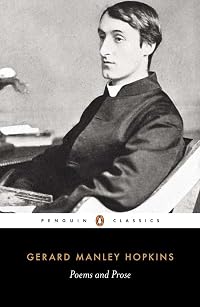
Poems and Prose of Gerard Manley Hopkins - selected and edited by W. H. Gardner
by Gerard Manley Hopkins
On This Page
Description
Closer to Dylan Thomas than Matthew Arnold in his 'creative violence' and insistence on the sound of poetry, Gerard Manley Hopkins was no staid, conventional Victorian. On entering the Society of Jesus at the age of twenty-four, he burnt all his poetry and 'resolved to write no more, as not belonging to my profession, unless by the wishes of my superiors'. The poems, letters and journal entries selected for this edition were written in the following twenty years of his life, and published show more posthumously in 1918. His verse is wrought from the creative tensions and paradoxes of a poet-priest who wanted to evoke the spiritual essence of nature sensuously, and to communicate this revelation in natural language and speech-rhythms while using condensed, innovative diction and all the skills of poetic artifice.. show lessTags
Recommendations


























Member Recommendations

Exiles by Ron Hansen
by inge87
Member Reviews
You either love him or hate him. I love him, and recall being most indignant when Brigid Brophy included him in “Fifty Works of English Literature we could Do Without”. Who now reads Ms Brophy….? I love both the magical, dazzling, sometimes hard-to-follow words, and the thought behind them: that I am a jack, joke, poor potsherd, yet an immortal diamond, that each hung bell’s bow swung finds tongue to fling out broad its name, that I am soft sift, yet steady as water in a well. Hopkins was an early warning on eco-destruction: “the soil is bare now, nor can foot feel, being shod”; “O if we but knew what we do when we delve or hew – hack and rack the growing green”; “Long live the weeds and the wilderness yet”. His show more nature observations are precise and accurate. Priest and celibate he was, but the rhythm of his grimmer sonnets kept running through my head whilst I was in labour: “No worst, there is none”; “Patience, hard thing”. Favourites: “I am soft sift” and “I kiss my hand” (yes, let’s go OTT!) from “Wreck of the Deutschland”; “God’s Grandeur”; “The Starlight Night”; “Spring”; “The Windhover”; “Binsey Poplars”; “Inversnaid”; “As Kingfishers Catch Fire”; “That Nature is a Heraclitean Fire”, and “Ash-boughs”. show less
I'm not at all religious, but there is just something very uplifting about Hopkin's poetry - especially when I first read him in my teens. He has still got it for me, though.
Hopkins is my favorite poet of all time. Especially good if you're depressed. Well, he has some of the most depressed poms I know of. Maybe not good to read when you're too depressed.
An absolutely fascinating poet, whose mind I am still attempting to wrap myself around.
Ratings
Members
- Recently Added By
Lists

Philip Ward's Lifetime Reading Plan
592 works; 22 members

Poetry Corner
187 works; 15 members

Harold Bloom - The Western Canon: C. The Democratic Age
336 works; 15 members

Mustich's 1000 Books to Read Before You Die: A Life Changing List
1,001 works; 20 members
Author Information

140+ Works 5,014 Members
Gerard M. Hopkins was born on July 28, 1844 in England, into a large and talented family. He attended Oxford, and entered the Jesuits in 1868. He later studied theology and, after destroying much of his youthful poetry, took up writing. In 1877, Hopkins was ordained as a priest. He was assigned to several churches and continued to write poetry, show more none of which was published until after his death. Hopkins's poems are noted for their intricate rhythm, which he labeled sprung rhythm. The poems are exemplified by their clever puns, wordplay and imaginative phrasing. His works include several series of sonnets, such as Pied Beauty and The Windhover, as well as "terrible" sonnets that explore the conflict between his sexual longing and his devotion to God. Gerard M. Hopkins died of typhoid fever on June 8, 1889, in Ireland. (Bowker Author Biography) show less
All Editions
Some Editions
Awards and Honors
Series
Belongs to Publisher Series
Common Knowledge
- Canonical title
- Poems and Prose of Gerard Manley Hopkins - selected and edited by W. H. Gardner
- Original publication date
- 1953
- Dedication*
- To the memory of Robert Bridges (1844–1930), Poet Laureate 1913–1930, Friend and adviser of Gerard Manley Hopkins, Preserver and first editor of his poems
- Disambiguation notice
- This is a selection of Hopkins’ poetry and prose edited by W. H. Gardner. Do not combine with other selections.
*Some information comes from Common Knowledge in other languages. Click "Edit" for more information.
Classifications
Statistics
- Members
- 1,549
- Popularity
- 14,842
- Reviews
- 4
- Rating
- (4.24)
- Languages
- English, Spanish
- Media
- Paper, Ebook
- ISBNs
- 3
- ASINs
- 60